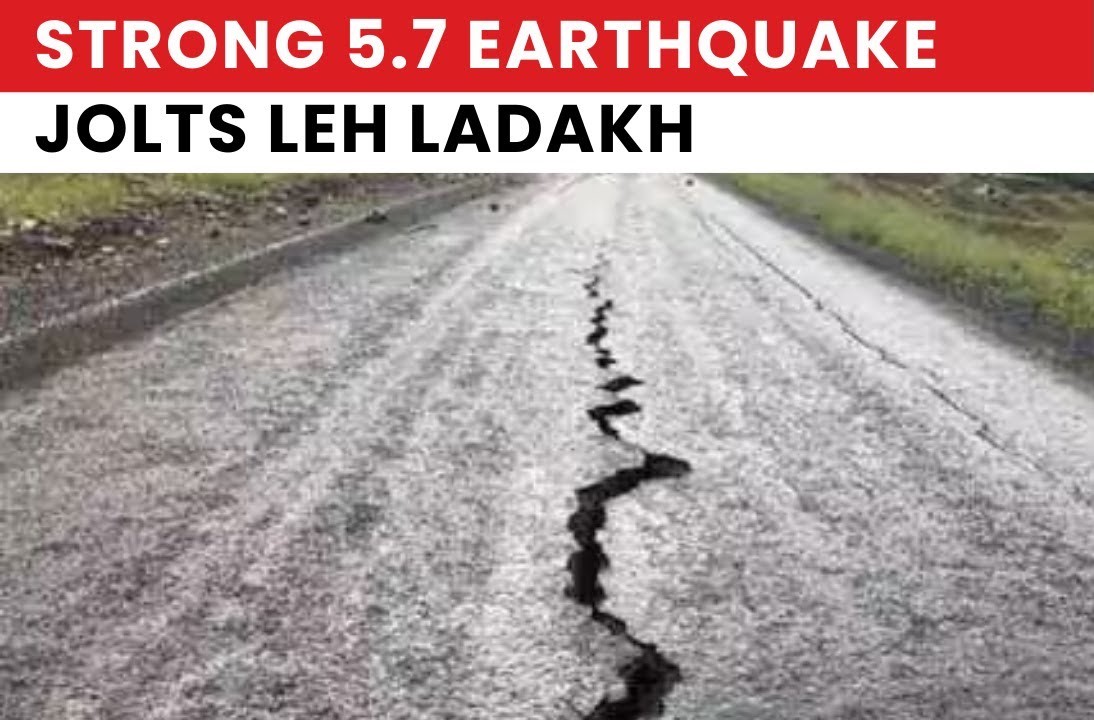
Ladakh Earthquake: 5.7-Magnitude Tremor in Leh Caps Two Months of Seismic Activity Across Jammu & Kashmir
By: Javid Amin | 19 January 2026
Strong Earthquake Jolts Leh, Tremors Felt Across J&K
A moderate-to-strong earthquake of magnitude 5.7 struck Leh in Ladakh on January 19, 2026, sending tremors across vast parts of Jammu, Kashmir, and Ladakh, and prompting authorities to issue safety advisories as a precaution.
According to seismological observations, the earthquake originated at a considerable depth of around 171 kilometres, a factor that allowed the tremors to travel widely while limiting surface-level damage. Residents in Srinagar, Kargil, parts of Jammu, and adjoining districts reported noticeable shaking, triggering brief panic but no immediate reports of casualties or major damage.
The government placed emergency services on alert, while monitoring agencies intensified surveillance amid concerns over continued seismic activity in the region.
A Region on the Move: Earthquake Timeline of the Last Two Months
The Leh earthquake is not an isolated incident. Over the past two months, Jammu & Kashmir and Ladakh have experienced repeated seismic tremors, reflecting the region’s tectonic sensitivity.
Timeline of Earthquakes & Tremors (Nov 2025 – Jan 2026)
| Date | Magnitude | Location | Depth | Impact |
|---|---|---|---|---|
| Nov 29, 2025 | 4.5 | Kargil, Ladakh | ~10 km | Mild tremors, no damage |
| Dec 12, 2025 | 4.8 | Kupwara, North Kashmir | ~15 km | Felt in Srinagar, minor panic |
| Dec 28, 2025 | 5.0 | Doda, Jammu region | ~20 km | Strong tremors, no casualties |
| Jan 5, 2026 | 4.3 | Anantnag, South Kashmir | ~12 km | Light but widespread tremors |
| Jan 19, 2026 | 5.7 | Leh, Ladakh | 171 km | Tremors across J&K, advisory issued |
Seismologists note that while most of these earthquakes were moderate, their frequency is significant and demands sustained attention rather than alarmist reaction.
Why Are Earthquakes So Frequent in Jammu, Kashmir, and Ladakh?
1. Himalayan Seismic Belt: A Global Hotspot
Jammu & Kashmir and Ladakh sit atop the Himalayan seismic belt, one of the most tectonically active regions on Earth. This belt marks the collision zone between:
-
The Indian Plate, moving northward
-
The Eurasian Plate, resisting that movement
This collision, still ongoing, continuously builds stress in the Earth’s crust.
2. Tectonic Stress Accumulation and Release
The Indian Plate moves roughly 4–5 cm per year, pushing beneath the Eurasian Plate. Stress accumulates along major fault systems, including:
-
Main Himalayan Thrust (MHT)
-
Karakoram fault system
-
Zanskar and Indus suture zones
When accumulated stress exceeds rock strength, it is released suddenly as earthquakes.
3. Depth Matters: Why the Leh Quake Was Widely Felt
The January 19 Leh earthquake occurred at an unusually deep depth of about 171 km. Such deep-focus earthquakes:
-
Spread seismic waves over larger areas
-
Cause less intense surface damage
-
Are felt across multiple regions
This explains why tremors were sensed across J&K but did not lead to widespread destruction.
4. Historical Vulnerability of the Region
The region has a long record of devastating earthquakes, including:
-
2005 Kashmir earthquake (M 7.6), which killed tens of thousands
-
Numerous moderate tremors over the decades
Experts warn that seismic silence does not mean safety; in fact, long quiet periods can allow dangerous stress build-up.
Government Advisory Issued After Leh Earthquake
Following the January 19 tremor, authorities issued a public safety advisory across Ladakh and parts of Jammu & Kashmir.
Key Advisory Points
-
Move to open spaces during tremors
-
Avoid elevators
-
Stay away from weak structures, windows, and heavy furniture
-
Keep emergency kits ready
-
Follow official updates from monitoring agencies
Emergency response teams in Leh, Srinagar, and Jammu were placed on standby, while the National Center for Seismology (NCS) continued real-time monitoring.
Seismic Risk Map: Where Does J&K and Ladakh Stand?
Based on India’s seismic zoning classification:
🔴 Zone V – Very High Risk
Includes:
-
Ladakh: Leh, Kargil
-
Kashmir Valley: Srinagar, Baramulla, Kupwara, Anantnag, Pulwama
Recent epicenters:
-
Leh (Jan 19, 2026 – M 5.7)
-
Kupwara (Dec 12, 2025 – M 4.8)
-
Anantnag (Jan 5, 2026 – M 4.3)
🟡 Zone IV – High Risk
Includes:
-
Jammu region: Doda, Ramban, Rajouri, Poonch, Kathua, Samba, Jammu
Recent epicenter:
-
Doda (Dec 28, 2025 – M 5.0)
This alignment of recent earthquakes with high-risk zones reinforces scientific warnings about the region’s vulnerability.
Infrastructure and Preparedness Concerns
Urban Vulnerability
Many buildings, especially older constructions, were not designed to modern seismic codes, increasing risk during stronger earthquakes.
Mountain Terrain Challenges
-
Landslides triggered by shaking
-
Road blockages in narrow valleys
-
Difficult access for rescue operations
Critical Infrastructure at Risk
-
Hydropower projects
-
Highways and tunnels
-
Transmission lines
Experts stress that moderate earthquakes serve as reminders, not reassurances.
Why Frequent Moderate Tremors Should Not Be Ignored
While moderate earthquakes can release some stress, scientists caution that:
-
They do not eliminate the possibility of a major quake
-
Stress may still be accumulating along larger fault segments
-
The Himalayan region is capable of producing magnitude 7+ earthquakes
Preparedness, therefore, must be continuous, not reactive.
The Bigger Picture: Earthquakes and Climate Stress
Though earthquakes are tectonic in origin, experts note that:
-
Glacial retreat
-
Changing groundwater patterns
-
Large infrastructure loads
can influence surface stability, potentially amplifying earthquake-related impacts such as landslides.
Key Takeaway: Vigilance Over Panic
The 5.7-magnitude Leh earthquake and the series of tremors over the past two months highlight a clear reality: Jammu, Kashmir, and Ladakh are seismically active regions by nature.
While there is no immediate cause for panic, there is every reason for:
-
Stronger building codes
-
Public awareness
-
Disaster-preparedness drills
-
Continuous scientific monitoring
In the Himalayas, earthquakes are inevitable. Disasters are not — if preparedness keeps pace with risk.


