Kharge brings opposition leaders together as supporters gather at Ramlila Maidan; rival political mobilisation and competing turnout estimates add to the high-stakes confrontation
By: Javid Amin | 01 November 2026
New Delhi: Delhi has become the centre of a major political confrontation as opposition parties under the INDIA bloc mobilise for their ‘Chalo Dilli’ march and ‘Vote Bachao, Desh Bachao’ rally against alleged irregularities in the revision of electoral rolls and the functioning of Chief Election Commissioner (CEC) Gyanesh Kumar.
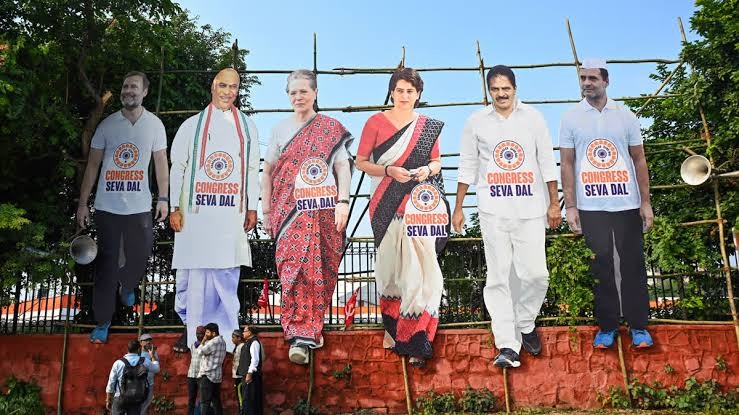
Supporters of Congress, the Samajwadi Party and Left parties began gathering at Ramlila Maidan and other locations across the capital early Sunday. The march is scheduled to proceed from the Minto Road-Connaught Place junction to Ramlila Maidan, where opposition leaders are expected to address the gathering. The mobilisation follows a symbolic protest against the CEC organised at Congress president Mallikarjun Kharge’s residence on Saturday.
The opposition’s central charge is that the Election Commission’s Special Intensive Revision (SIR) of electoral rolls has resulted in large-scale deletions and risks excluding eligible voters. The INDIA bloc is demanding accountability from the poll panel and the resignation of Gyanesh Kumar.
The Election Commission, however, has rejected allegations of unilateral decision-making and political bias. It has told the Supreme Court that its SIR-related orders were approved unanimously by all three members of the Commission. The dispute is therefore no longer confined to a political exchange: it has become a wider contest over electoral transparency, institutional credibility and public confidence in the voting process.
Kharge’s residence becomes the centre of opposition consultations
The mobilisation gathered political momentum on Saturday when senior INDIA bloc leaders assembled at Kharge’s residence on Rajaji Marg for a symbolic public impeachment exercise against CEC Gyanesh Kumar.
The proceedings were presided over by former Lok Sabha Speaker Meira Kumar. Kharge moved a symbolic motion containing six charges against the CEC, accusing him of undermining electoral fairness and facilitating alleged manipulation of voter lists.
According to reports, more than 250 opposition lawmakers attended the exercise, which involved 19 opposition parties. The resolution calling for Kumar’s removal was passed unanimously by those participating.
The terminology needs clarification. This was a political demonstration staged in the form of an impeachment proceeding, not a constitutional impeachment or a legally binding removal process. The CEC can be removed only through the constitutional procedure applicable to a Supreme Court judge, involving parliamentary proceedings and prescribed voting requirements.
The symbolic exercise was intended to communicate the seriousness of the opposition’s allegations and demonstrate that its campaign had support beyond one political party.
By bringing together leaders from several opposition formations, the INDIA bloc sought to project the controversy as a collective institutional concern rather than an isolated Congress campaign.
‘Chalo Dilli’: Supporters gather across the capital
By Sunday morning, supporters from different states had begun reaching Delhi for the rally.
Party workers assembled at Ramlila Maidan, while groups of Congress supporters gathered near Himachal Bhawan and Samajwadi Party workers assembled outside party chief Akhilesh Yadav’s residence. Supporters of Left parties were also reported arriving at New Delhi Railway Station before proceeding towards the rally venue.
The programme has two main parts:
-
The march: The ‘Chalo Dilli’ procession is scheduled to begin around noon from the Minto Road-Connaught Place junction.
-
The rally: The procession will culminate at Ramlila Maidan, where opposition leaders are expected to address participants.
The campaign is being organised under the slogan ‘Vote Bachao, Desh Bachao’, placing electoral rights and the credibility of democratic institutions at the centre of the mobilisation.
The gathering is also intended to bring together political workers, students, youth groups and civil society representatives. Rahul Gandhi has appealed to people beyond the traditional party cadre to participate, presenting the issue as one that affects every eligible voter.
Security arrangements and competing estimates of turnout
Delhi Police has made extensive security arrangements for the mobilisation.
Reports indicate that more than 4,000 police personnel, along with central security forces, have been deployed for crowd management and protection. The arrangements include surveillance cameras, drones, security zones and traffic diversions around central Delhi. Some reports put the wider security deployment, including police and paramilitary personnel, at close to 10,000.
The expected turnout has become a point of comparison between the opposition and the authorities.
| Estimate | Number |
|---|---|
| INDIA bloc’s projected turnout | Up to 10 lakh |
| Delhi Police’s planning estimate | Around 50,000 |
These are projections, not verified attendance figures. The opposition’s estimate reflects its mobilisation target, while the police figure is linked to crowd-management planning and the capacity of the venue. Ramlila Maidan’s effective capacity is also affected by arrangements for seating, enclosures and emergency passageways.
The actual size of the gathering will become clearer as the march and rally progress. Until then, claims of a particular turnout should be treated cautiously.
What is the Special Intensive Revision controversy?
At the centre of the opposition’s campaign is the Election Commission’s Special Intensive Revision of electoral rolls.
An electoral roll is the official list of eligible voters for a constituency. It is periodically updated to include newly eligible citizens, correct errors and remove entries that are no longer valid, such as those belonging to deceased or permanently relocated persons.
The SIR is a more intensive exercise than routine annual updating. It involves a detailed verification of voter records and is intended to improve the accuracy of electoral rolls.
The controversy is over how this exercise is being conducted, what documentation is being required and whether eligible voters risk losing their place on the electoral list.
Opposition parties allege that the revision has resulted in large-scale deletions and that the process could disproportionately affect vulnerable communities and people who face difficulties producing the required documents.
The Election Commission maintains that the exercise is lawful and necessary to ensure accurate electoral rolls. It has also argued that eligible people whose names are missing can seek enrolment through the prescribed process.
The Commission’s response to the Supreme Court is particularly important in understanding the competing positions.
In an affidavit, the ECI said the three orders relating to the SIR, issued in June 2025, October 2025 and May 2026, were approved unanimously by the three-member Commission. It rejected the suggestion that CEC Gyanesh Kumar had acted unilaterally.
This does not automatically resolve every question about the implementation of the revision. But it does mean that allegations against the CEC must be distinguished from the Commission’s formal position and the legal questions currently under consideration.
Why the opposition is targeting Gyanesh Kumar
The INDIA bloc’s campaign has gradually moved beyond criticism of individual SIR decisions to a direct challenge to the credibility and leadership of the Election Commission.
Opposition leaders argue that the poll panel must ensure that no eligible voter is excluded and that the electoral process remains impartial. They have also raised concerns about the transparency of voter-list revision and the Commission’s handling of complaints.
The demand for Kumar’s resignation is intended to turn these allegations into a question of institutional accountability.
The government and BJP reject the opposition’s broader political narrative. The ruling party has accused its opponents of attacking constitutional institutions and using the Election Commission controversy to mobilise against the government.
The BJP’s criticism reflects a different interpretation of the dispute: that electoral procedures should be challenged through evidence and legal channels rather than political demonstrations.
The central question is whether the concerns raised by the opposition can be substantiated through verifiable evidence, and whether the Election Commission’s explanations adequately address them.
BJP hits back with its own political mobilisation
The opposition rally is not unfolding in an entirely one-sided political environment.
The BJP has also organised a march in Delhi on November 1, focusing on the 1984 anti-Sikh riots and accusing the Congress of choosing an insensitive date for its Ramlila Maidan mobilisation.
Union Minister Hardeep Singh Puri criticised the INDIA bloc’s decision to hold its rally on the anniversary of the violence that followed former Prime Minister Indira Gandhi’s assassination. He argued that the date was inappropriate given the memory of the victims.
The BJP’s counter-mobilisation has added another political dimension to the day.
The two sides are seeking to draw public attention to different questions. The INDIA bloc wants the focus to remain on electoral transparency and the Election Commission. The BJP is attempting to challenge the opposition’s political credibility and highlight the historical responsibility of the Congress over the 1984 violence.
This competing mobilisation shows how the same public space can become a stage for two sharply different political narratives.
Salman Khurshid signals that the agitation may continue
Senior Congress leader Salman Khurshid has indicated that the Ramlila Maidan rally should not be viewed as a one-day event.
Speaking to reporters ahead of the mobilisation, Khurshid said the protest would continue beyond Sunday’s gathering, signalling that the opposition intends to sustain pressure on the Election Commission and the government.
His remarks suggest that the INDIA bloc is considering a longer campaign rather than relying on a single large demonstration.
The possibility of further protests is politically significant. A large rally can demonstrate organisational strength, but maintaining a sustained movement requires coordination between parties that have different regional priorities and electoral interests.
The alliance will need to agree on a common strategy, communicate its demands clearly and maintain public interest after the immediate mobilisation ends.
What is at stake for the INDIA bloc?
The rally presents the opposition with several political tests.
1. Demonstrating unity
The INDIA bloc has brought together parties with different political histories, regional interests and electoral strategies. A coordinated rally provides an opportunity to demonstrate that they can work together on a national issue.
2. Building public confidence
The opposition must explain precisely how the SIR process could exclude eligible voters and provide credible examples to support its allegations. General accusations may attract attention, but documented evidence will be essential to sustain public confidence.
3. Taking the campaign beyond Delhi
The political impact of the rally will depend on whether opposition parties can carry the issue into states and constituencies where voter-list revision is a concern.
4. Maintaining momentum
A large gathering can create political pressure, but a sustained campaign requires a clear programme, consistent messaging and continued public engagement.
The opposition’s challenge is to turn its slogan, ‘Vote Bachao, Desh Bachao’, into a campaign with identifiable demands and measurable outcomes.
What the BJP and Election Commission must address
The BJP and the Election Commission face a different but equally important challenge: responding to allegations in a way that builds public confidence.
The Election Commission has defended the legality of the SIR and its internal decision-making. But public confidence depends not only on formal orders. It also depends on whether voters can understand the process, verify their registration status and seek timely correction if their names are missing.
The Commission’s position that eligible voters can apply for enrolment is important, but the practical accessibility of that process also matters.
Clear public information, transparent deletion and correction procedures, accessible grievance mechanisms and timely responses to complaints can help address concerns.
For the BJP, the political task is to distinguish between legitimate questions about voter-list management and allegations it considers politically motivated. Dismissing every concern as political drama may not be enough to reassure voters who have genuine difficulties with their electoral records.
Ground analysis: A rally about more than numbers
The political importance of the ‘Chalo Dilli’ mobilisation cannot be measured only by how many people reach Ramlila Maidan.
The opposition is attempting to connect a technical administrative exercise, the revision of electoral rolls, with a larger public question: who gets to vote, how electoral rights are protected and how citizens can hold constitutional institutions accountable.
That is a powerful political message, but it also carries a responsibility. Allegations of voter exclusion must be supported by evidence, and the Election Commission must respond to genuine concerns with transparency.
The INDIA bloc also faces an organisational test. Its constituent parties have often disagreed on electoral strategy and regional priorities. Sustaining a common campaign after the rally may prove more difficult than assembling leaders and supporters for one event.
For the BJP, the controversy offers an opportunity to portray the opposition as politically motivated. But the ruling party cannot substitute political counter-attacks for clear answers to questions about electoral administration.
Ultimately, the credibility of the electoral process is larger than the interests of either side.
What happens after Ramlila Maidan?
The opposition’s next steps will determine whether Sunday’s mobilisation becomes a turning point or remains a major but isolated demonstration.
Reports indicate that the INDIA bloc plans to take its concerns to President Droupadi Murmu and continue raising the issue through protests in different states.
The legal proceedings surrounding the SIR and the CEC’s functioning will also remain important. Courts may examine specific allegations and determine whether the Commission’s actions comply with constitutional and statutory requirements.
For voters, however, the most immediate concern is simpler: whether their names are correctly recorded on electoral rolls and whether they can exercise their franchise without unnecessary obstacles.
The coming days will show whether the INDIA bloc can convert its Delhi mobilisation into a sustained national campaign and whether the Election Commission’s explanations can answer the concerns being raised.
The real test is not simply how many people gather at Ramlila Maidan. It is whether the political confrontation produces greater transparency, stronger accountability and renewed public confidence in the electoral process.