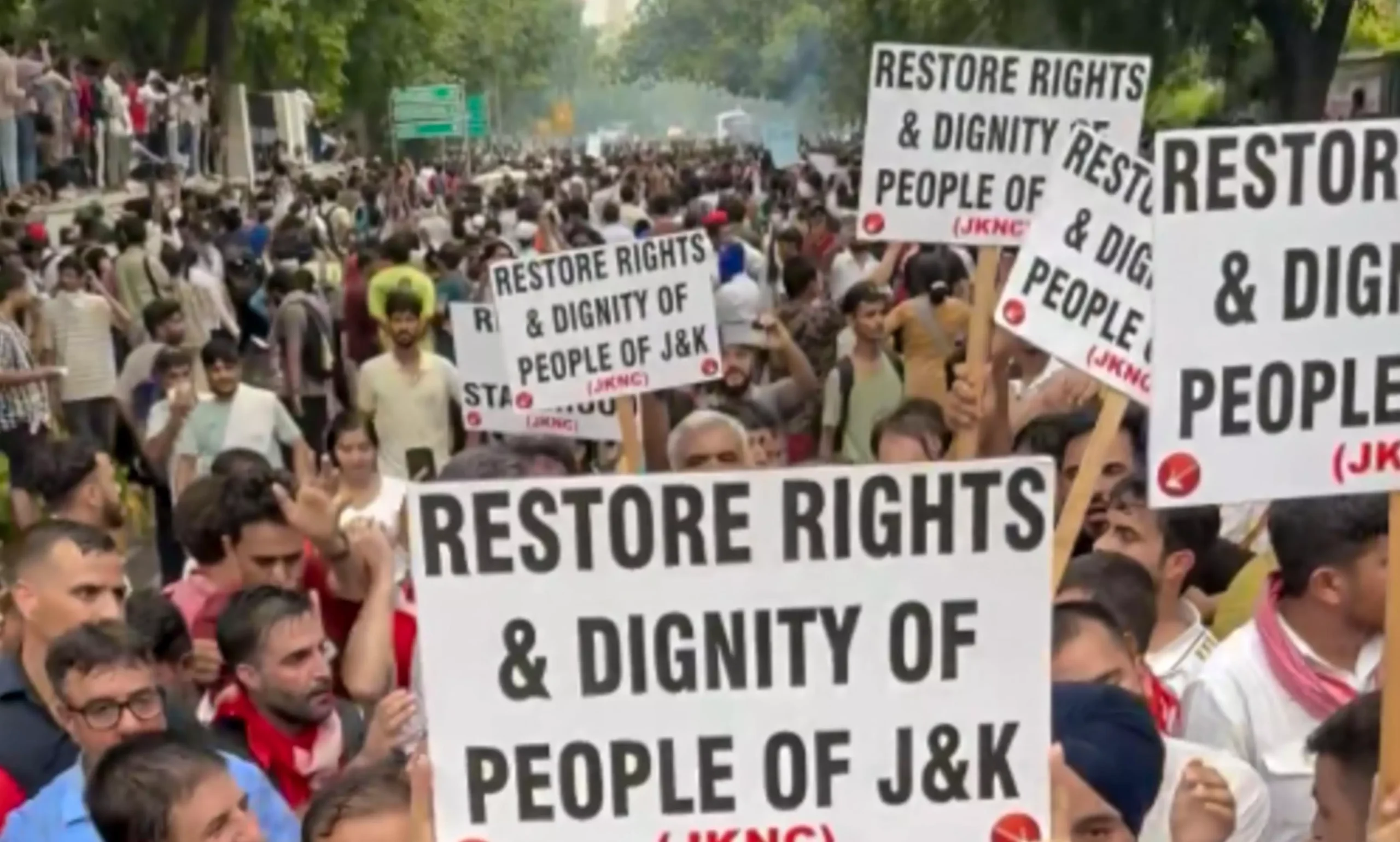
Eighteen legislators reportedly sign an eight-point memorandum seeking a Cabinet overhaul and stronger political action; Ruhullah’s impending exit adds ideological pressure, while Omar Abdullah faces questions over governance, internal democracy and the party’s future direction
By: Javid Amin | 31 October 2026
Srinagar: The growing discontent within the National Conference (NC) has moved well beyond disappointment over the October 27 Cabinet expansion. A memorandum reportedly signed by 18 party legislators has brought a wider set of grievances into the open, including the restoration of Jammu and Kashmir’s statehood and special status, implementation of the party’s 2024 election manifesto, the functioning of the Omar Abdullah-led government and the influence of political advisers in decision-making.
The development comes at a particularly sensitive moment for the ruling party. Senior legislators have questioned the Cabinet arrangement, Srinagar MP Aga Syed Ruhullah Mehdi has reiterated his decision to leave the party and surrender his Lok Sabha membership on November 3, and the leadership is attempting to contain growing speculation about an internal split.
The National Conference is facing a deeper internal challenge after 18 legislators reportedly signed a memorandum seeking Cabinet restructuring, stronger efforts for statehood and Article 370, and time-bound implementation of the party manifesto. Ruhullah Mehdi’s planned resignation has added another dimension to the debate over the party’s political direction.
The memorandum is especially significant because it connects two issues that the party leadership would prefer to manage separately: dissatisfaction with the distribution of political power and frustration over the pace of delivery on the promises that helped bring the NC back to government in 2024.
The immediate trigger was the Cabinet expansion. But the questions now being raised concern the party’s political identity, its relationship with its elected representatives and whether its government is adequately pursuing the commitments on which it sought public support.
The memorandum changes the nature of the dispute
According to reports published on October 31, 18 NC legislators met at the Srinagar residence of Lolab MLA Qaiser Jamsheed Lone and prepared an eight-point memorandum addressed to party president Farooq Abdullah and Chief Minister Omar Abdullah.
The document reportedly carries the signatures of all 18 legislators. KNS reported that it was submitted to the party leadership, while other reports said it had been sent to the residences of the senior leaders. The party had not independently confirmed receipt at the time of the initial reports.
The reported demands include:
-
A fresh restructuring of the Council of Ministers.
-
Time-bound implementation of the NC’s 2024 Assembly election manifesto.
-
Intensified political efforts for restoration of Jammu and Kashmir’s statehood and special status.
-
Removal of Chief Minister Omar Abdullah’s adviser Nasir Aslam Wani.
-
Review of ministers against whom legislators have raised complaints, including allegations of corruption.
-
Withdrawal of the Roads and Buildings portfolio from Deputy Chief Minister Surinder Choudhary.
-
Implementation of concerns and decisions reportedly discussed at the June 3 meeting in Dachigam.
-
Better consultation and communication between legislators and the Chief Minister.
The demands are not simply about giving disappointed legislators ministerial positions. They raise questions about how decisions are made, how ministers are evaluated and whether elected representatives have a meaningful role in shaping the government’s direction.
One of the legislators quoted by KNS said the memorandum was intended to strengthen the party and make the government more responsive, rather than create divisions. The same report said the legislators believed their earlier concerns had not been adequately addressed during the recent Cabinet expansion.
That is an important political distinction. The group is presenting its intervention as an attempt to correct the government’s functioning from within, not as a move to bring it down.
But the scale and nature of the demands make it difficult to dismiss the episode as routine dissatisfaction.
The numbers reveal a serious challenge, but not yet a formal split
Reports about the size of the group have varied.
KNS and Kashmir Reader reported that 18 legislators participated in the meeting and that the memorandum carried their signatures. The Times of India subsequently reported that around 18 attended physically, while seven others joined online, taking the wider group to approximately 25. Other reports have cited different figures, reflecting uncertainty over the total number of legislators supporting the initiative.
This distinction matters. A signed memorandum represents a more concrete political development than anonymous reports of dissatisfaction. But the reported numbers should not be treated as proof that every legislator who attended or supported the meeting has joined a permanent faction.
The NC has 41 MLAs in the 90-member Jammu and Kashmir Assembly. A group of 18 signatories would therefore represent a substantial section of the party’s legislative strength. If the wider figure of 25 is confirmed, the leadership’s challenge would be even more serious.
Yet the group has not publicly announced a separate legislative bloc, a breakaway organisation or a move to withdraw support from the government.
The more accurate description at this stage is an organised internal challenge to the party leadership.
The Dachigam meeting: A grievance that did not disappear
The latest memorandum also points back to the June 3 meeting at Dachigam, where legislators had reportedly raised concerns about the functioning of the government and the performance of certain ministers.
According to subsequent reports, the discussion included dissatisfaction with the roles of Deputy Chief Minister Surinder Choudhary, Javed Rana and Satish Sharma. The legislators reportedly wanted the Chief Minister to consider changes and act on complaints raised against members of the government.
The October Cabinet expansion appeared to offer an opportunity to address at least some of those concerns.
Instead, the group reportedly concluded that the changes had not gone far enough. The fact that the memorandum again refers to the Dachigam discussions suggests that the legislators believe their earlier representations were not translated into meaningful action.
This is where the issue of internal democracy becomes important.
A political party can accommodate competing ambitions only when its elected representatives believe that their concerns are being heard. When repeated meetings produce no visible outcome, dissatisfaction can move from private conversations to organised collective action.
The NC leadership now faces a question it cannot answer simply by pointing to the limited number of ministerial positions: what mechanism exists for legislators to influence government decisions when they are not part of the Cabinet?
Cabinet expansion exposed the limits of political accommodation
The October 27 expansion was the immediate trigger for the latest confrontation.
Four NC legislators—Ali Mohammad Sagar, Mir Saifullah, Shamima Firdous and Altaf Ahmad Wani—were inducted into the Council of Ministers. Independent MLA Satish Sharma was dropped.
The resulting Council of Ministers reached its maximum permitted strength of nine, including the Chief Minister, under the current Union Territory framework. The limitation is significant because the NC has 41 MLAs, while its wider governing arrangement also includes Congress legislators, independents and a CPM representative.
The existing structure leaves many elected representatives outside the government, regardless of their political seniority or expectations.
NC provincial president for Kashmir Showkat Mir has pointed to this statutory limitation while dismissing the suggestion that every disappointed MLA can be accommodated in the Cabinet. He has also argued that restoration of full statehood would create greater scope for ministerial appointments.
That explanation is legally relevant, but it does not resolve the political grievance.
Legislators are not demanding only ministerial accommodation. Their memorandum reportedly seeks changes in the distribution of portfolios, removal of the Chief Minister’s adviser, implementation of manifesto commitments and greater consultation.
In other words, the disagreement concerns not just who holds office, but who exercises influence over government decisions.
Nasir Aslam Wani becomes a central point of contention
The demand for the removal of Nasir Aslam Wani, adviser to the Chief Minister, is among the most politically sensitive elements of the memorandum.
The legislators’ reported objection suggests dissatisfaction with the role played by people around the Chief Minister who do not hold elected legislative positions.
The broader issue is familiar in coalition and party politics. Elected representatives expect access to the head of government, an opportunity to raise constituency concerns and a meaningful role in policy discussions. When they believe that access is controlled by a small group of advisers or political managers, frustration can develop into allegations of a decision-making coterie.
However, it is important to distinguish between the existence of a demand and proof of wrongdoing. The memorandum’s reported call for Wani’s removal does not, by itself, establish that he has improperly exercised authority or that the allegations made by dissatisfied legislators are substantiated.
The political significance lies in what the demand reveals about the relationship between the Chief Minister and his own legislators.
If a sizeable group believes that elected representatives cannot communicate directly with the leadership, the problem is no longer confined to the performance of one adviser. It becomes a question of institutional access and accountability.
The Chief Minister will need to address that concern through a transparent consultation mechanism rather than allowing the controversy to revolve entirely around personalities.
The Ruhullah factor: The ideological crisis becomes more visible
The internal tensions have acquired a sharper ideological dimension because of Aga Syed Ruhullah Mehdi’s decision to leave the National Conference.
The Srinagar MP has reiterated that he intends to resign from both the party and his Lok Sabha membership on November 3. His announcement is rooted, according to his public statements, in the party’s failure to pursue its electoral commitments on Article 370, constitutional rights and the release of prisoners.
Ruhullah’s criticism is not a new reaction to the Cabinet expansion. His differences with the party leadership have been developing for more than a year, beginning with disagreements over reservation policy and later expanding into broader questions about the NC’s political position after the 2024 election.
In his public remarks, he has accused the leadership of seeking votes on promises that it has not pursued with sufficient determination after returning to power.
He has also challenged the party’s emphasis on restoration of statehood as the immediate political objective, arguing that statehood alone does not address the constitutional changes of August 2019.
His position is significant because it exposes a difference in political priorities within the wider NC ecosystem.
For Omar Abdullah, the restoration of statehood is a central and immediate demand, while the government must also function within the constitutional and administrative framework currently in place.
For Ruhullah, the party must not allow the pursuit of statehood to replace its earlier commitment to the restoration of special constitutional status.
The memorandum’s demand for an intensified struggle on statehood and Article 370 overlaps with themes raised by Ruhullah. But there is no verified evidence that he drafted the memorandum, organised the legislators’ meeting or is leading the group.
That distinction must remain clear. Shared political concerns do not establish a formal political alliance.
Article 370: The promise that continues to test the party
The Article 370 question remains the most difficult ideological issue for the National Conference.
The party contested the 2024 Assembly election with a manifesto that promised to work towards the restoration of Jammu and Kashmir’s special status and constitutional guarantees. It also made restoration of statehood a major political demand.
The NC’s position is shaped by the events of August 2019, when the Union government removed Jammu and Kashmir’s special constitutional status and reorganised the former state into two Union Territories.
In December 2023, the Supreme Court upheld the constitutional validity of the government’s decision to abrogate Article 370. It also directed that Assembly elections be held and statehood restored at the earliest.
This legal background matters because the NC government does not have the power to unilaterally restore Article 370. Any such change would involve constitutional and parliamentary processes beyond the authority of the Union Territory administration.
That limitation does not prevent the party from pursuing its political position through Parliament, public mobilisation, legal arguments and democratic engagement.
The legislators’ demand for an intensified struggle therefore raises a question of political strategy: how does the party intend to pursue a commitment that it cannot fulfil through executive decisions in Srinagar?
The leadership must explain whether it plans to build a coordinated political campaign, seek wider opposition support at the national level, pursue legal avenues where available or continue raising the issue through parliamentary and public platforms.
Without a clearly articulated strategy, the promise risks becoming a recurring source of internal frustration.
Statehood: A demand that connects the party’s political and administrative problems
Restoration of statehood is different from the Article 370 question in both its legal context and immediate political implications.
The Supreme Court’s December 2023 judgment directed that steps be taken to restore statehood at the earliest, while the Union government has repeatedly indicated its commitment to the process.
For the NC, statehood is not merely a symbolic demand. It is also connected to the functioning of the elected government.
Under the Union Territory framework, the elected administration does not exercise control over all major areas of governance, including police and public order. The Lieutenant Governor also retains important powers under the applicable legal framework.
The reduced Cabinet ceiling has created another practical limitation.
The NC leadership has argued that a full statehood arrangement would provide greater room for political and administrative accommodation. Showkat Mir has made this point while responding to the current unrest.
But legislators appear to be demanding more than an eventual increase in Cabinet strength. They want the party to intensify its political campaign for statehood rather than allowing the issue to remain primarily a demand directed at New Delhi.
The distinction is important. A government can continue administrative work under the existing framework while simultaneously pursuing a political campaign for greater constitutional authority.
The legislators’ concern appears to be that the second part has not received sufficient attention.
Gurezi and the search for an internal negotiating channel
The role of senior Gurez MLA Nazir Ahmad Khan Gurezi has also attracted attention.
Reports around the legislators’ meeting indicated that a delegation headed by Gurezi could approach Farooq Abdullah and Omar Abdullah to present the group’s concerns. Gurezi was also reported to have played a role in discussions following the meeting.
However, accounts of the gathering have differed. Gurezi reportedly described the meeting as a friendly lunch, while other reports attributed a more formal political purpose to the discussions.
That difference is worth acknowledging rather than assuming that every participant has embraced the same political interpretation.
Gurezi’s possible role as an intermediary would be significant because he is a senior legislator with experience in the party and the Assembly. A delegation led by him could offer the leadership a way to address the grievances without allowing the situation to develop into a public confrontation.
But mediation can work only if both sides are willing to negotiate.
The legislators want direct engagement with the party’s top leadership and a response to their demands. The leadership, meanwhile, must decide how much of the Cabinet and advisory structure it is prepared to reconsider.
Is the National Conference developing three political centres?
The current developments suggest three broad priorities competing within the NC’s political space. These should not be described as established factions, because no formal division into camps has been demonstrated.
The governance-first approach
This is associated with Omar Abdullah’s position as Chief Minister. It emphasises administration, development, public services, employment, investment and the practical limitations imposed by the Union Territory framework.
The government must deliver on everyday issues while working within the powers currently available to it. It also has to manage relations with the Centre and maintain the stability of the coalition.
The constitutional-struggle approach
This position is most clearly articulated by Ruhullah and is also reflected in the memorandum’s demand for an intensified struggle for statehood and Article 370.
Its supporters want the NC to maintain a sharper political identity and prevent governance responsibilities from overshadowing its constitutional commitments.
The internal-democracy and representation approach
The legislators behind the memorandum are highlighting the need for greater consultation, transparency in Cabinet decisions, accountability among ministers and direct access to the Chief Minister.
This is not necessarily an ideological challenge to Omar Abdullah’s leadership. It is a demand for greater influence by elected representatives over the party and government.
These priorities can coexist in a functioning political organisation. The crisis emerges when one group believes that another has monopolised decision-making or diluted the party’s original commitments.
The leadership’s task is to reconcile them without allowing the organisation to become paralysed by competing demands.
Could BJP benefit from the internal turmoil?
The BJP is an obvious political beneficiary if the National Conference remains occupied with internal disputes.
A prolonged disagreement could weaken the ruling party’s public image, distract its ministers from governance and provide the opposition with an opportunity to question its unity.
BJP leaders have already used the developments to predict a split within the NC and instability in the Omar Abdullah government. Leader of Opposition Sunil Sharma has publicly suggested that the unrest could lead to a search for an alternative political arrangement.
But political advantage should not be confused with evidence of political engineering.
There is no verified evidence that the BJP organised the NC legislators’ meeting, directed the memorandum or is coordinating the internal challenge.
The NC’s problems are rooted in identifiable disagreements over Cabinet appointments, government functioning, access to leadership and the party’s political commitments.
The BJP can exploit those divisions without having created them.
For the NC, the most effective response would be to address its own internal concerns rather than dismiss every criticism as an opposition conspiracy.
Is the government at risk?
The current developments do not establish that the Omar Abdullah government is on the verge of collapse.
The memorandum represents a serious internal challenge, but a demand for Cabinet restructuring is not the same as a withdrawal of support from the government.
The NC has 41 legislators in the 90-member Assembly and heads a coalition that includes Congress, independents and the CPM. The group’s political influence is substantial, but there has been no confirmed announcement that its members intend to vote against the government or support an alternative administration.
Ruhullah’s proposed resignation from the Lok Sabha is also separate from the Assembly’s numerical strength. He is a Member of Parliament, not an MLA whose departure would directly reduce the government’s legislative numbers.
His exit would, however, carry political consequences. It could intensify criticism of the NC’s ideological direction and weaken the party’s claim that it continues to represent the full range of political expectations among its supporters.
The immediate danger is therefore not necessarily government collapse. It is a loss of political cohesion and credibility.
What happens next will define the leadership’s response
The next phase will depend on how Farooq Abdullah and Omar Abdullah respond to the memorandum.
A meeting with the legislators could prevent the dispute from escalating. But a meeting alone will not be sufficient if the group receives no clear answers on its central demands.
The leadership will have to address at least four questions:
-
Will it consider a fresh Cabinet restructuring or explain why the current arrangement must remain unchanged?
-
Will it publish a time-bound roadmap for implementing the 2024 manifesto?
-
What concrete political strategy will it adopt for restoration of statehood and special status?
-
Will it establish a formal mechanism through which elected legislators can raise concerns and participate in major decisions?
The Ruhullah question will require a separate response. His announced departure is rooted in ideological disagreements that cannot be resolved simply by changing ministerial portfolios.
The party must also consider how to maintain its political identity while governing under a framework in which many of its major electoral promises depend on decisions by the Union government and Parliament.
The real battle is over what the NC wants to become
The National Conference has historically functioned as both a political party and a major force in Jammu and Kashmir’s political movements. Its identity has been shaped by electoral politics, regional aspirations, constitutional demands and the changing relationship between Srinagar and New Delhi.
The current crisis is exposing the difficulty of carrying all those responsibilities simultaneously.
Omar Abdullah’s government is expected to deliver on development, employment and public services. At the same time, the party is expected to maintain its commitments on statehood, constitutional rights and political representation.
Its legislators want greater influence over the government’s decisions. Its dissenting MP says the party has not pursued its promises with sufficient determination. Its leadership insists that disagreements can be resolved internally and that the government should be allowed to complete its term.
These positions cannot simply be reduced to a fight for ministerial berths.
The Cabinet expansion opened the dispute, but the memorandum has given it a broader political character. It has placed manifesto implementation, statehood, Article 370, the role of advisers and internal democracy on the same negotiating table.
The National Conference now faces a defining choice: it must demonstrate that it can govern effectively without losing the political commitments that brought it to power.
The question is no longer simply who gets a ministerial chair. It is whether the NC can remain a governing party, a constitutional-political force and a representative organisation for its legislators and supporters—all at the same time.


