Expectations, ground realities and political outcomes: The November 1 mobilisation brought India’s biggest Opposition leaders together, but did it create enough momentum to challenge the BJP or influence the Election Commission?
By: Javid Amin | 01 November 2026
New Delhi: The INDIA bloc’s ‘Chalo Dilli, Vote Bachao, Desh Bachao’ march was supposed to achieve something bigger than filling the streets of the national capital. It was an attempt to demonstrate that India’s Opposition parties, despite their regional rivalries and political differences, could still come together around a common national issue.
On November 1, leaders from the Congress, Trinamool Congress, Samajwadi Party, Rashtriya Janata Dal, Jharkhand Mukti Morcha, National Conference and Left parties shared a political platform in Delhi. Their immediate target was the Election Commission’s Special Intensive Revision (SIR) exercise and Chief Election Commissioner Gyanesh Kumar. Their broader message was that electoral transparency and the protection of voting rights should become a national political concern.
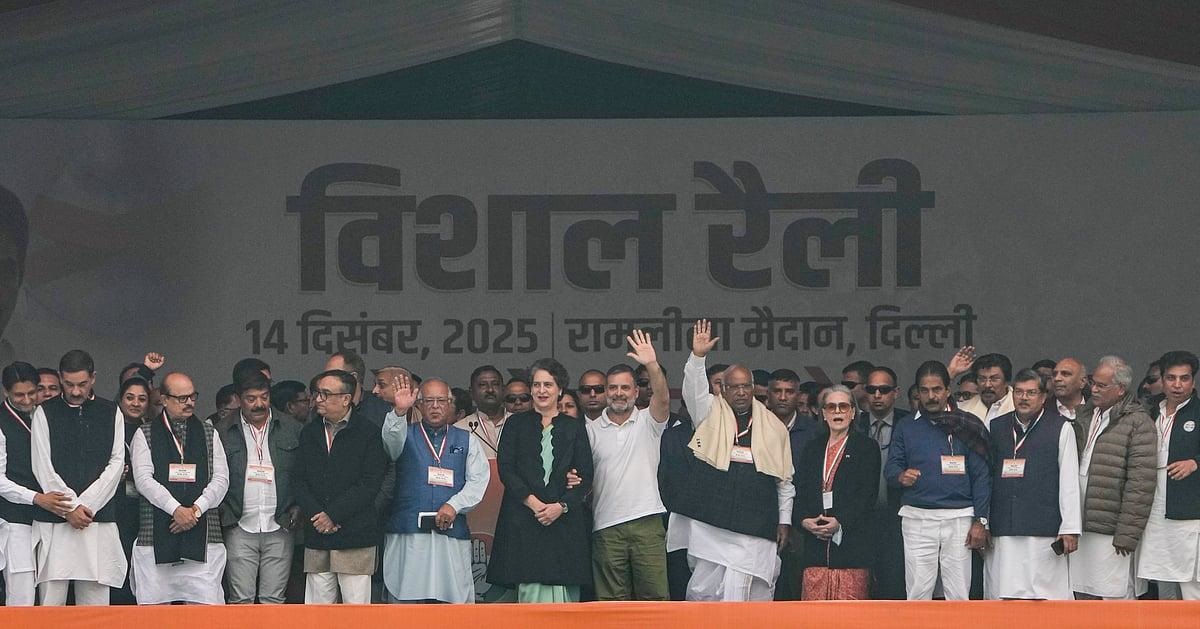
The gathering delivered the images the Opposition wanted: Rahul Gandhi alongside Mamata Banerjee, Akhilesh Yadav, Tejashwi Yadav, Hemant Soren and Farooq Abdullah. For a coalition frequently criticised for internal divisions, that was no small achievement.
But political rallies are ultimately judged by more than the number of leaders on stage, the size of the crowd or the attention they receive on television.
Did the march change the national political conversation? Did it put the Election Commission under meaningful pressure? Did it offer ordinary voters a clear reason to join the movement? And, perhaps most importantly, did the INDIA bloc demonstrate that it can sustain a common political campaign beyond a single day?
The answers reveal a mixed picture. The march was a considerable organisational achievement and an important demonstration of Opposition unity. However, its immediate institutional impact remained limited, while the challenge of converting political visibility into sustained public support was still unresolved.
1. What the INDIA bloc wanted to achieve: Five political objectives
The Opposition entered November 1 with five broad expectations. Each had a different political purpose, but together they were intended to establish the INDIA bloc as a credible national alternative.
A. Demonstrate that the INDIA bloc is still politically relevant
Perhaps the most important objective was to counter the perception that the INDIA bloc had lost momentum after the 2024 Lok Sabha elections.
The alliance had demonstrated its electoral potential by reducing the BJP’s parliamentary majority in 2024. However, subsequent political developments, regional electoral setbacks and disagreements among its constituents raised questions about whether the coalition could maintain its unity.
The Delhi rally was designed to answer those questions.
The participation of Rahul Gandhi, Mallikarjun Kharge, Mamata Banerjee, Akhilesh Yadav, Tejashwi Yadav and other senior leaders provided a visible demonstration that the alliance had not disappeared.
Assessment: Largely achieved. The leaders appeared together, although the durability of their political coordination remains untested.
B. Bring regional political heavyweights onto one platform
The INDIA bloc is not a conventional political party with a single command structure. It is a coalition of parties with strong regional leadership and different electoral interests.
Bringing these leaders together is therefore an achievement in itself.
Mamata Banerjee has her own political priorities in West Bengal. Akhilesh Yadav’s principal electoral battlefield is Uttar Pradesh. Tejashwi Yadav remains focused on Bihar, while Hemant Soren’s political strength is rooted in Jharkhand.
Farooq Abdullah represents another important political constituency through the National Conference in Jammu and Kashmir.
Their participation sent a message that national cooperation remains possible even when regional competition continues.
Assessment: One of the strongest achievements of the rally.
C. Make SIR a national political issue
Before the mobilisation, the controversy surrounding SIR was largely being discussed through political statements, legal proceedings and state-level protests.
The Opposition wanted to take the issue directly to the public.
The argument was simple: electoral roll revision is not merely an administrative exercise. It affects who can participate in elections and therefore has consequences for democratic representation.
The rally succeeded in bringing the subject into national headlines. International agencies, including Reuters and Associated Press, also covered the demonstration, giving the controversy wider visibility.
Assessment: Achieved in terms of visibility, but only partially in terms of changing public opinion.
D. Put political pressure on the Election Commission
The Opposition’s demand for Gyanesh Kumar’s resignation was intended to turn its allegations into an institutional accountability campaign.
The public impeachment exercise held on October 31, followed by Sunday’s rally, represented an effort to build pressure through both symbolic political action and public mobilisation.
However, there is a fundamental limitation.
The removal of a Chief Election Commissioner is governed by constitutional safeguards. A political resolution or public demonstration cannot independently remove the office-holder.
Consequently, the rally could increase political pressure, but it could not itself produce the institutional outcome demanded by the Opposition.
Assessment: Politically significant, but without an immediate institutional result.
E. Launch a continuing national movement
The final expectation was perhaps the most ambitious.
The Congress and its allies wanted November 1 to become the starting point of a sustained campaign rather than another demonstration that would disappear from public attention within a few days.
The message attributed to Salman Khurshid, that the protest would not stop with one rally, reflects this intended strategy. However, the exact quotation should be treated cautiously because an independently verifiable transcript was not available.
The wider campaign plans, including proposed state-level outreach and subsequent marches, indicate that the Opposition was considering a longer political engagement.
Assessment: The launch has taken place. Whether it develops into a genuine nationwide movement remains an open question.
2. Ground reality: What actually happened at Ramlila Maidan?
The rally was unquestionably a major political gathering. But a closer examination of attendance, participation and the competing claims surrounding the event reveals a more complicated picture than the initial expectations suggested.
The crowd was substantial, but the 10-lakh target was not achieved
The organisers had projected a turnout of up to 10 lakh people. Delhi Police had anticipated approximately 50,000 participants.
Those figures were dramatically different, and the venue’s physical capacity offered an important reality check.
Before the rally, police estimates suggested that Ramlila Maidan could accommodate approximately 30,000 to 40,000 people once chairs, enclosures and movement corridors were installed.
Following the event, the BJP challenged the Congress’s turnout claims.
BJP MP Sambit Patra alleged that around 40 per cent of the ground remained vacant. He also claimed that between 5,000 and 7,000 of the 28,000 chairs were empty during footage recorded between 3.30 pm and 4 pm.
The Dainik Jagran report offered a different estimate, suggesting that approximately 60,000 to 70,000 people may have attended when those inside and outside the venue were considered. It cited a senior Delhi Police officer for the estimate.
Reuters and Associated Press described the gathering as attracting thousands or tens of thousands of demonstrators. Neither provided a definitive independently verified attendance count.
The fairest conclusion is that the rally attracted a substantial crowd, but the organisers’ projection of one million participants was not supported by the available evidence.
This matters politically.
A rally does not need a million people to be successful. However, when organisers set an exceptionally high target, the gap between expectation and actual turnout becomes part of the political story.
The leadership presence was stronger than the mass mobilisation
The participation of senior leaders was arguably more impressive than the final crowd figures.
Rahul Gandhi, Mallikarjun Kharge, Mamata Banerjee, Akhilesh Yadav, Tejashwi Yadav, Farooq Abdullah and Supriya Sule were among the prominent figures associated with the mobilisation.
The participation of leaders from different regions helped the event achieve its principal symbolic objective.
But a distinction must be made between the presence of political leadership and the ability to mobilise ordinary citizens on a much larger scale.
The former was clearly visible. The latter produced a more mixed result.
The youth participation question
One of the more interesting aspects of the rally was the involvement, or lack of direct participation, of independent youth-led groups.
The Cockroach Janta Party (CJP), which had emerged as part of the wider protest environment, supported the issue but chose not to formally join the INDIA bloc demonstration.
Its founder, Abhijeet Dipke, said the organisation wanted to retain its independent identity rather than become associated with a political alliance.
This is politically important.
The Opposition wants to present the SIR movement as a citizens’ campaign rather than a conventional party protest. But independent youth groups may be reluctant to surrender their identity or credibility by appearing under established political banners.
That creates a challenge for the INDIA bloc: how can it lead a national movement without making every participating organisation appear to be an extension of party politics?
3. Where the Opposition succeeded
A. Unity optics: The biggest political achievement
For several months, questions about the INDIA bloc’s relevance had overshadowed its original political purpose.
The November 1 gathering offered a direct response.
The sight of regional leaders sharing a platform demonstrated that the alliance could still coordinate at the national level when a common issue emerged.
This is particularly important because the BJP has consistently sought to portray the Opposition as divided, opportunistic and incapable of presenting a coherent alternative.
The rally temporarily weakened that narrative.
However, unity on a protest platform is not the same as unity during elections. Seat-sharing arrangements, leadership questions and state-level rivalries will continue to test the coalition.
B. National media attention
The event received extensive coverage from Indian and international media.
Reuters, AP and The Guardian covered the demonstration, bringing the SIR controversy to audiences beyond India’s domestic political debate.
The rally also forced the BJP to respond publicly, particularly on questions surrounding crowd size, the timing of the event and the Opposition’s allegations against the Election Commission.
That response itself demonstrated that the mobilisation had attracted political attention.
However, media visibility should not be confused with public persuasion. Extensive coverage can keep an issue alive without necessarily changing voters’ opinions.
C. Demonstrating organisational capacity
The mobilisation involved political workers travelling from different states, coordination between party organisations and arrangements for a large gathering in central Delhi.
The presence of supporters from Maharashtra, Bihar, Uttar Pradesh and other regions demonstrated that the Congress and its allies could still organise a cross-state political programme.
A particularly revealing example came from Maharashtra. Hindustan Times reported that Chanda Veragde, president of the Chandrapur City Mahila Congress, brought approximately 500 women supporters to Delhi after organising their participation over two weeks.
Such accounts show that the rally involved more than senior leaders and television cameras. There was genuine organisational work at the grassroots.
D. Keeping electoral accountability in the political conversation
The Opposition succeeded in connecting electoral roll revision with a broader debate about democratic representation.
Its central argument was that accurate electoral rolls are essential, but eligible voters must not lose their voting rights because of administrative errors.
This is a legitimate public-interest issue, regardless of party affiliation.
The Election Commission’s position is that SIR is intended to remove duplicate, deceased and otherwise ineligible entries, while providing mechanisms for eligible citizens to seek inclusion.
The Opposition argues that the safeguards are insufficient and that genuine voters risk exclusion.
The rally ensured that this disagreement remained prominent in the national conversation.
4. Where the Opposition fell short
The rally demonstrated organisational strength, but it also exposed several weaknesses that could limit the campaign’s future effectiveness.
A. The turnout fell short of the political ambition
The most visible gap was between the organisers’ expectations and the actual gathering.
A projection of 10 lakh participants created enormous expectations. The eventual crowd, although substantial, did not approach that figure.
The BJP immediately used the discrepancy to question the Opposition’s organisational claims.
This provided the ruling party with an opportunity to shift part of the debate away from SIR and towards the rally’s perceived failure to meet its own attendance target.
For the Opposition, the lesson is straightforward: political mobilisation should be judged against realistic targets rather than headline-grabbing projections.
B. A common protest, but an unclear political roadmap
The Opposition had a clear demand: the resignation of Chief Election Commissioner Gyanesh Kumar.
It also raised concerns about SIR and the broader functioning of the Election Commission.
But what happens after the resignation demand?
Would the alliance seek an independent audit of disputed deletions? Would it establish a nationwide voter-assistance network? Would it demand public disclosure of state-wise deletion and restoration data? Would it pursue specific legal remedies?
These are questions that require concrete answers.
A voter whose name is missing from an electoral roll may be less interested in the political confrontation in Delhi than in knowing how to restore their registration.
The Opposition needs to connect its constitutional arguments with practical assistance.
Without that link, the campaign risks remaining a movement driven primarily by political speeches.
C. The BJP succeeded in introducing a competing narrative
The BJP did not remain silent.
Union Minister and party president J.P. Nadda described the gathering as a conspiracy to create anarchy under the cover of democracy. Other BJP leaders questioned the Opposition’s crowd claims and criticised the choice of November 1.
The BJP also organised counter-mobilisation and press conferences.
One of its strongest political arguments concerned the anniversary of the 1984 anti-Sikh violence.
November 1 falls immediately after the anniversary of former Prime Minister Indira Gandhi’s assassination on October 31, 1984, and is associated with the spread of anti-Sikh violence in Delhi.
The BJP accused the Congress of political insensitivity in choosing the date. The Congress, meanwhile, had defended its rally schedule as part of its previously announced SIR campaign.
This controversy created a competing political conversation that diluted the Opposition’s attempt to keep the spotlight exclusively on voter rights.
D. The movement struggled to separate itself from established party politics
The participation of senior leaders was an advantage, but it also created a potential limitation.
The INDIA bloc wanted the gathering to represent citizens concerned about electoral integrity.
Yet the event was organised and led by established political parties, with their familiar slogans, leadership structures and competing political narratives.
The decision of CJP to support the cause without formally joining the rally illustrates this tension.
If independent groups and ordinary voters are to become central to the movement, the Opposition will have to give them meaningful space rather than simply invite them to participate in party-led demonstrations.
E. No immediate institutional breakthrough
By the conclusion of the rally, the principal demands remained unresolved.
-
The Chief Election Commissioner had not resigned.
-
The SIR process had not been suspended.
-
No new institutional decision had been announced in response to the demonstration.
-
The Election Commission had not publicly changed its position because of the rally.
The absence of an immediate outcome does not make the protest meaningless. Institutional change rarely follows automatically from a single demonstration.
But it does mean that the rally’s success must currently be measured in political rather than administrative terms.
5. BJP’s response: Did the Opposition hand the ruling party an opportunity?
The BJP’s response deserves particular attention because it reveals how the ruling party interpreted the mobilisation.
Instead of treating the event simply as another Opposition protest, BJP leaders attempted to challenge its credibility on three fronts.
First, crowd strength. Sambit Patra used video footage and the number of empty chairs to dispute the Congress’s projected turnout.
Second, political intention. J.P. Nadda described the rally as an attempt to create instability and anarchy, rejecting the Opposition’s presentation of it as a democratic movement.
Third, historical sensitivity. The BJP questioned the decision to hold the rally on November 1, citing the anniversary of the 1984 anti-Sikh violence.
These arguments served an obvious political purpose: shifting the discussion from the Election Commission’s functioning to the Opposition’s credibility and motives.
But the BJP also faces an important question.
Disputing the size of a rally does not, by itself, answer concerns about voter deletions, the accuracy of electoral rolls or the accessibility of correction mechanisms.
The government and the Election Commission will ultimately have to address those substantive issues through evidence and institutional accountability.
The political contest, therefore, has two parallel dimensions. The Opposition must establish the credibility of its allegations, while the authorities must demonstrate that the electoral revision process is fair and transparent.
6. Expectations versus reality: The November 1 scorecard
| Opposition’s expectation | Ground reality | Assessment |
|---|---|---|
| Massive nationwide mobilisation | Substantial gathering, far below the 10-lakh projection | Partially achieved |
| INDIA bloc unity | Major regional leaders shared a platform | Achieved |
| National media attention | Extensive national and international coverage | Achieved |
| Pressure on the Election Commission | Political pressure increased, no immediate institutional change | Partially achieved |
| Clear shift in public opinion | Issue received visibility, wider opinion shift unproven | Uncertain |
| Participation beyond party cadres | Independent youth participation remained complicated | Partially achieved |
| Launch of sustained campaign | Further mobilisation indicated, durability untested | In progress |
| Immediate policy outcome | No immediate administrative change | Not achieved |
The table highlights an important distinction: the rally performed better as an exercise in coalition coordination than as an instrument for securing immediate institutional change.
7. What message did the rally send to different political stakeholders?
The political significance of the demonstration differs depending on who was watching.
Message to the BJP: The Opposition is still capable of coordination
The first message was directed at the ruling BJP.
For months, the ruling party has benefited politically from highlighting disagreements within the Opposition. The Delhi rally challenged that perception by bringing several prominent regional leaders together.
It demonstrated that the BJP cannot assume that the INDIA bloc has become politically irrelevant.
However, the BJP also received an opportunity to question the Opposition’s mobilisation capacity and portray the rally as politically motivated.
The message was therefore mixed: the Opposition demonstrated unity, but the ruling party showed that it could still control parts of the political counter-narrative.
Message to Opposition workers: The campaign is not over
Perhaps the most important audience was the political cadre.
Party workers from different states needed reassurance that their national alliance remained active and that their efforts were part of a larger political programme.
For Congress workers in particular, the rally offered an opportunity to see Rahul Gandhi and other senior leaders leading a coordinated national campaign.
For regional parties, it reinforced the idea that cooperation at the national level could continue despite competition in their home states.
The message was simple: the political contest continues, and the alliance intends to remain engaged.
Message to regional parties: National cooperation remains possible
The presence of Mamata Banerjee, Akhilesh Yadav, Tejashwi Yadav, Hemant Soren and Farooq Abdullah was especially important.
These leaders have independent political bases and do not necessarily depend on the Congress for their electoral strength.
Their participation showed that the INDIA bloc can still provide a common platform when the issue is considered important enough.
However, the real challenge will emerge during seat-sharing negotiations and future state elections.
Message to voters: Electoral transparency is becoming a national issue
The Opposition also wanted ordinary citizens to understand that electoral roll revision is not simply a dispute between political parties.
It concerns the right of eligible citizens to participate in elections.
This message has the potential to reach beyond traditional party supporters, particularly if the campaign focuses on documented cases of wrongful deletion and provides practical assistance to affected voters.
That could become the Opposition’s strongest route to building public credibility.
8. Ground reality: What political Delhi is actually telling us
Looking beyond the speeches and competing political claims, four conclusions emerge from the available reporting.
First, the INDIA bloc is not politically finished.
The participation of major regional leaders demonstrates that the alliance can still coordinate when there is a shared national issue.
Second, the Congress remains the central organising force.
The event provided Rahul Gandhi and Mallikarjun Kharge with an opportunity to coordinate a wider Opposition campaign. But the participation of regional leaders also showed that the alliance cannot function through Congress leadership alone.
Third, the crowd did not match the organisers’ ambition.
The rally attracted substantial participation, but the 10-lakh projection proved unrealistic. The discrepancy became an important part of the BJP’s counter-campaign.
Fourth, the Opposition has not yet converted visibility into institutional influence.
The SIR controversy remains unresolved, the demand for the CEC’s resignation has not produced a change in office, and the Election Commission has not announced a policy reversal in response to the demonstration.
There is also a broader political consideration.
The next major test for the alliance will be its ability to maintain cooperation ahead of the 2027 Assembly elections in several states. The rally has provided a common platform, but it has not settled the competing ambitions of its constituents.
The political assessment is therefore neither an outright success nor a failure.
It was a successful demonstration of organisational coordination, a significant media event and an incomplete attempt to build a larger national movement.
9. What must the INDIA bloc do next to avoid losing momentum?
If the Opposition wants November 1 to become a defining political moment, it needs to move beyond rallies and adopt a more structured strategy.
1. Establish a nationwide voter assistance network
The INDIA bloc should consider creating state-level and district-level teams to assist citizens whose names are missing from electoral rolls.
Such teams could help voters understand the claims and objections process, submit the required forms and track applications.
This would make the campaign directly relevant to ordinary citizens.
2. Publish evidence rather than rely exclusively on allegations
The Opposition needs to document disputed deletions, identify patterns and publish verifiable information.
State-wise data, district-level comparisons and documented cases of eligible voters being excluded would give the campaign greater credibility.
The Election Commission should also be pressed to publish transparent explanations of deletions, additions and restoration requests.
3. Keep independent civil society groups involved
The CJP episode offers an important lesson.
Not every organisation concerned about electoral transparency will necessarily want to become part of an established political alliance.
The INDIA bloc should create space for independent organisations, academics, legal experts, election observers and citizens to participate without requiring political affiliation.
4. Maintain regional coordination
The alliance needs a mechanism for regular consultation among its senior leaders.
A common national campaign should not become an occasional exercise in which regional leaders appear together only when a major rally is organised.
5. Connect the national campaign with everyday concerns
Electoral transparency is important, but voters also make political choices based on employment, education, inflation, agriculture, public services and governance.
If the Opposition wants to build a wider political alternative, it must connect its institutional arguments with the everyday concerns of citizens.
A movement that speaks only about political institutions may struggle to develop the broader social support required for electoral success.
10. Final political verdict: Show of strength, but not yet a game changer
Editorial assessment of the November 1 INDIA bloc rally
Subjective political assessment based on the available reporting, not an official or independently measured score.
Opposition unity – 9/10 | Leadership participation – 9/10 | Organisational coordination – 8/10 | Public mobilisation – 7/10 | Media visibility – 9/10 |
Narrative-building – 7/10 | Immediate political impact- 4/10 | Institutional or policy impact – 1/10
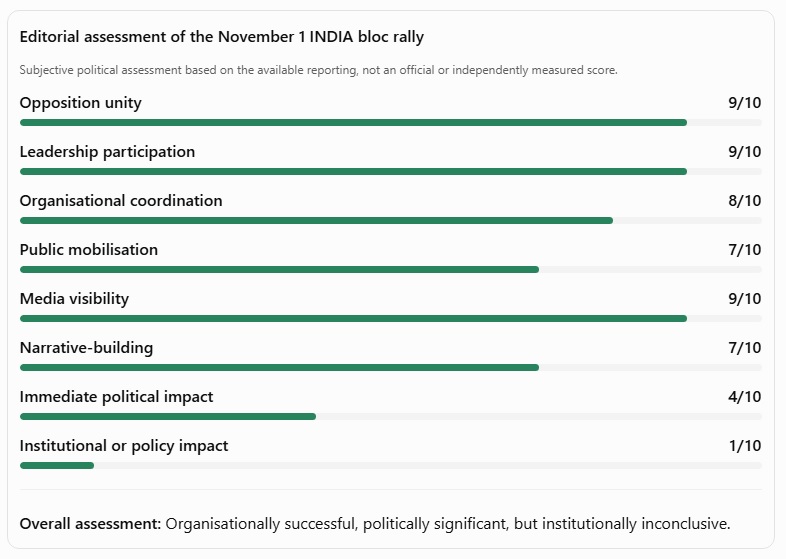
Overall assessment: Organisationally successful, politically significant, but institutionally inconclusive.
The November 1 rally did not shake the government, force an immediate decision from the Election Commission or produce a change in the SIR process.
Nor did it establish that the INDIA bloc could mobilise anything close to the million people projected by its organisers.
But dismissing the demonstration as a failure would also overlook its significance.
At a time when the Opposition’s unity was being questioned, several of India’s most influential regional leaders came together in Delhi. They shared a common platform, backed a common campaign and demonstrated that national-level political coordination remains possible.
That is an important achievement, particularly for a coalition whose constituents have their own political ambitions and regional rivalries.
Yet the rally also exposed the distance between political symbolism and political power.
A photograph of Opposition leaders standing together can generate headlines. Sustained coordination, public trust, grassroots mobilisation and measurable political outcomes require considerably more work.
The real test of the INDIA bloc begins after Ramlila Maidan.
If the alliance can turn the SIR controversy into a sustained campaign backed by evidence, legal action, voter assistance and public engagement, November 1 could be remembered as the beginning of a larger political movement.
If its leaders return to their respective political priorities and the issue gradually disappears from public attention, the gathering may be remembered as another impressive but temporary show of Opposition unity.
Delhi witnessed the Opposition’s ability to stand together. What remains to be seen is whether it can fight together, organise together and ultimately convince voters together.


