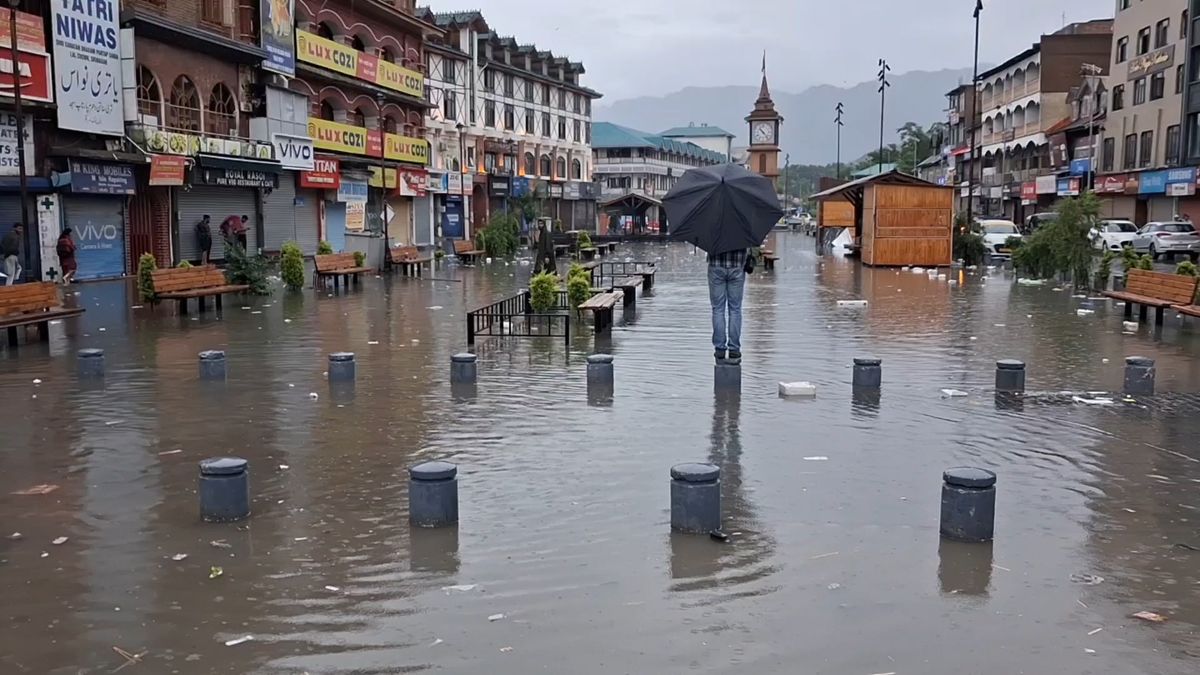
Srinagar Urban Crisis: How Planning Failure, Smart City Projects and Governance Gaps Are Turning Paradise Into a City Under Stress
By: Javid Amin | 22 Aug 2026
Srinagar Is Not Becoming a Slum Overnight — It Is Becoming a City Without Enough Urban Systems
There is a phrase increasingly being used to describe the uncomfortable transformation of Srinagar:
“Srinagar is a slum in the making.”
It is provocative. It is also incomplete.
Srinagar is not officially classified as a slum city. Nor would it be accurate to suggest that every part of the city resembles a slum.
There are landscaped boulevards, renovated public spaces, restored heritage areas, new roads, riverfront projects and visibly upgraded commercial zones.
But walk a few hundred metres away from the showcase areas and another Srinagar appears.
Open drains.
Overflowing garbage.
Traffic bottlenecks.
Illegal or poorly regulated construction.
Encroached water channels.
Unfinished roads.
Parking chaos.
Sewage entering storm-water systems.
Shrinking open spaces.
Construction on the urban fringe.
And a growing dependence on cosmetic interventions to solve structural problems.
That contradiction is the real story.
Srinagar does not suffer from a shortage of projects. It suffers from a shortage of integrated urban management.
And the evidence is increasingly difficult to ignore.
The National Rankings Already Gave Srinagar a Warning
If the question is, “Where does Srinagar stand nationally?”, there is no single index that measures whether a city is “good” or “bad.”
Different surveys measure different things.
But two rankings tell an interesting story.
Ease of Living Index: Srinagar Finished Last Among Million-Plus Cities
The Union Ministry of Housing and Urban Affairs’ Ease of Living Index 2020 ranked Srinagar 49th among 49 cities with populations above one million.
Its score was 42.95.
That put Srinagar below cities such as Guwahati, Amritsar, Ranchi, Jabalpur and Patna.
This is not a current 2026 ranking — and that distinction matters.
The Ease of Living Index 2020 remains the latest comparable nationwide EoLI ranking available for Srinagar. Therefore, it would be misleading to write that Srinagar is currently ranked last in India’s livability index.
But the 2020 result remains a remarkably important baseline.
It showed that Srinagar’s picturesque reputation did not translate into a high quality of urban life.
The city scored particularly poorly on the broader quality-of-life and economic dimensions, even though citizen perception was not uniformly negative. The official dataset placed Srinagar’s weighted score at 42.95.
There is another ranking — and it tells a slightly different story
The Swachh Survekshan 2024–25 paints a more encouraging picture.
Srinagar ranked 32nd among India’s million-plus cities, with a total score of 7,488. It ranked 234th the previous year, according to the published results.
That is a substantial improvement.
So the picture is not simply:
Srinagar is getting worse at everything.
It is more complicated.
Srinagar can improve its sanitation-survey ranking while residents still experience serious structural urban problems.
Why?
Because cleanliness rankings and urban liveability are not the same measurement.
And a city can improve its score through better collection, street cleaning and survey performance while still struggling with drainage, transport, land-use planning, sewage infrastructure, parking, public spaces and housing.
That distinction is crucial.
The Smart City Paradox: Billions Spent, Yet the Basic City Still Struggles
This is where the Srinagar story becomes much more interesting.
The Smart City Mission was supposed to transform urban infrastructure and improve quality of life.
Government records show the scale of the intervention.
In its 2024 annual report, the Union government stated that 262 Smart City projects had been identified for Srinagar, of which 223 worth approximately ₹4,596 crore had been completed, with another 47 projects worth ₹2,620 crore under execution.
Earlier reporting from Srinagar Smart City Limited described a different project count and budget structure, with 161 projects and an initial budget of about ₹940 crore.
The difference is important.
It indicates that different official reporting frameworks may be counting different components, phases or project categories.
That is precisely why an independent audit matters.
And now one has been ordered.
Why Did the Government Order an External Audit of Srinagar Smart City?
In June 2026, the Omar Abdullah government ordered a third-party/external audit of the Srinagar Smart City project.
The stated logic was significant: the project had been declared completed, and the government wanted an assessment of what was actually delivered and what impact it had on the ground.
That is not the same thing as announcing a corruption investigation.
It is important not to make that leap.
There is currently no basis to label the Smart City Mission a “scam” merely because an audit has been ordered.
But the audit does raise a legitimate public question:
If the project was successful, why was a third-party assessment necessary after completion?
That question deserves an evidence-based answer.
The audit should establish:
- What was sanctioned?
- What was actually constructed?
- What was the original cost?
- What was the final expenditure?
- Which projects were delayed?
- Which were modified?
- Which assets are operational?
- Who maintains them?
- What is their annual maintenance cost?
- Which projects improved measurable outcomes?
- Which were primarily cosmetic?
- Were original DPR objectives achieved?
- Did the projects integrate with the Master Plan?
- Did they improve drainage, mobility, sewage and waste management?
- Were there cost escalations?
- Were contracts modified?
- Were assets handed over properly?
- What is the condition of completed infrastructure today?
Until those questions are answered, calling the project either a success or a scam is premature.
The audit should let the evidence speak.
The Real Question: Did Srinagar Get a Smart City — or Smart-Looking Streets?
This may be the most uncomfortable question in the entire debate.
Smart urbanisation is not primarily about decorative paving.
It is not about illuminated façades.
It is not about installing cameras.
It is not about beautifying one commercial corridor.
It is not about turning a few roads into attractive pedestrian spaces.
A smart city is fundamentally about systems.
A city is smart when:
- sewage is treated;
- storm water drains actually carry storm water;
- waste is segregated and processed;
- public transport works;
- parking is managed;
- buildings follow land-use regulations;
- floodplains remain protected;
- water bodies are not used as garbage sinks;
- traffic is managed through data;
- public spaces are accessible;
- infrastructure is maintained after inauguration.
And this is where Srinagar’s story becomes uncomfortable.
Because the city’s own planning documents warned about many of these problems years ago.
The Master Plan Was Not the Problem. Implementation Was.
The Srinagar Master Plan 2035 was notified in 2019 after years of preparation, consultation and evaluation.
The plan was not blind to the city’s problems.
It explicitly proposed green spaces, interconnected open spaces, green corridors and protection of environmentally sensitive areas.
It called for a whole-to-part approach to spatial planning, including detailed zoning to control encroachments and changes in land use.
The plan also identified the city’s transport crisis with striking clarity.
According to the Master Plan, Srinagar’s population was growing at roughly 2% annually while vehicular traffic was increasing by more than 7% annually.
The document warned that road infrastructure was growing much more slowly than vehicle numbers and described traffic congestion as having reached a critical level.
Even more revealing, it noted that Srinagar had already had earlier transport plans — including the Srinagar Urban Transport Project and Comprehensive Mobility Plan — but that meaningful implementation had not followed.
That is the root of the problem.
The Valley did not lack warnings.
It lacked sustained implementation.
Srinagar’s Urban Crisis Is Therefore Not New
This is perhaps the biggest misconception.
Today’s traffic jam did not suddenly appear in 2026.
Today’s encroachment did not begin with the Smart City Mission.
Today’s waste crisis did not begin with the current administration.
Today’s drainage problems were not created by one government.
The Master Plan was already documenting serious problems years ago.
That means Srinagar’s urban decline is institutional and cumulative.
Governments change.
Departments change.
Mayors change.
Chief ministers change.
Projects change.
But the underlying urban system continues.
That is why political blame alone cannot explain the crisis.
The Most Damning Evidence Comes From the Drainage System
If one wants to understand Srinagar’s urban-governance problem in one example, look at Nadroo-Hyderpora.
The CAG’s recent audit found that a storm-water drainage project had been designed in a way that allowed wastewater from households to enter the drainage system.
The audit found that the dewatering station discharged approximately 1.72 crore litres of wastewater into a flood channel over ten days in October 2023 — despite there being no rainfall during that period.
This is extraordinary.
A drainage system designed for storm water was effectively carrying sewage.
The audit also found that the locality did not have a separate sewage network.
And the problem was known.
The project had cost approximately ₹12.80 crore, involved 5.80 km of drains and was completed in 2021 before being handed over to the Srinagar Municipal Corporation in 2023.
This is not simply a garbage problem.
It is an urban engineering and planning problem.
And it demonstrates something fundamental:
If sewage and storm water are not separated, every heavy rainfall event becomes a sanitation crisis — and even without rain, sewage can end up being pumped into waterways.
That has direct implications for the Jhelum, flood channels, wetlands and ultimately Kashmir’s lakes.
Srinagar’s Waste Problem Is Finally Reaching the Point of No Return
Then there is Achan.
For decades, Srinagar’s waste-management system effectively relied on accumulation.
The result is a mountain of legacy waste.
Recent reporting puts the accumulated waste at approximately 11.5 lakh metric tonnes after roughly four decades of dumping. The administration has now begun biomining with a target of clearing the legacy waste over two years and developing an integrated waste-management facility on the 123-acre site.
This is potentially a major correction.
But it also raises a simple question:
How did a capital city accumulate more than a million tonnes of legacy waste before the system was fundamentally redesigned?
The answer is partly institutional.
Waste collection is easier to see than waste processing.
A truck collecting garbage creates an immediate visible action.
Processing, segregation, composting, recycling, material recovery and scientific disposal require systems that operate continuously and largely out of public view.
For years, Srinagar concentrated heavily on collection while the back-end system struggled.
The CAG’s broader audit of urban local bodies identified deficiencies in solid-waste planning, collection, disposal, processing and environmental-risk assessment.
That is why Achan should not be treated simply as a landfill problem.
It is the physical monument to a 40-year failure to build a circular waste system.
And Here Is the Paradox: Srinagar Is Improving in Cleanliness Rankings
This deserves emphasis.
Srinagar’s 2024–25 Swachh Survekshan ranking improved dramatically to 32nd among million-plus cities, from 234th the previous year.
That is a genuine improvement and should not be dismissed.
But it creates an important editorial question:
How can a city simultaneously improve dramatically in a cleanliness ranking while carrying 11.5 lakh tonnes of legacy waste and continuing to face serious wastewater and drainage problems?
There is no contradiction if we understand what rankings measure.
A city can become better at daily collection and visible cleanliness while still carrying decades of accumulated environmental debt.
That is precisely why policymakers should avoid treating a ranking as the final verdict on urban health.
The Slumification Risk Is Actually Happening at the Periphery
The word “slum” becomes more meaningful when we examine Srinagar’s housing geography.
The city’s Master Plan documentation recorded 77 unnotified slum pockets identified under the Rajiv Awas Yojana-era planning exercise, covering around 18,000 households. It also identified numerous informal housing clusters around the city and suburbs, particularly along highways.
Again, these figures come from the planning documentation and should not be presented as a current 2026 slum census.
But they demonstrate that informal urbanisation is not a new phenomenon.
The deeper issue is this:
People do not build informal settlements simply because they dislike planning.
They build where formal housing is unaffordable, serviced land is scarce or planning does not keep pace with population growth.
The Master Plan itself identified:
- shortage of serviced land;
- rising construction costs;
- regulatory constraints;
- difficulty accessing housing finance.
That creates a predictable outcome.
People move outward.
Agricultural land gets converted.
Small settlements expand along roads.
Infrastructure arrives later.
Sewage networks lag behind.
Public transport becomes inadequate.
Schools and health services follow even later.
Eventually the city becomes a patchwork of formal neighbourhoods, villages, colonies, commercial strips and informal construction.
That is peri-urban sprawl.
And it is one of Srinagar’s greatest long-term threats.
Encroachment Is Not Only a Law-and-Order Problem
This is another area where the debate often becomes simplistic.
Authorities periodically launch anti-encroachment drives.
Structures are demolished.
Land is recovered.
Officials issue statements.
Then, months or years later, the pattern returns.
Why?
Because enforcement alone cannot solve a land-use crisis.
If land values rise dramatically while urban housing supply remains limited, the economic incentive to occupy or convert land remains powerful.
This is why the answer must include:
clear zoning + affordable housing + serviced land + transparent permissions + satellite monitoring + enforcement + political consistency.
The J&K government has also tightened building-permission rules. The 2025 amendments explicitly allow permits to be revoked where construction violates the sanctioned plan, Master Plan, Zonal Plan or building bye-laws, with demolition/removal possible after due process.
The law therefore provides tools.
The real test is whether those tools are applied consistently.
Traffic Is Not a Traffic Police Problem
Every day, Srinagar’s traffic debate tends to revolve around the same things:
“Remove encroachments.”
“Deploy more traffic police.”
“Open another road.”
“Repair the bottleneck.”
“Build a flyover.”
But the city’s own Master Plan had already identified the structural problem: vehicles were increasing faster than road capacity.
That is a planning equation.
You cannot solve unlimited private-vehicle growth by continuously widening roads in a historic city whose geography is constrained by rivers, lakes, wetlands, mountains and old neighbourhoods.
Road widening itself can destroy pedestrian space, mature trees and historic urban fabric.
The long-term solution is therefore modal:
buses + e-buses + walking + cycling + park-and-ride + parking management + traffic demand management.
The government has already moved towards e-buses. Official records say 200 electric buses were being operated in the twin capitals as part of the shift towards greener urban transport.
But buses alone will not solve the problem.
They must be frequent, reliable, affordable and connected to a coherent network.
What Happened to the “Green” in Smart City?
This may be one of the most visible criticisms from residents.
Smart City development has produced upgraded streetscapes and public spaces.
But residents and observers have repeatedly questioned whether the city has added enough meaningful green infrastructure alongside hard landscaping.
Public discussions have also highlighted concerns about loss of mature trees and the lack of new green spaces in redeveloped corridors.
These are citizen accounts rather than official measurements, so they should be treated as perceptions rather than quantified facts.
But the underlying concern is supported by planning documents.
The Master Plan envisaged interconnected open spaces, green corridors and at least 3.5% organised green space under parks and gardens, along with connections between “green” and the city’s lakes, wetlands and rivers.
The question therefore is not whether Srinagar should look attractive.
It is:
Did the Smart City programme strengthen the ecological structure of the city, or mainly upgrade its visible surfaces?
That is precisely the sort of question the external audit should answer.
The Dal Lake Problem Is Actually a City Problem
It is tempting to treat Dal Lake as a separate environmental issue.
It isn’t.
Dal is effectively a mirror of Srinagar.
Sewage entering the lake reflects inadequate sewer connectivity.
Solid waste entering the water reflects weaknesses in urban waste management.
Encroachment reflects failures in land-use enforcement.
Weed growth reflects nutrient loading.
Traffic and tourism pressure reflect the city’s economic dependence on a fragile landscape.
The recent CAG audit of lake conservation identified deficiencies in sewage infrastructure, sewer networking, waste management, weed management, monitoring and land-use control.
So when Dal deteriorates, Srinagar is not suffering from a “lake problem.”
Srinagar is looking at itself in the lake.
The Most Dangerous Failure: Fragmented Governance
Here lies the root cause.
Who actually manages Srinagar?
The answer is complicated.
There is the:
- Srinagar Municipal Corporation;
- Srinagar Development Authority;
- Housing and Urban Development Department;
- Town Planning Organisation;
- Roads & Buildings Department;
- Urban Environmental Engineering Department;
- Jal Shakti Department;
- Traffic Police;
- Transport Department;
- Srinagar Smart City Limited;
- Lakes and Waterways Development Authority;
- Pollution Control Committee;
- Revenue authorities;
- district administration;
- tourism authorities;
- other specialised agencies.
This institutional architecture creates a classic governance problem:
everyone owns a piece of the city, but nobody owns the whole city.
The existence of Srinagar Smart City Limited itself reflects this fragmented model. The government constituted the company as a Special Purpose Vehicle for implementation of Smart City projects.
That arrangement can accelerate project delivery.
But it can also create another problem.
Who is responsible for what happens after the project is completed?
A beautifully redesigned road still needs:
- drainage;
- waste collection;
- parking control;
- road maintenance;
- pedestrian enforcement;
- sewer connectivity;
- electricity;
- landscaping;
- traffic management.
If those systems belong to different agencies, the “smart” asset can quickly become an ordinary asset with extraordinary maintenance requirements.
This Is Why the Smart City Audit Matters
The external audit ordered in 2026 should not become another political blame game.
It should become the city’s most comprehensive urban-performance review in years.
The government should publish the complete findings.
Not just a summary.
The public should know:
Money
How much was sanctioned and spent?
Projects
How many were actually completed?
Quality
Were they built according to specifications?
Utility
How many are functioning?
Maintenance
Who maintains them?
Outcomes
Did congestion fall?
Did pedestrian safety improve?
Did drainage improve?
Did waste collection improve?
Did public transport improve?
Did green space increase?
Did pollution decline?
Did citizen satisfaction rise?
Accountability
Where did projects fail, and why?
That is what a genuine third-party audit should establish.
“Ghotala” Is Not Yet the Right Word — Unless Evidence Emerges
There is a temptation in public debate to call every large infrastructure programme a “ghotala” when the results are disappointing.
That is poor journalism.
A failed project is not automatically a corrupt project.
A delayed project is not automatically a scam.
A costly project is not automatically an illegal project.
Corruption requires evidence.
The proper vocabulary at this stage is:
audit, accountability, implementation failure, cost-effectiveness, contractual compliance, project quality and outcome assessment.
If the audit discovers inflated bills, manipulated tenders, conflict of interest, deliberate diversion of funds, fraudulent certification or other wrongdoing, then stronger terminology would be justified.
Until then, the more powerful story is actually broader:
Why did a city with enormous public investment still fail to fix its basic urban systems?
That question cannot be answered by blaming one contractor.
The Administration’s “U-Turn” Needs to Be Understood Carefully
Calling the current administration’s decision a “U-turn” is politically attractive, but analytically it needs qualification.
The government has not abandoned the Smart City concept.
Instead, it has effectively moved from project completion to performance verification.
That is potentially a healthy correction.
The problem is timing.
If the project is already declared complete, then questions naturally arise:
Why was independent scrutiny not built into the process from the beginning?
An effective governance model would conduct:
- baseline assessment;
- project implementation;
- independent quality audit;
- citizen-impact assessment;
- financial audit;
- post-completion evaluation.
Instead, the public conversation now appears to be asking for the fourth and fifth steps after the project has already been declared complete.
That is not necessarily a U-turn.
It is better described as late-stage accountability.
The Bigger Failure Is the Gap Between “Project” and “City”
This is where Srinagar’s urban crisis becomes a lesson for India.
Governments are generally better at building projects than maintaining systems.
A bridge can be inaugurated.
A road can be photographed.
A fountain can be switched on.
A riverfront can be opened.
A smart pole can be installed.
A drainage project can receive a completion certificate.
But a city does not function because projects are completed.
It functions because thousands of systems work together every day.
That includes:
land use + housing + sewage + drainage + waste + transport + water + environment + policing + maintenance + taxation + enforcement.
Srinagar’s crisis is the failure to integrate these systems.
So, Is Srinagar Becoming a Slum?
The honest answer is:
Not literally — but there are clear signs of slum-like urbanisation in parts of the metropolitan area.
The more technically accurate description is:
Srinagar is experiencing uncontrolled peri-urban growth, infrastructure deficits, environmental degradation, traffic stress, informal housing expansion and fragmented urban governance.
That is less dramatic than “slum.”
But it is more accurate.
And, ironically, more alarming.
Because a slum can sometimes be cleared or redeveloped.
A dysfunctional metropolitan system involving wetlands, highways, villages, lakes, housing colonies, commercial corridors and competing government agencies is much harder to repair.
Five Root Causes Behind Srinagar’s Urban Decline
1. Planning Without Consistent Enforcement
Srinagar has a Master Plan.
The problem is whether the plan consistently determines what gets built.
A plan that is ignored becomes a document rather than a planning instrument.
2. Infrastructure Has Followed Construction — Instead of Leading It
Housing and commercial development often arrive first.
Sewerage, drainage, parking, public transport and green spaces follow later.
That reverses the correct sequence.
A modern city should build:
infrastructure → zoning → housing → economic activity.
Srinagar too often experiences:
construction → population → traffic → sewage → drainage crisis → emergency infrastructure.
3. Too Many Agencies, Too Little Unified Accountability
When one agency constructs a road, another manages drainage, another controls traffic, another handles waste and another regulates land use, accountability becomes diffuse.
The citizen sees one city.
Government sees multiple jurisdictions.
That gap is costly.
4. Political Incentives Favour Visible Projects
There is a political advantage in inaugurating something visible.
A landscaped road is visible.
A sewer pipe buried underground is not.
A new bridge is visible.
Preventing illegal construction is not.
A riverfront is visible.
Maintaining a waste-treatment plant for 20 years is not.
Urban governance needs to reward outcomes, not simply inaugurations.
5. Environmental Limits Were Treated as Obstacles Instead of Infrastructure
Srinagar’s lakes, wetlands, floodplains and open spaces are not vacant land waiting for development.
They are part of the city’s natural infrastructure.
When they are encroached upon, the city loses flood storage, biodiversity, groundwater functions and ecological resilience.
The cost eventually returns as flooding, pollution, heat and infrastructure expenditure.
What Should Be Done Now?
If the government genuinely wants to rescue Srinagar, another beautification campaign should not be the first priority.
The first priority should be a Srinagar Urban Recovery Mission.
And it should have measurable targets.
First: Publish the Smart City Audit
Make the complete third-party report public.
Second: Create One Metropolitan Command Structure
Bring major urban functions under a coordinated metropolitan planning mechanism.
Third: Freeze Critical Ecological Zones
No further construction should be permitted in identified floodplains, wetlands, lake buffers and drainage channels.
Fourth: Separate Sewage From Storm Water
This should become an emergency engineering priority.
The Nadroo-Hyderpora findings show why.
Fifth: Fix the Waste Chain
Collection is only step one.
Segregation, processing, recycling, composting, biomining and scientific disposal must work together.
Sixth: Build Public Transport Before Widening Roads
Srinagar cannot solve congestion by continuously accommodating more private vehicles.
Seventh: Protect Mature Trees and Expand Urban Green Space
Every major road project should have a measurable green-space and tree-retention component.
Eighth: Create a Public Urban Dashboard
Citizens should be able to see:
- project status;
- expenditure;
- contractor;
- completion date;
- maintenance agency;
- water-quality data;
- waste-processing data;
- traffic statistics;
- encroachment cases;
- building permissions.
Transparency should become part of the infrastructure.
The City Does Not Need Another Makeover. It Needs a Reset.
Srinagar remains one of India’s most extraordinary cities.
Its historic neighbourhoods, waterways, gardens, architecture, cultural heritage and Himalayan setting give it an identity few Indian cities can match.
That is precisely why its deterioration is so painful.
The tragedy is not that Srinagar lacks beauty.
It is that beauty is being asked to compensate for weak urban systems.
A tourist may photograph Dal Lake and Nishat Garden.
A resident has to navigate the drain outside his house.
A visitor may admire the renovated boulevard.
A commuter may spend an hour trapped in traffic.
A government advertisement may showcase Smart City infrastructure.
A neighbourhood may still lack proper sewage separation.
A cleanliness ranking may rise dramatically.
A million tonnes of legacy waste may still sit at Achan.
All of these things can be true at the same time.
And that is the real Srinagar story.
The Final Question Is Not Who Is to Blame
The debate over Srinagar’s decline should not become another political exchange between one administration and another.
The city has been struggling with these problems across governments.
The Master Plan warned about them.
Engineers warned about them.
Residents complained about them.
Environmentalists documented them.
Auditors have now identified them.
The question is whether the political and administrative system is finally prepared to act on them as one connected problem.
Because Srinagar does not need another isolated project.
It needs a citywide operating system.
A functioning sewer network.
A functioning waste economy.
A protected wetland system.
A rational transport network.
Affordable and planned housing.
Strict land-use enforcement.
More public green space.
Transparent infrastructure contracts.
And one authority capable of looking at Srinagar not as 20 departments, 200 projects and thousands of individual permissions — but as one living urban ecosystem.
That is the difference between a city that merely looks modern and a city that actually works.
Srinagar’s Crossroads
The external Smart City audit could become just another government report.
Or it could become the starting point for something much bigger.
The government has an opportunity to ask a question that should have been asked years ago:
After spending thousands of crores on urban development, what kind of city have we actually built?
If the answer is uncomfortable, that is not a reason to hide it.
It is the reason to fix it.
Because the greatest danger facing Srinagar is not that it will suddenly become a slum.
The greater danger is that it will become something harder to recognise:
a beautiful city whose natural landscape survives, whose monuments remain, whose tourist photographs remain attractive — but whose everyday urban systems no longer work.
And that transformation has already begun.
The choice now is whether Srinagar stops it — or normalises it.


