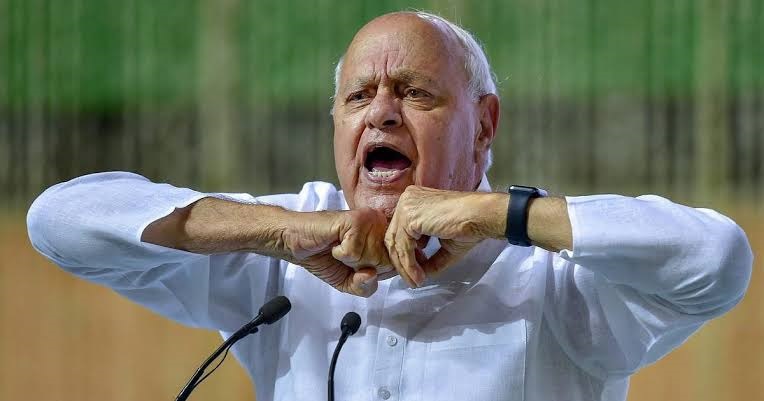
Farooq Abdullah Calls Article 370 Verdict ‘Completely Wrong’, Questions Delay in J&K Statehood Restoration
By: Javid Amin | 19 October 2026
Srinagar: National Conference president Farooq Abdullah has renewed his criticism of the Supreme Court’s judgment upholding the abrogation of Article 370, describing the verdict as “completely wrong” and reaffirming his party’s commitment to restoring Jammu and Kashmir’s special constitutional status and full statehood.
Addressing a workers’ convention in Arwah, in the Beerwah constituency of Budgam district, the veteran politician said the National Conference would continue its political struggle for the restoration of Articles 370 and 35A and the constitutional rights of the people of Jammu and Kashmir.
Abdullah also questioned the delay in restoring statehood, an issue that has remained central to the region’s political debate since the erstwhile state was reorganised into two Union Territories in August 2019.
His remarks bring renewed attention to a constitutional dispute that has shaped Jammu and Kashmir’s politics for years. Although the Supreme Court has upheld the Centre’s decision to make Article 370 inoperative, the demand for special status continues to influence political debate, while the separate question of restoring full statehood remains unresolved.
The National Conference, which returned to power after the 2024 Assembly elections under Chief Minister Omar Abdullah, has continued to press the Centre on both issues.
Farooq Abdullah Questions Supreme Court’s Article 370 Judgment
“The Supreme Court’s decision was completely wrong,” Abdullah said, according to reports published on October 19.
He argued that the Supreme Court had, in earlier proceedings, recognised Article 370 as having a permanent character and questioned the legal reasoning behind the Constitution Bench’s December 2023 judgment.
The remarks reflect the National Conference leadership’s continuing disagreement with the constitutional changes introduced by the Union government in August 2019. However, Abdullah’s interpretation of the earlier judicial position is a political and legal argument, not the operative position established by the Supreme Court’s final judgment on the matter.
In its December 11, 2023, ruling, a five-judge Constitution Bench unanimously upheld the Centre’s decision to abrogate Article 370. The Court held that Article 370 was a temporary provision and upheld the relevant presidential orders through which the constitutional changes were implemented.
The judgment marked a major legal setback for political parties and petitioners who had challenged the removal of Jammu and Kashmir’s special status.
The Court’s ruling did not, however, end the political debate over the region’s constitutional future. Regional parties have continued to question the loss of autonomy and demand the restoration of statehood.
What Happened in August 2019?
To understand Abdullah’s criticism, it is necessary to revisit the events of August 2019.
On August 5, 2019, the Union government announced a series of constitutional changes that effectively removed Jammu and Kashmir’s special status under Article 370. The changes were accompanied by the introduction of the Jammu and Kashmir Reorganisation Bill, which Parliament subsequently passed.
The erstwhile state was reorganised into two Union Territories: Jammu and Kashmir, which retained a legislature, and Ladakh, which became a Union Territory without a legislature.
The decision fundamentally changed Jammu and Kashmir’s constitutional and administrative relationship with the Union government.
Before the changes, Article 370 provided the framework through which the Indian Constitution applied to Jammu and Kashmir, subject to specific constitutional arrangements. Article 35A, introduced through a presidential order in 1954, enabled the erstwhile state legislature to define permanent residents and provide them with certain special rights and privileges.
Following the 2019 changes, the former constitutional framework ceased to operate in its previous form.
The government defended the move as a step towards national integration, uniform application of constitutional provisions, improved governance and economic development. Supporters also argued that removing the special constitutional arrangements would create greater opportunities for investment and strengthen the delivery of central welfare schemes.
Opponents, including the National Conference and the Peoples Democratic Party, maintained that the changes weakened Jammu and Kashmir’s autonomy and were carried out without the consent of an elected state government.
That disagreement continues to shape the region’s political discourse.
Supreme Court’s December 2023 Verdict: What Did the Judges Say?
The constitutional challenge eventually reached the Supreme Court, where a five-judge Constitution Bench heard arguments on the validity of the Centre’s 2019 actions.
On December 11, 2023, the Court delivered a unanimous judgment upholding the abrogation of Article 370.
The ruling addressed several important questions concerning the constitutional status of Jammu and Kashmir, the powers of the President during President’s Rule and the validity of the presidential orders issued in August 2019.
The Court concluded that Article 370 was a temporary provision and that the President had the authority to declare it inoperative through the process used by the Union government.
The judgment also upheld the separation of Ladakh as a Union Territory. On statehood, the Court directed that Jammu and Kashmir’s statehood should be restored “at the earliest and as soon as possible”.
The Court separately directed that Assembly elections be held by September 30, 2024. Elections took place in September and October 2024, and an elected government subsequently took office under Omar Abdullah.
The statehood direction, however, did not include a specific deadline for completing the restoration.
That distinction has become increasingly important. While the legal challenge to the abrogation of Article 370 has been decided, the demand for statehood has continued to generate political pressure and separate legal questions.
Why Farooq Abdullah Is Still Demanding Articles 370 and 35A
For the National Conference, the demand to restore Articles 370 and 35A is closely connected to its longstanding position on Jammu and Kashmir’s political autonomy.
The party has consistently argued that the former constitutional arrangements reflected the region’s distinctive historical circumstances and political relationship with the Union of India.
Abdullah has maintained that the National Conference will not abandon its commitment to restoring the region’s former special status.
According to reports of his latest address, he expressed confidence that changing political circumstances and public sentiment would eventually strengthen the demand.
“The winds of change have begun to blow, and they are gathering speed,” he reportedly told party workers.
The statement reflects the party’s effort to keep the issue alive politically, even after the Supreme Court’s judgment.
However, political commitment and legal enforceability are two different matters. The National Conference can continue to campaign for restoration, but the Supreme Court’s binding judgment remains in force unless it is lawfully reconsidered or superseded through a constitutionally valid process.
The restoration of Article 35A would also involve addressing the legal framework that existed before August 2019. It cannot be treated as an independent administrative step detached from the wider constitutional changes.
Jammu and Kashmir’s Accession and Its Political Legacy
Abdullah also referred to the historical circumstances surrounding Jammu and Kashmir’s accession to India and the region’s political aspirations.
The history remains central to the debate over Article 370.
Maharaja Hari Singh, the ruler of the princely state, signed the Instrument of Accession in October 1947 amid an armed invasion from tribal forces entering from the direction of Pakistan. The accession was accepted by the Governor-General of India, Lord Mountbatten.
The Instrument of Accession initially addressed specified subjects, including defence, external affairs and communications. Article 370 subsequently provided a constitutional framework for the application of the Indian Constitution to Jammu and Kashmir.
Over the following decades, presidential orders extended additional provisions of the Indian Constitution to the state.
The political meaning of this history remains contested. Regional parties have often viewed the special constitutional arrangement as a safeguard for Jammu and Kashmir’s distinct political identity, while successive Union governments have differed over the extent and nature of the autonomy it should provide.
The Supreme Court’s 2023 judgment addressed the constitutional validity of the 2019 changes. It did not erase the historical and political disagreements that continue to influence public debate.
Abdullah’s remarks draw on that longer history, linking the demand for restoration to questions of political representation, autonomy and public confidence in democratic institutions.
Omar Abdullah Government and the Statehood Question
Farooq Abdullah’s criticism also comes against the backdrop of the challenges facing the elected government led by his son, Omar Abdullah.
The National Conference won the 2024 Assembly elections on a platform that included the restoration of statehood and opposition to the loss of Jammu and Kashmir’s special status.
The return of an elected government restored an important element of representative politics, but it did not automatically return Jammu and Kashmir to its former status as a state.
As a Union Territory with a legislature, Jammu and Kashmir continues to operate under a different administrative and constitutional framework from that of a full-fledged state.
The elected government’s powers exist alongside those of the Lieutenant Governor, with responsibilities divided under the applicable legal framework. The arrangement has become a source of political friction, particularly over the distribution of administrative authority.
The National Conference has argued that restoring statehood would strengthen the elected government’s ability to implement its policies and respond to public concerns.
The Centre, meanwhile, has maintained that statehood will be restored, although the process has not been completed.
The Supreme Court’s direction that statehood be restored at the earliest has provided a legal and political reference point for the demand. The absence of a specific deadline, however, has left room for continued disagreement over when the commitment should be fulfilled.
Political Significance of Abdullah’s Latest Remarks
Abdullah’s statement carries significance beyond his criticism of the Supreme Court judgment.
First, it signals that the National Conference intends to retain restoration of special status as a central part of its political identity. The party’s position is unlikely to disappear simply because the legal challenge did not succeed.
Second, the remarks renew pressure on the Union government over statehood. Unlike the demand to reverse the Article 370 judgment, the restoration of statehood has a distinct legal and political pathway and was expressly addressed by the Supreme Court.
Third, the statement highlights the continuing difference between the National Conference’s position and that of the BJP. While the National Conference seeks the restoration of special status as well as full statehood, the BJP opposes a return to the pre-2019 constitutional arrangement.
These differences are likely to remain important in debates over governance, federalism and Jammu and Kashmir’s future relationship with the Union government.
For residents, the issue is not confined to constitutional theory. It also concerns who exercises administrative authority, how elected representatives respond to local demands and whether political assurances translate into changes in governance.
The challenge for political leaders is to explain what their demands would mean in practical terms, while recognising the legal constraints created by the Supreme Court’s judgment.
Current Scenario: Is Article 370 Still a Live Legal Issue?
As of October 20, 2026, the legal position needs to be understood in two separate parts: the status of Article 370 and the restoration of Jammu and Kashmir’s statehood.
Article 370 verdict: The main case has been decided
The Supreme Court upheld the Centre’s 2019 decision on December 11, 2023. Review petitions challenging that judgment were dismissed in May 2024, with the Court finding no apparent error warranting a review.
The original constitutional challenge is therefore not awaiting its first or final verdict. Article 370 has not been restored, and no subsequent judgment overturning the 2023 ruling has been identified in the available reporting.
This does not mean that political debate has ended or that every conceivable future legal proceeding is impossible. It means that the existing Supreme Court judgment remains binding.
Statehood restoration: The question remains unresolved
Jammu and Kashmir continues to be a Union Territory with an elected Legislative Assembly. The Supreme Court directed that statehood be restored at the earliest, but it did not specify a final date.
The issue has remained on the political agenda. In September 2026, the Jammu and Kashmir Assembly passed a resolution moved by Chief Minister Omar Abdullah seeking the immediate restoration of full statehood. BJP legislators opposed the resolution and walked out before the vote.
The resolution added political weight to the demand, but it did not itself change Jammu and Kashmir’s legal status. The necessary steps to restore statehood must still be taken through the appropriate constitutional and legislative process.
Separate petitions seeking a time-bound restoration of statehood have also been reported before the Supreme Court. No subsequent final ruling on those pleas was identified in the available records reviewed for this report.
Can Article 370 be restored?
The National Conference can continue to demand the restoration of Articles 370 and 35A through political and constitutional means. But the party’s demand does not suspend or reverse the Supreme Court’s judgment.
Any future attempt to re-establish special constitutional arrangements would have to confront the existing judgment and comply with the applicable constitutional framework.
Statehood and special status are separate questions. Restoring statehood would return Jammu and Kashmir to state status within the Union, but it would not automatically reinstate Article 370 or the former provisions associated with Article 35A.
For that reason, the delay in statehood restoration should not be described as evidence that the Article 370 case itself remains undecided.
A Political Debate That Is Far From Over
Farooq Abdullah’s latest remarks underline the distance between a judicial decision and the political acceptance of that decision.
For the Union government and supporters of the 2019 changes, the Supreme Court’s judgment has settled the principal constitutional challenge. For the National Conference and other opponents, the loss of special status remains a defining political grievance.
The immediate legal position is clear: the Supreme Court’s verdict upholding the abrogation of Article 370 remains in force. The demand for restoration, however, continues in political debate, while the question of Jammu and Kashmir’s full statehood remains unresolved.
The next major development will depend on the Union government’s decisions on statehood and any further judicial proceedings concerning the delay. Until then, Abdullah’s statement is best understood as a renewed political challenge to the constitutional settlement created in 2019, rather than evidence that the Supreme Court has reopened the Article 370 case.
For Jammu and Kashmir, the larger question remains how political representation, administrative authority and the region’s long-standing demand for autonomy will evolve under the present constitutional framework.
Follow Us on WhatsApp
Get Breaking News, Exclusive Updates & In-Depth Analysis from Kashmir and beyond, delivered straight to your phone.
Join our WhatsApp Channel: Follow Now


