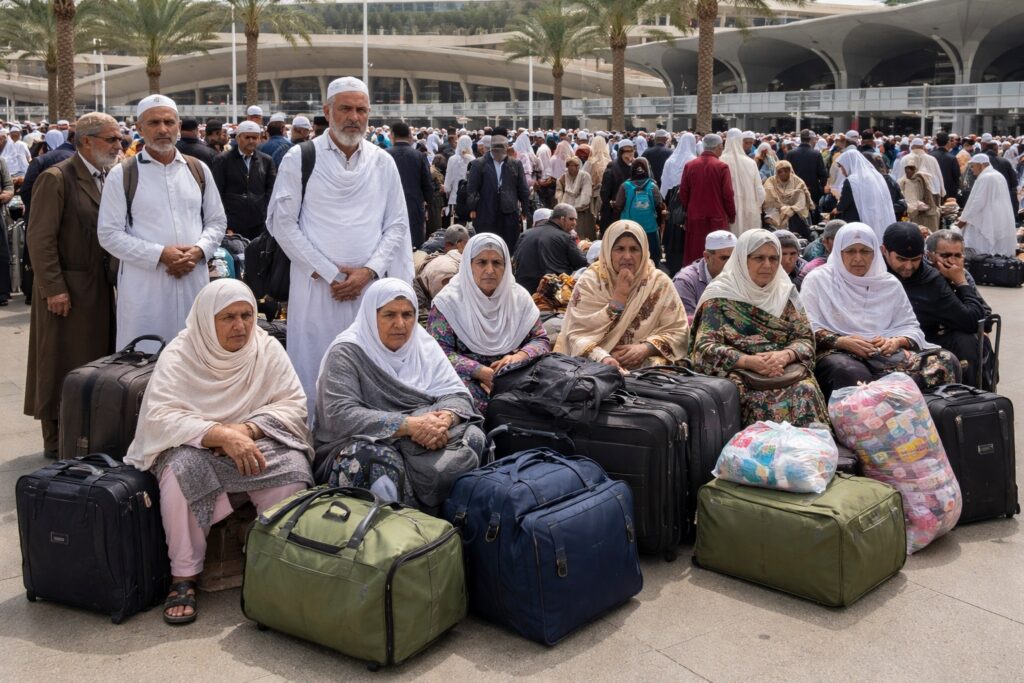
34 Kashmiri Umrah Pilgrims Stranded in Saudi Arabia as Flight Cancellations Deepen Hardship; Families Seek Urgent Help
By: News Desk | 23 October 2026
At a time when their families would have expected to welcome them home, at least 34 Kashmiri Umrah pilgrims remain stuck in Saudi Arabia, facing an uncertain return journey, mounting expenses and growing anxiety. Their return flights were scheduled for October 13, but cancellations linked to regional security concerns have disrupted their plans, leaving several elderly pilgrims particularly vulnerable.
The group has appealed to Jammu and Kashmir Lieutenant Governor Manoj Sinha, Chief Minister Omar Abdullah and the Union government to intervene and arrange their safe return. According to reports published on October 23 and 24, the prolonged delay has left some pilgrims struggling to pay for accommodation, food and medicines, while expensive alternative routes remain beyond the reach of many.
For the Kashmiri pilgrims still waiting, however, the national figures offer little immediate reassurance. Their most pressing concerns are practical: when will they be able to travel, who will cover the additional costs, and what support is available if the wait continues?
Why Are Kashmiri Umrah Pilgrims Unable to Return Home?
The immediate problem is a disruption to air travel between India and Saudi Arabia amid a deteriorating regional security situation.
According to the flight advisory reported by the Indian Embassy in Riyadh, IndiGo services to and from Riyadh were cancelled through October 31, while flights connecting Jeddah, Dammam and Madinah were cancelled through October 27. Reports also said Air India and Air India Express had suspended Saudi routes through October 24, with Akasa Air extending its suspensions through October 27. These dates reflect the advisories reported on October 23 and should not be treated as a guarantee of when normal services will resume.
That is particularly difficult for pilgrims who have already completed their religious journey and budgeted for a fixed return date.
The October 13 deadline that changed everything
The 34 Kashmiri pilgrims were reportedly scheduled to return on October 13. By October 23, their return had been delayed by around 10 days, with no confirmed common departure arrangement publicly reported for the group.
For younger travellers with savings, flexible tickets or relatives able to transfer money, an extended stay may be manageable. For elderly pilgrims, people taking regular medication and families travelling on limited budgets, the same disruption can become considerably more serious.
The central uncertainty is not merely when the next flight will operate. It is whether every member of the group can access a safe, affordable and medically appropriate route home.
Elderly Pilgrims Face the Greatest Pressure
The financial burden is only part of the problem. Reports from Kashmir say several members of the stranded group are elderly and experiencing anxiety as the delay continues.
Their situation deserves particular attention because prolonged travel disruption can create overlapping difficulties: disrupted medication routines, additional accommodation costs, fatigue and uncertainty about how long essential supplies will last.
No medical assessments or independently verified accounts from individual pilgrims were available in the reporting reviewed for this article. It would therefore be inappropriate to assign specific illnesses or describe individual medical emergencies without confirmation. But the reported shortage of money for medicines and daily necessities is itself a reason for urgent welfare checks.
A practical response would begin with identifying elderly passengers, those with mobility limitations and anyone requiring regular medication. Authorities and tour operators could then establish whether these travellers have adequate accommodation, access to pharmacies and hospitals, and a reliable way to contact their families.
The need is not limited to medical support. Clear communication can also reduce distress. Families need to know where their relatives are staying, which authority is handling their case and whether any travel option has been confirmed.
For people waiting thousands of kilometres from home, uncertainty can be as exhausting as the journey itself.
Why Some Pilgrims Cannot Afford Alternative Flights
Reports say some travellers have managed to return through connecting flights or alternative routes, but the Kashmiri pilgrims have described these options as financially out of reach.
Transit through Bahrain, Kuwait or Qatar has been discussed in reporting as a possible option for passengers requiring urgent travel, subject to applicable visa requirements and actual flight availability. These are not guaranteed routes, and travellers should confirm entry, transit and onward-connection rules before making arrangements.
The answer can depend on the airline’s ticket conditions, the reason for cancellation, the booking arrangement and the terms agreed with the travel operator. The available reports do not establish the individual contractual arrangements for the 34 pilgrims.
That uncertainty makes government coordination especially important. A negotiated group rebooking, assistance with essential expenses or a coordinated alternative itinerary could be more practical than expecting each passenger to arrange a separate journey.
The Government Says Return Arrangements Are Underway
The Ministry of External Affairs has acknowledged the wider problem and said Indian diplomatic missions in Saudi Arabia are working with airlines and tour operators.
MEA spokesperson Randhir Jaiswal said around 3,000 stranded Umrah pilgrims had returned to India on available flights during the preceding week. He added that more than 10,000 other pilgrims had returned on their scheduled services during the same period. The ministry said arrangements were being discussed to facilitate the return of those still affected.
These measures indicate that the disruption is receiving official attention. But they do not establish that a dedicated flight has been arranged for the Kashmiri group, that their additional expenses will be covered or that every passenger has received a confirmed return date.
That distinction matters. General assurances that authorities are coordinating with airlines are not the same as a case-specific travel plan.
The immediate priority should be to translate coordination into verifiable arrangements for the affected passengers, particularly those who cannot afford alternative tickets.
A Larger Disruption: Are More Kashmiri Pilgrims Affected Than the Reported 34?
One detail warrants closer examination. While the headline figure for the immediate case is 34 Kashmiri pilgrims, the wider number of people from Jammu and Kashmir affected by the flight suspensions may be higher.
The Jammu and Kashmir Association of Hajj and Umrah Companies has raised concerns about a broader group of stranded travellers. Its secretary-general, M. Younis Zahid, told Indmedia News that around 30 to 35 tour operators had groups of pilgrims stuck in Saudi Arabia and estimated that the total number could exceed 300. He also called for government assistance with food and accommodation until flight operations resumed.
The two numbers may refer to different groups rather than contradicting each other. The figure of 34 relates to a specifically reported group from Jammu and Kashmir. The estimate of more than 300 potentially covers pilgrims associated with multiple operators and travel groups.
That distinction is important for planning assistance. A response designed for 34 passengers may be inadequate if hundreds more are affected across different cities, hotels and travel itineraries.
Authorities should therefore establish a consolidated list that records each stranded pilgrim’s location, airline, original return date, ticket status, medical needs and contact details. Such a list would help prevent people from being overlooked and give officials a clearer basis for arranging assistance.
The national figures need careful interpretation
The MEA’s statement that around 3,000 stranded Umrah pilgrims returned during the previous week is encouraging, but it does not mean the problem has been resolved.
The ministry separately referred to more than 10,000 pilgrims who returned on their scheduled flights. Those are two distinct groups: travellers who were already booked on available services and people whose journeys had been disrupted. Combining the numbers without that distinction could give readers a misleading impression of how many stranded passengers have been assisted.
The available public reporting does not establish the final number of stranded Indian pilgrims, the exact number from Jammu and Kashmir or how many remain without confirmed travel arrangements as of October 24.
A transparent update from the authorities would help resolve these questions.
What the Jammu and Kashmir Government Can Do
The stranded pilgrims have appealed to Lieutenant Governor Manoj Sinha and Chief Minister Omar Abdullah to coordinate with the Centre and the airlines. Their request reflects the practical limits of what a state or Union Territory administration can do independently when its residents are caught in an international travel disruption.
The Jammu and Kashmir government cannot itself determine when Saudi airports reopen or compel an airline to operate a flight. Those decisions involve aviation authorities, airlines, security assessments and diplomatic coordination.
It can, however, press the Ministry of External Affairs to prioritise vulnerable residents, coordinate with tour operators, verify passenger lists and help families communicate with their relatives abroad.
Several immediate steps would make a meaningful difference:
-
Identify vulnerable pilgrims: Establish which passengers are elderly, require regular medication or need assistance with mobility.
-
Secure essential welfare support: Work with tour operators, community organisations and Indian missions to ensure food, accommodation and access to medical care.
-
Seek affordable rebooking: Ask airlines and operators to explore group rebooking, available seats on alternative services and practical connecting routes.
-
Provide a verified helpline: Give families a reliable channel for updates on passenger status, expected departure and assistance arrangements.
-
Publish regular updates: Explain what has been arranged, what remains unresolved and when the next update will be issued.
These are practical measures rather than guarantees of immediate repatriation. Their value lies in reducing the financial and emotional burden while safe travel options are being worked out.
The Responsibility of Tour Operators Cannot Be Ignored
The role of travel companies is another important part of the story.
Pilgrims often book Umrah packages that combine flights, accommodation, local transport and arrangements connected with their religious visit. When a return journey is cancelled, the consequences can extend beyond the airline ticket. The status of accommodation and the cost of additional nights may depend on the package terms and the operator’s response.
The Jammu and Kashmir Association of Hajj and Umrah Companies has called for assistance with food and accommodation for stranded pilgrims.
That appeal points to a need for coordination between the government, airlines and tour operators. It does not, by itself, establish that any particular operator has abandoned its passengers or breached a contract.
The relevant questions are specific: Were the original tickets refundable or changeable? Have operators helped passengers secure alternative seats? Who is paying for additional hotel nights? Have elderly pilgrims received help obtaining medicines? Are passengers being given accurate information about revised travel arrangements?
Those questions should be answered with reference to the individual booking agreements and the actual assistance provided.
For future pilgrimages, the disruption also offers a lesson for travellers and organisers. Clear emergency-contact arrangements, documented cancellation policies, accessible travel insurance information and contingency plans for extended stays can make a difficult situation more manageable.
No travel plan can eliminate the risk of a regional security crisis. But better preparation can reduce the burden it places on passengers.
Indian Embassy Helplines for Stranded Pilgrims in Saudi Arabia
Indian nationals who need assistance can contact the Indian Embassy in Riyadh or the Consulate General of India in Jeddah. The following round-the-clock control-room details were published in reports reproducing the MEA’s advisory.
Embassy of India, Riyadh
Telephone
+966 55 441 2016
+966 54 212 6784
Toll-free number
800 247 1234
For calls made within Saudi Arabia only.
WhatsApp messages
+966 53 621 6082
Consulate General of India, Jeddah
Telephone
+966 12 261 4093
+966 55 612 2301
WhatsApp messages
+966 53 620 9704
Before relying on these numbers, confirm that they remain active through the official Indian Embassy or Consulate channels. When contacting a control room, provide the pilgrim’s full name, passport details through the appropriate secure channel, location, airline, booking reference and medical or welfare needs.
Conclusion: The Priority Must Be Safe, Affordable Return
For the 34 Kashmiri Umrah pilgrims whose return was scheduled for October 13, the prolonged disruption has become a test of how effectively airlines, travel operators and government agencies respond when an ordinary journey is interrupted by a security crisis.
The Indian government says diplomatic missions are coordinating with airlines and tour operators, and thousands of stranded Umrah pilgrims have already returned through available flights. Yet the reported hardship among the Kashmiri group, alongside the broader estimate of hundreds of potentially affected pilgrims from the Union Territory, shows why general progress figures are not enough.
The immediate need is clear: reliable information, adequate food and accommodation, access to medicines, and a realistic return plan that does not depend on passengers finding money they may no longer have.
The next meaningful update should establish how many Kashmiri pilgrims remain stranded, what assistance they have received and whether confirmed seats have been secured for them.
For elderly pilgrims waiting far from home, the measure of an effective response will not be the number of meetings held or assurances issued. It will be whether they can return safely, without being left to bear the financial and emotional costs of a crisis they did not create.
Follow Us on WhatsApp
Get Breaking News, Exclusive Updates & In-Depth Analysis from Kashmir and beyond, delivered straight to your phone.
Join our WhatsApp Channel: Follow Now

