Farooq Abdullah’s Pakistan Remark Sparks Political Storm; BJP Demands Public Apology
By: Javid Amin | October 24, 2026
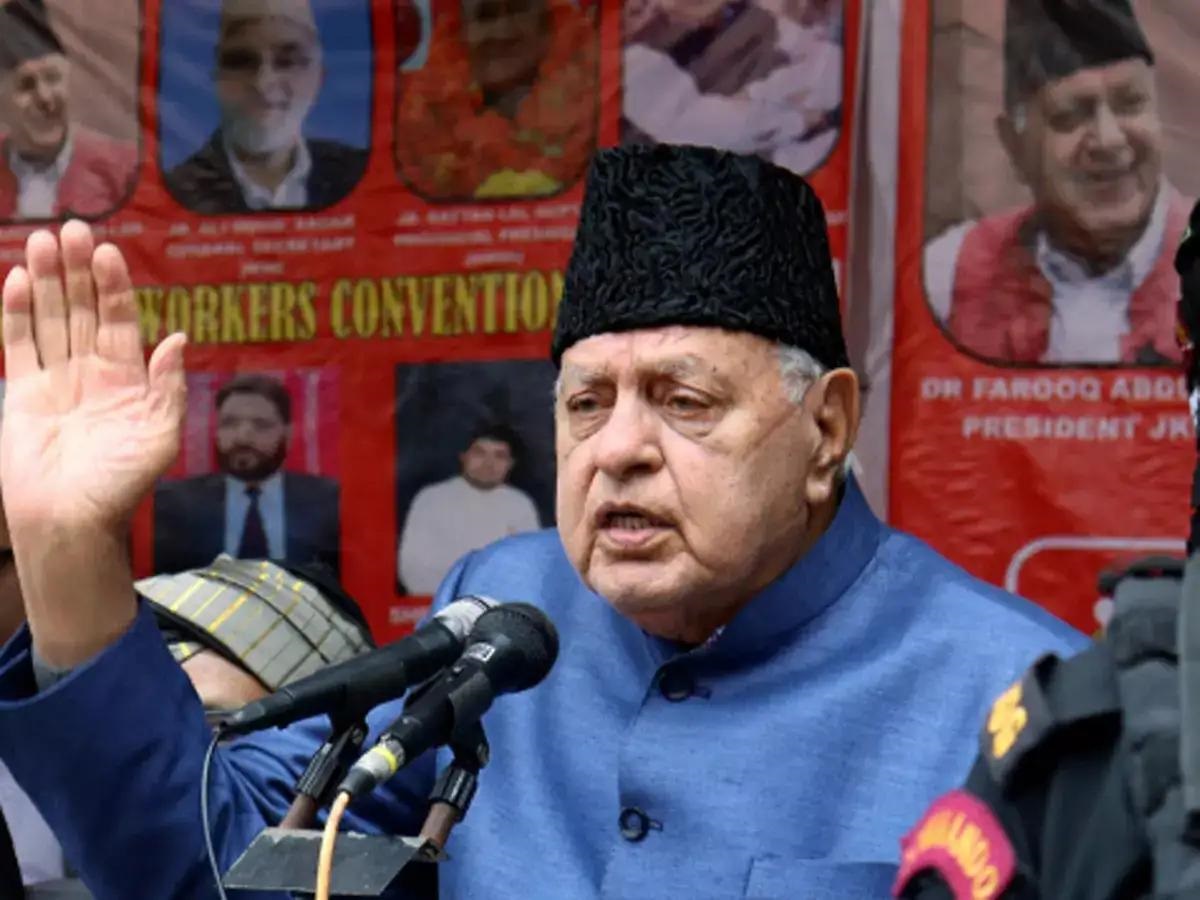
National Conference president Farooq Abdullah has triggered a fresh political confrontation after saying that Pakistan’s efforts to raise the Kashmir issue internationally were helping protect the people of Jammu and Kashmir. The remarks, made at a party workers’ convention in Baramulla on Saturday, drew an angry response from the Bharatiya Janata Party (BJP), whose leaders accused the veteran politician of echoing Pakistan’s narrative and demanded a public apology.
The controversy has quickly moved beyond a single speech. It has reopened a deeper debate over Kashmir’s constitutional status, the role of Pakistan in the dispute, the Centre’s policies since the abrogation of Article 370 in August 2019, and the continuing demand for the restoration of Jammu and Kashmir’s full statehood.
Abdullah’s reported statement was unusually direct. Referring to Pakistan’s repeated attempts to raise Kashmir at international forums, he said that the neighbouring country was helping protect Kashmiris, while questioning whether the intentions of the Indian government towards the region’s people were genuine.
His remarks have been seized upon by BJP leaders as evidence of what they describe as an unacceptable political position. Abdullah’s party, however, has long opposed the constitutional changes introduced in 2019 and continues to argue that Kashmir’s political aspirations and rights require greater attention.
The central question is not merely whether Abdullah’s words were politically provocative. It is also what the controversy reveals about the unresolved disagreements shaping Jammu and Kashmir’s relationship with New Delhi—and why a statement about international diplomacy can so quickly become a national political flashpoint.
What Did Farooq Abdullah Say in Baramulla?
According to reports published on October 24, Abdullah addressed National Conference workers in Baramulla and questioned whether the people of Jammu and Kashmir could expect justice from the government in New Delhi.
Referring to Pakistan’s efforts to raise Kashmir internationally, he said:
“Our neighbour is protecting us. Otherwise their intentions were not right.”
The statement was reported in the context of his argument that international pressure had compelled the Indian government to remain restrained towards Kashmiris. Abdullah also urged people to stand up for their rights and warned that failing to defend their identity could have serious consequences.
The wording matters because Abdullah did not simply acknowledge that Pakistan continues to raise Kashmir at international forums. He appeared to attribute a protective role to those efforts and questioned the intentions of the Indian government.
That interpretation immediately created political controversy.
For critics, the remarks amounted to giving Pakistan credit for safeguarding Kashmiris despite the long history of conflict between India and Pakistan. For those who share Abdullah’s criticism of the post-2019 constitutional changes, the wider context concerns political representation, identity and the need for the region’s grievances to receive attention.
Nevertheless, the claim that Pakistan’s diplomatic activity is protecting Kashmiris remains Abdullah’s political assessment. The existence of international advocacy does not, by itself, establish that it has produced a particular improvement in the rights, security or political circumstances of the population.
That distinction is essential to understanding both the substance of the statement and the reaction it provoked.
BJP Hits Back: ‘Look Across the Border’
The BJP responded sharply, with leaders accusing Abdullah of making remarks that they said ignored Pakistan’s role in the conflict and violence associated with Jammu and Kashmir.
BJP national spokesperson RP Singh challenged Abdullah to examine the conditions of Kashmiris living across the Line of Control. He argued that Jammu and Kashmir’s development and integration with India had advanced following the abrogation of Article 370, crediting the Narendra Modi government’s policies for the changes. 【
Singh’s response reflected the BJP’s broader political argument: that Pakistan should not be portrayed as a protector of Kashmiris when India has repeatedly accused it of supporting cross-border terrorism and contributing to instability in the region.
Other BJP leaders also condemned Abdullah’s remarks. J&K BJP president Sat Sharma demanded a public apology, while party leaders Yamini Sharma and Yudhvir Sethi accused the National Conference chief of echoing Pakistan’s position. Some BJP leaders went further, describing the statement as seditious and calling for legal action.
These descriptions represent the BJP’s political response, not a judicial finding that Abdullah committed an offence. Whether any statement violates a law is a separate question that must be assessed under the applicable legal provisions and evidence.
The political response has nevertheless been forceful. By framing the controversy around national security and allegiance, the BJP has shifted attention from Abdullah’s criticism of the Centre towards the question of whether a senior Indian politician should credit Pakistan with protecting Kashmiris.
For the National Conference, the challenge is different: to explain the substance of Abdullah’s argument while confronting the political consequences of language that critics regard as deeply provocative.
Why the Remark Has Become More Than a Political Exchange
The controversy is unfolding in a region where competing narratives about identity, constitutional rights and national integration have shaped political debate for decades.
Kashmir is not simply a territorial dispute between India and Pakistan. It is also a question of governance for millions of residents whose lives are affected by security policy, political representation, economic opportunities and the distribution of administrative power.
The BJP and the National Conference approach these questions from sharply different positions.
The BJP presents the constitutional changes of 2019 as a decisive step towards integrating Jammu and Kashmir more fully with India, removing a special constitutional arrangement and creating conditions for development. The National Conference continues to oppose those changes and advocates restoration of the region’s former constitutional status, alongside full statehood.
Abdullah’s latest remarks have brought these disagreements into sharper focus because they connect the question of Kashmir’s political future with Pakistan’s international campaign.
For the BJP, that connection is unacceptable because it risks legitimising a rival country’s claims over the region. For Abdullah, the apparent argument is that international attention can place pressure on New Delhi when Kashmir’s political concerns are not adequately addressed.
Neither interpretation should be accepted without examining the evidence behind its broader claims.
Pakistan’s diplomatic efforts are well documented, but their effectiveness in protecting Kashmiris is a separate question. Likewise, the BJP’s claims about development and integration need to be evaluated through verifiable outcomes, including public services, employment, investment, security and democratic accountability.
The controversy is therefore about more than a phrase. It reflects a continuing struggle over who defines Kashmir’s political interests and how those interests should be represented.
Article 370: The Constitutional Dispute Behind the Controversy
To understand Abdullah’s position, it is necessary to revisit August 2019, when the Union government revoked Jammu and Kashmir’s special constitutional status under Article 370 and reorganised the former state into two Union Territories: Jammu and Kashmir, and Ladakh.
The BJP defended the decision as a measure to strengthen national integration, extend constitutional provisions and promote development. The National Conference opposed the move, arguing that it undermined the region’s constitutional position and political autonomy.
The dispute subsequently reached the Supreme Court. In December 2023, the Court upheld the Union government’s decision to abrogate Article 370, settling the central constitutional challenge in the government’s favour.
The judgment did not, however, end political opposition to the decision.
The National Conference has continued to advocate the restoration of Articles 370 and 35A and full statehood. Abdullah reiterated that position earlier in October 2026, describing the Supreme Court’s ruling as wrong and questioning the continued delay in restoring statehood.
This distinction between a legal ruling and an ongoing political disagreement is important. The Court’s decision established the legal outcome of the constitutional challenge, but it did not eliminate debate over the political consequences of the changes or the future structure of governance.
For Abdullah, those questions remain central to the relationship between Jammu and Kashmir and New Delhi. For the BJP, the 2019 decision remains a defining achievement of its Kashmir policy.
His Pakistan remark has therefore landed in an environment already marked by deep disagreement over the meaning of integration, the limits of autonomy and the rights of the region’s people.
Pakistan’s Kashmir Diplomacy: International Attention Versus Tangible Results
Pakistan has made Kashmir a longstanding priority in its foreign policy, raising the dispute at the United Nations and through bilateral and multilateral diplomatic engagements.
India, meanwhile, maintains that Jammu and Kashmir is an integral part of the country and has consistently rejected Pakistan’s attempts to internationalise the issue. New Delhi has also accused Pakistan of supporting cross-border terrorism—an allegation Islamabad has disputed in various contexts.
This longstanding disagreement has created two competing diplomatic narratives.
Pakistan presents its international campaign as an effort to draw attention to Kashmir’s political status and the aspirations of its people. India regards Pakistan’s campaign as an attempt to interfere in its internal affairs and challenge its territorial integrity.
Abdullah’s remarks appear to give weight to the first interpretation by suggesting that international pressure helps constrain the Indian government’s actions.
But the relationship between diplomatic attention and actual outcomes is complicated.
International discussion can influence political calculations, encourage dialogue and increase scrutiny of a dispute. It does not automatically produce changes in governance, protect individual rights or resolve competing territorial claims.
To establish that a diplomatic campaign has protected a population, it is necessary to identify measurable outcomes and demonstrate a credible connection between the diplomatic activity and those results.
The same standard should apply to claims that a particular domestic policy has improved conditions in the region. Assertions about development, security or political stability need to be assessed against reliable data and the lived experiences of residents.
The real question, therefore, is not simply whether Pakistan raises Kashmir internationally. It is whether those efforts have produced meaningful and demonstrable benefits for Kashmiris—and how those benefits should be measured.
Statehood and Political Representation Remain Unresolved Questions
The controversy has also revived attention to Jammu and Kashmir’s continuing demand for full statehood.
Following the 2019 reorganisation, Jammu and Kashmir became a Union Territory with an elected Legislative Assembly, while Ladakh was established as a separate Union Territory. The resulting governance structure changed the distribution of authority between elected representatives and the Union-appointed Lieutenant Governor.
For the National Conference, restoration of statehood is central to fulfilling the region’s political aspirations. The party argues that elected representatives should have the authority and institutional standing associated with a full-fledged state.
The BJP has supported the restoration of statehood in principle while rejecting demands to revive Jammu and Kashmir’s former special constitutional status. The disagreement is therefore not limited to whether statehood should return, but also concerns the constitutional framework and distribution of powers under which it would operate.
These questions have practical implications for residents.
They affect who makes key administrative decisions, how elected representatives exercise authority, how policies are implemented and how directly the government can be held accountable for its performance.
When political debate becomes dominated by accusations about national loyalty, these governance questions can receive less attention than they deserve.
Abdullah’s remarks may intensify the confrontation between the BJP and National Conference, but they do not resolve the underlying debate about statehood, representation or the future relationship between Jammu and Kashmir and the Union government.
Those issues will ultimately require political decisions and institutional clarity rather than competing accusations.
What About the People of Jammu and Kashmir?
One aspect often lost in political confrontations over Kashmir is the diversity of opinion among the people who live there.
Jammu and Kashmir is not politically uniform. Residents hold different views on Article 370, statehood, relations with New Delhi, Pakistan’s role and the priorities of elected representatives. Abdullah’s statement cannot be taken as a reflection of the views of every Kashmiri, just as the BJP’s political position cannot automatically be treated as representative of all residents.
For ordinary people, political arguments acquire meaning through their everyday consequences.
Employment opportunities, the quality of healthcare and education, reliable public services, economic development, personal security and meaningful political representation all contribute to how people assess governance.
Abdullah’s broader appeal to defend Kashmiris’ identity reflects the National Conference’s continuing emphasis on political rights and constitutional aspirations. The BJP’s response, meanwhile, emphasises integration, security and the development gains it attributes to the post-2019 changes.
Both narratives make claims about the region’s interests, but their merits should be judged through evidence and outcomes rather than political rhetoric alone.
The more important question is whether the political system can address public concerns while protecting democratic participation and ensuring that disagreements do not become a substitute for governance.
A Wider Political Context: Demolitions, Rights and Public Confidence
Abdullah’s Baramulla address also touched on issues beyond Pakistan and Article 370. According to reports, he urged Muslims across India to unite against demolition drives in BJP-ruled states, alleging that properties belonging to members of the community were being disproportionately targeted. He also criticised sections of the media, questioning their independence and their willingness to challenge those in power.
These allegations form part of a wider national debate over the use of demolition drives, minority rights and the accountability of public institutions.
Authorities have often defended demolitions on the grounds of illegal construction or encroachment, while critics have questioned whether enforcement is applied consistently and whether affected residents receive due process.
The circumstances of individual cases matter. Claims of selective targeting require examination of official records, legal procedures, the status of the properties involved and the remedies available to those affected.
Abdullah’s comments place these issues within his broader criticism of the BJP’s governance, but they should not be treated as proof that every demolition is discriminatory or that every official explanation is justified.
Their relevance to the current controversy lies in the wider political argument: Abdullah is questioning whether the rights and concerns of vulnerable communities receive adequate protection, while the BJP is challenging his characterisation of the government and his reference to Pakistan.
That disagreement is likely to remain politically significant, particularly as debates over constitutional rights and the treatment of minorities continue across India.
Could the Controversy Have Legal Consequences?
Some BJP leaders reportedly described Abdullah’s remarks as seditious and called for legal action. Such statements have added to the political intensity surrounding the episode.
However, a demand for legal action is not the same as a determination that an offence has occurred.
The legality of political speech depends on the applicable law, the specific words used, their context and the evidence relevant to any alleged offence. A politician’s criticism of government policy, however controversial, should not automatically be equated with criminal conduct.
India’s legal framework distinguishes between protected expression and speech or conduct that meets the requirements of a specific offence. Any investigation or prosecution must be assessed against the relevant statutory provisions and constitutional protections.
This distinction matters because the controversy concerns both the content of Abdullah’s remarks and the limits of acceptable political expression.
The BJP is entitled to condemn his statement and demand an explanation. Abdullah, like other political leaders, is also entitled to express criticism of government policy within the law.
Whether his words warrant any legal action is a separate question that cannot be settled by political condemnation alone.
What Happens Next?
The immediate political question is whether Abdullah or the National Conference will issue a further clarification, defend the statement in its existing form or respond directly to the BJP’s demand for an apology.
The controversy could also intensify the broader confrontation between the ruling National Conference in Jammu and Kashmir and the BJP, particularly as the parties continue to disagree over statehood, Article 370 and the Centre’s role in regional governance.
For the BJP, the remarks provide an opportunity to challenge the National Conference over its approach to Pakistan and national security. For the National Conference, the episode may become another occasion to highlight its opposition to the constitutional changes of 2019 and its concerns about political rights.
But the political value of the controversy should not be confused with its significance for the public.
The larger issues remain whether Jammu and Kashmir will regain full statehood, how powers will be distributed between elected representatives and the Lieutenant Governor, and what concrete improvements residents can expect in governance and public services.
These questions are more consequential than the immediate exchange of accusations.
Conclusion: Beyond the BJP–NC Political Row
Farooq Abdullah’s Pakistan remark has opened another chapter in Jammu and Kashmir’s continuing political debate. By crediting Pakistan’s international campaign with helping protect Kashmiris, he has provoked a strong response from the BJP, which has demanded an apology and accused him of echoing an adversarial narrative.
The controversy reflects a deeper disagreement over how Kashmir’s interests should be represented, whether international pressure has a meaningful role to play, and how the region’s relationship with New Delhi should evolve after 2019.
Pakistan’s diplomatic campaign is a matter of record. Whether it has protected Kashmiris in the manner Abdullah suggests is a political assessment that requires evidence of tangible outcomes. Similarly, claims that the post-2019 framework has delivered development and integration should be examined through credible indicators rather than accepted solely on the basis of political statements.
Ultimately, Jammu and Kashmir’s future cannot be reduced to a contest over which political party has the strongest rhetoric. It depends on accountable institutions, credible governance, public confidence and the ability to address legitimate concerns through democratic processes.
As the BJP and National Conference trade accusations, the most important question remains whether the region’s political debate can move beyond confrontation and deliver meaningful answers on statehood, representation, rights and development.
Follow Us on WhatsApp
Get Breaking News, Exclusive Updates & In-Depth Analysis from Kashmir and beyond, delivered straight to your phone.
Join our WhatsApp Channel: Follow Now


