Ladakh Found a Common Negotiating Ground. Why Does Jammu and Kashmir Still Struggle to Speak With One Voice?
By: Javid Amin | 03 November 2026
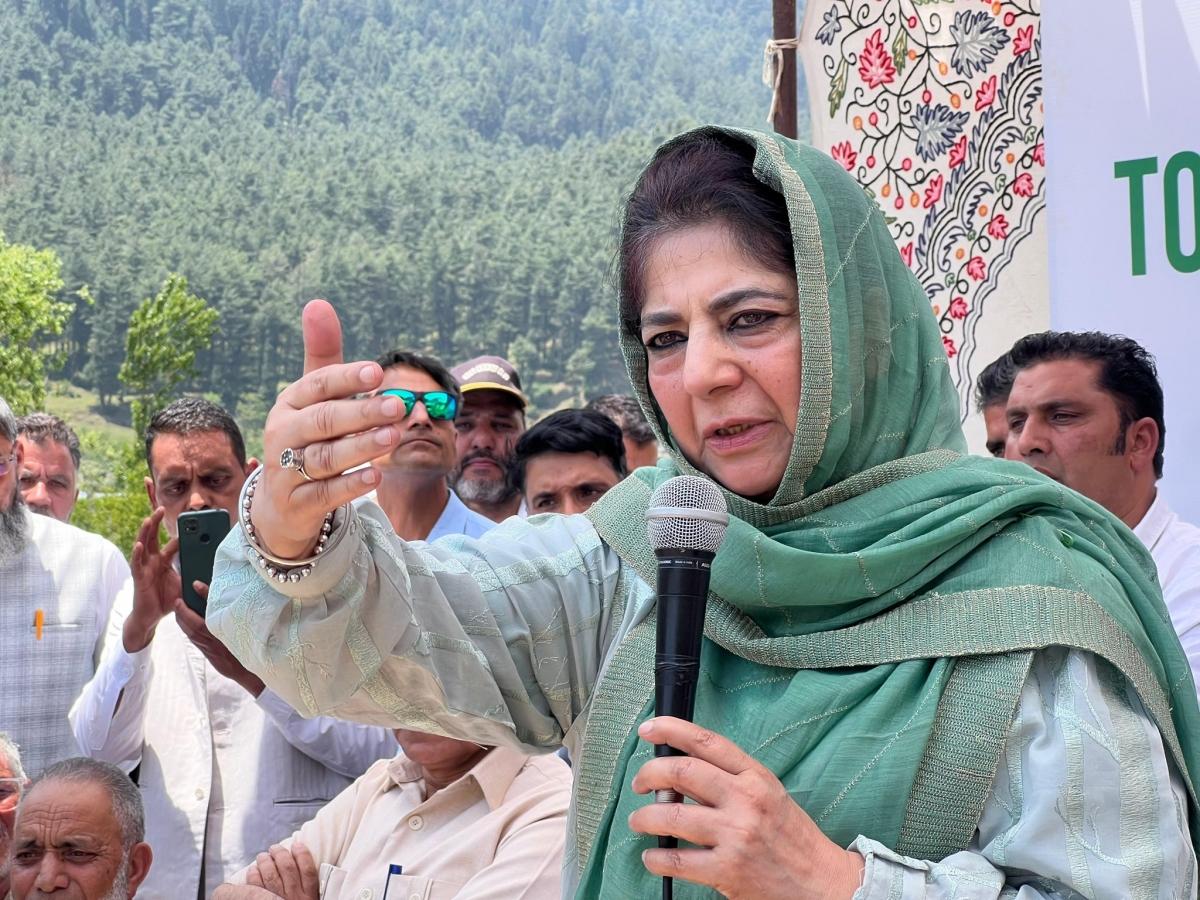
Analysis | Srinagar: When Peoples Democratic Party (PDP) president Mehbooba Mufti appealed to political leaders across Jammu and Kashmir to make a united approach to Prime Minister Narendra Modi and Union Home Minister Amit Shah, she was raising an issue that goes beyond the fortunes of any individual party.
Her message was straightforward: if political and civil society groups in Ladakh could overcome their differences and negotiate collectively with New Delhi, why could the political leadership of Jammu and Kashmir not do the same?
In June 2026, Mehbooba wrote to Chief Minister Omar Abdullah, Leader of Opposition Sunil Sharma, Congress leader Tariq Hameed Karra, CPI(M) leader Mohammad Yousuf Tarigami, People’s Conference chairman Sajad Gani Lone, MP Engineer Rashid and several other political and civil society representatives. She called for a united outreach to the Prime Minister and Home Minister to seek sustained dialogue on Jammu and Kashmir’s political future, constitutional rights and public concerns.
Her appeal followed an understanding reached between the Leh Apex Body (LAB), the Kargil Democratic Alliance (KDA) and representatives of the Union government during negotiations over Ladakh’s constitutional safeguards and democratic representation.
Months later, the question is no longer simply whether her proposal was politically sensible. It is whether Jammu and Kashmir’s political leadership has the trust, maturity and willingness to turn that proposal into a functioning common platform.
The answer, so far, is not encouraging.
But there is an important qualification: Ladakh has not achieved a final settlement either. Its talks with the Centre have faced disagreements over the proposed constitutional framework and the powers of an elected body. What Ladakh has demonstrated is not that unity guarantees success, but that a common negotiating position can give competing groups a stronger voice.
That is precisely the lesson Jammu and Kashmir has yet to apply.
The Ladakh Model: Unity Without Complete Political Agreement
The political experience of Ladakh since the 2019 reorganisation offers an important contrast.
After the erstwhile state of Jammu and Kashmir was divided into two Union Territories, Ladakh lost the political arrangement under which it had been part of a state with an elected legislature. The region also found itself without a conventional legislative assembly of its own.
Concerns quickly emerged over land, employment, local representation, cultural identity and control over natural resources.
Leh and Kargil did not always approach politics from the same perspective. Their social, religious and political priorities have historically differed. Yet the demand for stronger constitutional protection and democratic representation created a common ground.
The Leh Apex Body, representing civil society and political interests in Leh, and the Kargil Democratic Alliance, bringing together organisations and political voices from Kargil, became the principal platforms for negotiations with the Centre.
Their demands included statehood, constitutional safeguards under the Sixth Schedule, protection of local land and employment interests, and a more meaningful democratic structure for the region.
The two organisations continued to coordinate despite differences over political strategy and the precise form of the proposed settlement.
That coordination produced a significant development in May 2026, when the groups announced an in-principle understanding with the Union government on a framework involving constitutional safeguards and an elected Union Territory-level body. The subsequent discussions, however, showed that reaching an understanding on broad principles was easier than agreeing on the details.
This is where the Ladakh example becomes particularly relevant.
The LAB and KDA did not need to become one political organisation. They did not have to erase their ideological differences or agree on every local issue. They needed a common negotiating position on a limited set of demands.
That distinction is important for Jammu and Kashmir. Political unity does not necessarily require a merger of parties, a common election symbol or the abandonment of individual political identities.
It requires agreement on the issues that cannot be pursued effectively in isolation.
Ladakh’s Talks Also Reveal the Limits of the Model
There is a danger in presenting Ladakh as a complete success story.
The negotiations have made progress, but they have not delivered a final settlement. The differences became clear during the October 15 meeting between the Ministry of Home Affairs and representatives of the LAB and KDA.
Both sides exchanged draft proposals on constitutional safeguards and a proposed elected body for Ladakh, but no agreement was reached. Ladakh representatives said the Centre’s draft did not adequately address their demands, particularly the powers and authority of the proposed institution. A further meeting was scheduled for October 22.
The central disagreement was not merely about creating an elected body. It concerned what powers that body would actually exercise, how it would relate to the existing Ladakh Autonomous Hill Development Councils, and whether the proposed constitutional safeguards would provide meaningful protection.
The LAB and KDA have insisted that any arrangement must provide genuine legislative, executive and financial authority rather than a symbolic institution.
There have also been differences within Ladakh’s own political and civil society leadership over the proposed framework and the direction of negotiations. The release of meeting documents in October brought some of these disagreements into public view.
This is an important correction to the popular narrative.
Ladakh has not shown that unity automatically produces results. It has shown that unity can keep negotiations alive, create collective pressure and make it harder for the government to deal with competing groups separately.
That is the more realistic lesson for Jammu and Kashmir.
Jammu and Kashmir’s Shared Demands, Different Political Priorities
At first glance, the major political parties in Jammu and Kashmir appear to have considerable common ground.
The National Conference has made restoration of statehood a central demand and continues to oppose the 2019 constitutional changes. The PDP has called for dialogue, restoration of constitutional rights and a stronger political response to the post-2019 situation. Congress has repeatedly demanded restoration of statehood and promised to pursue it through its political programme.
But the overlap should not be exaggerated.
The parties do not have identical positions on Article 370, the scope of constitutional restoration, the role of the Union government or the methods through which political demands should be pursued.
The differences were visible during the 2024 Assembly election campaign. The National Conference made opposition to the 2019 changes and restoration of special status central to its political position. The Congress manifesto, by contrast, promised restoration of statehood but did not include a commitment to restore Article 370.
This distinction matters because a common political approach cannot be built on vague language.
If parties are to approach New Delhi together, they must first decide what they are actually asking for.
Is the immediate objective restoration of statehood? Is it a wider dialogue on constitutional rights and political autonomy? Should the demand for restoration of Article 370 be part of the common agenda, even when some parties have avoided making that commitment?
And what happens when the parties disagree on the method of engagement with the Centre?
These are not minor drafting issues. They go to the heart of whether a joint platform can function.
The challenge is to identify a minimum common programme without pretending that every political party has the same ideological position.
The Gupkar Alliance: A Political Experiment That Lost Momentum
Mehbooba’s proposal inevitably brings back memories of the People’s Alliance for Gupkar Declaration (PAGD).
Formed after the August 2019 constitutional changes, the alliance brought together several regional and national political parties, including the National Conference, PDP, CPI(M), People’s Conference and Awami National Conference, around the demand for restoration of the region’s pre-August 2019 constitutional position.
At the time, the alliance represented an unusual attempt to bring political rivals onto one platform.
The NC and PDP had spent years competing against each other. Their leaders had exchanged sharp political attacks, formed rival governments and pursued different electoral strategies. Yet the developments of August 2019 created a common political concern that temporarily outweighed those differences.
The PAGD participated in the 2020 District Development Council elections and secured a significant number of seats, demonstrating that a coordinated political front could have electoral and organisational value.
However, the alliance gradually lost momentum.
The reasons were not limited to ideological differences. Questions of leadership, seat-sharing, political credit, the future of the alliance and the return of ordinary electoral competition all complicated its functioning.
The People’s Conference, for example, eventually moved away from the alliance. Other partners continued to pursue their own political strategies, and the joint platform became increasingly less visible.
The lesson is not that the PAGD was meaningless. It showed that political rivals could cooperate when they faced a shared challenge.
The failure was in turning that temporary understanding into a durable arrangement with agreed rules, clear leadership and a common long-term strategy.
The PAGD demonstrated that political unity can be announced quickly. Maintaining it requires a much deeper commitment.
Mehbooba’s Outreach: A Welcome Initiative, But Was It Inclusive Enough?
There is another question that deserves attention.
Mehbooba’s June 2026 outreach was significant because it crossed conventional political lines. She wrote not only to the Chief Minister and opposition leaders but also to BJP leader Sunil Sharma, Congress representatives, Engineer Rashid and several civil society figures.
That was a departure from the usual approach in which political parties often call for unity among like-minded groups while excluding their principal rivals.
However, the outreach was not entirely comprehensive.
The list of recipients did not include every major regional political actor. In particular, the absence of Altaf Bukhari’s Apni Party and some other political figures raised questions about the boundaries of the proposed platform. The issue was also noted in subsequent reporting by Greater Kashmir.
That does not invalidate the proposal. No first round of political outreach can include every individual or organisation.
But if the objective is to create a collective voice for the entire Union Territory, the process must eventually become more inclusive.
A joint initiative cannot claim to represent all shades of opinion while leaving significant political and social voices outside its framework.
The same principle applies to Jammu and Kashmir’s regional diversity. A platform dominated by Valley-based parties may struggle to claim a broader mandate unless political voices from Jammu, Ladakh-linked communities and displaced groups are also meaningfully heard.
Unity must be built through consultation, not simply announced through a list of invitations.
The NC’s Internal Problems Add to the Fragmentation
The timing of Mehbooba’s appeal is particularly difficult for the National Conference.
The ruling party has been dealing with reported dissatisfaction among a section of its legislators following the October 27 cabinet expansion. Some MLAs have reportedly sought greater consultation, a review of ministerial performance and a stronger approach towards the party’s election commitments.
The departure of Aga Syed Ruhullah Mehdi has added another layer of political difficulty.
Ruhullah was a prominent NC campaigner and a three-time MLA from Budgam before entering the Lok Sabha. His public criticism of the party’s handling of constitutional and political promises, followed by his announced departure from the organisation and resignation from Parliament, has exposed a wider disagreement over the party’s political direction.
These developments should not be treated as a single organised revolt. The reported grievances of some legislators concern government functioning, cabinet representation and internal consultation. Ruhullah’s criticism is more directly focused on constitutional promises and the party’s political position.
But together, they reveal a party under pressure to explain how it intends to pursue the commitments on which it sought votes in 2024.
This internal situation also makes a broader political alliance more difficult. The NC is unlikely to welcome an initiative that could allow rival parties, particularly the PDP, to claim leadership of the regional political agenda.
The PDP, for its part, has its own interest in rebuilding its political relevance.
In such circumstances, the language of collective interest can quickly collide with the competition for political space.
Why Political Parties Find Unity So Difficult
The problem is not simply personal rivalry, although leadership competition remains a major factor.
There are at least five deeper reasons.
1. The Question of Who Leads
Every political alliance eventually faces the question of leadership.
Who will convene meetings? Who will speak to New Delhi? Who will represent the platform in public? Who will take responsibility if negotiations fail?
For parties with established leaders and electoral histories, accepting a secondary role can be politically difficult.
Mehbooba may have initiated the proposal, but other parties may be reluctant to allow the PDP to become the public face of a collective initiative.
The same problem would arise if the NC attempted to lead it.
2. Different Political Objectives
Statehood, restoration of Article 370, constitutional safeguards, political prisoners, reservation policy and democratic rights are all important issues, but they do not occupy the same position in every party’s programme.
Congress has emphasised statehood while avoiding a clear commitment on Article 370 in its 2024 Assembly manifesto. The NC and PDP have taken stronger positions on the constitutional question.
A common platform must acknowledge these differences rather than conceal them.
3. Competition for Political Credit
If a joint delegation succeeds in securing a meeting with the Prime Minister or Home Minister, every participating party will want to explain the achievement to its supporters.
If negotiations fail, each party may blame the others.
This fear of losing political ownership discourages cooperation even when the underlying demand is shared.
4. Distrust Built Over Years
The NC and PDP are not natural partners simply because they oppose certain decisions taken in 2019.
Their political rivalry has shaped Jammu and Kashmir for decades. Both have accused the other of political compromises, administrative failures and opportunistic alliances.
The PAGD temporarily overcame some of that distrust, but it did not eliminate it.
A new initiative would need to establish clear rules and mutual assurances to prevent old disagreements from returning.
5. The Jammu-Kashmir Divide
A platform claiming to speak for Jammu and Kashmir must also confront the different political priorities within the Union Territory.
The Valley’s political discourse often places Article 370, autonomy and constitutional identity at the centre. In Jammu, political preferences are more varied, and parties have different views on regional representation, governance and the relationship with New Delhi.
A platform that fails to address these differences risks becoming a Valley-centric initiative rather than a genuinely representative regional effort.
Dialogue With Delhi: What Would a Common Agenda Look Like?
If the political leadership is serious about Mehbooba’s proposal, it does not need to begin with a grand alliance.
It could start with a limited and clearly defined common agenda.
Such an agenda could include:
- Restoration of full statehood to Jammu and Kashmir.
- A sustained political dialogue involving elected representatives and other relevant stakeholders.
- Protection of democratic institutions and representative government.
- A transparent discussion on constitutional rights and the political consequences of the 2019 changes.
- Review of reservation and recruitment concerns through an evidence-based process.
- A clear position on political prisoners and due process.
- Greater consultation with political, social and regional representatives.
Agreement on these points would not require every party to abandon its independent position on Article 370 or other constitutional questions.
Instead, parties could record their differences openly while agreeing to pursue the issues on which they share common ground.
A joint delegation could then approach the Centre with a written memorandum, a clear list of demands and a mutually agreed negotiating team.
The process would also need a mechanism for reporting back to the public. Without transparency, the initiative could become another closed-door political exercise whose progress is difficult to assess.
The Centre’s Responsibility Cannot Be Ignored
There is a temptation to place the entire burden of the present political deadlock on Jammu and Kashmir’s parties.
That would be incomplete.
The Union government has its own responsibility to engage with elected representatives and address legitimate political concerns. The Supreme Court, in its December 2023 judgment on Article 370, upheld the constitutional changes while directing that statehood be restored to Jammu and Kashmir at the earliest and that Assembly elections be held by September 2024.
The Assembly elections were subsequently conducted, but statehood had not been restored by November 2026.
The Centre has repeatedly said that statehood would be restored at an appropriate time. The absence of a publicly established timeline continues to create uncertainty.
A united political approach could strengthen the demand, but it cannot replace the Centre’s responsibility to provide clarity and engage with elected institutions.
Nor should political unity become a precondition for dialogue. New Delhi can engage with different political parties and civil society groups independently while also welcoming a common delegation if one emerges.
The responsibility is therefore shared: political parties must overcome unnecessary divisions, while the Centre must demonstrate that dialogue is more than a procedural exercise.
Is the Window Closing?
The political environment in Jammu and Kashmir is not becoming easier for consensus-building.
The National Conference is managing internal disagreements. The PDP is trying to regain political ground. Congress is attempting to maintain its relevance in the region. Smaller parties and independent leaders are seeking a larger role.
The emergence of independent political voices, including Ruhullah, adds to the number of actors competing to define the region’s political agenda.
This does not mean that a common platform is impossible. It means that the political cost of building one is rising.
The longer parties remain focused on leadership competition, the harder it becomes to convince the public that their demand for collective dialogue is driven by common interests rather than political positioning.
Yet the public’s concerns do not disappear because parties disagree.
Questions about statehood, constitutional rights, jobs, reservation, representation and governance remain part of the region’s political debate.
A united approach would not solve every problem. But it could give these demands a clearer and more organised channel.
The Bottom Line: Unity Is a Process, Not a Political Slogan
Mehbooba Mufti’s appeal was important because it challenged the political leadership to look beyond immediate party interests.
But the comparison with Ladakh needs to be understood correctly.
Ladakh has not secured everything it demanded. Its negotiations with the Centre remain difficult, and disagreements over the proposed constitutional framework show that even a united front can face serious obstacles.
What the LAB and KDA have demonstrated is the value of sustained coordination. They have kept a common negotiating position alive despite political, regional and organisational differences.
Jammu and Kashmir has had similar moments before, most notably through the PAGD. But it has struggled to turn temporary cooperation into a lasting political arrangement.
The real test for Mehbooba’s proposal is therefore not whether the NC, PDP, Congress and other parties can issue another joint statement.
It is whether they can agree on a minimum agenda, accept a fair mechanism for leadership, include voices beyond their immediate political circles and remain united when negotiations become difficult.
The biggest weakness in Jammu and Kashmir’s political response is not the absence of shared concerns. It is the inability to convert those concerns into a sustained collective strategy.
And until that changes, calls for New Delhi to listen to a united voice will continue to be undermined by the divisions within the very political leadership asking to be heard.

