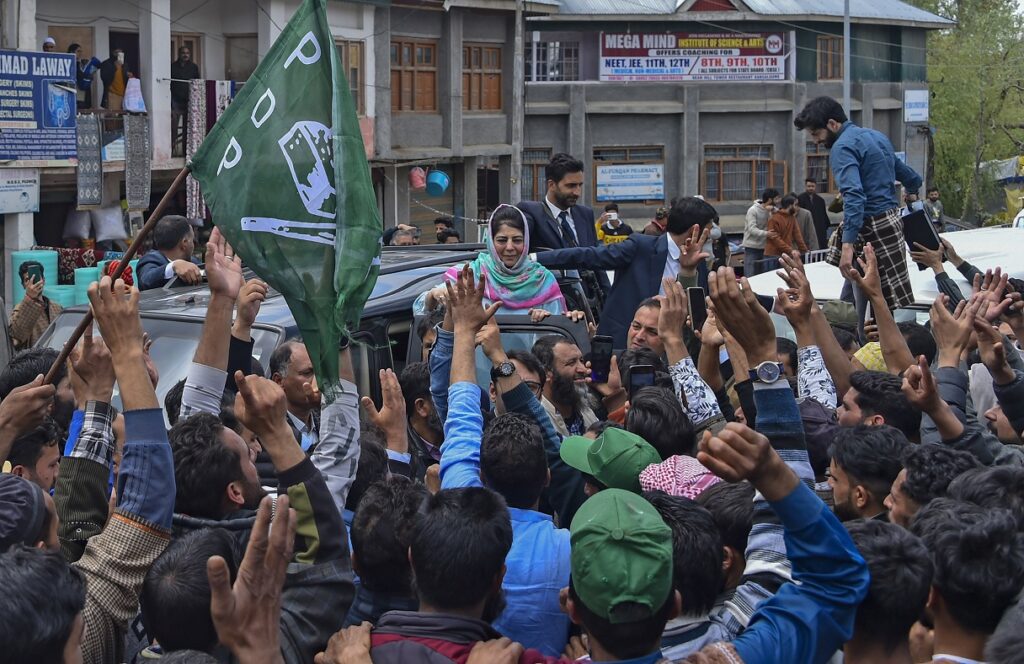
Iltija Mufti on Lal Chowk Diwali and Jamia Masjid Restrictions
By: News Desk | 10 November 2026
PDP leader questions the Omar Abdullah government over what she describes as unequal treatment of religious activities; repeated restrictions at Srinagar’s historic mosque raise questions about security policy, elected-government accountability and freedom of worship.
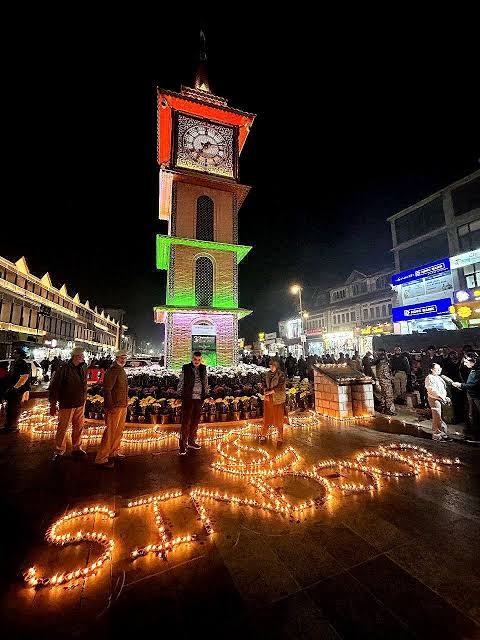
SRINAGAR, November 11: The thousands of earthen lamps that illuminated Srinagar’s Lal Chowk on November 8 were widely presented as a picture of communal harmony, with tourists and local residents gathering around the iconic Ghanta Ghar to celebrate Diwali. But the festivities have also triggered a political debate over a different question: why have congregational prayers at Srinagar’s historic Jamia Masjid repeatedly been restricted on major Islamic occasions?
PDP leader Iltija Mufti has brought that question directly to the National Conference-led government, accusing it of remaining silent while Diwali celebrations were facilitated at one of the city’s most prominent public landmarks and worshippers continued to face restrictions at the mosque in Nowhatta.
Her intervention has placed the Omar Abdullah government in a politically uncomfortable position. The issue is no longer limited to the authorities’ decisions on access to a particular religious site. It concerns the elected government’s ability and willingness to question restrictions imposed by the administration, explain the security reasoning behind them and defend the religious rights of people in Jammu and Kashmir.
The comparison, however, needs to be examined carefully. Celebrating Diwali at Lal Chowk and offering congregational prayers at Jamia Masjid are not competing activities. One does not need to be restricted because the other is permitted. The real issue is whether public authorities apply consistent principles when dealing with religious gatherings and whether restrictions on worship are necessary, proportionate and transparently justified.
What Iltija Mufti said
Reacting to the November 8 celebrations at Lal Chowk, Iltija questioned why a large public religious celebration could take place in the heart of Srinagar while access to Jamia Masjid had repeatedly been restricted on important occasions.
She criticised what she described as the NC government’s silence and argued that the repeated denial of access to the mosque raised serious concerns about religious freedom and equal treatment.
Her remarks were reported by Free Press Kashmir on November 10. The report described her criticism as being directed at the contrast between the Diwali celebrations and restrictions on Muslim congregational prayers.
The political significance of her statement lies partly in its target. Iltija did not direct her criticism exclusively at the security administration or the Lieutenant Governor. She questioned the elected government led by Omar Abdullah, which has repeatedly faced criticism from opposition parties over its limited authority in matters involving police and public order.
That distinction matters because the NC government cannot be held solely responsible for every security decision in the Union Territory. But it can still be questioned over its political response, its engagement with the authorities and the extent to which it raises concerns about restrictions affecting ordinary citizens.
What happened at Lal Chowk on November 8?
On Sunday evening, November 8, thousands of earthen lamps illuminated the area around Srinagar’s historic clock tower. Tourists and local residents gathered at Ghanta Ghar, with participants lighting diyas and celebrating the festival.
A PTI report carried by Greater Kashmir said dozens of tourists assembled at the clock tower, while local Hindus and Muslims also joined the celebrations. The report quoted a tourist from Kolkata expressing happiness at celebrating Diwali in Kashmir.
Other local reports described participation by people from different communities and highlighted the atmosphere of togetherness. Some reports put the number of lamps at more than 10,000, although that figure should be treated as a reported estimate rather than an independently audited count.
There is little reason to question the value of such celebrations. Public spaces should be open to peaceful cultural and religious expression, provided the law is respected and public safety is maintained. For a city that has experienced prolonged political uncertainty and violence, scenes of residents and visitors celebrating together carry symbolic importance.
But the symbolism of an event does not settle the separate question of whether worshippers at another religious institution are receiving equal consideration.
That is where Iltija’s criticism finds its political ground.
Jamia Masjid: A recurring dispute over major religious occasions
Jamia Masjid in Nowhatta is among Kashmir’s most significant religious and historical institutions. It is not simply a neighbourhood mosque. Its large congregations, Friday sermons and religious gatherings give it a central place in the Valley’s religious and public life.
Restrictions on congregational prayers there have repeatedly generated controversy, particularly since the political and security changes of August 2019.
The events of 2026 provide a clear illustration of why the issue remains sensitive.
Shab-e-Barat, February 3, 2026: The mosque’s managing body, Anjuman Auqaf Jama Masjid, said police had directed it to close the gates despite preparations for the religious occasion. Congregational night prayers were consequently not permitted, according to reports published by Kashmir Observer and other outlets.
Jumat-ul-Vida, March 13, 2026: Authorities disallowed congregational prayers at the mosque on the last Friday of Ramadan. Mirwaiz Umar Farooq said the closure marked the seventh consecutive year in which prayers on the occasion had been prevented. The Anjuman Auqaf also criticised the decision.
Eid-ul-Azha, May 27, 2026: Authorities again did not permit Eid congregations at either Jamia Masjid or Srinagar’s Eidgah. The restriction was reported as the eighth consecutive year without Eid prayers at the two venues. Mirwaiz Umar Farooq said he had also been placed under house arrest.
These incidents establish that restrictions have not been limited to one isolated occasion. They have affected some of the most significant dates in the Islamic calendar, when large numbers of worshippers traditionally gather.
There is, however, an important qualification. It would be inaccurate to suggest that Jamia Masjid has remained continuously closed for all Friday prayers. Congregational prayers have been permitted on other occasions. In March 2026, for example, a large congregation was allowed on a Friday, although Mirwaiz Umar Farooq said he was prevented from delivering the sermon.
The distinction is important: the documented pattern concerns repeated restrictions on particular major occasions and some Friday gatherings, not an uninterrupted ban on every Friday prayer.
The security argument and the question of proportionality
Authorities have historically justified restrictions on large gatherings in Kashmir through security concerns, the possibility of protests and the risk of public disorder.
Jamia Masjid’s political and historical significance has also made it a sensitive location for the administration. Its congregations can attract worshippers from different parts of the Valley, while sermons and public gatherings have, at various points, intersected with political mobilisation.
An Indian Express report from 2022, for instance, documented police concerns that a large congregation could turn into an anti-government demonstration. That account reflected the security administration’s reasoning at the time, although it does not establish the justification for every subsequent restriction.
Security concerns cannot simply be dismissed. The administration has a responsibility to prevent violence, protect public order and ensure that large gatherings can take place safely.
But security restrictions also require scrutiny. A decision to prevent thousands of people from gathering for religious prayers should be based on a specific and credible assessment, not treated as an automatic response to the location’s political history.
The questions are straightforward: What particular threat was identified? Was a complete closure necessary? Could the congregation have been managed through regulated entry, additional deployment or other security arrangements? Were worshippers and mosque authorities given a clear explanation?
Without transparent answers, repeated restrictions risk creating the perception that religious practice itself is being treated as a security problem.
The Omar Abdullah government’s difficult position
The controversy also exposes the limitations of Jammu and Kashmir’s present political arrangement.
Omar Abdullah heads an elected government, but Jammu and Kashmir remains a Union Territory, and the Lieutenant Governor retains control over important areas, including police and public order.
Under the Union Territory’s administrative framework, these are not ordinary subjects over which the elected Council of Ministers exercises full executive control. The Transaction of Business Rules provide for the Lieutenant Governor’s discretionary role in matters connected with police and public order.
This constitutional and administrative division complicates the political accountability debate.
The NC government may not have direct authority to order the police to permit a particular congregation. It would therefore be misleading to suggest that Omar Abdullah personally ordered the closures or could unilaterally reverse every such decision.
But limited executive authority does not eliminate political responsibility.
The elected government can seek explanations from the administration, raise the matter with the Lieutenant Governor, communicate the concerns of religious bodies and publicly state whether it considers the restrictions justified. It can also press for a consistent policy that protects worship while addressing genuine security concerns.
This is the space in which Iltija’s criticism should be assessed.
Her question is not merely whether the government had the power to organise or permit Diwali celebrations. It is whether the government has shown comparable urgency in raising the concerns of worshippers at Jamia Masjid.
As of the reporting available for this article, no detailed official response from the National Conference government addressing her specific criticism had been reported. That absence should not automatically be interpreted as approval of the restrictions, but it leaves the government open to questions about its public position.
PDP and NC: A familiar political contest over Kashmir’s rights
The exchange also fits into the wider political competition between the PDP and the National Conference.
Both parties have historically claimed to represent Kashmir’s political aspirations, but their approaches and electoral narratives have differed. The PDP has often attempted to occupy the space of political reconciliation, civil liberties and criticism of excessive central intervention. The NC, meanwhile, has returned to power on promises that include restoration of statehood, protection of constitutional rights and delivery of its electoral commitments.
Iltija’s intervention gives the PDP an opportunity to question whether the NC government is translating those promises into action.
For the PDP, the issue is particularly useful because it connects a visible public event with a long-running grievance. The images of Lal Chowk illuminated by thousands of lamps are easy to understand and widely shareable. The repeated closure of a major mosque on important religious occasions provides a contrasting political narrative.
But the argument should not be reduced to a competition between religious communities or festivals. That would risk turning a question about government policy and civil liberties into an unnecessary communal confrontation.
The principle should be consistent: peaceful religious celebrations at Lal Chowk should be welcomed, and peaceful congregational prayers at Jamia Masjid should receive the same presumption of permission, subject to specific, proportionate and clearly explained security requirements.
Why the issue matters beyond party politics
The Jamia Masjid controversy has implications beyond the immediate exchange between the PDP and the NC.
First, it concerns public confidence in institutions. When a major religious gathering is repeatedly prevented, and the reasons are not explained in sufficient detail, people are more likely to view security decisions through a political lens.
Second, it tests the credibility of elected representatives. Voters expect an elected government to raise concerns that affect their daily lives and constitutional rights, even when the final administrative authority rests elsewhere.
Third, it raises a broader question about how security policy is implemented in a society that has experienced prolonged conflict. Security and religious freedom are not necessarily opposing objectives. The challenge is to protect both through careful planning rather than relying on blanket restrictions.
Finally, it tests the meaning of normalcy in Kashmir. Public celebrations, tourism and visible cultural activity are important indicators of social confidence. But normalcy cannot be measured only through festivals, public events or the appearance of crowded streets. It must also be reflected in the ability of citizens to practise their faith, assemble peacefully and receive clear explanations when authorities impose restrictions.
The real test for Omar Abdullah
Iltija Mufti’s remarks have put a difficult question before the Omar Abdullah government: will it treat the Jamia Masjid issue as an opposition allegation, or will it use its political position to seek a clear explanation and press for a consistent approach?
The government does not have unrestricted control over police and public order. That is a constitutional reality. But it still has a responsibility to represent public concerns and make its position known.
The administration, in turn, must explain why particular congregations are restricted, what security assessments support those decisions and whether less restrictive arrangements could achieve the same objectives.
The larger principle should be uncomplicated. Diwali celebrations at Lal Chowk should not become a source of resentment, and prayers at Jamia Masjid should not become a recurring source of uncertainty. Both forms of peaceful religious expression deserve respect.
The controversy will ultimately be judged not by the political statements exchanged over it, but by whether worshippers can gather without arbitrary obstruction and whether authorities can demonstrate that any restrictions are necessary, proportionate and transparently justified.
For Kashmir, that is a more meaningful measure of equal treatment than any festival photograph or political slogan.