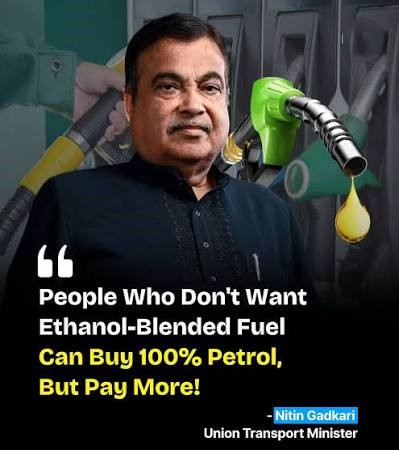
E20 Fuel Row Intensifies: Gadkari Sacking Demand, AAP Campaign and Transport Unions’ Protest Call
By: News Desk | 28 July 2026
India’s E20 fuel debate is rapidly moving beyond the petrol pump and into the political arena.
What began as a technical and environmental policy discussion around ethanol blending has now become a broader argument over consumer rights, vehicle compatibility, fuel economy, government preparedness and accountability.
Opposition voices are demanding action against Union ministers, the Aam Aadmi Party is preparing a political campaign around the issue, and transport bodies are planning protests against the nationwide availability of E20 petrol.
The controversy has also acquired a new dimension after a consumer dispute commission recently ordered compensation in a case involving alleged vehicle damage linked to E20 petrol. The ruling does not establish that E20 universally damages vehicles, but it has added weight to consumer concerns and intensified calls for clearer accountability when disputes arise.
At the same time, the Centre and automotive authorities strongly reject the suggestion that E20 is broadly unsafe. The government says India’s ethanol-blending programme has been implemented through years of testing, consultation and phased adoption. The Automotive Research Association of India (ARAI) has also maintained that E20-compatible vehicles undergo extensive validation and that available evidence does not point to widespread engine failures caused by the fuel.
That contradiction lies at the heart of the E20 controversy.
For the government, the policy represents energy security, lower dependence on imported fossil fuels and progress towards a cleaner transport system.
For critics, the central question is simpler: What happens to millions of vehicle owners whose cars, motorcycles and commercial vehicles were designed before E20 became the standard blend?
The answer to that question could determine whether the controversy remains a political campaign issue or develops into a larger consumer and economic movement.
E20 Fuel Policy: Why Is the Issue Becoming Political?
E20 petrol is a blend containing up to 20% ethanol and 80% petrol. India has promoted ethanol blending as part of a broader strategy to reduce dependence on imported crude oil, support domestic agricultural and biofuel industries and lower the carbon intensity of transport fuels.
The ethanol-blending programme has expanded steadily over the past decade. According to the government, average ethanol blending rose from around 12% in 2022-23 to approximately 19.2% in 2024-25, reaching 20% during the November 2025-June 2026 period.
The Centre now says the country achieved the 20% blending milestone five years ahead of the original target.
From a policy perspective, the argument is straightforward: India imports a large share of its crude oil requirements, making the economy vulnerable to international oil prices and geopolitical shocks. Greater domestic ethanol use can potentially reduce the petroleum import bill while creating an additional market for agricultural feedstocks.
But energy policy does not operate in isolation.
Fuel is one of the most visible recurring expenses for Indian households, farmers, delivery workers, taxi operators, truckers and small businesses. Any change in fuel composition can therefore have an immediate economic and political impact.
That is why the E20 debate has moved rapidly from laboratories and government policy documents to workshops, petrol pumps and political rallies.
The Core Dispute: Engine Damage or Vehicle Compatibility?
One of the most important issues in the E20 debate is also one of the most misunderstood.
Critics have alleged that ethanol-blended petrol can damage engines, fuel systems and other vehicle components, particularly in older vehicles that were not designed or certified for higher ethanol blends.
The government and technical authorities, however, reject the claim that E20 is causing widespread engine failure.
In a July 4 briefing, ARAI said E20-compatible vehicles undergo structured validation and verification, including long-duration testing. The government has also cited large-scale real-world use and said there is no verified evidence of widespread vehicle breakdowns attributable to E20 in compatible vehicles.
This distinction is crucial.
The debate is not simply about whether ethanol is “good” or “bad” for engines. It is about which vehicle was designed for which fuel blend, how older vehicles perform with higher ethanol concentrations, and who bears the cost when compatibility becomes a problem.
That is where consumer anxiety has grown.
Vehicle owners have reported concerns about mileage, performance, fuel-system problems and repair expenses. Some of these claims remain anecdotal and cannot automatically be attributed to E20 without technical inspection. However, dismissing every complaint as misinformation risks undermining public confidence.
A credible policy response must therefore separate three questions:
- Does E20 damage modern, certified E20-compatible vehicles?
- How does prolonged E20 use affect older vehicles designed for lower ethanol blends?
- What protection is available to consumers when a vehicle owner believes fuel compatibility has caused damage?
The third question may ultimately prove the most politically important.
Consumer Costs: The Mileage Debate Is More Complicated
Ethanol contains less energy per unit volume than petrol. As a result, fuel economy can be affected when ethanol content increases.
The exact impact varies according to the vehicle, engine design, driving conditions and fuel formulation. It is therefore misleading to claim that every vehicle will experience the same mileage reduction.
However, even a modest reduction in fuel economy matters to people who drive long distances every day.
For private car owners, the additional cost may be manageable.
For taxi drivers, delivery workers, small transport operators and commercial fleets, the calculation is different.
A vehicle that travels hundreds of kilometres each week consumes significantly more fuel than an occasional private-use car. Even a small change in mileage can increase operating costs over months and years.
This is why transport unions have become an important part of the E20 debate.
Their argument is not limited to engine compatibility. It is also about the economics of running a vehicle in a sector where fuel, maintenance, insurance and financing already account for a significant share of operating costs.
Transport Unions Prepare for Protest
The controversy is now spilling onto the streets.
Delhi-based transport associations have announced plans for a protest march to Parliament on August 4, 2026, demanding the withdrawal or review of E20 fuel. The proposed demonstration reflects growing resistance among transport stakeholders who say older vehicles and commercial fleets may face compatibility and operating-cost challenges.
The significance of the protest should not be underestimated.
Transport unions have the ability to turn a technical policy dispute into a public mobility issue. If demonstrations expand, the consequences could reach beyond politics, potentially affecting taxis, commercial vehicles, logistics operators and local transport services.
At the same time, the government will be keen to avoid a situation in which E20 becomes associated with fuel shortages, road blockades or disruptions to public transportation.
The coming weeks will therefore test whether the Centre can contain the issue through technical clarification and stakeholder engagement or whether the controversy becomes a sustained movement.
Nitin Gadkari Faces Political Pressure
Union Road Transport and Highways Minister Nitin Gadkari has become one of the most visible political targets in the E20 debate.
Opposition leaders have called for his removal, arguing that the government should have ensured greater preparedness and consumer protection before moving towards widespread E20 availability.
The criticism is politically significant because Gadkari is closely associated with India’s road transport and automobile policy landscape.
However, the political framing of the issue requires some nuance.
The Ethanol Blended Petrol programme is not a policy created by a single ministry or a single minister. It has evolved over several years through the involvement of multiple government departments, oil marketing companies, automobile manufacturers and technical institutions.
Gadkari has also publicly pushed back against criticism surrounding the policy in the past, describing some online attacks as politically motivated.
The latest political demands nevertheless indicate that the controversy is no longer being treated merely as an automobile-sector dispute.
For the opposition, E20 offers an opportunity to frame the government as having prioritised policy targets over consumer preparedness.
For the government, the challenge is to demonstrate that the transition has been scientifically validated and that consumers are not being left to absorb unexpected costs.
AAP Turns E20 Into a Political Campaign
The Aam Aadmi Party has also moved to capitalise on the growing public debate.
The party’s campaign is positioning E20 as a consumer issue, focusing on alleged financial burdens, vehicle concerns and questions over policy implementation.
That strategy could broaden the issue beyond car enthusiasts and transport operators.
Fuel policy is politically sensitive because it touches almost every section of society. A person may not understand ethanol chemistry or engine calibration, but they understand a falling mileage figure, an expensive repair bill or a vehicle that requires more frequent servicing.
The AAP campaign therefore has the potential to transform a technical debate into a broader political narrative around household expenses and government accountability.
Whether that campaign gains traction, however, will depend on evidence.
Political slogans may attract attention, but the strongest arguments will ultimately come from independent testing, documented vehicle failures, consumer-court decisions and transparent government data.
A Consumer Court Ruling Adds a New Dimension
The E20 controversy received a significant boost in public attention after the Raipur District Consumer Disputes Redressal Commission ruled in favour of a vehicle owner who alleged that E20 petrol had caused substantial damage.
The commission directed the manufacturer and dealer to reimburse repair expenses.
The case is important because it gives consumers another avenue to seek relief when they believe they have suffered losses.
However, one consumer-court ruling should not be interpreted as proof that E20 universally damages vehicles.
Consumer disputes are decided on the evidence presented in individual cases. A single ruling does not establish a nationwide technical conclusion applicable to every vehicle or every E20-compatible model.
Nevertheless, the case highlights a genuine policy gap: What happens when consumers and manufacturers disagree about whether fuel compatibility caused vehicle damage?
That question deserves a clear answer.
The government could strengthen consumer confidence by creating transparent procedures for technical assessment, independent testing and dispute resolution. Automobile manufacturers and fuel companies could also provide clearer information about model-year compatibility and recommended fuel specifications.
The absence of clarity creates fertile ground for rumours and misinformation.
The Government’s Defence: E20 Is Scientifically Validated
The Centre has mounted a strong defence of the ethanol-blending programme.
According to the government’s latest position, E20 has been introduced through a phased process involving institutions such as ARAI, the Indian Institute of Petroleum, NITI Aayog, automobile manufacturers and oil marketing companies.
The government says E20-compatible vehicles have undergone extensive validation and that more than 20 crore two-wheelers and over 3 crore petrol cars have been operating on higher ethanol blends without verified evidence of widespread engine failure attributable to ethanol blending.
The government also says there is currently no decision to increase nationwide petrol blending beyond 20%. Any future move towards higher blends, it says, would require further scientific and technical studies and consultations with stakeholders.
This is an important clarification because a significant part of the online debate has focused on fears of an immediate move to even higher ethanol concentrations.
For now, the official position is that E20 remains the current policy ceiling for nationwide petrol blending.
The government has also argued that ethanol is not a new fuel and pointed to countries such as Brazil, where ethanol has been used extensively for decades.
But international comparisons must be made carefully.
Fuel policy depends on vehicle technology, climate, fuel standards, agricultural systems, consumer behaviour and infrastructure. What works in one country cannot simply be transplanted into another without considering local conditions.
The Real Economic Question: Who Pays for the Transition?
The E20 debate ultimately raises a larger socio-economic question.
Every energy transition creates winners and losers.
The long-term benefits of reducing fossil-fuel dependence may be substantial. But the transition costs are often felt immediately by consumers.
For an affluent vehicle owner, replacing an older car may be inconvenient.
For a low-income family dependent on a motorcycle for commuting, or a driver whose car is the source of household income, an unexpected repair bill can be financially painful.
This is why policymakers must consider the distributional impact of the transition.
If the government wants rapid adoption of cleaner fuels, it must also ensure that consumers have access to:
- Clear vehicle compatibility information
- Reliable fuel-quality standards
- Transparent testing mechanisms
- Affordable repair and maintenance support
- Effective consumer grievance systems
- Independent technical assessments in disputed cases
The success of an energy transition should not be measured only by the percentage of ethanol blended into petrol.
It should also be measured by whether ordinary consumers trust the transition.
Is E20 Becoming a Larger Political Crisis?
At present, it would be premature to describe the E20 controversy as a full-scale national political crisis.
The government retains strong technical and institutional arguments in favour of the policy, while widespread engine failure has not been established as a fact.
But the political risk is increasing.
Three factors could accelerate the controversy.
First: More Consumer Complaints
If additional documented cases emerge involving older vehicles and expensive repairs, pressure on the government could intensify.
Second: Wider Transport Union Mobilisation
If commercial vehicle associations in multiple states join the movement, the issue could become much harder to contain.
Third: Political Consolidation
If opposition parties coordinate their campaigns, E20 could become a broader symbol of what they describe as rushed policymaking and inadequate consumer consultation.
The government therefore faces a communications challenge as much as a technical one.
Simply saying that E20 is safe may not be enough.
The public wants to know what happens when something goes wrong.
What Should the Government Do Next?
A constructive response would be to move the debate away from political slogans and towards measurable safeguards.
The government could consider publishing a comprehensive, publicly accessible database showing which vehicle models and model years are certified for E20.
It could also establish a standard mechanism for investigating complaints where vehicle owners allege fuel-related damage.
Independent laboratories, automobile manufacturers and oil companies could participate in a transparent testing framework.
Most importantly, the government should engage directly with transport unions.
The objective should not necessarily be to reverse the ethanol-blending programme, but to ensure that the transition does not create disproportionate financial pressure on consumers and commercial operators.
A clear compensation or dispute-resolution framework could also reduce anxiety.
The government has already emphasised that manufacturers continue to honour warranties for vehicles using E20 as recommended. The next step should be ensuring that consumers clearly understand the boundaries of those warranties and what evidence is required when a fuel-related complaint is made.
E20 Fuel Controversy: The Road Ahead
The E20 debate is ultimately about more than ethanol.
It is about trust.
India’s transition towards cleaner and more domestically sourced energy is a legitimate policy objective. Reducing fossil-fuel dependence and improving energy security are important national priorities.
But sustainability cannot be built by ignoring the everyday economic realities of consumers.
The government has a strong case when it points to scientific testing, industry participation and the absence of evidence for widespread E20-related engine failure in compatible vehicles.
Critics, however, have a legitimate role in asking whether older vehicle owners, commercial drivers and small transport operators have been adequately protected during the transition.
Both realities can exist at the same time.
The E20 policy may be technically viable while still requiring better consumer safeguards.
That is perhaps the most important lesson emerging from the controversy.
The immediate challenge for the government is to prevent a technical disagreement from becoming a trust deficit. The immediate challenge for the opposition is to ensure that political criticism is supported by independently verified evidence rather than unproven claims.
For consumers, the demand is straightforward: clarity, transparency and protection.
As transport unions prepare for further mobilisation and political parties sharpen their campaigns, the E20 debate is likely to remain in the national spotlight.
The next phase will be determined not by social-media claims, but by what happens on the ground—at petrol pumps, repair workshops, consumer courts and on India’s increasingly busy roads.
The E20 controversy, in the end, is a test of how India manages the human cost of a major energy transition.