Kashmir’s Fragile Ecology Under Pressure
By: Javid Amin | 27 July 2026
Behind the postcard views of Gulmarg’s ski slopes and Pahalgam’s pine forests, a quieter crisis is unfolding — one built from concrete, timber violations, and a tourism economy racing ahead of the government’s ability to control it.
Kashmir has always sold itself on a single promise: untouched beauty. Snow-draped peaks, meadows that seem to breathe, rivers that have carried civilisations for centuries. But that promise is now colliding with a harder reality. Behind the tourist brochures, the Valley’s most celebrated destinations — Gulmarg, Pahalgam, Sonamarg, Doodhpathri, Bhaderwah, Patnitop — are quietly absorbing a construction boom that officials themselves admit has spiralled out of control.
This isn’t speculation or exaggeration dressed up as journalism. It’s now part of the government’s own record.
The Real Numbers Behind the Boom
A widely shared claim recently suggested that roughly 5,000 hotels have come up in Kashmir over the past six years, with 90% of them illegal. That figure doesn’t hold up against official records — and getting the scale right matters, because it’s the difference between a serious problem and a manufactured panic.
What the Jammu & Kashmir government has actually confirmed, through its own Tourism Development Authorities (TDAs), tells a story that’s alarming enough without embellishment. Between 2023 and 2026, TDAs sanctioned 807 constructions across the Union Territory’s notified tourist zones — a mix of hotels, guesthouses, and tourism-linked real estate. In the 2025–26 fiscal year alone, 415 building permissions were granted, the highest figure in three years.
Running parallel to this legal expansion is a far messier picture: 578 unauthorised constructions have been identified across the same tourist belt. That is not a rounding error — it’s roughly seven unauthorised structures for every ten legally sanctioned ones, spread across some of the most ecologically sensitive terrain in the Himalayas.
The regional breakdown is where the story gets specific. Bhaderwah in the Jammu division carries the heaviest burden, with 358 illegal structures flagged and notices issued. Doodhpathri, a fragile meadow-and-forest destination in central Kashmir, has 147 unauthorised builds, with FIRs registered and further action pending. Pahalgam has recorded 28 illegal constructions, of which 13 have been sealed. Gulmarg — Asia’s premier ski destination — has 21, with 20 sealed and one demolished. Patnitop saw 15 illegal structures torn down outright. Sonamarg and Verinag reported five and four violations respectively.
Alongside this, the homestay sector has expanded fast and largely within the rules: 2,613 registered units now offer a combined 19,328 beds, a sign that at least part of Kashmir’s accommodation boom is happening through channels the government can actually track and tax.
So the real story isn’t “90% of everything is illegal.” It’s that unauthorised construction has become a structural feature of Kashmir’s tourism economy — persistent, geographically concentrated, and stubbornly resistant to enforcement, even as legal permitting hits record highs.
Where the Violations Are Concentrated — and Why It Matters
Location isn’t a footnote here; it’s the whole point. Gulmarg, Pahalgam and Sonamarg aren’t just popular — they sit inside some of the most hydrologically and ecologically delicate zones in the western Himalayas.
Pahalgam and Sonamarg are gateways to the Thajiwas and Kolahoi glaciers, water sources that feed rivers and streams across the Valley. Kolahoi alone has lost nearly a quarter of its area since 1962, fragmenting into smaller ice bodies as warming accelerates. Every hotel, guesthouse or road cut into the slopes around these glacial catchments adds stress to a system already losing mass.
Gulmarg’s forests act as a buffer against avalanches and regulate snowmelt timing — a function disrupted when trees are cleared for construction footprints, parking areas, or approach roads. Locals and environmental commentators have pointed to rising black carbon levels in Gulmarg, driven partly by the growing convoy of vehicles, including all-terrain vehicles and bikes, ferrying tourists up the mountain. Black carbon deposits on snow accelerate melting, compounding the very glacial retreat that threatens the region’s water security.
Doodhpathri and Bhaderwah, meanwhile, illustrate a different problem: destinations being “discovered” and commercialised faster than any regulatory framework can catch up. These were, until recently, considered offbeat, lower-traffic alternatives to the big three. Their sudden emergence at the top of the illegal-construction list suggests that Kashmir’s tourism sprawl is now pushing into areas with even less institutional oversight than Gulmarg or Pahalgam ever had.
A Valley Built on Water — Now Building Over It
To understand why unauthorised construction in Kashmir is treated as an ecological emergency rather than a mundane zoning issue, you have to understand what’s actually being built on.
Kashmir’s tourism economy is, at its core, a water economy. The Jhelum River, Dal Lake, Wular Lake, Manasbal Lake, and countless natural springs known locally as naags have sustained the Valley’s agriculture, culture and settlements for centuries — long before hospitality became big business. Forests intercept rainfall and stabilise slopes through root systems; wetlands act as natural flood buffers, absorbing excess runoff and releasing it gradually rather than all at once.
Construction has increasingly spread into exactly these spaces — floodplains, wetlands, riverbanks, and unstable hill slopes — often without meaningful ecological assessment. Many of Kashmir’s smaller streams, or nallahs, run dry or carry minimal water for most of the year, creating a dangerous illusion that the land around them is safe to build on. That illusion has led roads, residential colonies, hotels and commercial establishments to occupy natural drainage corridors that, during heavy rain, revert to being exactly what they were designed to be: water channels.
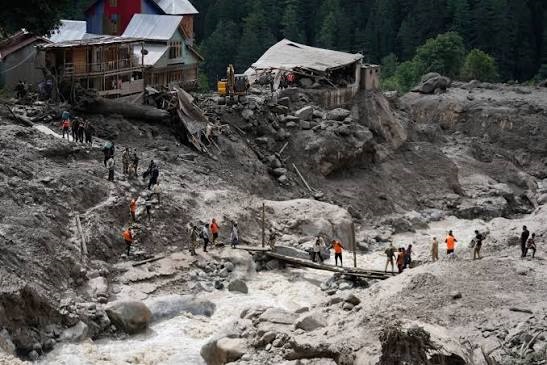
The consequences aren’t hypothetical. Kashmir’s catastrophic 2014 floods exposed precisely this failure of land-use planning — heavy rainfall was the trigger, but damaged wetlands, blocked drainage channels, and unchecked construction magnified the disaster into one of the worst in the region’s modern history. More recently, flash floods and cloudburst-triggered landslides — including a 2026 incident in Ramban that buried a truck under debris on the Jammu-Srinagar highway — have reinforced a pattern experts have been warning about for years: unregulated riverbed mining, deforestation, and floodplain encroachment don’t cause extreme weather, but they dramatically amplify its destructive power.
There’s also a slower, less dramatic crisis playing out in the region’s lakes and wetlands. Untreated sewage from expanding urban and tourism infrastructure continues to flow into Dal Lake and other water bodies, contributing to eutrophication — the nutrient overload that fuels algal blooms and starves aquatic ecosystems of oxygen. Encroachments on open water, illegal structures along lake shores, and weak enforcement of decades-old court orders have left agencies like the Lake and Waterways Development Authority (LAWDA) fighting a battle it has been losing since at least 2001, when the Supreme Court first ordered action on Dal Lake encroachments.
Forests Under the Axe
The scale of forest loss tied to “development” in Kashmir is difficult to overstate. As of March 2026, more than 14,359 hectares of forest land were under active encroachment for developmental projects, spread across ecologically sensitive zones including the Pir Panjal range, Kupwara’s forests, and parts of Baramulla — areas that regulate watersheds, prevent soil erosion, and stabilise mountain slopes.
Large infrastructure projects have compounded the damage. The Udhampur-Srinagar-Baramulla rail link, for instance, required extensive tunnelling, blasting and hill-cutting through Ramban, Reasi and Banihal, destabilising geological formations across the route. Tourism expansion and pilgrimage-related construction have converted alpine meadows and wetlands into commercial zones at a pace few anticipated. During the 2025 Amarnath Yatra alone, more than 600,000 pilgrims generated up to four tonnes of waste daily along the route — a burden the region’s waste infrastructure was never built to absorb.
Forest fires have added another layer of stress. Between April 2025 and February 2026, roughly 366 forest fire incidents damaged close to 972 hectares of forest cover, with a sharp spike of 48 fires destroying about 100 hectares between December 2025 and February 2026 alone — a period marked by an unusually severe precipitation deficit, including Srinagar’s lowest rainfall since 1960.
Deforestation doesn’t just mean fewer trees. It means weaker soil, reduced water retention, higher landslide risk, and — increasingly — wildlife pushed out of shrinking natural habitat and into human settlements. Reports of leopards and bears straying into villages have become more common across the Valley, a direct consequence of habitat fragmentation that also puts both people and animals at greater risk.
Why Enforcement Keeps Falling Short
None of this is happening in an information vacuum. Kashmir’s High Court has, at various points over the past decade, directed authorities to remove illegal constructions around sites like Gulmarg, describing encroachment on state land as a symptom of selective enforcement — one where, as the court itself observed, ordinary citizens would be evicted “within seconds” while influential violators escape consequence.
The current round of enforcement looks more serious on paper. Authorities have begun using GIS-based inventory systems to map authorised constructions in areas with approved master plans, including Gulmarg, Pahalgam and Sonamarg. In some jurisdictions, capturing geo-coordinates of proposed developments is now mandatory before permissions or no-objection certificates are granted — a step toward closing the loophole where structures simply get built and regularised after the fact.
Enforcement action so far has included notices, FIRs, penalties, sealing of properties, and demolitions. But the regional imbalance is telling: Bhaderwah and Doodhpathri, with the highest violation counts, are also where enforcement appears earliest-stage — notices and FIRs registered, but full resolution still pending. In more high-profile destinations like Gulmarg and Pahalgam, where scrutiny (and tourist footfall) is higher, sealing and demolition have moved faster.
That pattern suggests the core problem isn’t a lack of legal tools — it’s inconsistent political will, uneven monitoring capacity across regions, and a tourism economy generating enough revenue that violators are willing to gamble on delayed or partial enforcement.
The Way Forward: What Experts Are Actually Recommending
Environmental commentators and policy voices in Kashmir have converged on a fairly consistent set of recommendations, and they go beyond simply “enforce the law harder.”
Treat floodplains and wetlands as infrastructure, not vacant land. Urban and tourism planning needs to be anchored in ecological reality rather than land revenue maps that classify a floodplain as empty, monetisable space.
Enforce building codes as binding rules, not formalities. Environmental clearances and structural safety certifications need to function as actual gatekeeping mechanisms, not paperwork completed after construction is already underway.
Shift tourism policy toward low-impact, community-centred models. Homestays, small-scale locally owned enterprises, and genuine eco-tourism can distribute economic benefit while reducing pressure on the handful of hotspots currently absorbing the bulk of visitor traffic. The 2,613 registered homestays already show this model can scale — it simply needs to be prioritised over large hotel construction in sensitive zones.
Expand GIS-based monitoring beyond the current three destinations. If geo-tagging and satellite oversight worked well enough to flag violations in Gulmarg, Pahalgam and Sonamarg, extending that same system to Doodhpathri, Bhaderwah, and emerging destinations like Gurez, Bangus Valley, Karnah, and Aharbal would close the gap before those areas replicate the same violation patterns.
Strengthen catchment and watershed management, not just riverbed dredging. Dredging the Jhelum offers temporary relief from siltation, but experts are clear it isn’t a permanent fix. Unless sediment entering the river from degraded catchments is controlled at the source — through forest protection, slope stabilisation, and quarrying restrictions — flood risk will keep resetting to a higher baseline after every monsoon.
Build genuine public accountability into enforcement. Civil society groups and local media in Kashmir have repeatedly raised alarms about encroachment, sand mining, and illegal construction — often well before official action follows. Formalising channels for that kind of public reporting, and acting on it faster, could close the lag between violation and response.
The Outlook
Kashmir’s mountains were never just scenery. They’re a functioning system — glaciers feeding rivers, forests regulating water and soil, wetlands absorbing floods before they reach towns and cities. Tourism has given the Valley an economic engine it badly needs, and the government’s own data shows legal, regulated growth is genuinely happening: hundreds of sanctioned hotels, thousands of registered homestays, and — for the first time — the beginnings of satellite-based oversight.
But 578 documented violations across a handful of tourist hubs, over 14,000 hectares of encroached forest, and a rising frequency of flash floods and landslides all point to the same conclusion: the pace of unregulated development is still outrunning the pace of regulation. Kashmir doesn’t need to choose between tourism and ecology — the homestay model and the GIS pilot programs prove a middle path exists. What it needs is the political will to apply that path consistently, before the next monsoon turns another cluster of hillside hotels into a cautionary headline.
The mountains have been sending warnings for years. The question now is whether enforcement catches up before the next cloudburst decides the answer for everyone.
This feature draws on official Jammu & Kashmir Tourism Department data, court records, and recent ground reporting from Kashmir-based publications. Figures reflect the most recently available government disclosures as of mid-2026.


