August 5 Returns to Kashmir Politics: PDP Announces J&K-Wide Protest for Article 370 Restoration
By: Javid Amin | 28 July 2026
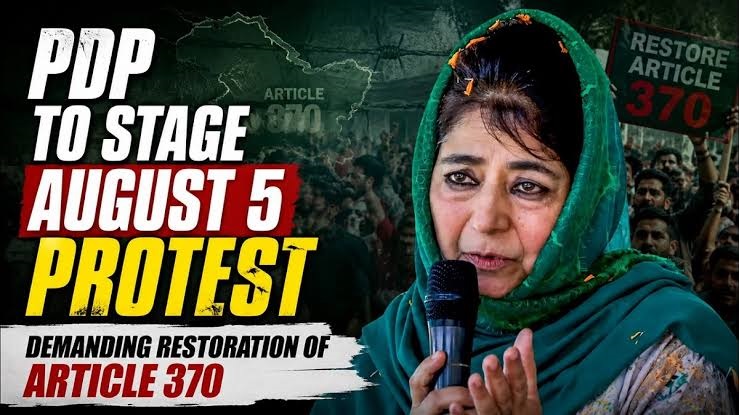
The political temperature in Jammu and Kashmir is set to rise again as the People’s Democratic Party (PDP) has announced peaceful protests across the Union Territory on August 5, the seventh anniversary of the 2019 abrogation of Article 370.
PDP president and former Jammu and Kashmir chief minister Mehbooba Mufti has called on party workers and supporters to organise protests at district headquarters, putting the restoration of Article 370 and Article 35A back at the centre of the political debate.
The announcement is significant not merely because of the date, but because it comes at a time when opposition politics in J&K is increasingly divided over how to frame the region’s post-2019 political demands.
While the National Conference (NC) has made the restoration of statehood its immediate political priority, the PDP has argued that statehood alone does not address what it describes as the larger constitutional question. The party has instead sought to keep Article 370, Article 35A, political detainees and civil liberties within the central political conversation.
The latest announcement was made on July 28 during the PDP’s 27th foundation day. According to reports, the party resolved to continue its constitutional and democratic campaign for the restoration of Article 370, Article 35A and what it calls the constitutional safeguards that previously defined Jammu and Kashmir’s special status.
The August 5 mobilisation, therefore, is likely to be as much about the PDP’s political positioning as it is about marking the anniversary of the 2019 constitutional changes.
Why August 5 Remains a Politically Charged Date in J&K
For the PDP and sections of the political spectrum in Kashmir, August 5 is not an ordinary date on the political calendar.
On August 5, 2019, the Union government announced constitutional changes that effectively ended Jammu and Kashmir’s special status under Article 370. The former state was subsequently reorganised into two Union Territories—Jammu and Kashmir, and Ladakh.
The Supreme Court, in its December 2023 judgment, upheld the Union government’s move on Article 370 and directed that statehood for Jammu and Kashmir be restored at the earliest. The judgment has since become an important reference point in the continuing political debate over the region’s future constitutional and administrative status.
For the PDP, however, the political argument does not end with statehood.
The party continues to maintain that the changes of August 2019 fundamentally altered the constitutional relationship between Jammu and Kashmir and the Union of India. Its demand for the restoration of Article 370 and 35A therefore remains a core part of its political identity.
That position puts the PDP at a distinct point in the current opposition landscape.
PDP’s August 5 Protest: What Is the Party Demanding?
The PDP’s protest agenda goes beyond a single constitutional demand.
At the centre is the call for the restoration of Article 370 and Article 35A, alongside what the party describes as a broader struggle for constitutional rights, democracy and federal principles.
The party has also raised concerns relating to political detainees and preventive detention, while calling for greater protection of democratic rights.
The resolution adopted by the party additionally touched on issues including the reopening of cross-Line of Control trade and travel routes, representation and governance, recruitment, regional development, natural resources and the safe return of Kashmiri Pandits and other displaced communities.
This wider agenda is important because it shows that the PDP is attempting to frame August 5 not merely as an anniversary protest, but as part of a continuing political campaign.
The core demands can broadly be understood as:
- Restoration of Article 370.
- Restoration of Article 35A.
- A broader constitutional and political resolution of the Kashmir issue.
- Release of political prisoners and detainees, according to the party’s stated position.
- Greater protection of civil and democratic liberties.
- Opposition to what the PDP describes as arbitrary use of preventive detention laws.
- Reopening of cross-LoC trade and travel routes.
- Greater regional representation and economic rights.
The exact implementation and scale of the August 5 programmes will likely vary from district to district, but the political message is clear: the PDP wants Article 370 to remain a central issue in J&K politics.
Article 370 vs Statehood: The New Opposition Fault Line
The most interesting political dimension of the PDP’s announcement is the growing difference between the party’s agenda and that of the National Conference.
The NC has intensified its campaign for restoration of Jammu and Kashmir’s statehood. On July 20, NC president Farooq Abdullah, Chief Minister Omar Abdullah and party leaders held a protest in New Delhi demanding the restoration of statehood.
The PDP, however, did not join that mobilisation on the terms proposed by the NC.
Mehbooba Mufti had made it clear that the PDP would participate only if the restoration of Article 370 and the release of political prisoners were central to the agenda. She criticised a statehood-only campaign as insufficient to address what she considers the larger constitutional struggle.
This disagreement is more than a tactical difference.
It represents two different political strategies.
National Conference’s approach
The NC has increasingly focused on:
- Restoration of statehood.
- Strengthening democratic institutions.
- Pressing the Centre to fulfil its commitment on statehood.
- Building a broader political coalition around an immediate and achievable demand.
PDP’s approach
The PDP continues to emphasise:
- Restoration of Article 370.
- Restoration of Article 35A.
- Constitutional safeguards.
- Release of political detainees.
- Civil liberties and democratic rights.
- A larger political resolution of the Kashmir question.
The distinction gives the PDP a sharper ideological position, but it also creates a challenge for opposition unity.
Why the PDP Is Choosing August 5
The choice of August 5 is politically deliberate.
For the PDP, the date carries enormous symbolic value. It allows the party to connect its current political campaign directly with the events of 2019 and reinforce its argument that the constitutional changes of that year remain unresolved in the political consciousness of a section of the population.
The move also allows Mehbooba Mufti and the PDP to reclaim political space at a time when the NC has been more visible on the statehood issue.
In political terms, the August 5 campaign serves three purposes.
First, it reinforces the PDP’s traditional position on Article 370.
Second, it distinguishes the party from the NC’s immediate statehood-focused campaign.
Third, it attempts to bring civil liberties and political detentions into the same political conversation.
The strategy is therefore both ideological and electoral.
What Does the August 5 Protest Mean for J&K Politics?
The announcement comes at a sensitive moment for opposition politics in Jammu and Kashmir.
The NC remains the dominant political force in the elected government, while the PDP is attempting to maintain its relevance by highlighting issues that it believes have been diluted in the current statehood debate.
The result is a political landscape where opposition parties may agree on some broad concerns but disagree sharply on priorities.
The divide can be illustrated simply:
| Political Question | PDP Position | NC’s Current Emphasis |
|---|---|---|
| Article 370 | Restoration remains a core demand | Not abandoned, but statehood is the immediate campaign focus |
| Article 35A | Restoration demanded | Part of the broader constitutional debate |
| Statehood | Important but insufficient on its own | Immediate political priority |
| Political detainees | Release is a key demand | Also raised within broader political concerns |
| August 5 | A day for mobilisation over Article 370 | Focus differs from the PDP’s anniversary campaign |
| Opposition strategy | Separate mobilisation around constitutional rights | Coalition-building around statehood |
This divergence could become increasingly important in the run-up to future political battles in J&K.
Will the Opposition Remain Divided?
This is perhaps the biggest political question emerging from the PDP’s August 5 announcement.
On paper, the NC and PDP share several concerns. Both have opposed the post-2019 political arrangement in different ways, and both have called for greater democratic and political rights for Jammu and Kashmir.
But their political messaging is not identical.
The NC has increasingly sought to turn the restoration of statehood into a broad, nationally acceptable demand that can attract support from political parties outside Jammu and Kashmir.
The PDP, meanwhile, is reluctant to allow Article 370 to disappear from the political agenda.
That difference has already been visible.
When the NC invited opposition parties to join its Jantar Mantar protest, the PDP indicated that it would not participate unless Article 370 restoration and the release of political prisoners were given a central place.
The August 5 protest now reinforces that separate political trajectory.
Whether this ultimately weakens the opposition or creates a broader debate remains to be seen.
The Public Response Will Be the Real Test
Political announcements are one thing. Ground mobilisation is another.
The success of the PDP’s August 5 call will depend heavily on the scale of participation at district level and the ability of the party organisation to mobilise supporters across different parts of Jammu and Kashmir.
The response could also vary geographically.
The political mood in the Kashmir Valley may not necessarily be identical to that in Jammu, Pir Panjal, Chenab Valley or other regions. The PDP’s challenge will therefore be to translate a largely Kashmir-centric constitutional demand into a broader territorial political campaign.
The party’s decision to call for district-level protests rather than relying solely on a single central gathering is significant in this context.
It gives the mobilisation a decentralised structure and allows the party to demonstrate organisational presence across the Union Territory.
At the same time, the scale of participation will be closely watched by both supporters and opponents of the PDP.
Delhi Will Be Watching the August 5 Mobilisation
Any large political mobilisation around Article 370 is likely to attract national attention.
For the Union government, the constitutional position is legally settled following the Supreme Court’s 2023 judgment, while the political question of statehood remains a separate issue.
For the PDP, however, the demand for restoration of Article 370 continues to be framed as a constitutional and democratic struggle.
This creates an important political contradiction.
The PDP can continue to campaign for restoration, but the current legal and constitutional framework makes any immediate reversal of the 2019 changes highly unlikely.
The party’s challenge, therefore, is to maintain political relevance around an issue that has strong symbolic resonance among its support base but faces significant resistance at the national level.
The August 5 protest is consequently likely to be judged not only by its immediate turnout but also by whether it succeeds in keeping the Article 370 debate alive beyond the anniversary itself.
Political Prisoners and Civil Liberties Add a Second Layer
The PDP’s August 5 campaign is also notable for its emphasis on political detainees and civil liberties.
By combining the Article 370 demand with calls for the release of political prisoners and opposition to preventive detention, the party is attempting to broaden the campaign from a constitutional issue to a rights-based political narrative.
This is strategically significant.
A campaign focused exclusively on Article 370 risks becoming an annual symbolic exercise. By adding civil liberties, democratic rights and detention-related concerns, the PDP is seeking to give the mobilisation a wider political meaning.
However, these issues are also politically sensitive and likely to attract competing interpretations from the Centre and rival parties.
The debate is therefore likely to remain sharply contested.
PDP’s Political Calculation: Reclaiming Its Traditional Space
The PDP’s latest move can also be read through the lens of the party’s political survival and revival.
The party’s influence has declined considerably from the period when it formed governments in Jammu and Kashmir, including its alliance with the BJP between 2015 and 2018.
Since the 2019 changes, the PDP has struggled to regain the political space it once occupied in the Valley.
Article 370 remains one of the few issues on which the party has maintained a clear and consistent position.
By making August 5 a focal point for mobilisation, Mehbooba Mufti is effectively reminding voters of the PDP’s longstanding political narrative.
The strategy is straightforward: if statehood becomes the only opposition demand, the PDP risks losing its distinct political identity.
The August 5 protest is therefore an attempt to draw a clear line between the PDP’s constitutional position and the NC’s immediate political priorities.
What Happens Next?
The next few days will be crucial for determining the political impact of the PDP’s announcement.
Three developments will be particularly important.
1. Scale of mobilisation
The number of districts where protests actually take place, and the size of participation, will indicate the PDP’s organisational strength.
2. Opposition response
The response of the NC, JK People’s Conference and other political groups will determine whether August 5 becomes a broader opposition issue or remains primarily a PDP-led mobilisation.
3. Government response
The security and administrative response to the proposed protests will also shape the political narrative. Any restrictions, detentions or preventive measures could themselves become part of the debate over civil liberties.
August 5 Could Deepen the Political Debate Over J&K’s Future
The PDP’s August 5 protest call has reopened a question that has never entirely disappeared from Jammu and Kashmir’s political discourse: Should the political conversation focus on restoration of statehood, or should it go further and revisit the constitutional changes of 2019?
The NC’s statehood campaign and the PDP’s Article 370 campaign represent two distinct answers.
For the PDP, statehood without constitutional safeguards is incomplete.
For the NC, statehood represents an immediate democratic necessity and a demand around which a wider political coalition can potentially be built.
The two positions need not necessarily be mutually exclusive, but the political strategies behind them are clearly different.
That difference is now becoming more visible.
As August 5 approaches, the PDP is seeking to ensure that Article 370 remains at the heart of the Jammu and Kashmir political debate. Whether the party succeeds in turning the anniversary into a significant mass mobilisation—or whether the event remains primarily a symbolic assertion of its political position—will depend on public participation, the response of other opposition parties and the administration’s handling of the protests.
One thing, however, is already clear: seven years after August 5, 2019, the political debate over Jammu and Kashmir’s constitutional future remains far from settled in the region’s electoral and public discourse.