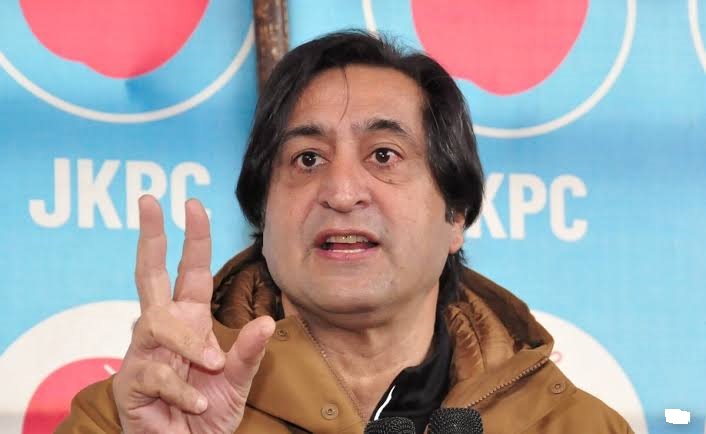
Sajad Lone Rejects NC’s Jantar Mantar Protest, Says ‘Article 370 Cannot Be Reduced to a Statehood Demand’
By: Javid Amin | 18 July 2026
JKPC Chairman Calls for Assembly Resolution Before Any Delhi Protest, Accuses National Conference of Diluting Kashmir’s Constitutional Agenda
A fresh rift has emerged within Jammu and Kashmir’s regional political landscape after Jammu & Kashmir People’s Conference (JKPC) chairman Sajad Gani Lone refused to join the National Conference’s (NC) proposed protest at Jantar Mantar in New Delhi.
Instead of supporting the demonstration, Lone accused the National Conference of shifting the political focus away from the restoration of Article 370 and Article 35A by prioritising the demand for statehood.
Calling Article 370 the “paramount issue,” Lone argued that any political movement seeking justice for Jammu and Kashmir must first reaffirm the constitutional issues that arose following the constitutional changes of August 5, 2019.
His remarks add another dimension to the growing political contest among regional parties over how the struggle for Jammu and Kashmir’s constitutional and political future should be pursued.
What Sajad Lone Said
Addressing the proposed Delhi protest, Sajad Lone made it clear that the People’s Conference would not participate in the National Conference’s programme.
According to Lone:
- The JKPC will not join the NC’s proposed sit-in at Jantar Mantar.
- Restoration of Article 370, Article 35A, and full statehood remain the party’s stated objectives.
- Article 370 must remain the foremost political priority.
- An emergency session of the Jammu and Kashmir Legislative Assembly should be convened before any public protest.
- The Assembly should first adopt a formal resolution before political parties approach New Delhi.
Lone argued that constitutional institutions should lead the political process instead of symbolic street demonstrations.
Assembly Before Agitation
One of the central themes of Lone’s statement was his insistence that the elected Assembly should take the lead.
He proposed the following sequence:
- Convene a special session of the Legislative Assembly.
- Pass a unanimous resolution demanding restoration of statehood.
- Build consensus among all political parties.
- Send an all-party delegation to New Delhi.
- Only thereafter consider public demonstrations if required.
According to Lone, such a constitutional approach would carry greater political legitimacy than isolated party-led protests.
Criticism of the National Conference
Lone also questioned the National Conference’s political strategy.
Referring to developments preceding the constitutional changes of August 2019, he recalled that senior NC leaders met the Prime Minister shortly before the abrogation of Article 370.
He suggested that those meetings failed to prevent the constitutional changes and argued that regional parties should learn from that experience by building broader political consensus rather than acting independently.
These remarks represent Lone’s political criticism of the NC. The National Conference has consistently maintained that it opposed the decisions of August 2019 and has repeatedly sought restoration of constitutional guarantees through political and legal means.
The Debate Over Article 370 and Statehood
Why Lone Sees a Difference
Lone’s criticism centres on what he describes as a shift in political priorities.
According to him:
- Article 370 and Article 35A concern Jammu and Kashmir’s constitutional relationship with the Union of India.
- Statehood concerns the administrative status of the Union Territory.
While the National Conference has repeatedly demanded both restoration of statehood and the reversal of the constitutional changes of August 2019, Lone argued that placing greater emphasis on statehood risks weakening the broader constitutional debate.
This distinction now appears to be one of the principal differences between the two regional parties.
Political Implications
Growing Opposition Fragmentation
Lone’s refusal to join the Delhi protest highlights continuing divisions among regional parties.
Although several parties oppose aspects of the post-2019 political framework, they differ significantly on:
- Political priorities.
- Strategy.
- Methods of engagement with New Delhi.
- Sequencing of constitutional demands.
Such differences may make it more difficult to present a united political position.
Competing Leadership Claims
The latest exchange also reflects competition for political leadership within Kashmir’s regional political space.
The National Conference seeks to project itself as leading the campaign for restoration of statehood.
The People’s Conference, meanwhile, is attempting to position itself as the party that continues to place Article 370 and Article 35A at the centre of political discourse.
Historical Memory and Contemporary Politics
July 13 continues to be one of the most debated dates in Jammu and Kashmir’s political history.
The 1931 killings, in which 22 protesters were killed outside Srinagar Central Jail, remain a significant historical reference for many regional political parties.
For decades, Martyrs’ Day was officially observed in the erstwhile state.
Since the constitutional changes of 2019, however, official commemorations have ceased, while political parties continue to interpret the events through different ideological and historical perspectives.
These competing interpretations have become part of the wider debate over Kashmir’s political identity and constitutional future.
A Note on Historical Claims
The user summary raises a broader historical argument regarding the National Conference’s later political engagement with members of the former Dogra royal family.
This is an issue on which historians and political commentators hold differing views.
- Critics argue that political accommodation of former Dogra elites appeared inconsistent with commemorating those who protested against autocratic rule in 1931.
- Supporters of the National Conference contend that post-1947 coalition-building and political accommodation reflected the practical realities of governance during a period of major constitutional transition.
These are matters of historical and political interpretation rather than settled fact, and they continue to be debated in academic and political circles.
Political Analysis: Strategy vs. Substance
Sajad Lone’s intervention is not merely a rejection of one protest; it is an attempt to redefine the opposition’s political agenda.
By insisting that Article 370 remains the principal issue, he is drawing a distinction between constitutional restoration and administrative restoration. His insistence on an Assembly resolution before street mobilisation reflects a preference for institutional politics over symbolic demonstrations.
For the National Conference, however, the proposed protest is part of a broader campaign to keep the demand for statehood alive in national political discourse. From the party’s perspective, mobilising public opinion in the national capital complements—not replaces—its constitutional and legal efforts.
The disagreement therefore reflects different political strategies rather than identical objectives pursued through different methods.
Challenges Ahead
Several questions now confront Jammu and Kashmir’s opposition parties:
- Can regional parties develop a common constitutional agenda?
- Will the proposed Jantar Mantar protest proceed with broad political participation?
- Can disagreements over political strategy be resolved without weakening the larger opposition narrative?
- How will the Assembly, if convened, address competing priorities such as statehood and constitutional restoration?
Conclusion
Sajad Lone’s decision to reject the National Conference’s proposed Jantar Mantar protest has exposed significant strategic differences within Jammu and Kashmir’s regional political opposition. While both the JKPC and the NC continue to advocate restoration of statehood, Lone argues that Article 370 and Article 35A must remain the primary constitutional demands, warning against allowing the debate to narrow to statehood alone.
The National Conference has not accepted Lone’s characterisation of its position and has consistently stated that it seeks both restoration of statehood and the reversal of the constitutional changes of 2019. As regional parties pursue different political strategies, the challenge will be whether they can maintain a united voice on issues of constitutional status and democratic representation while navigating their internal differences.


