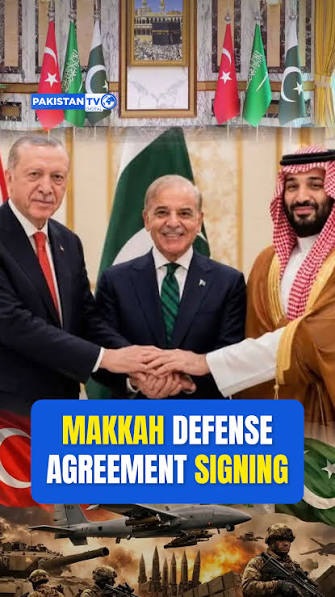
Shehbaz Sharif, Mohammed bin Salman and Recep Tayyip Erdoğan Seal Defence Pact as Middle East Security Landscape Undergoes Major Shift
By: Javid Amin | 07 Aug 2026
A New Security Equation Emerges in Makkah
Pakistan, Saudi Arabia and Türkiye have signed a new trilateral defence agreement in Makkah, bringing three influential Muslim-majority states closer together at a time when the Middle East’s security architecture is undergoing rapid change.
The agreement brings together Pakistan’s large military and nuclear deterrent, Saudi Arabia’s financial and strategic weight, and Türkiye’s advanced defence industry and NATO experience.
The pact is particularly significant because it builds on an existing Pakistan–Saudi defence relationship while potentially giving that partnership a much broader regional dimension.
The three countries have maintained close political and defence contacts for years, but Türkiye’s inclusion represents a potentially important step toward a more structured trilateral security framework. Earlier this year, the International Institute for Strategic Studies noted that discussions involving Pakistan, Saudi Arabia and Türkiye had been developing against the backdrop of major changes in Middle Eastern security.
What Is the Makkah Joint Defence Agreement?
At its core, the agreement is designed to deepen defence cooperation between Pakistan, Saudi Arabia and Türkiye.
The emerging framework is expected to cover areas including:
- Joint military coordination.
- Defence training and exercises.
- Intelligence and security cooperation.
- Defence-industrial collaboration.
- Military technology cooperation.
- Counter-terrorism coordination.
- Protection of strategic infrastructure and trade routes.
The most consequential element is the collective-security principle reportedly associated with the pact: an armed attack against one member would be treated as an attack against all three.
That language gives the agreement considerable strategic weight, although the practical mechanisms for responding to an attack will matter just as much as the political commitment.
It should therefore not automatically be described as a Middle Eastern equivalent of NATO. Collective-defence language does not by itself establish an automatic military response. The actual treaty provisions, decision-making procedures and implementation mechanisms will determine how binding the arrangement becomes.
Why the Makkah Signing Matters
The location itself carries political and symbolic significance.
Signing the agreement in Makkah, Islam’s holiest city, gives the pact a dimension that extends beyond conventional military cooperation.
For Pakistan and Saudi Arabia, the relationship has long contained religious, political, economic and security components. Türkiye has also developed increasingly close strategic ties with both countries.
The Makkah setting therefore allows the three governments to present the agreement not simply as a military arrangement, but as part of a broader effort toward regional cooperation and collective security.
At the same time, the symbolism should not obscure the hard geopolitical calculations behind the pact.
Pakistan Brings Military Weight and Strategic Deterrence
For Pakistan, the agreement expands its role in Middle Eastern security affairs.
Islamabad has maintained a longstanding defence relationship with Saudi Arabia, including military training, exercises and deployments.
The Strategic Mutual Defence Agreement signed by Pakistan and Saudi Arabia in September 2025 already established a collective-defence commitment between the two countries, treating aggression against one as aggression against both.
The new trilateral framework potentially adds Türkiye’s military capabilities and defence-industrial capacity to that relationship.
Pakistan consequently gains an opportunity to position itself not merely as a bilateral security partner of Riyadh but as part of a wider regional security structure.
That could also increase Islamabad’s diplomatic relevance at a time when Gulf states are reassessing their security relationships and seeking greater strategic autonomy.
Saudi Arabia Seeks Stronger Regional Deterrence
For Riyadh, the agreement comes at a period of heightened concern over regional security.
Saudi Arabia has historically relied heavily on the United States for advanced military capabilities and security guarantees. However, successive regional crises have encouraged Riyadh to diversify its defence partnerships.
The Pakistan–Saudi agreement of 2025 was an important step in that direction.
Bringing Türkiye into the equation potentially provides Saudi Arabia with another major military partner possessing a substantial defence industry, including capabilities in drones, naval systems, armoured platforms and aerospace technology.
The arrangement also strengthens Riyadh’s ability to develop security relationships that are not exclusively dependent on Washington.
Türkiye Adds Defence Industry and NATO Experience
Türkiye’s role could prove particularly important.
Ankara possesses one of the region’s most developed indigenous defence industries and has expanded its production of drones, missiles, naval platforms, armoured vehicles and electronic warfare systems.
Türkiye also remains a NATO member, giving it decades of experience operating within a major multinational military alliance.
Its participation could therefore provide the emerging trilateral framework with military expertise extending beyond traditional Gulf security cooperation.
Türkiye and Pakistan already have substantial defence ties. Their cooperation includes naval programmes, military exercises and defence-industrial projects. Pakistan’s MILGEM corvette programme with Türkiye is one example of this expanding relationship.
From Bilateral Pact to Trilateral Security Framework
The new agreement did not emerge overnight.
For months, Türkiye’s possible participation in the Pakistan–Saudi defence arrangement had been discussed.
The International Institute for Strategic Studies reported in May that Pakistan, Saudi Arabia, Türkiye and Egypt were increasingly coordinating on shared security concerns, while noting that Türkiye’s potential entry into the Pakistan–Saudi defence arrangement had been under discussion.
That background makes the Makkah agreement particularly significant.
It suggests that the region is moving from individual bilateral defence partnerships toward more interconnected security arrangements.
A Changing Middle East Security Architecture
The wider geopolitical environment is crucial to understanding the pact.
The Middle East has experienced a series of shocks to its traditional security order, including conflicts involving Iran, Israel, Gulf states and non-state armed groups.
These developments have encouraged regional powers to reconsider how they protect their territories, energy infrastructure and maritime trade.
The emergence of stronger Pakistan–Saudi–Türkiye cooperation can therefore be interpreted as part of a broader regional trend toward strategic diversification.
Rather than relying exclusively on one external security guarantor, regional powers increasingly appear interested in building overlapping partnerships.
The Three Countries Bring Different Strengths
| Country | Major Strategic Asset | Potential Contribution |
|---|---|---|
| Pakistan | Large military, nuclear deterrent, strategic geography | Personnel, deterrence, training and military expertise |
| Saudi Arabia | Financial resources, energy influence, Gulf geography | Defence financing, strategic infrastructure and regional access |
| Türkiye | Advanced defence industry, large military, NATO experience | Technology, weapons systems, training and operational expertise |
Together, these capabilities create a partnership with significant military and economic potential.
Is This an “Islamic NATO”?
The comparison is already likely to become part of the geopolitical debate.
But describing the agreement as an “Islamic NATO” would be premature.
NATO’s collective-defence mechanism operates within a highly institutionalised alliance structure with established command systems, integrated planning and formal decision-making procedures.
The Pakistan–Saudi–Türkiye arrangement would need much more institutional development before it could be compared directly with NATO.
The more accurate description, at least initially, is a trilateral strategic defence framework.
Its significance will depend on what happens after the signing: whether the three countries establish permanent mechanisms, conduct integrated exercises, share intelligence systematically and develop joint procurement or defence-production programmes.
Iran Will Be Watching Closely
The emergence of a stronger trilateral defence arrangement will inevitably attract attention in Tehran.
Iran maintains important relationships with various regional actors, while Saudi Arabia and Türkiye have their own complex relationships with Tehran.
The agreement does not necessarily mean the three countries have formed an explicitly anti-Iran alliance.
However, from Tehran’s perspective, a stronger security relationship involving Pakistan, Saudi Arabia and Türkiye could alter the regional balance.
Much will depend on whether the agreement remains focused on collective defence and regional stability or evolves into a more explicitly deterrence-oriented bloc.
The United States Faces a More Complicated Regional Picture
Washington also has reasons to monitor the development carefully.
On one hand, stronger defence capabilities among US partners and regional powers could reduce the burden on American forces.
On the other, the emergence of autonomous regional security arrangements could gradually reduce Washington’s exclusive influence over Gulf security architecture.
Saudi Arabia has increasingly pursued a diversified foreign-policy strategy, maintaining relations with Washington while simultaneously deepening ties with China, Türkiye, Pakistan and other powers.
The new defence arrangement fits into that broader trend.
What Does the Pact Mean for India?
The agreement will also attract attention in New Delhi.
Pakistan’s participation gives the pact a South Asian dimension that goes beyond Middle Eastern security.
Türkiye has already developed closer political and defence ties with Pakistan, while Saudi Arabia maintains extensive economic and strategic relations with India.
That creates an interesting triangle.
New Delhi is unlikely to view the agreement simply through the lens of a Pakistan-led bloc because India’s relationship with Saudi Arabia has expanded significantly in trade, investment, energy and strategic cooperation.
The practical impact on India will therefore depend on whether the new arrangement remains geographically focused on Gulf and regional security or expands into issues directly affecting South Asian strategic interests.
Energy Security Could Become a Major Focus
One of the most important areas for cooperation could be energy security.
Saudi Arabia is one of the world’s leading oil producers, while Pakistan is heavily dependent on imported energy.
Türkiye occupies a strategically important position between Europe, the Middle East and Asia.
A stronger security relationship could therefore support cooperation around:
- Maritime security.
- Protection of energy infrastructure.
- Oil and gas transportation.
- Red Sea security.
- Gulf shipping routes.
- Critical infrastructure protection.
The three countries have already participated in broader efforts aimed at improving maritime security. Pakistan recently backed a Saudi-led multinational maritime defence initiative involving a number of regional and international countries to protect shipping and energy routes.
Defence Industry Could Become the Real Game-Changer
The agreement’s most lasting impact may ultimately come not from troop deployments but from defence-industrial cooperation.
Türkiye has built a rapidly expanding domestic arms industry.
Pakistan has developed significant capabilities in fighter aircraft, missiles, drones and naval systems.
Saudi Arabia, meanwhile, has substantial financial resources and has repeatedly expressed ambitions to develop a domestic defence industry.
That combination creates the possibility of joint ventures, technology partnerships and co-production arrangements.
If those ambitions materialise, the pact could gradually develop an economic foundation that makes the security relationship more durable.
Major Challenges Ahead
1. Different Strategic Priorities
Pakistan, Saudi Arabia and Türkiye do not have identical foreign-policy objectives.
Their interests overlap on several issues, but they also maintain different relationships with Iran, Israel, the United States, Russia and China.
Managing those differences will be critical.
2. Defining the Collective-Defence Clause
The biggest test will come if one member faces a serious military attack.
What constitutes an “attack”?
Would assistance be automatic?
Would military intervention require political approval?
Would support mean troops, intelligence, weapons or logistical assistance?
These questions will determine the real strength of the pact.
3. Türkiye’s NATO Membership
Türkiye’s participation also creates a complicated strategic layer because Ankara remains a NATO member.
A new collective-defence commitment outside NATO would need to coexist with Türkiye’s existing alliance obligations and strategic relationships.
4. Risk of Regional Polarisation
If the agreement is perceived as an anti-Iran or anti-Israel military bloc, it could contribute to further regional polarisation.
The three countries therefore have an incentive to carefully frame the pact around defence, deterrence and regional stability.
The Bigger Picture: A New Era of Regional Security Partnerships
The significance of the Makkah Joint Defence Agreement extends beyond the three signatories.
For decades, Middle Eastern security architecture was heavily shaped by the United States and its military partnerships with Gulf states.
That model is now being supplemented by a more complicated network of regional partnerships.
Saudi Arabia is strengthening ties with Pakistan and Türkiye.
Türkiye is expanding its defence-industrial reach.
Pakistan is seeking a larger diplomatic and security role beyond South Asia.
The result is a more multipolar regional security environment.
What Happens Next?
The signing is only the beginning.
The real test will be whether the three governments translate political declarations into functioning military structures.
The next stages could include:
- Permanent defence coordination mechanisms
- Expanded joint military exercises
- Intelligence-sharing arrangements
- Defence-industrial partnerships
- Joint counter-terrorism operations
- Maritime security cooperation
- Military technology and training programmes
If these mechanisms develop, the Makkah agreement could become one of the region’s most consequential new security arrangements.
If implementation remains limited to political declarations and symbolic cooperation, its strategic impact will be considerably smaller.
Outlook: More Than a Symbolic Pact?
The Makkah Joint Defence Agreement marks an important moment in the evolving security landscape linking South Asia and the Middle East.
Pakistan brings military manpower and strategic deterrence. Saudi Arabia brings financial power, energy influence and Gulf geography. Türkiye contributes a large military, NATO experience and an increasingly sophisticated defence industry.
That combination gives the trilateral partnership considerable potential.
But potential is not the same as an operational alliance.
The agreement’s real importance will ultimately be measured by what happens after the cameras leave Makkah—whether the three countries establish integrated defence mechanisms, conduct meaningful joint exercises, develop shared military technologies and demonstrate that their collective-security commitment can survive a real regional crisis.
For now, the pact sends a clear geopolitical message: Pakistan, Saudi Arabia and Türkiye want a greater role in shaping the security order of their wider region rather than simply responding to decisions made by outside powers.
Fact-check note: The established background is that Pakistan and Saudi Arabia already had a Strategic Mutual Defence Agreement from September 2025, while Türkiye’s participation had been under discussion during 2026. The latest reported Makkah signing should therefore be understood as the expansion of that emerging security architecture.