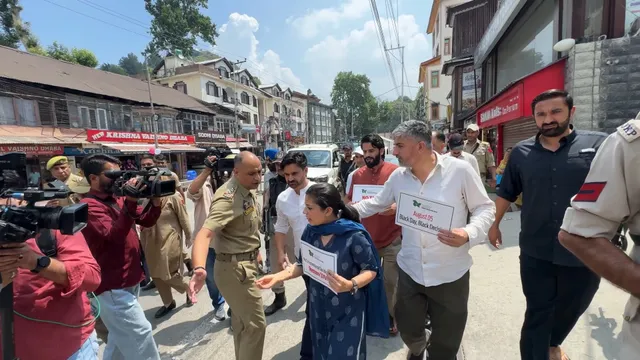
FIR Against Mehbooba Mufti, Iltija Over Alleged Assault on Cop During Article 370 Protest
By News Desk | 06 Aug 2026
The political confrontation surrounding the seventh anniversary of the abrogation of Article 370 has now moved into the legal arena, with Jammu and Kashmir Police registering an FIR against PDP president Mehbooba Mufti, her daughter Iltija Mufti and other party leaders following a confrontation between protesters and police in Srinagar.
The case stems from a PDP protest held on August 4, on the eve of the August 5 anniversary. Police allege that protesters attempted to breach restrictions, block Residency Road and move towards Lal Chowk, leading to a scuffle in which police personnel were allegedly obstructed and assaulted.
The FIR, registered at Kothibagh Police Station as FIR No. 63/2026, invokes Sections 132, 121 and 191(2) of the Bharatiya Nyaya Sanhita (BNS). Police have specifically alleged that Iltija Mufti assaulted an officer and bit his forearm, causing a bleeding injury. Mehbooba Mufti has been named in the case in connection with the alleged violation of restrictions.
The PDP, however, has rejected the police version and accused the security personnel of manhandling Iltija Mufti during the protest. The party says she sustained injuries and was subsequently treated at a private hospital in Srinagar.
The competing accounts have transformed what began as a symbolic political protest into a fresh confrontation between the PDP and the administration.
What Happened During the August 4 PDP Protest?
The incident occurred during a PDP-led candlelight protest outside the party office in Srinagar.
The programme was organised ahead of August 5, a date the PDP observes in opposition to the 2019 constitutional changes that ended Jammu and Kashmir’s special status under Article 370.
According to police, the gathering was held at Sher-e-Kashmir Park near the PDP office, with Mehbooba Mufti and Iltija Mufti among those leading the demonstration.
Police said protesters were repeatedly asked not to move onto the main carriageway of Residency Road, citing traffic and law-and-order concerns.
The police version alleges that a section of protesters nevertheless attempted to proceed towards Lal Chowk, breached barricades and obstructed personnel deployed for security duties.
A confrontation followed.
Police say several personnel were injured during the scuffle and that Iltija Mufti allegedly grabbed and bit the forearm of an officer who was performing official duties.
The allegation forms the centrepiece of the criminal case now under investigation.
FIR No. 63/2026: What Are the Charges?
The case has been registered at Kothibagh Police Station under three provisions of the Bharatiya Nyaya Sanhita.
According to the FIR details reported by police and multiple news organisations, the sections are:
| BNS Section | Broad Provision | Allegation in the Case |
|---|---|---|
| Section 132 | Assault or criminal force to deter a public servant from duty | Alleged assault on police personnel |
| Section 121 | Voluntarily causing hurt to deter a public servant from duty | Alleged injury to an officer |
| Section 191(2) | Rioting | Alleged participation in violent/disruptive confrontation |
The FIR names Iltija Mufti and Mehbooba Mufti, while police have also asked several other PDP leaders to join the investigation.
It is important to stress that an FIR records allegations and sets an investigation in motion; it is not a finding of guilt.
Whether the allegations are ultimately established is a matter for the investigative and judicial process.
Police’s Version: Protesters Breached Restrictions
The police account centres on the allegation that the PDP protest crossed the line from a permitted or controlled gathering into an unlawful attempt to move through a restricted area.
According to the police, personnel deployed near Residency Road noticed PDP workers moving towards the main road at around 9 pm on August 4.
Officers allegedly instructed the protesters not to assemble on the carriageway.
Police say those instructions were ignored and that some protesters attempted to push through barricades and move towards Lal Chowk.
The situation then became confrontational.
The police claim that protesters used criminal force, pushed and manhandled officers and obstructed them from carrying out their duties.
The FIR reportedly states that several police personnel suffered injuries.
The allegation against Iltija is more specific: police say she grabbed an officer and bit his forearm, causing a bleeding injury.
The officer was reportedly taken for medical treatment, where wound management and other treatment were provided.
PDP’s Counterclaim: Iltija Was Manhandled by Police
The PDP has strongly disputed the police narrative.
According to the party, Iltija was attempting to proceed peacefully towards Lal Chowk when police intervened.
The party alleges that she was dragged and manhandled by police personnel, including during an intervention involving a woman police officer and other personnel.
The PDP says Iltija sustained injuries during the confrontation and was admitted to a private hospital in Srinagar.
The party has also questioned the circumstances in which male police personnel allegedly physically restrained her.
The PDP has described the FIR against Mehbooba and Iltija as a misuse of official authority and said it intends to pursue the matter through legal channels.
Iltija was discharged from the private hospital after treatment, according to reports.
Two Completely Different Accounts of the Same Confrontation
The dispute is now essentially a case of competing narratives.
Police say:
- Restrictions were in place around the protest.
- Demonstrators attempted to move towards Lal Chowk.
- Barricades were breached.
- Police personnel were obstructed and allegedly assaulted.
- Iltija Mufti allegedly bit an officer.
- Several police personnel sustained injuries.
- The FIR was registered to investigate these allegations.
PDP says:
- The protest was peaceful.
- Iltija was trying to reach Lal Chowk to register her opposition to the 2019 changes.
- Police used excessive force against her.
- She was allegedly dragged and manhandled.
- She sustained injuries requiring hospital treatment.
- The FIR represents an attempt to suppress political dissent.
Neither side’s complete version has been judicially established.
That distinction is important as the investigation proceeds.
Iltija Mufti Summoned for Investigation
Following registration of the FIR, police summoned Iltija Mufti to join the investigation.
Police questioned her at the residence of Mehbooba Mufti on the outskirts of Srinagar on August 6, according to the New Indian Express, while subsequent reports said she was directed to appear before Kothibagh Police Station on August 7.
The development adds a new dimension to the case because the police investigation is now moving beyond the initial registration of the FIR.
Authorities have said further action will be taken in accordance with law after examining the evidence and identifying everyone found to be involved.
Why the FIR Is Politically Significant
An FIR against a former chief minister and sitting PDP president is politically significant in its own right.
Mehbooba Mufti is one of the most prominent regional opposition figures in Jammu and Kashmir.
Her daughter Iltija has also emerged as a prominent PDP voice, particularly on issues concerning Article 370, civil liberties and political rights.
The case therefore extends beyond an ordinary confrontation between protesters and police.
It has become another chapter in the broader political conflict between the PDP and the administration over how dissent around Article 370 should be handled.
For the PDP, the August 5 anniversary is a politically important opportunity to reiterate its demand for restoration of Article 370 and Article 35A.
For the administration, maintaining public order around a highly sensitive anniversary is a security priority.
The collision between these two objectives produced the August 4 confrontation.
Article 370 Remains at the Centre of the Dispute
The protest itself cannot be separated from the larger constitutional dispute.
August 5, 2019, marked the beginning of a fundamental change in Jammu and Kashmir’s constitutional and administrative structure.
The Centre’s decision rendered Article 370 inoperative and led to the reorganisation of the former state into the Union Territories of Jammu and Kashmir and Ladakh.
The Supreme Court upheld the Union government’s decision in December 2023, while directing that statehood be restored to Jammu and Kashmir at the earliest.
The PDP continues to reject the post-2019 constitutional arrangement and calls for restoration of Article 370 and Article 35A.
The National Conference has placed greater emphasis on immediate restoration of statehood, while continuing its broader opposition to the 2019 changes.
The August 4 protest was therefore not simply a street demonstration.
It was part of a continuing political campaign over the constitutional future of Jammu and Kashmir.
From Flag Controversy to FIR: August 5 Takes Another Turn
The latest FIR comes after a series of controversies surrounding the PDP’s August 5 mobilisation.
Earlier, photographs from Mehbooba Mufti’s candlelight protest showed her holding the Indian Tricolour alongside the former Jammu and Kashmir state flag, with the national flag appearing inverted.
The visuals triggered a separate political controversy and prompted questions about whether the display could attract legal scrutiny.
The latest confrontation now gives the August 5 political campaign a second and potentially more serious legal dimension.
What began as a symbolic protest over Article 370 has consequently moved into a formal police investigation.
Political Rights vs Public Order: The Bigger Debate
The case raises a recurring question in Jammu and Kashmir:
Where should the line be drawn between political protest and public-order restrictions?
The administration has a responsibility to prevent traffic disruption, violence and clashes during politically sensitive gatherings.
Political parties, meanwhile, have the right to express opposition and mobilise supporters peacefully, subject to lawful restrictions.
The difficulty arises when authorities and protesters disagree about whether those restrictions were reasonable and whether protesters crossed them.
That is precisely what the competing accounts in this case reveal.
The police maintain that the protesters violated restrictions and obstructed officers.
The PDP argues that the restrictions were used to prevent peaceful political expression and that excessive force was used against Iltija.
The investigation—and potentially the courts—will ultimately have to separate the competing claims from the established facts.
What Could Happen Next?
Several developments are likely to determine the next phase of the case.
Police Investigation
Investigators are expected to examine CCTV footage, video recordings, witness statements, medical records and other evidence from the confrontation.
Medical Evidence
The medical reports of both the injured police officer and Iltija Mufti could become important in establishing what happened during the physical confrontation.
Statements of Witnesses
Accounts from protesters, police personnel, local witnesses and other officials may help establish the sequence of events.
Further Questioning
Iltija and other individuals named in the case may be questioned as part of the investigation.
Possible Court Proceedings
If police file a chargesheet after investigation, the allegations will then be tested through the judicial process.
At this stage, however, the FIR should not be interpreted as a conviction or final determination of responsibility.
Will the Case Deepen PDP-Government Tensions?
Almost certainly, the case will become part of the wider political narrative.
The PDP is likely to portray the FIR as evidence of restrictions on political dissent.
The administration is likely to maintain that the law must apply equally when public servants are allegedly obstructed or assaulted.
The political consequences could be significant because the case involves two prominent PDP figures and comes immediately after a highly symbolic Article 370 anniversary.
The confrontation could also complicate relations between the elected government and the security administration, particularly if opposition parties attempt to turn the incident into a larger debate over civil liberties.
The Road Ahead for Iltija and Mehbooba
For Iltija Mufti, the immediate issue is the police investigation into the allegations contained in FIR No. 63/2026.
For Mehbooba Mufti, being named in the same case adds another legal confrontation to an already intense political campaign around Article 370.
For the PDP, the incident presents a difficult political choice.
The party can intensify its opposition campaign, but doing so could further increase confrontation with the administration.
Alternatively, it can shift the dispute towards the courts and focus its political messaging on what it describes as excessive restrictions on peaceful protest.
Either way, the FIR is unlikely to disappear from the political conversation soon.
Outlook: Article 370 Protest Now Becomes a Legal Battle
The Srinagar confrontation has transformed the August 5 political campaign into something considerably more consequential.
Police say protesters breached restrictions and that Iltija Mufti assaulted an officer. The PDP says she was manhandled while attempting to peacefully protest. Those competing accounts will now be tested through an investigation and, if necessary, the courts.
The case is important not simply because Mehbooba Mufti and Iltija Mufti have been named in an FIR, but because it sits at the intersection of three highly sensitive issues in Jammu and Kashmir: Article 370, political dissent and public order.
The coming days will show whether the confrontation remains an isolated legal case or develops into another major political flashpoint between the PDP and the administration.
For now, the central facts are established: FIR No. 63/2026 has been registered at Kothibagh Police Station; Mehbooba Mufti and Iltija Mufti are named; police allege assault, obstruction and rioting; and the PDP disputes the police account, alleging that Iltija was herself subjected to excessive force.
The final determination of what happened—and who bears legal responsibility—will depend on the evidence, not the competing political narratives.

