Sangarmal’s ₹421 Crore Gamble: Can Srinagar’s “Ghost Mall” Finally Come Back to Life?
By: Javid Amin | 07 September 2026
A record-breaking land auction has reopened one of Srinagar’s oldest civic embarrassments — and triggered an argument about who actually owns Kashmir’s most valuable real estate.
For fifteen years, Sangarmaal has been Srinagar’s inside joke. “Sangarmaal hasa chu failure” — Sangarmaal is a failure — is how locals describe the glass-and-steel shopping complex near Polo View that was supposed to be Kashmir’s first world-class mall and instead became a punchline: shuttered shops, algae blooming in ornamental fountains, escalators that led nowhere.
So when a 45-kanal parcel of land wrapped around that same complex sold for ₹421.75 crore in a marathon online auction that ran past 1:48 am on August 26, it wasn’t just a real estate story. It was Srinagar confronting its own history of failed ambition — and immediately arguing about whether it had just repeated the mistake or finally fixed it.
The Numbers That Surprised Everyone
The Srinagar Development Authority (SDA) had set a reserve price of ₹125 crore for the land, with government estimates ahead of the sale hovering closer to ₹200 crore. What came in instead was more than triple the reserve and over double the anticipated valuation: a winning bid of ₹421.75 crore from a three-company consortium.
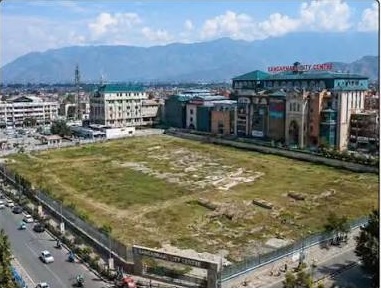
The property itself explains some of that enthusiasm. It sits in front of and behind the existing Sangarmal City Centre, a few hundred metres from the Kashmir Golf Course, directly opposite Polo View, roughly a kilometre from both Lal Chowk and Dal Lake. In a city where genuinely large, centrally located commercial parcels rarely come up for sale, this was about as close to irreplaceable as Srinagar real estate gets.
It wasn’t an isolated event, either. Around the same period, roughly 70 kanals of underused land at the Batamaloo bus stand — about 6 km away — went from a reserve price of ₹95 crore to a final bid of ₹305 crore, won by a firm called Construction Engineers with plans for retail, office and housing space. Read together, the two auctions suggest the SDA has stumbled onto something: Srinagar’s dormant public land bank may be worth dramatically more than anyone had assumed, if only it’s offered through a genuinely competitive process.
Who Actually Won the Land
Here’s where the story gets more complicated than “local hotelier wins big.” The winning consortium is made up of three companies: Parmesh Construction Company Ltd, a Delhi-registered firm; Pahalgam Green Hotels, the Jammu & Kashmir-based company through which hotelier Mushtaq Ahmad Chaya is involved; and Bhutani Infra Ltd, a real estate development company.
Multiple Kashmir-based outlets initially framed the win as a “Chaya-backed consortium” — accurate in the sense that Chaya heads the local entity within the group and has been its public face. But the underlying structure is a three-way partnership in which the Kashmiri firm is one voice among three, alongside two companies with no local roots. That distinction matters enormously for how the deal is being read politically.
Chaya, who has run the Mushtaq Group of Hotels since the mid-1980s and built a presence across Jammu & Kashmir and Delhi, has been unambiguous about his personal investment in the outcome. “Come what may, I had made up my mind that I would bid for it. I was ready to go for the bid at any cost,” he told Greater Kashmir. He described wanting to build “something big for Kashmir” — a hotel, shops, banquet halls and exclusive retail space “blending international malls and international facilities, but with the Kashmir touch.”
A Political Fight With Two Very Different Arguments
The auction has split reactions along lines that don’t map neatly onto “supporters versus critics” — the actual positions are more nuanced than that framing suggests.
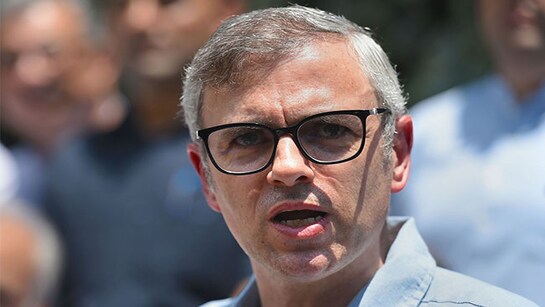
PDP’s Iltija Mufti took the sharpest line, alleging on social media that prime Kashmiri land was effectively being handed to an outside firm and that the inclusion of a small local company in the consortium was being used to obscure that fact. It’s worth being precise here: her allegation that the local partner served as a “front” was not independently substantiated by any evidence she presented. What is independently verifiable is the underlying structural fact she was reacting to — two of the three consortium partners are indeed non-local companies, which is a legitimate basis for the broader question she’s raising, even if the specific “front” characterization remains an accusation rather than a confirmed finding.
J&K Peoples Conference chief Sajad Lone, by contrast, does not oppose the auction itself — a nuance that’s been lost in some of the coverage. His actual position is more layered: he called the reserve price “significantly on the lower side” and argued the land should have fetched somewhere in the range of ₹900 crore to ₹1,000 crore rather than being settled at ₹421.75 crore. But his sharper structural critique wasn’t about price — it was about deal design. Lone argued the government should not have pursued “a lock, stock and barrel auction” at all, and should instead have retained an equity stake in the consortium, allowing the public exchequer to keep benefiting as the redeveloped property generates revenue over time, rather than taking a one-time payment and walking away.
Notably, Lone also used the moment to compare the current deal favourably against Kashmir’s own history. He pointed to the original Sangarmal Mall — conceived and built between 2002 and 2008 under the PDP-Congress coalition government, when the Urban Development Department fell under PDP’s charge — as a cautionary example of how badly this can go. “The economics of Sangramal Mall was disastrous. Nothing for the government,” he said, adding that the present auction model, while imperfect, “is much better than the old model where properties have been gifted away for a pittance.” He drew a comparison to the earlier Leela-Centaur hotel deal as a more workable template going forward.
Put simply: one senior political voice thinks Kashmir undersold a crown asset; another thinks Kashmir has finally learned to charge properly for it, even if the sale-versus-equity question remains open. Both critiques target the government’s asset-management strategy — they just arrive at very different conclusions about the ₹421.75 crore figure itself.
The Ghost Mall That Won’t Quite Die
To understand why so many Srinagar residents are watching this deal with equal parts hope and suspicion, you have to understand what’s already standing on that land.
The Sangarmal Shopping Complex was inaugurated in 2010, pitched at the time as Kashmir’s first world-class cultural and commercial hub — a fusion of glass, steel and traditional khatamband woodwork, designed with escalators, a planned multiplex, craft bazaars, and space earmarked for international brands. The original commercial plan was genuinely ambitious on paper: 62 shops in the main module, 38 spaces in a dedicated Craft Bazaar, 11 kiosks, two food courts, a restaurant and 11 office spaces.
None of it worked the way it was supposed to. By 2015 — five years after opening — an SDA inspection led by the Divisional Commissioner found tiles coming loose, fountains malfunctioning, and blue-green algae growing in stagnant water near an entrance gate. SDA engineers at the time pointed to a deeper structural problem: no major retail brands had been persuaded to anchor the complex, marketing was minimal, and many already-large shop units still sat vacant because traders hadn’t consolidated smaller spaces the way the mall’s format required. A decade later, the situation had only calcified — locals describe a building that “looks modern but feels lifeless,” with a handful of high-priced boutique stores operating amid mostly shuttered storefronts.
This history is precisely why Sajad Lone’s warning about “old tricks” resonates with residents, and why Iltija Mufti’s ownership concerns land with an audience already primed to distrust how prime Srinagar real estate gets allocated and managed. Sangarmaal isn’t an abstract cautionary tale here — it’s the literal site of the new deal.
What’s Actually Being Proposed This Time
The redevelopment plan differs from the original mall in scale and financing structure. According to consortium disclosures, the total project investment is expected to reach approximately ₹1,000 crore — the ₹421.75 crore land cost plus an estimated ₹650 crore in construction and development spending (separate reporting citing a ₹600 crore construction figure appears to reflect an earlier or partial estimate of the same build-out).
The plan reportedly includes an integrated hotel, retail and hospitality complex — shopping spaces, banquet facilities, exclusive retail, and entertainment and leisure components — alongside a notably large parking facility designed for roughly 5,000 vehicles, aimed squarely at one of central Srinagar’s most persistent complaints: the lack of adequate parking around large commercial sites. Chaya has stated the project is targeted for completion within three years.
Whether a 5,000-vehicle parking structure and an “international mall with a Kashmir touch” succeeds where the 2010 version failed will depend on the same unglamorous fundamentals that sank the original: securing genuine anchor tenants, sustained marketing, and active facility management — not simply a bigger budget or a flashier design brief.
The Bigger Question Underneath the Deal
Strip away the personalities and the Sangarmaal history, and the auction surfaces a genuine policy debate that Jammu & Kashmir hasn’t fully resolved: when the government monetises valuable public land, should it cash out entirely, or retain a long-term stake in what gets built on it?
The lock-stock-and-barrel model the SDA used here maximises upfront revenue and transfers all execution risk to the private consortium — useful for a cash-strapped exchequer, but it also means that if Chaya’s ₹1,000 crore vision succeeds spectacularly, the government’s financial upside is capped at what it already collected. The equity-stake model Lone is advocating for would expose the government to more risk if the project underperforms, but would let it share in the return if it works. Given that the original, wholly government-run Sangarmal Mall lost money for over a decade, it’s not obvious that direct government involvement is the safer path either — which may explain why even Lone, while pushing for equity retention, was careful to frame today’s auction model as an improvement, not a mistake.
Where This Leaves Srinagar
The Sangarmal auction is, at minimum, proof that Srinagar’s underused public assets can command serious private capital when opened to genuine competitive bidding — the Batamaloo result backs that up. Whether it also proves the city has learned from the mall’s original failure is a question that won’t be answered by a bid amount, no matter how large. It will be answered in three years, when Chaya’s consortium either fills those shops with brands people actually want to visit, or Srinagar gets a second, more expensive version of the same “ghost mall” joke.
For now, the ₹421.75 crore figure has done what big numbers usually do in Kashmir’s civic life: it has given everyone — investors, politicians, and residents who’ve spent fifteen years walking past a locked mall — a reason to argue about what development in this city is actually supposed to look like.
This feature is based on reporting from Greater Kashmir, Kashmir Observer, Kashmir Life, The Kashmir Images, The Chenab Times, Rising Kashmir and Newskarnataka, current as of September 7, 2026.