Vande Mataram Row: Clerics Apologise After Standing at Waqf Event as Grand Mufti Declares Participation Impermissible
By: Javid Amin | Srinagar | November 27, 2026
A controversy over the national song Vande Mataram has developed into a wider religious, political and constitutional debate in Jammu & Kashmir after several Muslim clerics who stood during its rendition at a Waqf Board function publicly expressed regret, while the region’s Grand Mufti declared participation in ceremonies where the song is sung impermissible under Islamic law.
What began as a seemingly routine moment at an official function has turned into a sensitive public debate over religious convictions, national symbols, institutional responsibilities and individual freedom.
The controversy has also exposed differences within Kashmir’s religious community. While the Mirwaiz Umar Farooq-led Muttahida Majlis-e-Ulama (MMU) strongly objected to the playing of the song at a Waqf Board event, some clerics who attended the function subsequently apologised for standing during its rendition. Others, including Maulana Abdul Rashid Sheikh Dawoodi, defended their decision, arguing that standing as a matter of protocol should not automatically be interpreted as an act of worship.
The intervention of Jammu & Kashmir Grand Mufti Nasir-ul-Islam has added another dimension. He has maintained that reciting Vande Mataram or participating in programmes where it is rendered is not permissible for Muslims under Islamic law.
The disagreement has consequently moved beyond the question of whether the song should have been played at a particular function. It has become a debate over how religious beliefs should be accommodated in public institutions without turning questions of faith and patriotism into instruments of confrontation.
How the Vande Mataram controversy began at the Waqf Board event
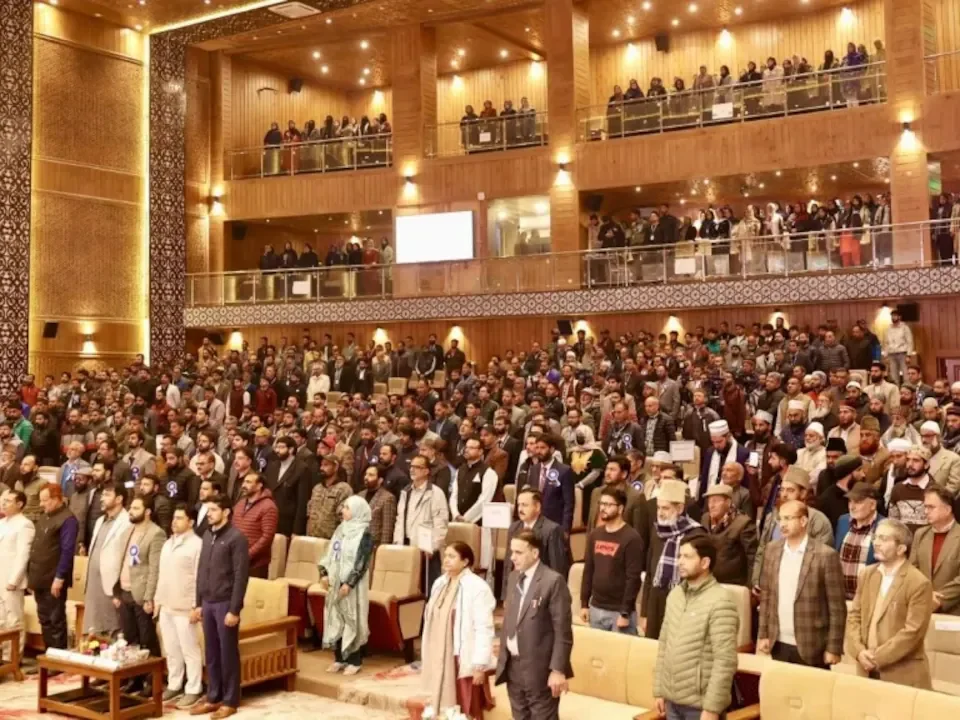
The controversy originated on November 23, when the Jammu & Kashmir Waqf Board organised Waqf Day celebrations at the Convention Centre of the Sher-e-Kashmir University of Agricultural Sciences and Technology of Kashmir (SKUAST-K) in Srinagar.
The function was organised under the leadership of Waqf Board chairperson Dr Darakhshan Andrabi. Union Minority Affairs Minister Kiren Rijiju attended as the chief guest.
Several political representatives, religious scholars, imams and other dignitaries were also present.
Among those attending were National Conference MP Mian Altaf Ahmad, Shia leader Imran Ansari and cleric Maulana Abdul Rashid Sheikh Dawoodi, along with other religious functionaries associated with the Waqf Board.
The controversy emerged when all six stanzas of Vande Mataram were played during the programme.
Several clerics and other attendees stood during the rendition, as is customary at many official functions when national symbols are presented.
Videos from the event subsequently circulated on social media, attracting criticism from sections of the religious community.
The Mirwaiz Umar Farooq-led MMU objected to the inclusion of the song, arguing that its religious references were incompatible with the Islamic principle of Tawheed, or the oneness of Allah.
The organisation also questioned why a religious institution such as the Waqf Board had included the song in its programme, particularly when the religious sensitivities of the Muslim-majority region were well known.
What followed was an increasingly public disagreement over the religious implications of standing during the rendition, the responsibility of the organisers and the limits of participation in official ceremonies.
Mirwaiz Umar Farooq-led MMU objects, invokes religious freedom
The Muttahida Majlis-e-Ulama, an umbrella organisation representing several religious institutions and scholars belonging to different Islamic schools of thought in Jammu & Kashmir, issued a strong objection to the rendition.
Led by Mirwaiz Umar Farooq, the organisation argued that Islam encourages love for one’s homeland but draws a distinction between patriotism and the worship or deification of the motherland.
Its central objection concerned the interpretation of certain expressions in Vande Mataram, particularly those which, in its understanding, attribute divine qualities to the motherland.
The MMU maintained that attributing divinity to anything other than Allah contradicts the fundamental Islamic principle of Tawheed.
However, its objection was not restricted to the lyrics.
The organisation questioned the decision to play the song at a Waqf Board function, arguing that an institution responsible for safeguarding Muslim religious endowments should have been particularly sensitive to the beliefs of the community it serves.
In its statement, the MMU described the decision as unacceptable and said the inclusion of the song had caused hurt and anguish among Muslims.
It also expressed concern over what it described as the increasingly routine inclusion of Vande Mataram at official functions in Jammu & Kashmir.
The organisation indicated that it was considering legal opinion and intended to submit a formal representation to the authorities seeking an end to what it described as the forced inclusion of the song at government functions, educational institutions and other public events.
This is an important distinction in understanding the MMU’s position: its objection concerns both the religious interpretation of the song and the question of whether participation should be expected or imposed in official settings.
Grand Mufti Nasir-ul-Islam declares participation impermissible under Islamic law
The controversy intensified on November 26 when Jammu & Kashmir Grand Mufti Nasir-ul-Islam publicly clarified his religious position.
In a video message, the Grand Mufti stated that reciting Vande Mataram or participating in programmes where it is sung was impermissible for Muslims under Islamic law.
His position was rooted in Tawheed, the Islamic doctrine that worship belongs exclusively to Allah and that no person, object, land or creation can be assigned divine status.
He also questioned the participation of religious figures in ceremonies where the song was rendered, maintaining that Muslims should not compromise their fundamental religious convictions.
The statement was significant because it extended the debate beyond the act of singing the song itself.
The Grand Mufti’s position covered participation in ceremonies where it is rendered, making the presence and conduct of Muslim religious figures at such events a matter of religious discussion.
However, the distinction between the Grand Mufti’s religious ruling and the broader legal position is important. His statement represents an interpretation of Islamic law; it does not establish a general legal prohibition under Indian law against attending public functions where the national song is played.
His intervention has nevertheless strengthened the position of those opposing the song’s inclusion in religiously associated programmes.
Clerics who stood during Vande Mataram issue public apologies
Perhaps the most striking development in the controversy came when some of the clerics who had stood during the song subsequently issued public statements expressing regret.
On November 25, videos and statements from a group of religious scholars began circulating, in which they acknowledged their participation and sought forgiveness from Allah.
In their message, the clerics described their action as a mistake and said they regretted what had happened.
They also recited the Kalima, reaffirming their belief in the oneness of Allah.
One of the statements carried a message to the effect that the participants had realised their mistake after the programme and were now seeking repentance.
Their response followed criticism from religious organisations and sections of the Muslim community after videos of the Waqf Day function became widely circulated.
Some clerics also urged people not to give the controversy a sectarian colour, pointing out that scholars from different Islamic schools of thought had attended the programme.
The public apologies have become one of the most discussed aspects of the episode because they raise questions beyond the original disagreement over the song.
Why did the clerics initially stand? Did they consider it an ordinary protocol requirement? Did they understand the religious objections before attending? And how much influence did the criticism following the event have on their subsequent decision to apologise?
The available reports establish that some participants expressed regret and sought forgiveness. They do not establish that every Muslim cleric who stood during the rendition subsequently apologised.
It is therefore important to distinguish between those who issued repentance statements and other attendees whose individual positions have not been independently established.
Nor should the apologies be described as a collective surrender. They were individual or group expressions of religious regret following criticism, not evidence that every participant had accepted the same interpretation.
Abdul Rashid Dawoodi refuses to equate standing with worship
While some clerics chose to express regret, Maulana Abdul Rashid Sheikh Dawoodi adopted a different position.
Dawoodi, who attended the Waqf Day function and stood during the rendition, defended his conduct by arguing that standing as a matter of protocol should not automatically be interpreted as worshipping the motherland.
His argument centres on the distinction between an outward gesture of respect and an act of religious devotion.
According to reports, Dawoodi challenged religious scholars and organisations to issue a clear fatwa if they believed that merely standing during Vande Mataram, without an intention to worship, amounted to Shirk or Kufr.
He also questioned what he described as reckless accusations against those who had attended the programme.
His position is significant because it introduces a disagreement over the interpretation of an action rather than simply the religious acceptability of the song.
For Dawoodi, the intention behind standing matters. A person may stand out of protocol, respect for an official ceremony or social convention without necessarily accepting any religious meaning associated with the words.
However, the Grand Mufti’s position is broader, treating participation in programmes where the song is rendered as impermissible.
This difference has exposed an important disagreement among religious figures in Kashmir.
It is not simply a division between those who support and oppose Vande Mataram. It is also a debate over whether attending a ceremony, standing during a rendition and singing the song should be treated as separate actions under Islamic jurisprudence.
What about Mian Altaf Ahmad and Imran Ansari?
The participation of prominent political and religious personalities has also attracted attention.
National Conference MP Mian Altaf Ahmad and Shia leader Imran Ansari were among those identified in reporting as having stood during the rendition at the Waqf Board function.
Their presence has become part of the wider discussion because both hold public positions and have influence within their respective social and political constituencies.
However, an important distinction needs to be made.
Their identification as attendees who stood during the rendition does not establish that they subsequently issued the same apology as the group of clerics whose video statements circulated.
Nor should their participation automatically be treated as an endorsement of every religious interpretation associated with the song.
The public record should be assessed individually. Political representatives, religious functionaries and ordinary attendees may have different reasons for participating in an official ceremony.
The controversy has nevertheless placed public figures under pressure to explain their conduct, particularly in a region where religious identity and political representation often intersect.
Why Vande Mataram has remained a sensitive national debate
To understand why the controversy has generated such strong reactions, it is necessary to look beyond the immediate incident.
Vande Mataram occupies a distinctive place in India’s national history.
Written by Bankim Chandra Chattopadhyay, the composition first appeared in the literary journal Bangadarshan on November 7, 1875. It was subsequently incorporated into his novel Anandamath, published in 1882.
The song became closely associated with India’s freedom movement and was popularised as a symbol of resistance against British colonial rule.
Rabindranath Tagore sang it at the 1896 Indian National Congress session in Calcutta, and it subsequently became an important expression of nationalist mobilisation.
Following independence, Vande Mataram was accorded the status of India’s National Song in 1950.
It is important to distinguish between the National Song and the National Anthem, Jana Gana Mana. Both have recognised national significance, but they are separate compositions with different constitutional and historical contexts.
The present controversy is particularly sensitive because of the song’s full six-stanza version.
The opening stanzas celebrate the motherland through descriptions of its natural beauty, prosperity and abundance. Later portions invoke divine imagery and refer to the motherland through religious symbolism and references to Hindu goddesses.
It is these later expressions that have formed the central point of religious objections raised by the MMU and other scholars.
For critics, the concern is not simply about patriotism or respect for India. It is about whether particular expressions can be reconciled with Islamic monotheism.
For supporters, the song represents the historical struggle for independence and devotion to the country, rather than an instruction to practise a particular religion.
Both perspectives help explain why the controversy cannot be understood simply as a disagreement over whether people should stand during a song.
Six stanzas and the new national song protocol: What changed in 2026?
Another important factor behind the Kashmir controversy is the Union Government’s updated protocol concerning the rendition of Vande Mataram.
In 2026, the Ministry of Home Affairs issued detailed instructions governing the occasions on which the National Song should be played or sung.
The official version comprises all six stanzas and has an approximate duration of three minutes and ten seconds.
The guidelines specify its rendition at certain formal government functions, including designated occasions involving the President, Governors and Lieutenant Governors, as well as other prescribed ceremonial events.
The instructions also state that audiences should stand to attention when the National Song is performed, subject to specified exceptions.
When both Vande Mataram and Jana Gana Mana are performed at the same event, the National Song is to be rendered first.
The protocol was circulated to State Governments, Union Territory administrations and government departments for compliance.
This provides an important administrative context to the Srinagar event.
However, the existence of a national protocol does not remove the need to examine the nature of a particular event, the applicable instructions and the constitutional rights of individuals.
The distinction between an official administrative direction and a criminal legal obligation is also important. The MHA order should not automatically be interpreted as creating a criminal offence for every individual who declines to participate.
The relevant official document is the Ministry of Home Affairs’ July 9, 2026 communication on orders relating to the National Song and National Anthem.
The constitutional question: Can patriotism be demanded in a particular form?
The Kashmir controversy also raises a question that extends beyond religious jurisprudence: how should national respect and freedom of conscience coexist in a constitutional democracy?
Article 25 of the Indian Constitution guarantees freedom of conscience and the right to freely profess, practise and propagate religion, subject to public order, morality, health and other constitutional provisions.
This protection does not mean that every religious objection automatically overrides government regulations. Equally, national symbols and official protocols should be administered with due regard for constitutional freedoms.
An important judicial precedent in this discussion is the Supreme Court’s 1986 judgment in Bijoe Emmanuel v. State of Kerala.
The case involved three schoolchildren belonging to the Jehovah’s Witnesses faith who refused to sing the National Anthem because of their religious convictions. They nevertheless stood respectfully when it was played.
The Supreme Court protected their right to remain silent, holding that their conscientious religious beliefs were protected under Articles 19(1)(a) and 25(1).
The judgment concerned the National Anthem, not Vande Mataram, and should not be presented as a direct ruling on the current Kashmir controversy. Nevertheless, it remains relevant to the broader constitutional discussion about compelled participation in national ceremonies.
It establishes an important democratic principle: respect for national symbols and freedom of conscience need not always be expressed through identical forms of participation.
In the present controversy, any legal question concerning the application of the MHA protocol, individual rights or the obligations of a public institution would need to be examined in its specific context.
The religious ruling of a Mufti and the constitutional position under Indian law are separate matters. Neither should be inaccurately presented as a substitute for the other.
Why holding the Waqf Board event at the centre of the controversy matters
There is another dimension that deserves attention: the institution that organised the programme.
The Jammu & Kashmir Waqf Board is responsible for managing Muslim religious endowments and associated properties. Its functions are closely connected with religious institutions, mosques, shrines and community welfare.
This is why the MMU’s objection was particularly directed at the decision to play Vande Mataram at a Waqf Board event.
The organisation’s argument is that an institution entrusted with protecting Muslim religious endowments should be mindful of the religious sensitivities of the community it serves.
Supporters of the decision, on the other hand, can point to the official character of the function and the national significance of the song.
The issue therefore raises questions about institutional judgement.
Could the organisers have anticipated the objections? Was the choice of the full six-stanza version necessary for this particular programme? Was there adequate consideration of the religious character of the institution?
These questions deserve answers from the Waqf Board leadership.
Dr Darakhshan Andrabi and the Board have a responsibility to explain the thinking behind the programme’s format, particularly because the controversy has now extended beyond the event itself.
At the same time, criticism of the organisers should not be converted into an allegation that every attendee was acting against the religious convictions of the community.
An individual’s participation, intention and subsequent explanation must be assessed separately.
Kashmir’s political and religious leadership faces a difficult balancing act
The controversy has also placed Kashmir’s political and religious leadership in an uncomfortable position.
For political representatives, the issue involves balancing their participation in official national events with the religious sensitivities of the communities they represent.
For religious scholars, it concerns the interpretation and protection of Islamic beliefs.
For the administration, it involves implementing government protocols while ensuring that public institutions do not unnecessarily intensify religious tensions.
The participation of Mian Altaf Ahmad, Imran Ansari and other prominent personalities has added political visibility to the issue. Meanwhile, Mirwaiz Umar Farooq’s intervention has ensured that the debate is not confined to social media discussions.
The latest disagreement also demonstrates that Kashmir’s religious leadership is not speaking with one voice.
The MMU has taken a strong institutional position against the song’s inclusion in public functions. The Grand Mufti has declared participation in related ceremonies impermissible. Dawoodi, meanwhile, has challenged the assumption that standing for a song necessarily constitutes worship.
These differences should be reported accurately rather than reduced to a simplistic confrontation between religious groups.
The administration, particularly the Waqf Board, must avoid allowing the controversy to become a prolonged confrontation between religious identity and national identity.
A democratic society should be capable of accommodating disagreement without questioning the patriotism or religious commitment of entire communities.
The real danger is allowing a disagreement over faith to become a political confrontation
The most concerning aspect of the controversy is the speed with which an incident at a public function turned into a wider social debate.
Social media circulation of the videos, criticism of the participating clerics and subsequent apology statements have increased the intensity of the discussion.
The situation also illustrates the pressure that religious figures can face when their actions are interpreted through the lens of community expectations.
A cleric may explain that he stood out of protocol. Another may believe that attending such a ceremony is religiously impermissible. A third may consider the song’s historical importance sufficient reason to participate.
These differences do not automatically make one person an enemy of the country or another an enemy of religion.
Equally, the public has a legitimate interest in understanding why a religious institution chose to include the song and how its leadership responds to the resulting concerns.
The responsibility of political and religious leaders should be to lower tensions, explain their positions and prevent the issue from becoming a source of communal hostility.
The government must also ensure that national symbols are respected without turning official ceremonies into tests of individual religious conformity.
What happens next?
Several developments will determine whether the controversy settles or expands further.
-
MMU’s proposed legal representation: The organisation has indicated that it intends to seek legal opinion and approach the authorities over the inclusion of the song at public functions.
-
Waqf Board’s explanation: The Board may need to clarify why the song was included in the programme and whether similar arrangements are planned for future events.
-
Religious clarification: The differences between the Grand Mufti’s position and Dawoodi’s argument may lead to further religious discussion about standing, singing and attending such ceremonies.
-
Government’s approach: The administration will need to balance the implementation of national protocol with constitutional protections and public sensitivity.
-
Political reactions: Representatives who attended the programme may face further questions about their participation and individual positions.
The most important question is whether the administration can prevent a disagreement over religious interpretation from becoming a larger political and social confrontation.
A debate that needs maturity, not another round of polarisation
The Vande Mataram controversy in Kashmir is no longer simply about a song played at a Waqf Board function.
It has brought religious interpretation, national symbolism, official protocol and constitutional freedoms into the same public debate.
The clerics who apologised have expressed their religious regret. Dawoodi has defended his conduct on the grounds of intention and protocol. The Grand Mufti has made his religious position clear, while the Mirwaiz-led MMU has questioned the decision to include the song at a Waqf Board function.
Each development reflects a different aspect of a debate that cannot be resolved through accusations or political slogans.
Love for the country and commitment to religious beliefs should not be treated as mutually exclusive identities. Nor should patriotism be reduced to a single outward gesture, or religious disagreement be used to question someone’s loyalty to the nation.
The government must respect the significance of national symbols while remaining mindful of constitutional freedoms. Religious leaders, meanwhile, have a responsibility to communicate their positions without encouraging hostility towards those who interpret the issue differently.
Kashmir does not need another controversy that divides society into competing camps. It needs a mature discussion in which national respect, religious conviction and constitutional freedom can coexist.
That is the larger test emerging from the Waqf Board’s Vande Mataram controversy.