Sajad Lone Demands JKSSB Closure, Says Recruitment Scandals Have Destroyed Public Trust
By: Javid Amin | 23 November 2026
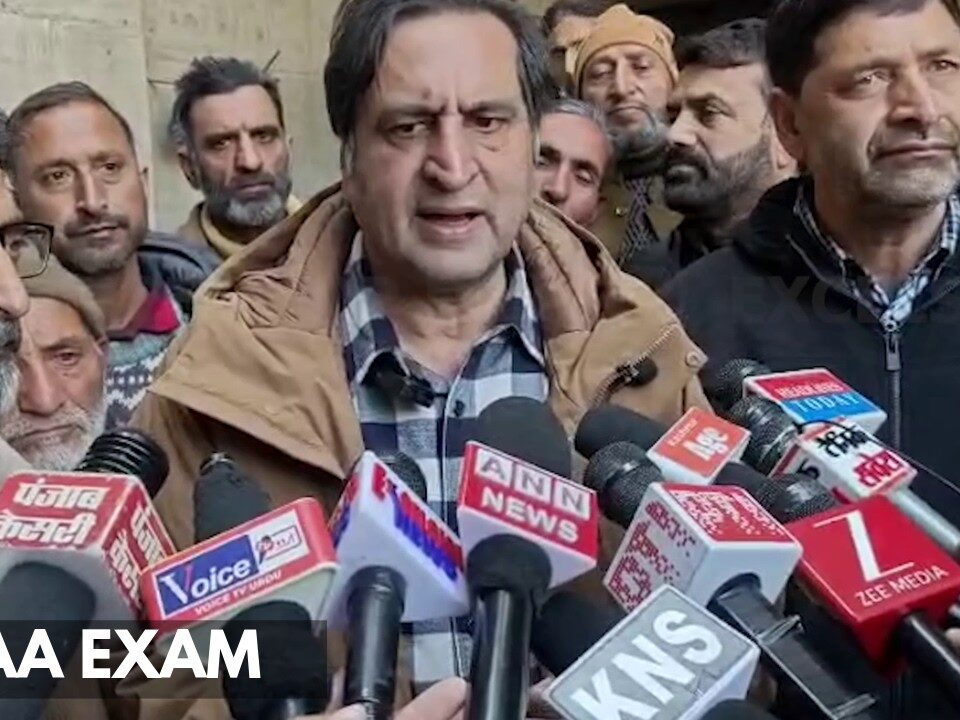
Sajad Gani Lone’s call to shut down the Jammu and Kashmir Services Selection Board (JKSSB) marks a sharper turn in the ongoing recruitment controversy, shifting the debate from alleged examination malpractice to the future of the institution itself.
The People’s Conference president argues that repeated recruitment scandals, allegations of corruption and suspected manipulation have damaged the credibility of the agency responsible for selecting candidates for government jobs. His demand is not simply for another inquiry or administrative correction, but for the dismantling of the existing system and a fundamental restructuring of public recruitment.
The demand comes at a particularly sensitive time, with thousands of aspirants anxiously awaiting recruitment opportunities and the latest allegations of cheating adding to years of frustration over examination integrity.
For young job seekers in Jammu and Kashmir, the controversy raises an unsettling question: if the institution entrusted with selecting candidates repeatedly faces allegations, how can applicants be confident that merit will ultimately prevail?
What exactly is Sajad Lone proposing: Abolish the board or decentralise recruitment?
The significance of Lone’s statement lies in the alternative he has proposed. He is not merely demanding disciplinary action against officials or another inquiry into the latest controversy. He is arguing that the recruitment structure itself needs to be dismantled and decentralised.
According to reports published on November 23, Lone argued that individual government departments should conduct recruitment independently, potentially through specialised examination agencies, particularly for computer-based tests. He questioned why departments should remain dependent on JKSSB for filling vacancies and argued that the centralised system had contributed to delays and left recruitment vulnerable to political interference.
The proposal could fundamentally change how government jobs are filled in Jammu and Kashmir.
Under the current centralised model, JKSSB conducts recruitment for various non-gazetted posts across government departments. Centralisation is intended to standardise selection procedures, reduce departmental discretion and create a common framework for competitive examinations. But Lone argues that the institution has failed to deliver the trust and efficiency expected of it.
His alternative would distribute recruitment responsibilities among departments, with technical agencies assisting in examination delivery.
The idea may appear attractive in the wake of repeated controversies, but decentralisation also raises important questions. Would departments have the expertise, resources and independence required to conduct secure examinations? Could a system involving numerous departments and outsourced vendors be easier to supervise, or would it create more fragmented accountability?
The problem, therefore, is not simply whether JKSSB should continue. It is whether any replacement model can demonstrably provide stronger safeguards, independent oversight and equal opportunity.
From complete overhaul to winding up: Lone’s position has hardened
The latest demand also reflects a shift in the language of the political debate.
On November 20, Lone was reported to have called for a complete overhaul of the recruitment board, expressing concern about recurring irregularities, alleged unusual marks patterns and the Board’s overall record. In subsequent statements reported on November 23, he went further, calling for JKSSB to be wound up and recruitment decentralised.
This progression is important. It suggests that the latest examination controversy has pushed criticism beyond the demand for stronger monitoring or administrative reform and towards questioning whether the institution should continue in its present form at all.
Lone has also argued that recruitment irregularities should be examined across successive governments rather than attributed to a single political administration. He has accused previous governments of political interference in appointments and challenged parties currently demanding accountability to examine their own records in office.
These are political allegations, not established findings of a comprehensive investigation. But they underline the wider nature of the dispute: recruitment integrity in Jammu and Kashmir has become a question of political credibility, institutional history and public confidence, not merely examination management.
Decentralisation may solve one problem, but create another
The proposal to let individual departments conduct their own recruitment has merits worth examining. Departments could plan vacancies more closely, coordinate recruitment with workforce requirements and potentially reduce the backlog created by a centralised selection calendar.
Yet decentralisation is not automatically synonymous with transparency.
If every department independently handles recruitment, the administration would need to ensure that each follows uniform rules on eligibility, reservations, question-paper security, evaluation, grievance redressal and publication of results. It would also need to prevent departments from becoming vulnerable to pressure from local political or bureaucratic networks.
The use of specialised examination vendors may improve technical delivery, particularly for computer-based tests, but outsourcing does not transfer away the government’s responsibility. The contracting department would still be accountable for selecting vendors, protecting data, supervising performance and responding to failures.
A fragmented recruitment structure could also make it harder for candidates to track vacancies and challenge irregularities if the grievance system is not uniform.
The core issue, therefore, is not centralisation versus decentralisation alone. It is whether the system is designed so that no department, contractor or official can exercise unchecked influence over selection.
That is the test any replacement for JKSSB would have to pass.
JKSSB defends examination security as political criticism intensifies
The recruitment controversy has also drawn a response from the Board itself. In a press notice dated November 19, JKSSB defended the integrity of its examination process and said it was updating its standard operating procedures, tightening access controls, improving examination-centre security and increasing technical surveillance to counter the use of electronic gadgets for unfair means.
The Board said the interests of genuine candidates and the sanctity of examinations remained paramount, and that attempts to undermine the process would be dealt with under law.
These measures indicate that JKSSB is seeking to strengthen its safeguards rather than accept the conclusion that the institution itself is beyond repair. But in a climate of distrust, the effectiveness of those measures will ultimately be judged by the results, not the announcements.
The unanswered question: Who will recruit if JKSSB is shut down?
Winding up JKSSB would be a major administrative decision. The government would have to determine which authority would assume responsibility for existing recruitment notifications, pending selections, examinations already conducted, results awaiting declaration, appeals and candidate grievances.
It would also need to establish a transition mechanism so that abolishing the Board does not further delay appointments or leave aspirants uncertain about examinations they have already taken.
A replacement system would require clear rules, a defined chain of responsibility, independent monitoring, secure examination technology, transparent vendor selection and an effective appeal mechanism. Without those safeguards, merely changing the institution’s name or distributing its responsibilities could leave the underlying problems untouched.
The government would also have to consider whether a restructured central recruitment authority, a department-led model or a hybrid arrangement would offer the strongest balance between efficiency and accountability.
That debate deserves evidence-based scrutiny rather than a rushed decision driven only by the latest controversy.
Recruitment controversy is now a test of political accountability
Sajad Lone’s demand to wind up JKSSB has added a new dimension to the recruitment controversy in Jammu and Kashmir. What began as questions about an alleged cheating racket has expanded into a debate over decades of recruitment practices, institutional credibility, political interference and the future of government hiring.
The government faces pressure to demonstrate that the latest allegations are being investigated independently and that examination security measures are more than procedural assurances. Opposition parties, meanwhile, are demanding sweeping changes, although their own records in government are also part of the political debate raised by Lone.
For the thousands of aspirants caught in the middle, the argument over whether JKSSB should survive may matter less than the outcome of the reforms it produces.
They want vacancies advertised on time. They want examinations conducted securely. They want results based on merit. They want investigations that establish facts, not merely headlines. And they want to know that paying an application fee and preparing for months will give them a fair opportunity to compete.
Ultimately, the credibility of Jammu and Kashmir’s recruitment system cannot be restored through political promises or institutional self-defence alone. It must be earned through transparent procedures, credible investigations, timely recruitment and accountability wherever wrongdoing is established.
Whether JKSSB is overhauled, restructured or eventually replaced, the next system must be better than the one it is meant to fix.
Because for Jammu and Kashmir’s unemployed youth, another recruitment experiment without accountability is not reform. It is another gamble with their future.