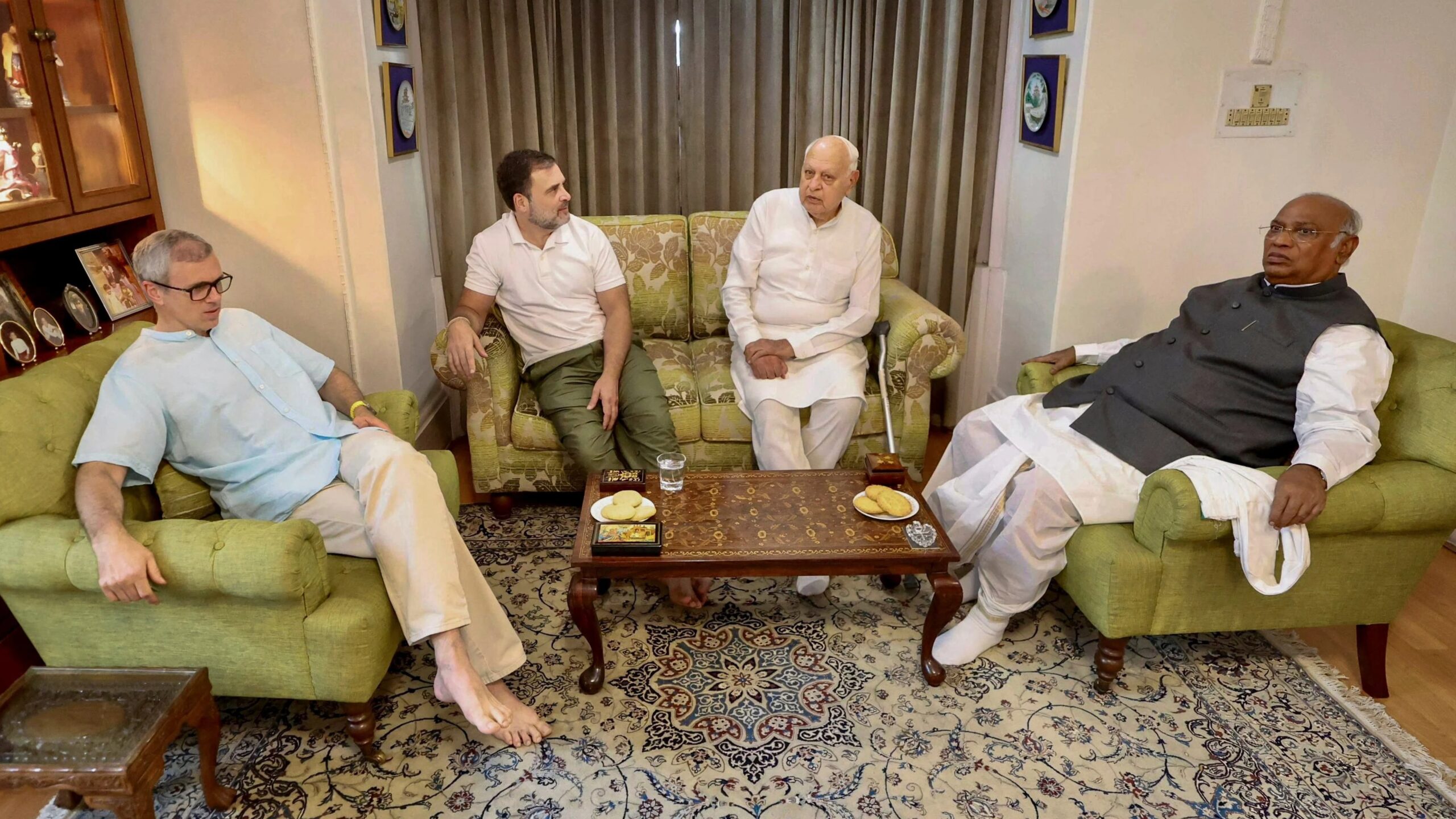
Congress Slams Centre Over J&K Statehood Delay, Signals Rift With NC Over ‘Two Power Centres’
By: Javid Amin | 20 May 2026
Tariq Hameed Karra Raises Possibility of Reconsidering Congress–NC Alliance as Statehood Frustration Deepens in Jammu & Kashmir
Political tensions in Jammu & Kashmir have intensified after the Indian National Congress sharply criticized the BJP-led Centre for delaying the restoration of statehood to the Union Territory, while simultaneously hinting at growing dissatisfaction within its alliance with the National Conference.
J&K Congress chief Tariq Hameed Karra accused the Centre of creating a “dual power structure” in Jammu & Kashmir, claiming people are now trapped between “two power centres” after the Assembly elections.
His remarks have triggered fresh speculation over the future of the Congress–NC coalition and reopened the broader political debate surrounding statehood, governance, democratic rights, and Centre–region relations in post-2019 Jammu & Kashmir.
Congress Accuses Centre of Failing to Restore Statehood
At the heart of Congress’s criticism is the continued delay in restoring full statehood to Jammu & Kashmir following the abrogation of Abrogation of Article 370 in August 2019.
“Promises Without Timeline”
Congress leaders argue that the BJP-led Centre repeatedly assured the people of Jammu & Kashmir that statehood would eventually be restored, yet no concrete roadmap or timeline has emerged.
According to Tariq Hameed Karra, this prolonged uncertainty has weakened democratic accountability and created administrative confusion across the Union Territory.
The Congress claims the current governance structure has effectively split authority between:
- The elected government
- The Lieutenant Governor-led administrative system backed by the Centre
This, Karra argues, has left ordinary citizens “sandwiched” between two parallel power structures.
What Congress Means by “Two Power Centres”
The phrase “two power centres” has become central to Congress’s political attack.
Governance Without Full Autonomy
Since Jammu & Kashmir’s reorganization into a Union Territory, several administrative powers remain under the control of the Centre through the Lieutenant Governor’s office.
While Assembly elections restored an elected political setup, Congress leaders argue that real authority over major governance decisions still remains heavily centralized.
Critics claim this arrangement creates:
- Delayed decision-making
- Administrative overlap
- Reduced accountability
- Political friction between elected representatives and bureaucracy
Congress argues that this hybrid system weakens democratic governance and undermines the mandate of elected representatives.
Congress Raises Youth Employment Concerns
Another major issue highlighted by Congress is unemployment and recruitment policy.
“Local Youth Being Marginalized”
Karra alleged that young people in Jammu & Kashmir are increasingly frustrated due to shrinking employment opportunities and recruitment patterns that locals perceive as unfair.
Congress leaders claim many residents believe outsiders are receiving employment opportunities while local youth continue struggling with unemployment.
The issue carries significant political sensitivity in Jammu & Kashmir, where employment has long been linked to identity, regional rights, and economic dignity.
Youth frustration has become one of the strongest drivers of political dissatisfaction in the Union Territory.
Allegations of Resource Exploitation
Congress also accused the Centre of allowing unchecked exploitation of Jammu & Kashmir’s natural resources.
Land, Sand, Bajri and Forest Produce Under Spotlight
According to Congress leaders, locals increasingly feel disconnected from decisions involving:
- Land use
- Mining contracts
- Sand and bajri extraction
- Forest resources
The party alleges that economic benefits are not adequately reaching local communities.
This criticism taps into a broader public perception that post-2019 governance has centralized economic control while weakening local participation in resource management.
Whether fully accurate or politically amplified, the issue resonates emotionally because it intersects with identity, ownership, and regional autonomy.
Cracks Emerging in Congress–NC Alliance
The growing criticism of governance structures has also exposed tensions inside the Congress–NC alliance.
Congress Questions Alliance Effectiveness
The Congress and NC alliance was largely built around a shared objective: countering the political expansion of the Bharatiya Janata Party in Jammu & Kashmir.
However, Congress leaders now appear increasingly concerned that the alliance is limiting their political identity while failing to deliver stronger pressure on the Centre over statehood restoration.
Reports suggesting Congress may reconsider its coalition arrangement with NC reflect growing frustration within sections of the party leadership.
Why Congress Is Feeling Politically Cornered
Several internal dynamics are shaping Congress’s evolving position.
1. Fear of Being Overshadowed by NC
Congress leaders privately worry that the party is losing visibility in Kashmir while NC continues dominating opposition politics in the Valley.
Remaining in the alliance may preserve opposition unity, but it risks reducing Congress to a secondary political actor.
2. Pressure to Build Independent Ground Support
Congress has recently intensified grassroots mobilization campaigns, particularly through initiatives like:
“Hamari Riyasat, Hamara Haq”
The campaign seeks to frame Congress as a direct champion of:
- Statehood restoration
- Democratic rights
- Local employment
- Resource protection
By strengthening booth-level networks and public outreach, Congress hopes to rebuild its independent political base.
3. Strategic Dilemma Over Opposition Unity
Congress now faces a difficult political calculation:
Stay With NC
- Maintains anti-BJP opposition unity
- Prevents vote fragmentation
- Preserves broader coalition politics
Exit the Alliance
- Helps Congress regain independent identity
- Allows stronger statehood-centric positioning
- Risks splitting opposition votes
This dilemma mirrors opposition politics across India, where coalition survival often clashes with party revival ambitions.
Centre’s Position on Statehood Restoration
The BJP-led Centre has consistently maintained that statehood will be restored to Jammu & Kashmir “at an appropriate time.”
However, officials continue linking the timeline to:
- Security stabilization
- Counter-terrorism progress
- Administrative normalization
- Electoral consolidation
The absence of a fixed timeline has allowed opposition parties to accuse the Centre of intentionally prolonging Union Territory status to maintain tighter administrative control.
Why Statehood Has Become an Emotional Issue in J&K
For many residents, the demand for statehood is no longer viewed purely as a constitutional or administrative matter.
It has evolved into a larger issue involving:
- Political dignity
- Democratic representation
- Regional identity
- Public participation in governance
This emotional dimension explains why statehood continues to dominate political narratives across party lines.
Even parties with differing ideologies often converge on the demand for restoration of full statehood.
Public Sentiment: Frustration, Fatigue and Uncertainty
Public frustration in Jammu & Kashmir stems from multiple overlapping concerns.
Growing Alienation Among Sections of Youth
Young people increasingly express anxiety over:
- Limited job opportunities
- Economic uncertainty
- Delayed political normalization
- Perceived exclusion from decision-making
This dissatisfaction has become politically significant because Jammu & Kashmir has one of the youngest demographic profiles in the country.
Political Fatigue With Endless Transition
Many residents feel the region has remained trapped in a prolonged “temporary phase” since 2019.
The repeated assurances regarding statehood without concrete deadlines have contributed to skepticism toward both regional parties and the Centre.
What Happens if Congress Pulls Out of the NC Alliance?
If Congress formally exits the alliance with NC, Jammu & Kashmir’s political landscape could shift dramatically.
Possible Outcomes
Fragmented Opposition
A split could divide anti-BJP votes between Congress, NC, PDP, and smaller regional players.
New Political Alignments
Congress may attempt tactical understandings with the People’s Democratic Party or independents.
BJP Gains Strategic Advantage
A divided opposition could strengthen BJP’s electoral position, especially in Jammu.
Congress Repositions Itself
Congress may attempt to emerge as the principal political voice demanding immediate restoration of statehood.
The Larger Political Battle Ahead
The current controversy reflects more than coalition tensions.
It highlights the central political battle shaping Jammu & Kashmir today:
Who controls the narrative around dignity, democracy, and statehood?
For Congress, intensifying criticism of the Centre may help reconnect with public frustration.
For NC, maintaining opposition unity remains critical.
For the BJP, retaining administrative control while managing regional sentiment remains a delicate balancing act.
And for the people of Jammu & Kashmir, the uncertainty surrounding statehood continues to fuel political anxiety, emotional fatigue, and growing impatience.
Conclusion
Congress’s sharp attack on the Centre over Jammu & Kashmir’s delayed statehood restoration marks a significant escalation in the region’s political discourse.
By accusing the administration of creating “two power centres,” the party is attempting to channel public frustration over governance, unemployment, and political uncertainty.
At the same time, growing strains within the Congress–NC alliance suggest opposition politics in Jammu & Kashmir may soon enter another phase of realignment.
Whether Congress ultimately remains within the coalition or chooses an independent path, one issue is likely to dominate the political conversation ahead: the unresolved question of Jammu & Kashmir’s statehood.


