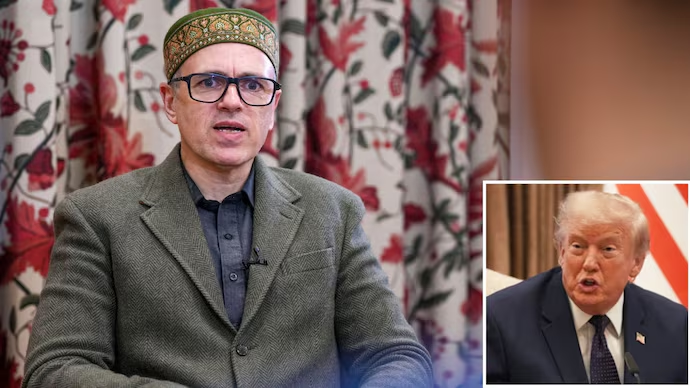
BJP Accuses Omar Abdullah of ‘Internationalising’ Kashmir; Trump Reference Triggers Fresh Political Confrontation
By: News Desk | 19 July 2026
Row erupts after J&K Chief Minister’s remarks on statehood and a satirical Trump post ahead of the National Conference’s Delhi protest
The political confrontation between the Bharatiya Janata Party (BJP) and the National Conference (NC) has intensified after the BJP accused Jammu and Kashmir Chief Minister Omar Abdullah of attempting to “internationalise” the Kashmir issue.
The controversy arose after Omar Abdullah, while campaigning for the restoration of Jammu and Kashmir’s statehood, remarked that if the Centre was unwilling to fulfil its promise, people might have to “go to Donald Trump” or even protest outside the White House. A day later, Abdullah shared a satirical social media post falsely attributed to U.S. President Donald Trump, captioning it with the words “If only!”.
The BJP seized upon these remarks, arguing that invoking a foreign leader in the context of Kashmir amounted to an attempt to internationalise what India considers an internal constitutional matter.
What Triggered the Controversy?
During a public rally ahead of the National Conference’s proposed protest for the restoration of statehood, Omar Abdullah questioned how long Jammu and Kashmir should wait for the Centre to honour its repeated assurances.
In a rhetorical remark, he said that if justice could not be secured in New Delhi, “Should we go to Donald Trump or protest outside the White House?” The statement was widely interpreted as political sarcasm aimed at highlighting delays in restoring statehood.
The following day, Abdullah shared a parody social media post that humorously portrayed Donald Trump supporting Jammu and Kashmir’s statehood demand. Abdullah himself added the caption “If only!”, making clear that it was satire rather than an authentic endorsement.
BJP’s Allegation
Reacting to the remarks, BJP leaders accused Omar Abdullah of attempting to draw international attention to Kashmir.
According to BJP leaders:
- Kashmir is an internal matter of India.
- Referring to a foreign head of state in political speeches is inappropriate.
- The Centre has already committed to restoring statehood at an appropriate time.
- Such statements unnecessarily create international narratives around domestic constitutional issues.
The BJP has also continued to argue that the National Conference’s Delhi protest is intended to divert attention from governance issues in Jammu and Kashmir.
Omar Abdullah’s Position
The National Conference maintains that its campaign is focused on the restoration of Jammu and Kashmir’s statehood, which it says was promised by the Union Government.
Omar Abdullah has argued that:
- Statehood is a constitutional commitment.
- The issue concerns democratic rights and governance.
- The Trump reference was rhetorical and satirical rather than a request for foreign intervention.
- The parody social media post was intended as political humour directed at the BJP.
Fact Check: Did Donald Trump Really Respond to Omar Abdullah?
No. There is no evidence that Donald Trump issued any statement or social media post supporting Omar Abdullah or Jammu and Kashmir’s statehood demand.
This is the most important factual point in the controversy.
The viral post that circulated online was a parody (fake) post, designed to imitate Donald Trump’s style of writing.
Omar Abdullah shared that spoof with the caption:
“If only!”
That caption itself indicated that the post was fictional and represented something he wished had happened—not something that actually occurred. Multiple media organisations identified the post as satirical.
So, did Trump respond?
No.
There is no verified statement, no verified Truth Social post, no verified X post, and no official White House communication in which Donald Trump commented on Omar Abdullah’s campaign for Jammu and Kashmir’s statehood.
If Trump Had Actually Responded, What Weight Would It Carry?
Legally and constitutionally, very little.
Here’s why:
1. Kashmir Is India’s Internal Constitutional Matter
India has consistently maintained that Jammu and Kashmir is an internal matter governed by the Constitution of India.
Neither statements by foreign leaders nor international commentary have any legal effect on decisions relating to:
- Statehood.
- Article 370.
- Article 35A.
- Legislative powers.
2. A Social Media Post Has No Diplomatic Value
Even if a foreign leader were to post support on social media, it would not:
- Change India’s constitutional position.
- Bind the Government of India.
- Influence Supreme Court decisions.
- Create any legal obligation.
At most, it would become a matter of political or diplomatic discussion.
3. Only Official U.S. Government Policy Would Carry Diplomatic Significance
Even an official statement by the U.S. administration would have political and diplomatic significance, but no legal authority over India’s constitutional decisions.
India has traditionally rejected third-party mediation on Kashmir, maintaining that any issues relating to Jammu and Kashmir are matters for India and, where applicable, bilateral engagement under existing agreements.
Political Significance
The controversy illustrates how political messaging increasingly shapes the debate over Jammu and Kashmir.
BJP’s Narrative
The BJP seeks to portray:
- The National Conference as unnecessarily invoking international references.
- The statehood campaign as political theatre.
- Governance and development as more pressing concerns.
National Conference’s Narrative
The NC argues that:
- Statehood is a constitutional promise.
- Public pressure is necessary after repeated delays.
- Political satire should not be interpreted as diplomatic outreach.
- The debate is fundamentally about democratic rights within India.
Political Analysis
From a political perspective, the disagreement is less about Donald Trump than about competing narratives.
The BJP has used Omar Abdullah’s Trump reference to reinforce its long-standing position that Kashmir should never be discussed in a manner that appears to invite international attention.
The National Conference, meanwhile, maintains that the Trump remark was rhetorical and that the parody post was clearly intended as satire. The party continues to focus on its demand for restoring Jammu and Kashmir’s statehood.
The episode demonstrates how a brief political quip can quickly become a major campaign issue when constitutional questions, national politics and social media intersect.
Conclusion
The BJP’s accusation that Omar Abdullah attempted to “internationalise” Kashmir has added another chapter to the escalating political contest over Jammu and Kashmir’s future. While the BJP argues that references to Donald Trump undermine India’s position that Kashmir is an internal matter, the National Conference insists that the comments were rhetorical and that the subsequent Trump post shared by Omar Abdullah was an obvious parody.
There is no evidence that Donald Trump actually responded to Omar Abdullah or endorsed Jammu and Kashmir’s statehood demand. The viral post was satirical, and Abdullah himself acknowledged that fact through his caption, “If only!” The broader political dispute, however, is likely to continue as both parties sharpen their competing narratives ahead of the National Conference’s statehood campaign and the BJP’s counter-mobilisation.


