No Hotspot, No Choice: Airtel’s 5G Tethering Diktat and the Real Cost of “Unlimited” Data in India
By: Javid Amin | 19 July 2026
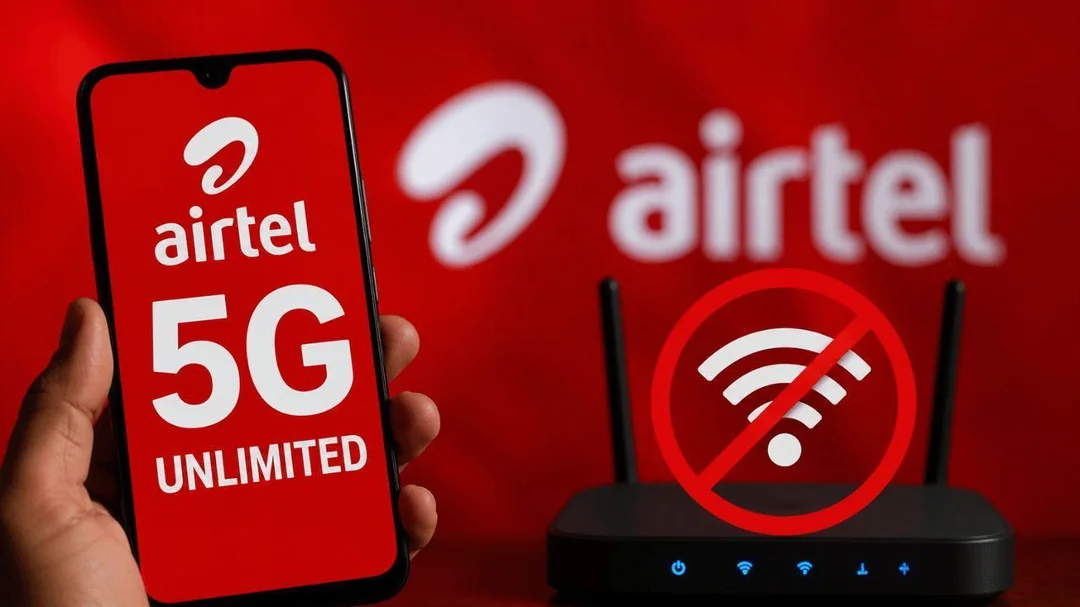
In the third week of July 2026, a screenshot did what years of tariff hikes hadn’t quite managed — it made Indian telecom users openly furious on social media. The image, appearing to show a clause buried in Airtel’s Unlimited 5G Data terms, read that data sharing “shall not be allowed via mobile hotspots” once a customer activated the unlimited benefit. For an offer marketed and sold as “unlimited,” the idea that it might not work the moment you tried to connect a laptop or tablet through your phone landed like a bait-and-switch.
This is the story of that controversy, what it reveals, and how it fits into a much longer pattern: a telecom market where a “year” quietly shrank to 13 recharge cycles, and where tariff hikes keep arriving bundled with features the average user never asked for — and increasingly, may not even be allowed to fully use.
The Diktat: Airtel’s Hotspot Clause, Explained
Here’s what actually happened, stripped of the noise. Airtel’s published terms and conditions for its Unlimited 5G Data offer surfaced online showing two restrictions that had gone largely unnoticed until users started comparing notes: first, that unlimited 5G data could not be shared with other devices via mobile hotspot, and second, that even without the hotspot question, the “unlimited” benefit was subject to a 300 GB monthly fair-usage cap, beyond which usage would be treated as commercial and potentially throttled or charged.
Users reacted with a mix of confusion and anger, many pointing out that mobile hotspot is often the only way to get a laptop or tablet online in areas without fixed broadband — precisely the use case that “unlimited 5G” is marketed to replace. Multiple technology outlets then found conflicting information: some saw the hotspot-restriction clause live on Airtel’s site, others found only the general terms and conditions with no such line, and Airtel itself did not immediately confirm or deny the policy. Within roughly 48 hours, at least one outlet reported that Airtel had removed the disputed hotspot clause from its terms altogether, and that in practical testing, hotspot functionality had continued to work throughout the controversy. As of this writing, the matter remains murkier than a clean resolution — the clause’s brief existence, and the confusion it caused, is the real story, regardless of whether it survives in Airtel’s fine print going forward.
What isn’t in dispute is the 300 GB monthly cap, which Airtel confirms applies to “personal, non-commercial use” — meaning a customer paying for “unlimited” data can still be flagged the moment they cross a threshold most people will never notice, but a genuine remote worker or multi-device household easily could. Reliance Jio, by contrast, has marketed its Unlimited 5G benefit as compatible with hotspot sharing without an equivalent public restriction, which is precisely why so many frustrated Airtel users on social media said they were considering porting out. There is no confirmed reporting that Jio itself is planning to introduce a similar hotspot or tethering restriction — if anything, the current contrast is being used by Jio’s user base as a reason to stay put — but the episode has put every operator’s “unlimited” fine print under fresh scrutiny.
The pattern to notice here isn’t really about hotspots. It’s about a semantic sleight of hand that’s becoming common across the industry: the word “unlimited” sold at a premium price, quietly fenced in by caps, exclusions and device restrictions that only surface when a customer reads (or is shown) the terms and conditions — not when they’re sold the plan at the store counter or in the app.
How a Year Became 13 Months: The Validity Math Nobody Explains
Long before hotspot clauses made headlines, telecom operators had already found a quieter way to extract an extra recharge from every customer, every year — and it hides in plain sight in something as mundane as “validity.”
A calendar year has 12 months and 365 days. A recharge plan advertised with 28-day validity, however, does not map onto a calendar month — it’s four weeks, not “a month.” Do the arithmetic: 12 recharges of 28 days each cover only 336 days of the year, not 365. That leaves 29 days uncovered — enough that most subscribers on 28-day plans end up needing a 13th recharge to actually stay connected for all twelve calendar months. What looks like “one recharge a month” on paper quietly becomes 13 recharges a year in practice.
This wasn’t always the case. Through the 2010s, most prepaid validity cycles ran a genuine 30 days, aligning reasonably well with a calendar month. Starting around 2019–2021, as operators pushed to lift average revenue per user, validity windows across the industry were widely shifted down to 28 days — even as headline prices for many plans stayed the same or rose only modestly. The effect is a hike that never has to be announced as one: the price per recharge might look unchanged, but the number of recharges a household needs each year quietly went up by roughly 8%, and few customers ever do the math to notice it.
It’s a small, almost invisible mechanism, but multiplied across hundreds of millions of subscribers making a hundred-plus recharges each, it adds up to real money extracted from household budgets every year — money that never shows up as a headline “tariff hike” in any news report, because technically, no price went up. The plan just runs out sooner than a month usually does.
The Bigger Pattern: Tariffs Rise, Choice Shrinks, and You’re Opted In Whether You Like It or Not
The hotspot controversy and the 28-day validity trick are two symptoms of the same underlying shift — India’s telecom pricing has moved from “pay for what you use” toward “pay for what we’ve decided you should have,” with the fine print doing the quiet work of narrowing what “unlimited” or “full month” actually means.
The tariff timeline tells the story on its own:
- 2016–2017 (Jio’s launch): Data collapsed from roughly ₹297/GB to under ₹10/GB. Free voice calls and 1 GB/day packs made India briefly one of the cheapest data markets on Earth.
- 2018–2019: The market stabilised around ₹149–₹399 packs for 1.5–2 GB/day — still highly affordable, and validity still largely ran a genuine 30 days.
- 2019–2021: Tariffs rose 35–40% in stages as Vodafone Idea and Airtel, weighed down by AGR dues, pushed to lift ARPU. Validity quietly shrank from 30 to 28 days industry-wide.
- 2022–2024: Entry-level packs roughly doubled, from about ₹99 to ₹199 in several circles, disproportionately hitting first-time users and low-income households.
- July 2024: Jio, Airtel and Vodafone Idea raised tariffs together for the first time in three years — increases of 10% to 27% depending on the plan — a move operators openly tied to recovering an estimated ₹1.5 trillion sunk into 5G rollout. Brokerages estimated this single round added roughly ₹47,500 crore a year to what Indian households collectively spend on mobile bills. Within weeks, state-run BSNL, which held its prices, gained close to 2.9 million subscribers while the three private operators lost several million between them — the first month-on-month shrinkage the industry had seen in years, and about as clear a signal of consumer discontent as TRAI data has ever produced.
- 2025–2026: The “unlimited 5G” era arrived — plans priced from roughly ₹699 to ₹999 a month, bundling hotspot access, OTT subscriptions and other add-ons by default, even as entry-level 1.5 GB/day plans crept up toward ₹299–₹349. And now, mid-2026, the first real controversy over whether “unlimited” quietly excludes the very use case — tethering a laptop — that makes mobile data valuable to remote workers and students without home broadband.
The average Indian mobile user consumes well under 10 GB a month. Yet the shelf is increasingly stocked with “unlimited” tiers built for heavy streamers, sold at a premium, bundled with hotspot access and OTT passes that a large share of subscribers never activate — and, as the Airtel episode showed, not even guaranteed to work exactly as marketed once the fine print is tested. Light users end up subsidising features they don’t use, while heavy users discover the “unlimited” label comes with caps, exclusions, and now, tethering questions they weren’t told about at the point of sale.
Where the Regulator Stands
TRAI, the body explicitly created to protect telecom consumers, has largely left retail tariff-setting to the operators themselves, under a long-standing policy of “forbearance” that assumes competition between operators will keep prices honest. That assumption looked reasonable when half a dozen operators were slugging it out for subscribers. It looks considerably shakier in a market now effectively down to three private players plus a financially strained BSNL — where all three have raised prices within days of each other more than once, and where a clause as consumer-relevant as “your unlimited plan can’t be shared via hotspot” can surface, spark days of national confusion, and be quietly walked back, all without any regulatory intervention or public disclosure requirement forcing operators to flag such terms clearly upfront.
TRAI has not been silent — it continues to issue consultation papers and amendment orders, including recent measures mandating shorter, voice-and-SMS-only recharge vouchers for users who don’t need data at all. But nothing in its current framework requires operators to define “unlimited” uniformly, disclose fair-use caps prominently at the point of sale, or justify why a “month” of validity has come to mean four weeks instead of thirty days. Each of those gaps is a small mechanism by itself. Together, they describe a regulator whose light-touch philosophy was built for a far more competitive market than the one that exists today.
Editorial Take
Strip away the terminology and the pattern across the hotspot clause, the 28-day validity cycle, and a decade of tariff hikes is the same: the customer is repeatedly opted into terms they didn’t negotiate and often don’t fully read, and the burden of discovering the fine print — whether it’s a hidden data cap, a missing four days of validity, or a hotspot restriction that may or may not survive public backlash — falls entirely on the subscriber. None of this means Indian telecom pricing is unreasonable in absolute terms, or that operators are wrong to want a return on genuinely enormous 5G investment. But “unlimited,” sold at a premium and fenced in by caps and exclusions nobody advertises upfront, isn’t really unlimited — it’s a marketing word doing the job a clearer price tag should be doing instead. Until operators are required to define these terms plainly, and until a regulator built for a six-player market updates its playbook for a three-player one, the common man will keep discovering the real terms of his “unlimited” plan the same way Airtel’s customers just did — by accident, on social media, after he’s already paid for it.
Author note for editorial desk: The Airtel hotspot/tethering controversy is a fast-developing story as of 18–19 July 2026, with conflicting reports on whether the disputed clause remains live; the piece reflects the state of reporting as of publication and should be re-verified against Airtel’s current terms and conditions before this goes to print, in case the company issues a formal clarification after this draft is filed. All other tariff figures, subscriber numbers and dates have been cross-checked against TRAI subscription data releases and contemporaneous business/telecom trade reporting (2019–2026). No verbatim quotations exceeding fair-use thresholds have been used.
Disclaimer
This article is a journalistic analysis based on public reporting, TRAI data, and operator-published terms as of July 2026 — not legal or financial advice. The Airtel hotspot/tethering situation is still developing and reports on it conflict; verify current terms directly with Airtel before acting on this information. All figures are sourced from third-party and regulatory data believed reliable at publication but subject to revision. Jio, Airtel, Vi, BSNL, and TRAI are named for factual reference only; this piece is independent, unaffiliated, and not intended to defame any party. Content may be updated or corrected as new information emerges.

