People’s Democratic Party Sets Conditions to Join NC’s Delhi Protest, Demands Article 370 Restoration and Release of Political Prisoners
By: News Desk | 18 July 2026
Mehbooba Mufti Says Statehood Alone Cannot Replace the Demand for Constitutional Rights Restored Before August 2019
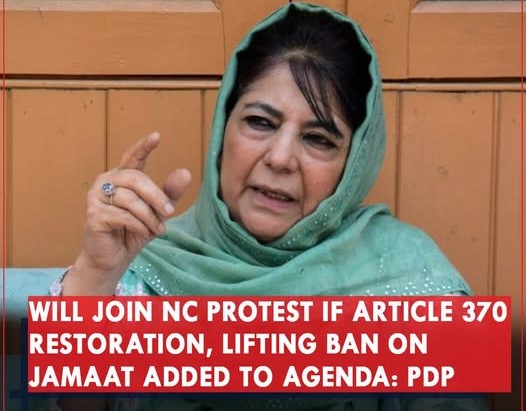
Fresh differences have emerged among Jammu and Kashmir’s regional political parties after the People’s Democratic Party (PDP) announced that it would participate in the National Conference’s (NC) proposed protest at Jantar Mantar in New Delhi only if the programme expands beyond the demand for statehood.
PDP president Mehbooba Mufti said that any joint political campaign must include the restoration of Article 370 and Article 35A, the release of political detainees, and broader civil and democratic rights. According to the PDP, limiting the protest solely to statehood risks overlooking what the party considers the core constitutional issues arising from the changes introduced on August 5, 2019.
The statement highlights continuing differences among Kashmir’s regional parties over both the priorities and strategy of opposition politics, even as they broadly seek greater political and constitutional rights for Jammu and Kashmir.
What the PDP Has Demanded
The PDP has made its participation in the Delhi protest conditional upon the inclusion of a broader political agenda.
According to Mehbooba Mufti, the proposed protest should not be confined to the demand for statehood alone.
Instead, the party wants the movement to include:
- Restoration of Article 370.
- Restoration of Article 35A.
- Release of political detainees and prisoners, subject to applicable legal processes.
- Review of restrictions affecting political and civil rights.
- Wider constitutional and democratic issues arising after the 2019 reorganisation of Jammu and Kashmir.
The PDP argues that these issues are interconnected and should be presented together in any united political campaign.
Why the PDP Says Statehood Alone Is Not Enough
The PDP believes that focusing exclusively on statehood risks narrowing the political debate.
According to the party, restoration of statehood would address the administrative status of Jammu and Kashmir, but would not, by itself, resolve questions relating to the constitutional changes made in 2019.
Mehbooba Mufti has repeatedly argued that:
- Article 370 remains central to the PDP’s political position.
- Constitutional safeguards should remain part of any dialogue with New Delhi.
- Political reconciliation requires more than administrative reforms.
These remarks reflect the PDP’s long-standing political stance following the abrogation of Article 370.
Demand for the Release of Political Prisoners
Another major condition put forward by the PDP concerns the release of political detainees.
The party argues that:
- Democratic engagement should include greater political freedoms.
- Detained political leaders and activists should be released where legally permissible.
- Confidence-building measures are necessary for meaningful political dialogue.
The PDP has also called for reconsideration of restrictions affecting organisations such as Jamaat-e-Islami.
It is important to note that organisations declared unlawful or subject to legal restrictions remain governed by applicable laws. Any changes to their legal status would require action by the competent authorities in accordance with the law.
National Conference’s Position
The National Conference has placed significant emphasis on the restoration of full statehood as one of its principal political demands.
The party has also consistently maintained that it opposes the constitutional changes of August 2019 and has challenged them through political and legal means.
However, the NC’s proposed Delhi protest has primarily been projected as a campaign for statehood, which the PDP believes does not adequately reflect the wider constitutional issues.
The National Conference has not accepted the suggestion that it has abandoned the demand for Article 370, maintaining that its political position includes both constitutional restoration and the return of statehood.
Political Dynamics Within the Opposition
Shared Goals, Different Priorities
Although the PDP and the National Conference share several political objectives, they continue to differ over how those objectives should be pursued.
PDP’s Approach
The PDP argues that:
- Constitutional restoration should remain the foremost issue.
- Statehood should be pursued alongside Article 370.
- Political reconciliation requires civil liberty measures.
- A united opposition must adopt a broader agenda.
National Conference’s Approach
The NC has focused its public mobilisation on:
- Restoration of full statehood.
- Greater powers for the elected government.
- Democratic representation.
- Continued political engagement with the Union Government.
The party maintains that statehood is an immediate and achievable constitutional objective while continuing to advocate its broader political positions.
Implications for Opposition Unity
The PDP’s conditional participation underscores the challenges of building a common opposition platform in Jammu and Kashmir.
While there is broad agreement on several political concerns, differences remain over:
- The sequencing of demands.
- Protest strategy.
- Engagement with New Delhi.
- Political messaging.
If these differences persist, regional parties may struggle to project a unified voice on key constitutional issues.
Public Perception
The debate is likely to resonate differently across sections of the public.
Some people may view the PDP’s insistence on Article 370 as a reaffirmation of its long-held constitutional position.
Others may consider the National Conference’s focus on statehood to be a more pragmatic strategy aimed at achieving incremental political progress.
These competing perspectives reflect the diversity of political opinion within Jammu and Kashmir.
Political Analysis: Competing Visions of the Opposition Agenda
The latest disagreement does not necessarily indicate a complete breakdown in opposition relations. Rather, it highlights differing political calculations.
The National Conference appears to be prioritising a demand that it believes can attract broader political consensus at the national level—restoration of statehood.
The PDP, by contrast, argues that separating statehood from the constitutional questions surrounding Article 370 risks weakening the larger political movement. By linking participation to constitutional safeguards, political detainees and civil liberties, the party seeks to frame the debate as one concerning both governance and constitutional rights.
Whether these differences can be reconciled will determine the strength and coherence of any future joint opposition campaign.
Challenges Ahead
The regional opposition now faces several important questions:
- Can the National Conference and PDP agree on a common protest agenda?
- Will the Delhi demonstration evolve into a broader constitutional campaign?
- Can opposition parties balance immediate political objectives with long-term constitutional demands?
- How will these differences influence public support in Jammu and Kashmir?
Conclusion
The People’s Democratic Party’s decision to condition its participation in the National Conference’s proposed Delhi protest on the inclusion of Article 370, Article 35A, the release of political detainees, and broader constitutional issues has highlighted significant strategic differences within Jammu and Kashmir’s opposition.
While the National Conference continues to place statehood at the forefront of its current mobilisation, the PDP argues that lasting political resolution requires addressing the wider constitutional changes introduced in 2019. As regional parties attempt to shape the future political discourse in Jammu and Kashmir, their ability—or inability—to bridge these differences will play a significant role in determining the effectiveness of any united opposition movement.