Ladakh Dialogue Faces Fresh Crisis as New Forum Challenges Leadership, MHA Meeting Fails to Take Place
By: News Desk | 22 October 22 2026
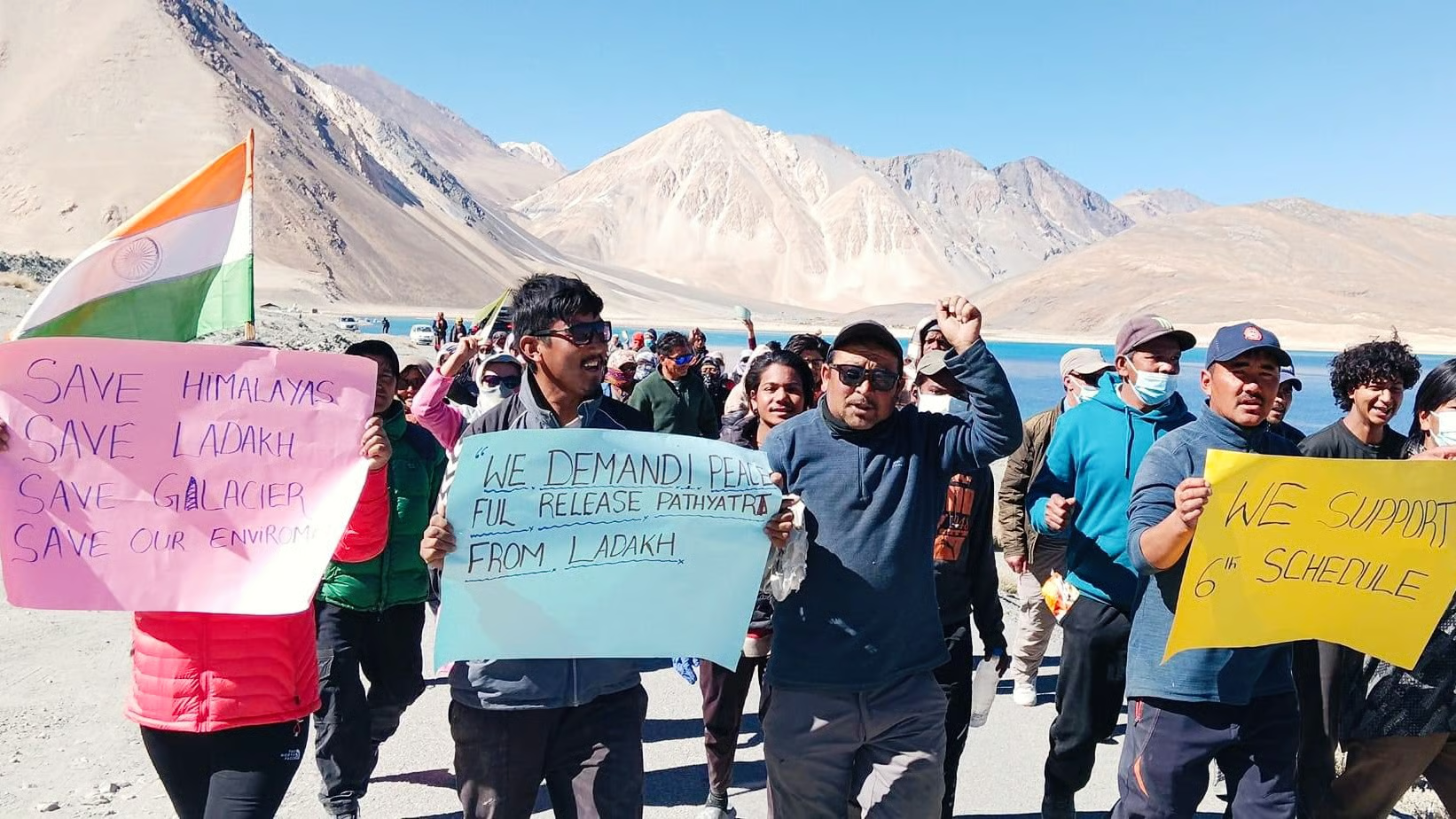
Leh/New Delhi: The political dialogue between Ladakh’s representatives and the Union government has entered a difficult phase, with a scheduled meeting with the Ministry of Home Affairs (MHA) failing to take place on October 22 and a newly formed civil society forum questioning the authority of the region’s established negotiating bodies.
The developments have deepened uncertainty over negotiations aimed at securing constitutional safeguards, greater democratic representation and protection of Ladakh’s land, culture, employment opportunities and natural resources.
The Leh Apex Body (LAB) and the Kargil Democratic Alliance (KDA), which have led much of the movement for greater political autonomy since Ladakh became a Union Territory in 2019, had expected to continue discussions with the Centre in New Delhi. However, LAB leaders said they had not received a formal invitation from the MHA for the proposed meeting.
The failure of the meeting to take place came just days after the two bodies rejected the Centre’s latest draft proposal, arguing that it fell short of commitments and understandings reached during earlier rounds of negotiations.
Activist Sonam Wangchuk reacted sharply, accusing the Centre of repeatedly frustrating Ladakh’s democratic aspirations and undermining public confidence in the dialogue process.
At the same time, a newly formed Civil Society Forum of Ladakh, led by former MP Thupstan Chhewang, has challenged whether LAB and KDA adequately represent the interests of all sections of the region.
The simultaneous emergence of internal divisions and a breakdown in the expected negotiating schedule has created a fresh challenge for a movement that has sought to unite Leh and Kargil around demands for constitutional protection and meaningful self-governance.
The immediate question is no longer simply what the Centre is prepared to offer. It is also whether Ladakh’s representatives can maintain a common negotiating position at a time when the differences between the two sides remain substantial.
October 22 Meeting Fails to Take Place, Leaving Talks in Uncertainty
The latest setback followed a round of discussions held in Leh on October 15, when representatives of LAB and KDA met the MHA subcommittee to examine proposals for a new governance framework.
The discussions ended without agreement. Both sides exchanged draft proposals, but Ladakh’s representatives said the Centre’s document did not meet their expectations regarding constitutional safeguards and the powers of a proposed elected Union Territory-level body.
A further meeting in New Delhi was expected on October 22 to continue the negotiations.
However, LAB chairman Chering Dorjay Lakruk said the group had not received an invitation from the ministry. Representatives of the negotiating bodies had prepared for the next round, but the expected discussions did not take place.
The absence of a meeting has raised questions about the immediate future of the dialogue, particularly after the rejection of the Centre’s draft.
LAB and KDA leaders have accused the Union government of moving away from earlier understandings. The Centre’s position, as reflected in previous official briefings, is that discussions are continuing on a governance arrangement tailored to Ladakh’s circumstances.
The distinction matters. The failure of the October 22 meeting does not, by itself, establish that negotiations have formally ended. It does, however, indicate that the process has encountered a serious procedural and political setback.
For Ladakh’s leadership, the concern is that delays and disagreements over the terms of the proposed framework could weaken confidence in a dialogue that has already involved months of discussions.
Sonam Wangchuk Accuses Centre of Breaking Ladakh’s Trust
Sonam Wangchuk, one of the prominent figures associated with Ladakh’s campaign for constitutional safeguards, has strongly criticised the latest development.
Reacting to the failure of the expected meeting, Wangchuk argued that repeated delays and disagreements had undermined the hopes of people seeking a more democratic system of governance.
“The country should know how the hopes of Ladakh have been ruined again and again,” he said, according to reports published on October 22.
His criticism reflects a broader concern among sections of Ladakh’s political and civil society leadership: that negotiations may produce a framework that offers constitutional assurances on paper but leaves decisive administrative powers with the existing Union Territory administration.
Wangchuk and other campaigners have argued that Ladakh needs more than symbolic representation. They want an elected institution with meaningful authority over matters affecting local communities, including land, jobs, cultural identity, environmental protection and development planning.
The central issue is whether the proposed body would have sufficient legislative, executive and financial powers to influence decisions, or whether its role would remain limited by the authority of the Lieutenant Governor and the Union administration.
Wangchuk’s allegations represent the position of the campaigners and should not be confused with a formal finding that the Centre has legally breached an agreement. The details of the earlier understandings, the wording of the competing drafts and the distribution of powers remain central to the disagreement.
Nevertheless, his reaction highlights the growing frustration among activists who believe that the negotiations have yet to deliver the democratic safeguards they have demanded.
What Are LAB and KDA Demanding From the Centre?
The Leh Apex Body and the Kargil Democratic Alliance emerged as key platforms for coordinating the region’s political demands following the August 2019 reorganisation of the former state of Jammu and Kashmir.
Their campaign has centred on four broad demands: statehood for Ladakh, inclusion under the Sixth Schedule of the Constitution, safeguards for local employment and separate parliamentary representation for Leh and Kargil.
The latest negotiations have also focused on a proposed elected Union Territory-level institution and a special constitutional framework intended to protect Ladakh’s distinctive social, cultural and environmental circumstances.
The principal demands include:
Constitutional safeguards for land and culture: Ladakh’s representatives want stronger protection for local land ownership, language, cultural traditions and natural resources. They argue that constitutional guarantees are necessary to prevent decisions affecting the region from being taken without meaningful local participation.
A powerful elected regional institution: LAB and KDA have sought a directly elected Union Territory-level body with legislative, executive, budgetary, planning and financial authority. They argue that an elected institution must have real powers rather than merely an advisory role.
Greater control over administration: The groups have pushed for elected representatives to exercise meaningful authority over officials implementing policies within the proposed body’s jurisdiction. Bureaucratic accountability has been an important part of earlier discussions.
Protection of jobs and local opportunities: Campaigners want safeguards to ensure that local residents are not disadvantaged in access to public employment and economic opportunities.
A governance framework reflecting Ladakh’s geography and communities: Ladakh includes the predominantly Buddhist Leh district and the predominantly Muslim Kargil district, with distinct local histories and political priorities. Any lasting arrangement must address the interests of both areas.
These demands have evolved through negotiations, protests and discussions involving political leaders, religious figures and civil society organisations.
The current disagreement centres on how far the Centre is prepared to go in granting these safeguards and whether the proposed institutional structure would provide the level of autonomy sought by Ladakh’s negotiating bodies.
Centre’s Article 371(K) Proposal Fails to Bridge the Gap
One of the most significant developments in the negotiations has been the Centre’s proposal for a special constitutional arrangement under a proposed Article 371(K).
The proposal, reported in September 2026, envisages a distinctive governance framework for Ladakh, including a directly elected Union Territory-level body and safeguards concerning land, culture, language, employment, the environment and natural resources.
Ladakh Chief Secretary Ashish Kundra previously described the proposed arrangement as a model that would be different from the existing state and Union Territory systems.
The proposed framework would require constitutional and legislative action. It is not an existing constitutional provision that has already granted Ladakh new powers.
For the Centre, the model appears intended to address concerns about the region’s distinctive circumstances without adopting the full statehood or conventional Union Territory-with-legislature model sought by some campaigners.
For LAB and KDA, however, the key question is the substance of the proposal.
An elected body may provide representation, but representation alone does not guarantee control over policy. The scope of legislative authority, the allocation of financial powers, the relationship with the Lieutenant Governor and the division of responsibilities between the proposed institution and the Ladakh Autonomous Hill Development Councils will determine how much practical authority the body would exercise.
The Centre’s proposal has therefore not resolved the fundamental disagreement.
In their October 15 discussions, the two negotiating bodies reportedly found the latest draft inadequate and rejected it, arguing that it departed from earlier understandings about the proposed institution’s powers.
The rejection suggests that the dispute is not merely about terminology or the creation of a new institution. It concerns who would ultimately make decisions affecting Ladakh and how those decisions would be held accountable to the people.
New Civil Society Forum Questions Who Speaks for Ladakh
As the negotiations with the Centre have stalled, another challenge has emerged from within Ladakh’s own civil society.
The newly formed Civil Society Forum of Ladakh, led by former MP Thupstan Chhewang, has questioned whether LAB and KDA continue to represent the full range of political and social interests across the region.
The forum has urged Prime Minister Narendra Modi to take account of what it describes as the ground reality in Ladakh and has called for a more inclusive approach to consultations.
Its emergence is significant because the earlier dialogue relied heavily on LAB and KDA as the principal platforms representing Leh and Kargil in negotiations with the Centre.
The new forum argues that the process has become insufficiently inclusive and that other voices, including religious leaders, intellectuals, former officials and public representatives, deserve a greater role.
Rigzin Spalbar, a member of the forum and a former chairman and Chief Executive Councillor of the Ladakh Autonomous Hill Development Council in Leh, said the group had been formed because sections of society believed the existing leadership was not adequately addressing their concerns.
In a resolution adopted in Leh, the forum criticised the direction of the negotiations and alleged that the original agenda of constitutional safeguards had been diverted from its broader objectives.
It also called for elections to Panchayats and the Ladakh Autonomous Hill Development Councils across the districts, arguing that stronger grassroots democratic institutions are essential to protecting local interests.
The forum’s intervention has introduced a new question into the negotiations: even if the Centre and LAB-KDA eventually reach an agreement, will the proposed settlement enjoy broad acceptance across Ladakh?
That question is especially important in a region where geography, religious diversity, local governance and different political histories shape public priorities.
LAB Leaders Reject Allegations, Warn of Attempts to Weaken Negotiations
The emergence of the new forum has not been welcomed by all members of the existing leadership.
LAB leaders have alleged that the group is attempting to discredit the current negotiating representatives at a critical stage of discussions with the Centre.
From their perspective, LAB and KDA have spent years coordinating the movement’s demands and have secured a place at the negotiating table through sustained political mobilisation.
They argue that introducing a competing representative platform while the constitutional framework remains unsettled risks weakening the collective position of Ladakh’s campaigners.
The dispute exposes a tension common to broad-based political movements. A coalition may achieve unity around a set of demands, but disagreements can emerge over leadership, strategy, the acceptable terms of a settlement and the extent to which different communities feel represented.
The new forum’s demand for wider participation may reflect genuine concerns about inclusivity. At the same time, the existing leadership’s warning that internal divisions could weaken negotiations cannot simply be dismissed.
Neither position, however, establishes that one group alone speaks for every resident of Ladakh.
The region’s political diversity makes representation a substantive issue rather than a procedural detail. A durable settlement will require a framework that is not only acceptable to the Centre and the principal negotiating bodies but also capable of securing wider public confidence.
Why Leh and Kargil’s Unity Matters
The cooperation between Leh and Kargil has been one of the defining features of Ladakh’s campaign for constitutional safeguards since 2019.
The two districts have different demographic, religious and political characteristics, but their principal negotiating bodies have worked together on demands concerning land, employment, culture and democratic representation.
That cooperation has helped LAB and KDA present a common platform to the Centre.
The emergence of a rival civil society forum could complicate that arrangement, particularly if disagreements over representation become intertwined with the substantive demands under negotiation.
However, internal debate does not necessarily mean that the broader movement has collapsed. It may also reflect a demand for a more representative negotiating process.
The challenge is to ensure that differences over leadership do not displace the central question of what constitutional safeguards Ladakh needs and how those safeguards should operate.
A settlement reached without sufficient consultation could face resistance. Conversely, prolonged fragmentation could make it harder for Ladakh’s representatives to negotiate a coherent framework with the Union government.
The coming weeks may therefore prove important not only for the talks with the Centre but also for the ability of Ladakh’s civil society and political leadership to agree on a common approach.
Why the Sixth Schedule and Statehood Remain Central to the Debate
The current negotiations cannot be understood without considering Ladakh’s status following the 2019 reorganisation.
Ladakh became a Union Territory without a legislature, with its administration operating under the Lieutenant Governor and the Union government’s framework. The existing Ladakh Autonomous Hill Development Councils provide elected local governance in Leh and Kargil, but they do not exercise the full range of powers available to a state legislature.
Supporters of statehood argue that a legislature and an elected government would provide stronger democratic accountability.
The demand for Sixth Schedule protection is rooted in concerns about tribal identity, customary practices, land rights and the preservation of local communities. The Sixth Schedule currently provides special autonomous governance arrangements for certain tribal areas in the northeastern states.
The Centre’s proposed Article 371(K) framework represents a different approach. It seeks to create a distinct constitutional arrangement rather than simply placing Ladakh within an existing model.
The disagreement is therefore about more than whether Ladakh should receive safeguards. It concerns the form those safeguards should take, the institutions responsible for implementing them and the extent of authority local representatives should exercise.
Until those questions are resolved, constitutional negotiations are likely to remain difficult.
What Happens Next? The Centre Faces a Test of Trust and Consensus
The failure of the October 22 meeting leaves the immediate schedule for the next round of discussions uncertain.
The Centre and Ladakh’s representatives will need to address both the substantive disagreement over the proposed governance framework and the procedural questions surrounding the continuation of negotiations.
A revised proposal could help restart the dialogue, but any progress will depend on the scope of powers offered to the proposed elected body and the extent to which the Centre is prepared to accommodate demands raised by LAB and KDA.
The internal dispute over representation presents an additional challenge. A wider consultation process could help establish whether the existing negotiating structure adequately reflects the interests of Ladakh’s different districts and communities.
However, expanding consultations should not become a substitute for clear decisions on constitutional safeguards. Nor should the existence of competing civil society voices be used to suggest that the region’s demand for greater democratic representation has disappeared.
For the negotiating bodies, the immediate task is to maintain pressure for meaningful powers while demonstrating that their proposals reflect broad public interests. For the Centre, the challenge is to show that the dialogue can produce a concrete framework rather than repeated rounds of discussions without agreement.
The future of the negotiations will depend on whether both sides can bridge the gap between the Centre’s proposed institutional model and Ladakh’s demand for stronger constitutional protection and democratic control.
Current Scenario: Ladakh’s Constitutional Future Remains Unsettled
As of October 23, 2026, Ladakh remains a Union Territory without a legislature. The proposed Article 371(K) arrangement has not become law, and no final agreement has been announced on the powers of the proposed elected body.
The October 15 discussions ended without consensus, the expected October 22 meeting did not take place, and the new Civil Society Forum has challenged the representative mandate of LAB and KDA.
Three questions now stand out.
First, will the Centre revise its proposal? Ladakh’s principal negotiating bodies have rejected the latest draft, saying it falls short of earlier understandings. A revised proposal would need to address the scope of legislative, executive and financial authority if it is to bridge the gap.
Second, can Ladakh’s representatives maintain a common negotiating position? The new forum’s demand for broader representation has introduced a fresh internal dispute. Whether this leads to wider consultations or deeper fragmentation remains to be seen.
Third, will the dialogue resume soon? The failure of the scheduled meeting has left the next step unclear. A fresh invitation and a clear agenda would be necessary to restart formal discussions.
The Centre has previously indicated that constitutional safeguards can be developed through dialogue and consensus. Ladakh’s campaigners, however, are demanding tangible progress on democratic representation and protection of the region’s resources.
The immediate impasse does not establish that negotiations have permanently ended. It does show that the process faces a serious test of trust, representation and political compromise.
For Ladakh, the stakes extend beyond a proposed constitutional provision. They concern who governs the region, how local communities participate in decisions affecting their lives, and whether the institutions created to protect Ladakh’s interests will have sufficient authority to do so.
The next phase of the dialogue will determine whether the current divisions can be overcome or whether the dispute over representation and constitutional safeguards becomes a longer-lasting political deadlock.
Follow Us on WhatsApp
Get Breaking News, Exclusive Updates & In-Depth Analysis from Kashmir and beyond, delivered straight to your phone.
Join our WhatsApp Channel: Follow Now


