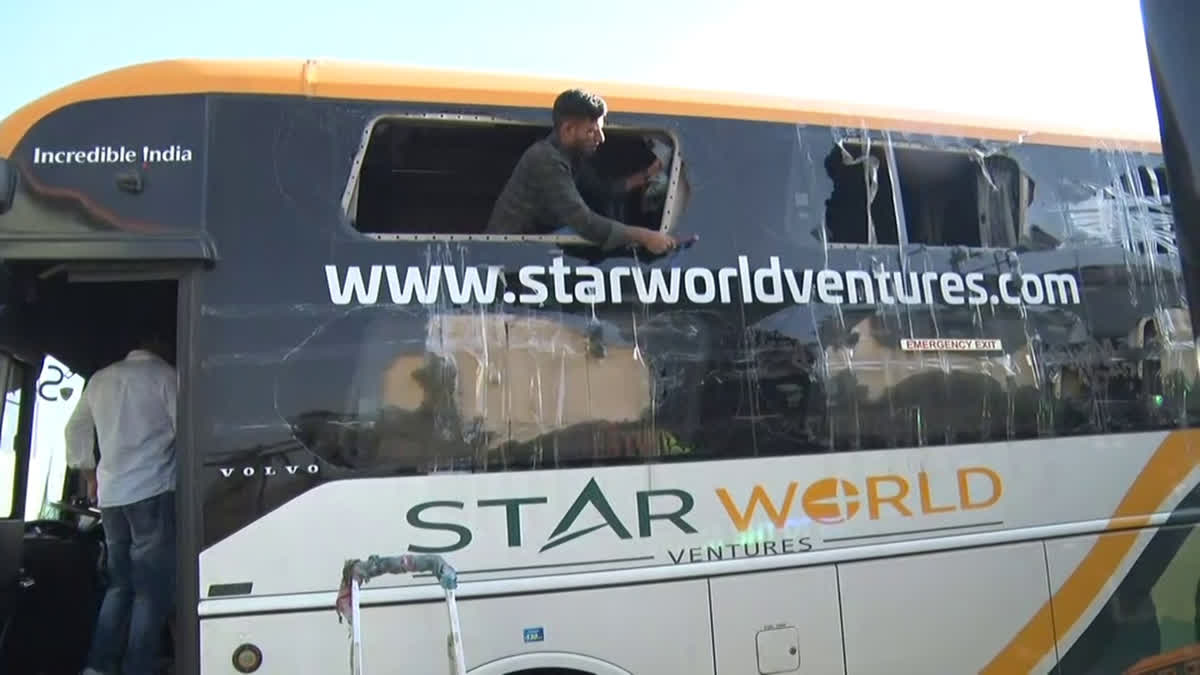
‘Why This Hatred Towards Kashmiris?’ Two Kashmir-Bound Buses Attacked in Haryana and Punjab, Raising Safety Concerns
By: Javid Amin | 18 October 2026
Stones, Shattered Windows and Growing Fear: Kashmir-Bound Bus Attacks Raise Safety Concerns
Two attacks on Kashmir-bound passenger buses in Haryana and Punjab within roughly 24 hours have raised serious concerns about the safety of Kashmiri travellers on interstate highways. The incidents, involving buses operated by Kashmir-based Star World Ventures, have prompted calls for strict legal action, a thorough investigation and assurances that passengers will not be targeted because of their place of origin.
The first incident took place near a dhaba in Haryana’s Karnal district late on October 17, when a bus travelling from Delhi to Srinagar was attacked with stones and bricks following an altercation. The second occurred near Doraha in Punjab’s Ludhiana district around 11 pm on October 18, when stones were thrown at another bus operated by the same company, shattering a windowpane but causing no reported injuries.
Police in both states have launched investigations. Two men were arrested in connection with the Karnal incident, while Punjab Police registered a case against unidentified persons in the Doraha attack and began examining CCTV footage to identify those responsible. Investigators are also exploring whether the two incidents are connected.
That difference in accounts lies at the centre of a growing controversy: while the precise motives behind the incidents remain under investigation, the immediate concern is that ordinary passengers should be able to travel without fear of assault, intimidation or discrimination.
A Night Journey Turns Frightening Near Doraha
The latest incident occurred on Sunday night, October 18, when a Delhi-to-Srinagar sleeper bus was travelling through Doraha in Punjab’s Ludhiana district.
According to reports citing Khanna police officials, the incident took place at approximately 11 pm. Stones were thrown at the bus, damaging a windowpane and frightening passengers travelling aboard the vehicle. No injuries were reported in this incident.
Driver Ishfaq Ahmad Sofi told The Indian Express that the bus had left Delhi at around 4 pm. As it approached Doraha, stones struck the vehicle, prompting him to stop. With women, children and elderly people among the passengers, his immediate concern was their safety.
The driver said he was relieved that nobody had been injured. Police subsequently escorted the bus for approximately 20 kilometres to help it continue its journey safely.
Punjab Police registered a case against unidentified individuals at Doraha police station. Investigators began reviewing footage from nearby dhabas, petrol pumps and toll plazas in an effort to identify the people involved.
Khanna police officials also confirmed that they were coordinating with their Haryana counterparts to determine whether the incidents shared a common motive or were separate acts of violence. Possible explanations under examination include mischief, extortion, rivalry and a deliberate targeted attack.
What Happened in Karnal? The First Attack That Sparked Outrage
The Punjab incident followed an attack on a Srinagar-bound bus late on Saturday, October 17, near Divine Star Dhaba in Haryana’s Karnal district.
According to the account given by Haryana Police, a bus travelling from Delhi to Srinagar stopped in the dhaba’s parking area. Two men travelling in a car were also at the location. An argument reportedly broke out while the vehicles were manoeuvring in the parking area, escalating into a physical confrontation.
Police said stones were thrown at the bus during the altercation, breaking windowpanes and damaging parts of the vehicle. A passenger and a dhaba employee sustained injuries, according to the police account reported by The Indian Express. Other reports and statements from the bus operator described a higher number of injured passengers, including an elderly man. The exact injury count therefore varies across published accounts.
Waqar Chowdhary alleged that the men called him a terrorist and objected to the presence of a Kashmir-registered bus at the location. He told The Indian Express that they demanded that he move the vehicle and used language suggesting that they would not allow people they labelled as terrorists to travel on the roads.
The bus operator, Aadil Ahmad Bhat, also alleged that the attackers objected to the vehicle being identified as Kashmiri. He said the confrontation escalated further when the men returned and stones were thrown at the bus.
However, the allegations should not be treated as a judicially established finding about the attackers’ motive.
Haryana Police’s version: A parking dispute that escalated
Haryana Police have maintained that the Karnal incident originated in a dispute over parking and giving way. Inspector General of Police for the Karnal Range Ashwin Shenvi said an altercation between the occupants of a car and people associated with the bus escalated into a scuffle, during which the bus was damaged.
Police also said that a passenger and a dhaba employee were injured. Two men, identified in reports as Mohit and Sawan, were arrested, and their vehicle was seized. The case was registered following a complaint by the dhaba manager.
The crucial question is whether investigators can establish what happened before, during and after the confrontation, including whether anti-Kashmiri remarks were made and whether they influenced the attack.
That distinction matters. Identifying the immediate trigger for a confrontation is not the same as conclusively establishing that identity played no role in the violence.
Two Incidents, One Transport Operator: Is There a Connection?
The fact that both buses belonged to Star World Ventures has intensified concern.
The incidents occurred on consecutive nights along the Delhi-to-Srinagar travel corridor. The first involved an extended confrontation and significant vehicle damage in Karnal; the second involved stones being thrown at a moving bus near Doraha, with no injuries reported.
The similarities have prompted police to investigate whether the attacks were linked. But the available evidence does not yet establish a common perpetrator, coordinated planning or a shared motive.
-
Were the attacks carried out by people who knew about the earlier incident?
-
Did the perpetrators target the buses because of their registration, route, operator or another reason?
-
Was there any connection between the people involved in the two incidents?
-
Can CCTV footage, eyewitness accounts and other evidence establish whether the attacks were deliberate and whether any identity-based hostility was involved?
These are questions for evidence-led investigation rather than speculation.
There is also a practical reason to take the incidents seriously even before a connection is established. When similar attacks occur in quick succession, passengers and transport workers may reasonably worry about their safety, regardless of whether the incidents ultimately prove to be related.
For a company operating a long-distance overnight service, the implications extend beyond damaged glass. Drivers must decide whether to continue a journey, passengers may become reluctant to travel, and families waiting at the destination may be left anxious until the bus arrives safely.
‘Why This Hatred Towards Kashmiris?’: Political Leaders Demand Accountability
The incidents have prompted strong reactions from Jammu and Kashmir’s political leadership and civil society.
Chief Minister Omar Abdullah condemned the Karnal attack and said his government had taken up the matter with the Haryana administration. His office said the government had conveyed its concern about the safety and well-being of passengers and had received assurances of prompt and stringent action under the law.
National Conference spokesperson Imran Nabi Dar questioned whether the response to the Haryana incident would be sufficient to deter further violence. Other political leaders also called for accountability and warned against allowing Kashmiris to be stigmatised because of their identity.
Peoples Democratic Party leader Waheed Para said the incidents reflected a troubling atmosphere in which ordinary Kashmiris could feel unsafe. Peoples Conference president Sajad Lone also condemned the Karnal attack, while Mirwaiz Umar Farooq expressed concern over reports of threats against Jammu and Kashmir-registered vehicles.
Political condemnation, however, will have limited value unless it is followed by a clear account of what happened, credible investigations and legal action based on evidence.
The public is entitled to know whether the attacks were isolated acts of violence, disputes that escalated beyond control or incidents involving deliberate hostility towards Kashmiri passengers. Each possibility demands a serious response, but the conclusions must be supported by the findings of the investigation.
JKSA Raises the Punjab Attack With State Authorities
The Jammu and Kashmir Students Association (JKSA) has also taken up the latest incident with Punjab authorities, calling for a thorough investigation and action against those responsible.
The organisation’s national convenor, Nasir Khuehami, urged Punjab Chief Minister Bhagwant Mann and senior police officials to take immediate cognisance of the attack and ensure that the perpetrators were identified.
Khuehami questioned why Kashmiris should fear for their safety while travelling through other parts of the country. He also stressed that no citizen should face threats or intimidation because of their place of origin.
In this case, the immediate priorities are clear: establish the circumstances of the Doraha attack, identify those responsible, determine whether the incident was linked to the Karnal violence and communicate the findings transparently.
The investigation must also distinguish between allegations circulating on social media and information verified through witness statements, CCTV footage and other evidence.
Why the Incidents Have Struck a Sensitive Nerve in Kashmir
For many Kashmiris, the significance of the attacks goes beyond two damaged buses.
Travel between Jammu and Kashmir and other parts of India is part of everyday life for students, workers, traders, tourists and families. People routinely cross state boundaries for education, employment, medical treatment and personal commitments. Long-distance bus services provide an important link for passengers travelling between Srinagar and major cities such as Delhi.
When a vehicle carrying ordinary passengers is attacked, the immediate harm is physical and psychological. When the driver alleges that he was called a terrorist because he was associated with a Kashmiri vehicle, the incident also raises a question about the relationship between regional identity and public safety.
It is important to maintain a distinction here. The reported allegations have not established that every person involved acted out of anti-Kashmiri prejudice, and the Haryana Police have disputed that interpretation of the Karnal incident. Nevertheless, the allegations are serious enough to warrant careful investigation rather than dismissal.
The issue is not whether a particular community should be shielded from ordinary law enforcement. It is whether every citizen can expect the same protection under the law, regardless of regional background, language, religion or place of residence.
A parking dispute, if that was the original trigger, does not justify violence. Nor does a person’s regional identity make them responsible for political or security developments associated with their home region.
The rule of law requires individual accountability, not collective suspicion.
Passenger Safety Must Extend Beyond the Immediate Crime Scene
The response to the two incidents should not end with arrests in one case and an FIR in the other.
For passengers travelling overnight, safety depends on a chain of arrangements: secure stopping points, prompt police assistance, reliable communication with transport operators and the ability to report threats without fear of being blamed for the incident.
The escort provided to the bus near Doraha was an immediate protective measure. Police investigations in both states are equally important to establish responsibility and prevent further incidents.
First, establish the facts quickly. CCTV footage, eyewitness statements, medical records and vehicle damage should be examined promptly. In the Karnal case, investigators must assess the allegations about threatening remarks alongside evidence concerning the parking dispute.
Second, coordinate across state boundaries. Punjab and Haryana Police should exchange relevant evidence if the investigations indicate a possible link. A shared transport operator and closely timed incidents make coordination sensible, although they do not prove that the attacks were connected.
Third, keep passengers informed. Transport operators and police should provide clear information about immediate safety arrangements and the progress of investigations where disclosure would not compromise the cases.
Fourth, apply the law consistently. Those found responsible should face appropriate legal consequences based on the evidence. If investigators establish that the violence was motivated by regional hatred, that finding should be addressed through the applicable legal process.
Finally, political leaders and public representatives should discourage collective blame and avoid treating unverified claims as established facts. Responsible public communication can help reassure affected communities without prejudging the outcome of an investigation.
What the Attacks Mean for Interstate Travel and Public Trust
The Delhi-Srinagar route connects people and communities across different regions. A passenger travelling towards Kashmir may be returning home after work, taking a family trip or making a journey for reasons unrelated to politics.
That ordinary reality can become obscured when a confrontation turns into a public controversy about identity.
For transport operators, repeated incidents can raise concerns about staff welfare, vehicle damage, journey delays and passengers’ willingness to use particular routes. For travellers, the consequences may include anxiety about stopping at roadside facilities or uncertainty over whether help will arrive if an incident occurs.
There is no verified evidence at present establishing the scale of any resulting change in bookings or travel behaviour. But the drivers’ accounts and the demands for additional assurances show why the incidents have prompted concern.
Public confidence will depend on what happens next. Arrests, where warranted, are one part of the response; credible evidence, transparent communication and a fair legal process are equally important.
The two attacks also illustrate why the language used during local confrontations deserves attention. If allegations of identity-based abuse are substantiated, authorities must address them seriously. If the evidence points to another motive, that too should be established clearly. Neither political pressure nor an early police explanation should substitute for a complete investigation.
The Road Ahead: Answers, Accountability and Reassurance
As of October 20, 2026, the immediate facts are that a Kashmir-bound bus was attacked in Karnal on October 17 and another bus operated by the same company was struck by stones near Doraha on October 18. The latest attack caused window damage but no reported injuries. Two men were arrested in the Haryana case, while Punjab Police registered a case against unidentified suspects and began examining CCTV footage. Investigators were also exploring a possible connection between the incidents.
Those answers will determine how the cases should be understood and what further measures may be necessary.
For now, the priority should be the safety of passengers and the identification of those responsible through a fair, evidence-based process. Kashmiris travelling outside their home region should not have to wonder whether their identity will make an ordinary journey dangerous. Nor should allegations about the motive behind an attack be settled through political argument before investigators establish the facts.
The question raised by the incidents — why should anyone fear for their safety while travelling because of where they come from? — deserves a response grounded in both justice and equal citizenship.
The strongest response will not come from rhetoric alone. It will come from credible investigations, accountability for those responsible and a clear assurance that every citizen has the right to travel safely, without intimidation or discrimination.
Follow Us on WhatsApp
Get Breaking News, Exclusive Updates & In-Depth Analysis from Kashmir and beyond, delivered straight to your phone.
Join our WhatsApp Channel: Follow Now


