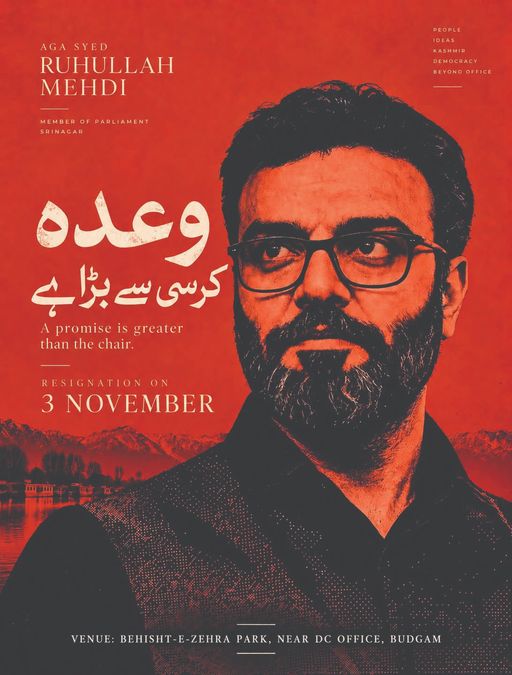
Ruhullah After Resignation: What Comes Next for Kashmir Politics?
By: Javid Amin | 03 November 2026
The November 3 announcement changes Ruhullah Mehdi’s political position, but it does not yet tell us what political structure he intends to build. The strongest clues point towards an organised public movement before any immediate launch of a new political party. The real test will be whether he can turn his personal credibility, the anger over Article 370 and dissatisfaction within the National Conference into a disciplined political network.
The most important distinction at this stage is between announcing an exit, completing the formal resignation process and building a viable political alternative. These are three different developments, and they should not be treated as though they have happened simultaneously.
There are also two separate political questions to watch: whether Ruhullah can establish an independent constituency outside the NC, and whether the party’s dissatisfied MLAs will convert their internal demands into a wider organisational challenge. The two developments may influence each other, but there is no sound basis yet to assume they will merge.
1. The clearest clue: he has described the next step himself
Before the Budgam gathering, Ruhullah gave an interview to Kashmir Observer in which he made an important distinction: he wanted to build an organised political movement, but forming a political party was not his immediate concern.
His stated idea is to identify people with credibility and political commitment from different sections of society, encourage them to become politically active and gradually build a political force around principles rather than individual personalities. He specifically spoke about replacing personality-driven politics with politics based on character, conviction and values.
That is more revealing than speculation about a new party name or a possible alliance. It suggests that his first move may be organisational rather than electoral: build a network, identify credible people, establish a common political programme and then decide whether that structure should become a party.
There is another useful clue in his Indian Express interview. He said he was already in touch with people and was looking for individuals with little or no political baggage who were willing to work on this path. That indicates that the idea of building a team was not merely an afterthought announced at Budgam; he had begun thinking about the human infrastructure required for a new political initiative.
My assessment: A movement-first approach is presently more credible than an immediate party launch. It gives him time to test support, recruit people and avoid the organisational costs of registering and running a political party before he has a functioning base.
2. The biggest political test may be a Srinagar by-election
This is where Ruhullah’s decision becomes much more consequential.
In the 2024 Lok Sabha election, he won the Srinagar constituency with 356,866 votes, securing 52.85% of the vote. He defeated PDP candidate Waheed Ur Rehman Para, who received 168,450 votes, by a margin of 188,416.
Ruhullah’s 2024 electoral mandate
3,56,866 – Votes received in the Srinagar Lok Sabha constituency
Vote share – 52.85%
Winning margin – 1,88,416
Runner-up – Waheed Ur Rehman Para (PDP)
Source: 2024 constituency results and election data. These were votes cast for Ruhullah as an NC candidate, not an independent candidate.
That last qualification is crucial.
Ruhullah has a personal political base, particularly in Budgam, where he has served as an MLA three times. But his 2024 parliamentary victory was achieved under the National Conference banner, with the party’s organisation, workers and electoral support behind him.
A fresh election would answer a question that the 2024 result cannot: How much of that mandate belongs to Ruhullah personally, and how much belonged to the NC?
If he contests independently and performs strongly, he would establish that his political influence can survive separation from the party. If he wins, it would be an extraordinary political endorsement. Even a competitive performance could give his proposed movement credibility.
But he should not assume that the 2024 margin will automatically follow him. The Srinagar parliamentary constituency is much larger than Budgam, and the electoral arithmetic will change when he contests without the NC symbol.
What does the law say about the by-election?
There is an important procedural step before any by-election can be announced.
Article 101(3)(b) of the Constitution provides that a parliamentary seat becomes vacant when a member resigns in writing and the Speaker accepts that resignation. The Speaker must also be satisfied that the resignation is voluntary and genuine.
Under Lok Sabha Rule 240, the resignation must be submitted in writing under the member’s own hand. The rules also allow the Speaker to make an inquiry where necessary. A resignation can be withdrawn before the Speaker accepts it.
Therefore, although India Today reported on November 3 that Ruhullah had resigned from his parliamentary seat, the legal position should be described carefully: the public announcement is confirmed, but formal vacation of the seat depends on acceptance by the Speaker. I have not found an independently confirmed acceptance notification in the material available at the time of this assessment.
If the vacancy is formally created, Section 151A of the Representation of the People Act, 1951, generally requires a by-election within six months. The exceptions include cases where less than one year remains in the member’s term, or where the Election Commission, in consultation with the Central Government, certifies that holding the election within that period is difficult.
With more than a year remaining in the current Lok Sabha’s term, the first exception would not apply.
The political implication: A Srinagar by-election could become Ruhullah’s first major electoral test outside the NC. It may also become the first direct contest between his emerging political project and the organisation he has just left.
3. Will the dissident NC MLAs join him?
This is probably the most important question for Omar Abdullah’s party.
The NC’s internal dissent and Ruhullah’s departure have occurred at the same time, but they are not necessarily parts of one coordinated political operation.
The legislators’ memorandum is primarily an organisational and governance document. The 18 legislators reported to have submitted it sought:
-
A review of ministerial performance and a possible cabinet reshuffle.
-
Removal or replacement of Chief Minister Omar Abdullah’s adviser Nasir Aslam Wani.
-
Withdrawal of the Public Works Department portfolio from Deputy Chief Minister Surinder Choudhary.
-
A time-bound mechanism to monitor implementation of election promises.
-
Greater consultation between the Chief Minister and elected legislators.
-
Stronger political mobilisation for statehood and constitutional rights.
-
Examination of allegations of corruption and administrative misconduct.
The legislators have presented their demands as an attempt to strengthen the party and government, not necessarily to bring down the administration. The allegations against individual ministers remain allegations and should not be treated as established wrongdoing.
There is, however, a significant difference between the reporting on the scale of this dissent.
The Economic Times reported 18 legislators submitting the memorandum. India Today, in its November 3 report, referred to 25 disgruntled lawmakers, saying 16 had formally signed a resolution and another nine supported the group. It also reported a 14-day ultimatum and a possible move to Raj Bhavan if demands were not met. These are different descriptions and counts, not proof that 25 legislators physically attended one meeting or signed the same document.
Why Ruhullah may not immediately become their leader
There is a particularly important clue from his November 2 interview.
Ruhullah had objected to legislators using his political position as leverage in their internal negotiations with the NC. He indicated that those who genuinely wanted to join his political path would have to make a clear break with the party and give up their political privileges, rather than use his name as a bargaining instrument.
That position makes an immediate alliance with the dissident MLAs less likely.
It also reveals a strategic problem for the legislators.
They may want a more accountable NC, a change in the cabinet or greater influence over Omar Abdullah’s government. Ruhullah wants to challenge what he considers the party’s ideological and political direction. Those objectives overlap on some issues, but they are not the same.
A legislator who wants to retain an NC Assembly seat and negotiate a ministerial reshuffle has a different incentive from someone prepared to resign from the party and surrender an elected parliamentary position.
My assessment: Watch for individual expressions of support, not a dramatic mass exodus. If one or two influential legislators openly join Ruhullah, that would be significant. But until they actually resign or take a clear organisational decision, describing them as members of a Ruhullah faction would be premature.
4. The anti-defection law makes an MLA break more complicated
There is another reason not to expect an easy migration of sitting NC legislators into a new political group.
The Tenth Schedule of the Constitution provides for disqualification when a legislator voluntarily gives up membership of the party on whose ticket they were elected, or votes against the party direction without prior permission or subsequent condonation.
The merger exception requires at least two-thirds of the legislature party to agree to the merger. The earlier one-third split exception was removed by the 91st Constitutional Amendment.
This means a handful of NC MLAs cannot simply announce a separate legislative group and assume that their Assembly seats are protected.
The legal and political choices are different:
-
They can remain in the NC and continue pressing for internal reforms.
-
They can resign from the Assembly and seek a fresh mandate under another political banner.
-
They can explore a legally valid merger if the constitutional requirements are satisfied.
-
They can continue expressing dissent, although voting against an authorised party direction may carry disqualification consequences.
This is why a political movement led by Ruhullah and a breakaway group of sitting NC legislators should not be treated as interchangeable.
A movement can attract supporters without immediately requiring elected representatives to abandon their seats. A formal legislative break carries much higher personal and legal costs.
5. Could Ruhullah form a new party later?
Yes. But his own statements suggest that he wants to postpone that decision until he has consulted people and built an organisation.
The Indian Express interview offers another important clue: he said neither the NC nor the PDP currently represented the political standard he wanted to establish. He also described his effort as an ideological challenge to the established political order, rather than a disagreement over cabinet positions.
That makes an immediate merger with the PDP or a move into another established party difficult to reconcile with his public position.
A new party would eventually need to answer questions that a public movement can temporarily avoid:
-
What is its precise constitutional and political programme?
-
Will it contest Assembly elections across Kashmir, Jammu or both?
-
Who will lead its organisation beyond Ruhullah?
-
How will it select candidates and resolve internal disagreements?
-
What will be its position on jobs, reservations, development, education and the economy?
-
How will it engage with the Union government and other political parties?
The Article 370 question may provide the movement with a powerful ideological foundation, but it cannot be its entire political programme.
There is also a constitutional reality that no new regional party can ignore. The Supreme Court upheld the abrogation of Article 370 in December 2023. Restoring it is therefore not something the Jammu and Kashmir Assembly or a regional government can accomplish through an ordinary resolution alone. A political movement can campaign for constitutional change, but it must explain the legal and parliamentary route it intends to pursue.
Ruhullah’s next challenge will be to move from expressing opposition to the post-2019 arrangement to explaining what practical political strategy he proposes.
6. What is the immediate danger to Omar Abdullah’s government?
Ruhullah’s resignation is a serious political setback for the National Conference, but it does not, by itself, threaten the government’s Assembly majority.
The more immediate concern for Omar Abdullah is the group of dissatisfied NC legislators.
The distinction is between losing a prominent MP and losing legislative support. The former weakens the party politically; the latter could affect the government’s survival.
The November 3 India Today report claims that 25 legislators are associated with the dissenting group and that some could approach Raj Bhavan if the leadership does not address their demands. However, the memorandum reported elsewhere contains a broader list of organisational and governance reforms and says the legislators do not intend to weaken the government. The two accounts should be treated as competing descriptions of the group’s intentions until the legislators themselves clarify their position.
There is also a constitutional and political obstacle to a simple rebellion: MLAs elected on an NC ticket remain subject to the anti-defection framework. A change of political allegiance is not the same as submitting a memorandum or criticising the Chief Minister.
For Omar Abdullah, the immediate strategy is likely to involve containing the internal dispute through consultation, organisational adjustments and possibly changes in responsibilities. Whether that will satisfy the legislators is not yet clear.
The key indicators to watch are:
-
Whether the leadership formally responds to the memorandum.
-
Whether the legislators accept any proposed corrective measures.
-
Whether they continue to meet as a coordinated group.
-
Whether any of them publicly distances themselves from the NC.
-
Whether there is an actual move to withdraw support or approach Raj Bhavan.
Until those developments occur, talk of the government falling should be treated as speculation rather than a confirmed political outcome.
7. What are the most likely political scenarios?
The following is a qualitative assessment, not a statistical forecast. It is based on Ruhullah’s own stated intentions, the reported NC memorandum and the electoral and legal circumstances.
Scenario A — Movement first, party decision later
Ruhullah builds a network of students, professionals, community representatives and politically active citizens. A party may emerge later if the movement develops a workable organisation and electoral programme.
Scenario B — Independent contest in a Srinagar by-election
If the Lok Sabha resignation is accepted and a by-election is announced, he could consult supporters and decide whether to contest independently. His own earlier statements indicate that he intends to consult people rather than announce a candidacy automatically.
Scenario C — Individual NC leaders join his initiative
Some dissatisfied legislators or former party functionaries may eventually support his movement. A mass exit is not confirmed, and his insistence on a clean break makes an immediate alliance difficult.
Scenario D — Immediate new party or alliance
This remains possible in the longer term, but it is not what Ruhullah has publicly prioritised. He has specifically said that building an organised movement comes first.
8. The political calculation behind his resignation
Ruhullah has surrendered something substantial: the parliamentary platform from which he could raise issues concerning Jammu and Kashmir.
That is not a minor sacrifice. Parliament gave him national visibility, institutional access and an opportunity to question the Union government directly. He is now attempting to exchange that formal platform for a more direct political relationship with the public.
His calculation appears to rest on three beliefs.
First, that the NC has lost credibility among a section of its own supporters. His argument is that the party sought votes on a promise to challenge the post-2019 political arrangement but became more cautious after returning to power.
Second, that a political space exists between established regional parties. His criticism is not restricted to the NC. He has indicated that the PDP also does not meet his expectations for the kind of politics he wants to build. That gives him room to position himself outside the traditional NC-PDP contest, although it also means he cannot automatically rely on either party’s organisational support.
Third, that public credibility can be converted into an organisation. This is the most difficult part of his strategy. A leader may attract a large crowd, command media attention and influence political debate. Building a party or movement that can sustain itself beyond one individual requires local leadership, regular public engagement, funding, policy development and a disciplined structure.
The test will not be the size of the Budgam gathering alone. It will be what happens after the gathering.
9. The next 30–90 days: What should we watch?
| Development | Why it matters |
|---|---|
| Speaker’s decision on resignation | Establishes whether the Srinagar seat is formally vacant |
| First public meeting after Budgam | Shows whether the movement is becoming organised |
| Formation of a core team | Indicates whether the initiative can operate beyond Ruhullah personally |
| Public position on a Srinagar by-election | Tests whether he intends to return to electoral politics immediately |
| Response from dissident NC MLAs | Shows whether the two streams of dissent will remain separate |
| NC leadership’s response to the memorandum | Determines whether the internal crisis can be contained |
| A written political programme | Shows whether the movement has policy substance beyond protest against the NC |
The most revealing development may not be a party announcement. It may be the appearance of a small but credible group of organisers who begin working with Ruhullah across different constituencies.
If that happens, the movement will have taken its first meaningful step towards becoming a political alternative.
Final assessment: The resignation is the beginning, not the destination
Ruhullah has crossed an important political line. His resignation announcement has turned a prolonged dispute with the National Conference into an independent political challenge. But the next phase will be more difficult than the decision to leave.
The NC has an established organisational network, elected representatives, local leadership and a long political history. Ruhullah has personal credibility, a strong ideological message and a substantial electoral victory behind him. What he does not yet have, at least publicly, is a fully developed organisation capable of matching the NC across the region.
The most credible immediate path is therefore a movement built around political rights, constitutional questions, accountability and a new style of regional leadership, followed by a collective decision on whether to enter electoral politics as a party.
A Srinagar by-election could accelerate that process. A strong performance would give him a fresh mandate independent of the NC. A weak performance would expose the gap between personal popularity and organisational strength.
For Omar Abdullah, the bigger immediate challenge remains the dissident MLAs. If their grievances are resolved, the government may survive this episode with political damage but without a legislative crisis. If they harden their position, the NC could face a more serious organisational problem.
And for Kashmir’s regional politics, one question now stands above the rest:
Can Ruhullah build a political force that is larger than his own personality, or will his resignation remain a powerful act of dissent without a durable political structure behind it?
That is the real story to follow after Budgam.


