Rahul Gandhi’s ‘Chalo Delhi’ campaign faces a crucial test over electoral-roll revision, opposition unity and the right to protest; permission for the Ramlila Maidan rally remains valid, but the proposed march route has become a fresh point of contention
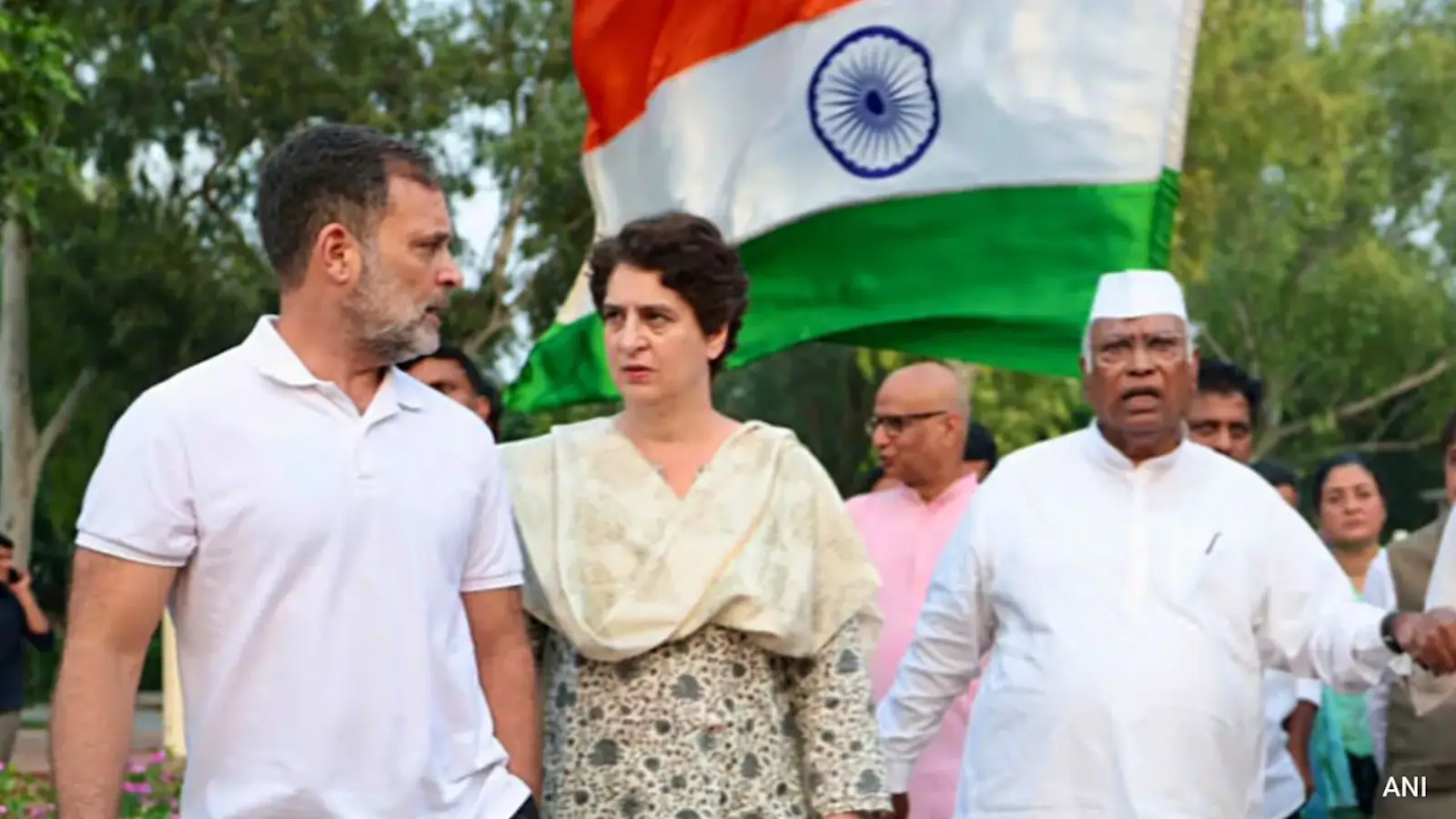
New Delhi, October 31: The INDIA bloc’s November 1 rally at Ramlila Maidan is shaping up to be more than another opposition demonstration. Led by Congress president Mallikarjun Kharge and Rahul Gandhi, the mobilisation is intended to turn allegations surrounding the Special Intensive Revision (SIR) of electoral rolls into a national political campaign, with opposition parties demanding accountability from Chief Election Commissioner Gyanesh Kumar.
But as the rally approaches, a second contest is unfolding alongside the political confrontation: one over where demonstrations can take place, how protesters can reach the venue and how much freedom organisers have to shape the event.
The INDIA bloc’s November 1 rally at Ramlila Maidan has become a major test of opposition unity and the right to protest. While Delhi Police has cleared the gathering, conditions on the event and uncertainty over the proposed march route have intensified the political dispute.
Delhi Police has granted permission for the Ramlila Maidan gathering, scheduled between 10 am and 5 pm. However, the permission comes with detailed conditions, including restrictions on movement outside the venue. On October 31, police officials also said they had not received a separate request or formal intimation for the march Rahul Gandhi announced from the Minto Road–Connaught Place junction to Ramlila Maidan.
This distinction is central to the controversy. The rally has not been cancelled, and police maintain that its permission remains valid. But the proposed street march has created uncertainty over whether the opposition’s planned programme will take place in the form its leaders have publicly announced.
The real political battle is over electoral credibility
The INDIA bloc has placed the SIR exercise at the centre of its campaign, accusing the Election Commission of allowing electoral-roll revisions that could exclude eligible voters and undermine confidence in the democratic process.
The opposition’s broader allegation is that the removal of names from voter lists, particularly on a large scale, can affect electoral participation if adequate safeguards, verification and opportunities for correction are not provided.
The Election Commission’s position and the legal framework governing SIR must be considered separately from the opposition’s political claims. Electoral-roll revision is a statutory process, and the Commission has defended the exercise as part of its responsibility to maintain accurate voter lists. The controversy concerns the scale of deletions, the verification process, transparency and the ability of affected voters to restore their names.
The scale of the issue is not insignificant. The Indian Express reported that after more than 13 crore names were dropped from draft rolls across states and Union Territories where the exercise had been completed, the Election Commission directed a special enrolment drive for voters who may have been left out. The Commission’s instruction provides an important part of the picture: the revision process has generated concerns serious enough to prompt a separate effort to bring excluded voters back onto the rolls.
For Rahul Gandhi and other opposition leaders, this provides a political opportunity to frame the issue around voting rights rather than limiting it to a technical dispute over electoral administration.
The government and the Election Commission, meanwhile, face the task of demonstrating that the revision process is transparent, legally sound and accessible to every eligible voter.
What exactly is planned for November 1?
The Congress-led INDIA bloc has invited opposition parties and other stakeholders to participate in the gathering at Ramlila Maidan.
Rahul Gandhi announced that the proposed march would begin around noon from the Minto Road–Connaught Place junction and proceed towards the rally venue. The gathering itself has been cleared for 10 am to 5 pm.
The Congress has set an ambitious mobilisation target of around 10 lakh participants, according to reports, although that figure represents an organisational target rather than a verified turnout estimate. Party units have been asked to mobilise supporters from different parts of the country.
The campaign is expected to bring together opposition leaders, party workers, student groups and civil society participants. Its political significance will depend not simply on the number of people who attend, but on the breadth of participation and the ability of different alliance partners to maintain a common message.
The rally’s central demands include accountability over SIR, the resignation of CEC Gyanesh Kumar and safeguards for electoral integrity.
Behind the scenes: The protest-site decision has changed the political geography of Delhi
One of the most consequential developments ahead of the rally came on October 12, when Delhi Police removed Jantar Mantar from the list of designated protest venues.
The police named three alternatives: Ramlila Maidan in Central Delhi, Burari Ground in North Delhi and CBD Ground in East Delhi. The order followed recommendations from a committee constituted by the Union Home Ministry to examine alternative locations for demonstrations. The police also referred to a Supreme Court direction to identify suitable alternative sites for protests.
On paper, the change provides designated locations where citizens can organise demonstrations. But the geographical consequences are politically important.
Jantar Mantar has historically been one of the most visible protest locations in the national capital. Its proximity to Parliament Street and central government offices made it a natural focal point for demonstrations seeking national attention.
The Indian Express reported that Jantar Mantar is roughly two kilometres from Parliament, compared with around six kilometres for Ramlila Maidan, approximately 14 kilometres for the CBD Ground and about 23 kilometres for Burari.
The change therefore affects more than the choice of a venue. It changes the relationship between a protest, the political institutions it seeks to address and the public visibility it can generate.
The authorities have cited administrative and security considerations. Opposition groups and protest organisers, however, have questioned whether moving demonstrations away from established central locations reduces their political impact.
It would be inaccurate to describe the decision as an order specifically designed to obstruct the November 1 rally. The Supreme Court direction and the Home Ministry committee’s recommendations form part of the official background. Nevertheless, the timing and practical impact of the change have become part of the wider political dispute.
The march-route dispute: The most immediate flashpoint
The sharpest disagreement ahead of Sunday’s event concerns the proposed march from Minto Road–Connaught Place to Ramlila Maidan.
Delhi Police has confirmed that the Congress received a no-objection certificate for the rally at Ramlila Maidan. But officers from the Central and New Delhi districts told the Hindustan Times on October 31 that neither district had been approached for permission or formally informed about the proposed march.
Police officials said they were monitoring the situation and would take necessary measures. They did not announce in advance whether participants would be stopped from undertaking the march.
This creates a practical and political dilemma.
For the opposition, a march through central Delhi would provide visibility and reinforce the image of a nationwide democratic mobilisation. For the police, a large procession through busy roads raises questions about traffic, crowd control, security deployment and the management of public spaces.
The authorities have the responsibility to regulate public gatherings. But restrictions must also be reasonable, clearly communicated and applied consistently.
If the rally proceeds at Ramlila Maidan while the march is restricted, the opposition may portray the decision as an attempt to limit the visibility of its protest. Police, on the other hand, can argue that permission for a gathering at a designated venue does not automatically authorise a separate procession through roads and junctions.
The distinction between these two positions will matter greatly on November 1.
Thirteen conditions, a 5 pm deadline and tight crowd management
The police clearance for the Ramlila Maidan rally is conditional. Organisers have been directed to arrange high-definition CCTV cameras at important locations, establish a monitoring system, deploy identifiable volunteers and provide adequate drinking water and toilet facilities.
The gathering must remain peaceful and conclude by 5 pm. Participants cannot stay overnight at the venue, vehicles must use designated parking locations, and the organisers must comply with police directions concerning crowd management and public order.
Reports also state that the organisers have been asked to provide details of volunteers, invitees, vehicles and the programme schedule. Any violation of the stipulated conditions could invite legal action or affect the permission.
These requirements are not automatically evidence of political interference. Large gatherings require arrangements for public safety, emergency access, sanitation and traffic management.
The political question is whether the conditions are proportionate and whether they leave the organisers adequate room to conduct a peaceful demonstration.
A strict deadline, restrictions on movement and detailed compliance requirements can become contentious when the event is designed to project mass participation. The authorities must ensure public order without unnecessarily restricting the right to peaceful assembly.
The postponed ‘public impeachment’: Another dispute over access and political space
The November 1 rally has also been preceded by controversy over a separate INDIA bloc programme described by its organisers as a symbolic “public impeachment” of the Chief Election Commissioner.
The programme was initially scheduled for October 30. Congress leaders said they had faced difficulties securing venues, including Hotel Ashok, the Constitution Club and Talkatora Stadium.
Congress general secretary K.C. Venugopal alleged that the authorities had obstructed preparations for the event at Ramlila Maidan despite the Congress having booked the ground for the November 1 rally period.
Police sources offered a different account, saying the party had not submitted a separate request for permission to hold the October 30 programme at Ramlila Maidan. Police also maintained that the NOC for the November 1 rally had not been withdrawn.
The symbolic programme was subsequently postponed. PTI reported on October 30 that the postponement was due to rain and that the event was likely to be held on October 31 at Congress president Mallikarjun Kharge’s residence.
This sequence illustrates the competing narratives surrounding the opposition’s preparations. Congress leaders have alleged that access to venues was being restricted, while police sources have pointed to the absence of separate applications for particular events. The weather-related postponement is a separate development and should not be presented as proof of administrative obstruction.
There is also an important constitutional distinction: the “public impeachment” is a political demonstration, not a formal impeachment proceeding under the Constitution. The Chief Election Commissioner can be removed only through the prescribed constitutional process, which is distinct from a public protest demanding resignation.
What could be brewing behind the curtain?
The most revealing part of the build-up is the convergence of several developments: the removal of Jantar Mantar as a designated protest site, disputes over access to venues for related opposition programmes, strict conditions attached to the Ramlila Maidan permission and the unresolved question of the proposed march route.
Taken together, these developments create a difficult environment for opposition mobilisation. But they do not establish that the government or police are pursuing a coordinated plan to sabotage the rally.
There are, however, several political and administrative pressure points worth watching.
1. Limiting the protest’s visibility
The shift away from Jantar Mantar changes where demonstrations take place and how close they are to the national political establishment. Ramlila Maidan is a major public gathering space, but it does not provide the same immediate proximity to Parliament and central government offices.
The practical effect is that the opposition must generate visibility through the scale of its gathering, media coverage and political messaging rather than relying on a march near the seat of power.
2. The march could become the day’s defining confrontation
The difference between permission for a rally and permission for a procession may appear technical, but it has the potential to become the central flashpoint.
If organisers attempt the announced route without the necessary clearance, police may intervene. If the march is prevented, opposition leaders could accuse authorities of restricting peaceful political expression.
Either outcome could shift attention away from SIR and towards the handling of the protest itself.
3. Administrative conditions could become a political weapon in the narrative battle
The organisers must meet extensive safety and compliance requirements. Authorities are entitled to impose reasonable conditions, but the way those conditions are enforced will be closely watched.
Any last-minute change, inconsistent instruction or confrontation involving participants could become politically significant. Conversely, orderly conduct and cooperation by organisers would make it harder for either side to portray the event as an administrative failure.
4. The opposition’s internal coordination faces its own test
The INDIA bloc is a coalition of parties with different regional priorities, political calculations and organisational strengths. A joint rally requires more than leaders sharing a stage.
The key test will be whether major alliance partners mobilise meaningful numbers, speak with a common voice and sustain the campaign after the event. A strong Congress turnout without comparable participation from regional allies could expose the limits of the alliance’s national coordination.
5. The government and Election Commission face a credibility test
The opposition’s allegations will not be settled by a rally. The Election Commission’s credibility will ultimately depend on the transparency of the SIR process, the availability of correction mechanisms and the treatment of eligible voters whose names have been removed.
The Commission’s reported special enrolment drive for people left out of the rolls is an important part of this debate. The opposition will argue that corrective steps do not remove the need for accountability; the Commission can point to the revision and enrolment procedures as safeguards.
The public will need clear, verifiable information about deletions, objections, claims and restoration of names—not simply competing political assertions.
The BJP versus INDIA bloc: A battle over the meaning of democracy
The rally is likely to sharpen the political confrontation between the BJP-led NDA and the opposition alliance.
For the INDIA bloc, SIR provides an opportunity to build a campaign around voting rights, electoral transparency and institutional accountability. Rahul Gandhi has repeatedly used the expression “vote chori” to frame the opposition’s allegations.
For the BJP and the government, the counterargument is likely to centre on the Election Commission’s constitutional independence, the need for accurate electoral rolls and the responsibility of political parties to substantiate allegations.
The Election Commission is a constitutional body, and the credibility of its decisions is central to the legitimacy of elections. At the same time, criticism of electoral administration and peaceful demands for accountability are part of democratic political life.
The challenge is to ensure that the debate is settled through evidence, institutional transparency and lawful procedures rather than escalating into a contest of accusations.
What November 1 can—and cannot—change
The rally is unlikely to produce an immediate change in the Election Commission’s leadership or alter the legal status of the SIR exercise. A public demand for the CEC’s resignation does not itself trigger removal from office.
Its political significance will instead depend on three factors: turnout, alliance participation and whether the campaign continues beyond the capital.
A large and diverse gathering could give the opposition renewed momentum and strengthen its ability to raise electoral-roll concerns in Parliament and across states. A poorly attended event, or one dominated by organisational disputes, could weaken the impression of national unity.
The longer-term test will be whether the INDIA bloc can translate the rally into a sustained campaign involving voter assistance, documented cases of alleged wrongful deletion, legal scrutiny and coordinated political action.
Traffic and public movement in Delhi
The rally is also expected to affect traffic across central Delhi. The Times of India reported that Delhi Traffic Police had deployed additional personnel across the Central Range and identified parking arrangements at Metro and railway stations to manage the expected rush.
Traffic arrangements are expected to remain in place during the 10 am–5 pm rally window. Commuters should follow live traffic advisories and allow additional travel time around Ramlila Maidan, Minto Road and adjoining central Delhi routes.
The real test is whether the right to protest is protected
The November 1 mobilisation has become a test on two fronts.
Politically, it will measure whether the INDIA bloc can turn its electoral-integrity campaign into a credible national movement. Administratively, it will test whether a major opposition demonstration can take place peacefully while respecting reasonable security and traffic restrictions.
The verified record so far does not establish a deliberate sabotage operation. It does show a series of disputes over protest locations, permissions and the proposed march route—issues that deserve scrutiny because the right to peaceful assembly is a central democratic safeguard.
Ultimately, the rally’s success should not be judged only by the size of the crowd or the volume of political speeches. It should also be measured by whether the opposition presents verifiable evidence, whether authorities facilitate peaceful participation and whether the Election Commission addresses public concerns about electoral-roll integrity with transparency.
The most important question after November 1 will be whether the political noise produces institutional answers. A rally can command headlines for a day. Restoring confidence in the electoral process requires evidence, accountability and action long after the crowds leave Ramlila Maidan.