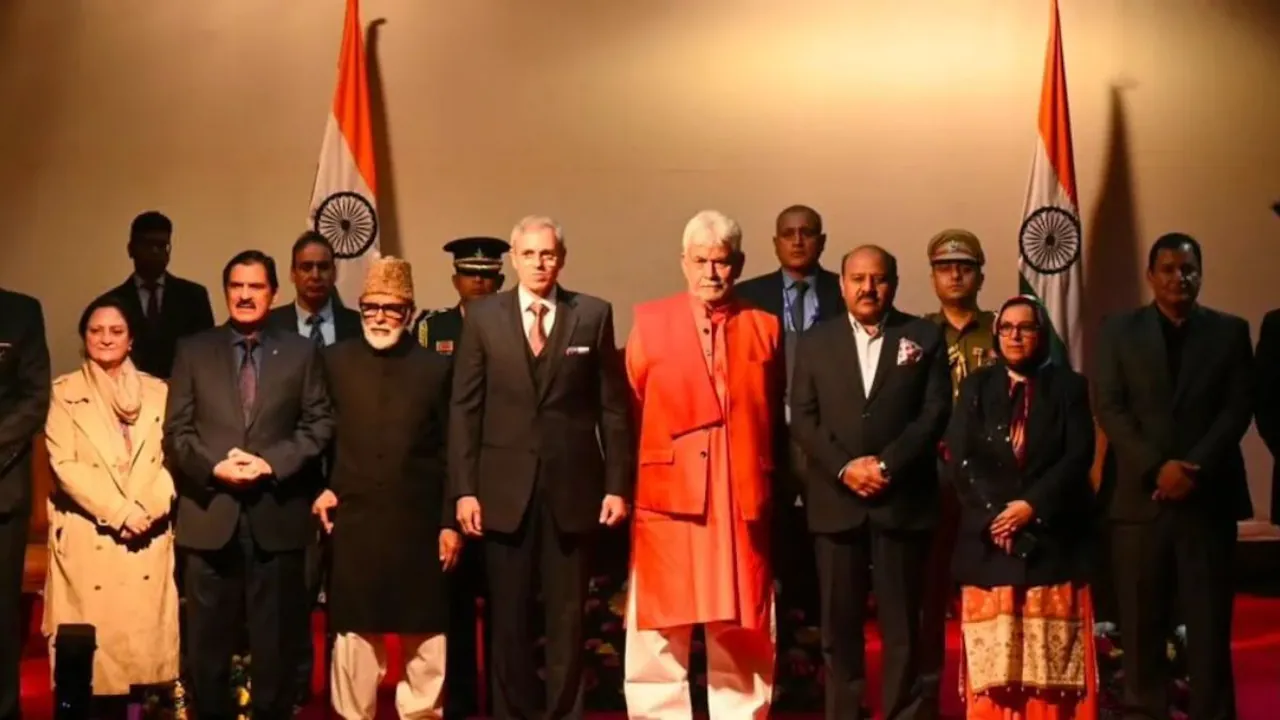
NC Rebellion: 19 MLAs Challenge Omar Abdullah as Cabinet Reshuffle Exposes Deepening Rift Within National Conference
From overlooked veterans and regional representation to Aga Syed Ruhullah Mehdi’s political confrontation, the National Conference is facing a test of internal cohesion barely two years after returning to power in Jammu and Kashmir.
By: Javid Amin | Srinagar | 30 October 2026
What was expected to be a long-awaited exercise in strengthening the Jammu and Kashmir government has turned into an uncomfortable political test for Chief Minister Omar Abdullah. The October 27 cabinet reshuffle, intended to fill vacant ministerial positions and bring the government to its maximum permissible strength, has instead exposed a growing crisis within the ruling National Conference (NC).
The discontent is no longer confined to legislators who missed out on ministerial positions. It has moved into a wider debate over political authority, internal democracy, regional representation and the influence of those operating within the Chief Minister’s inner circle.
The most significant development came on October 31, when reports emerged that 19 National Conference legislators had adopted a joint resolution demanding a fresh cabinet reshuffle and the removal of two close aides of Omar Abdullah, accusing them of interfering in party and administrative affairs. The demands, reported by India Today, suggest that dissatisfaction has developed into a more coordinated challenge to the party leadership.
This development changes the political character of the controversy.
A disappointed legislator can be accommodated through organisational responsibilities or future political assurances. A group of 19 MLAs collectively questioning cabinet decisions and the functioning of the Chief Minister’s office presents a different challenge. It raises questions about how decisions are being made, who exercises influence within the government and whether the party’s elected representatives feel adequately consulted.
Yet, describing the situation as an outright rebellion or an imminent government collapse would be premature. There is, so far, no publicly established breakaway faction or confirmed move to withdraw legislative support.
What is unfolding is better understood as a serious internal power struggle within a party that has returned to government with considerable political expectations.
And the cabinet reshuffle may have merely brought those underlying tensions into the open.
October 27: The Cabinet Expansion That Opened a Political Fault Line
On October 27, Lieutenant Governor Manoj Sinha administered the oath of office and secrecy to four National Conference legislators at Lok Bhawan in Srinagar.
The new ministers were:
-
Ali Mohammad Sagar, MLA from Khanyar.
-
Shamima Firdous, MLA from Habba Kadal.
-
Mir Saifullah, MLA from Trehgam.
-
Altaf Ahmad Wani (Altaf Kaloo), MLA from Pahalgam.
At the same time, Independent MLA Satish Sharma, who represented Chhamb in Jammu district, was dropped from the Council of Ministers.
The expansion was the first major cabinet reshuffle since Omar Abdullah assumed office in October 2024. The government had been functioning with several ministerial positions vacant, and the exercise was expected to bring political and administrative stability by distributing responsibilities among additional ministers.
However, the appointments also carried an unmistakable political message: the Chief Minister had opted to induct established National Conference leaders, including experienced former ministers, rather than accommodate every aspirant who had expected a place in the government.
Ali Mohammad Sagar and Mir Saifullah brought considerable legislative and administrative experience. Shamima Firdous added another woman to the Council of Ministers, while Altaf Kaloo strengthened the party’s representation from south Kashmir.
The decision, however, left several senior legislators disappointed.
Reports following the ceremony described visible resentment among supporters of Mubarak Gul and Abdul Majeed Larmi. The disappointment was particularly noticeable around the party headquarters, where supporters of overlooked leaders reportedly raised slogans.
The reshuffle had filled the vacant positions, but it had not resolved the political expectations that had accumulated during nearly two years of government.
There was also a constitutional constraint behind the exercise. Under Section 53 of the Jammu and Kashmir Reorganisation Act, 2019, the Council of Ministers cannot exceed 10 per cent of the total strength of the Legislative Assembly. With 90 elected seats, the government can have a maximum of nine ministers, including the Chief Minister.
The October 27 expansion brought the Council to that ceiling. In other words, there is no additional ministerial berth available without another minister first leaving office.
That limitation has made the politics of accommodation considerably more difficult.
The 19-MLA Meeting: From Private Disappointment to Organised Dissent
The most consequential development after the reshuffle was the gathering of dissatisfied legislators in Srinagar on Friday, October 30.
According to India Today’s October 31 report, 19 NC legislators met at the residence of Lolab MLA Qaiser Jamshed Lone. The meeting reportedly continued for nearly four hours, during which the participants discussed their grievances and prepared a joint resolution for submission to party president Farooq Abdullah.
The reported demands were significant.
The legislators reportedly sought:
-
A fresh cabinet reshuffle based on merit and balanced regional representation.
-
Replacement of ministers who had completed two years in office.
-
Removal of two individuals whom they accused of interfering in party and administrative affairs.
-
Greater consultation with elected legislators in important organisational and governmental decisions.
The two individuals named in the India Today report were Nasir Aslam Wani, an adviser to the Chief Minister, and Member of Parliament Shammi Oberoi. These are allegations attributed to the dissenting legislators, not established findings of administrative misconduct.
The demand to reconsider the role of the Chief Minister’s close aides deserves particular attention.
It suggests that the disagreement is not simply about who gets a ministerial position. At its heart is a question of political access: do elected MLAs have sufficient influence over decisions affecting their constituencies, or has authority become concentrated around a small group of political and administrative intermediaries?
That question can become uncomfortable for any ruling party.
An MLA’s political standing depends heavily on the ability to deliver development projects, resolve administrative problems and maintain communication with the government. When legislators believe that access to decision-makers is restricted, frustration can quickly extend beyond cabinet appointments.
There is, however, an important distinction between the reported resolution and a formal rebellion. The available reporting establishes that a meeting took place and that demands were discussed. It does not establish that the legislators have withdrawn support from Omar Abdullah or formed a separate legislative group.
Indeed, other reporting has described the gathering as a broader meeting involving independent legislators who support the government. The precise attendance figures and characterisation of the gathering have therefore varied across reports.
The political significance lies in the collective expression of dissatisfaction, rather than in treating every reported participant as a confirmed member of an organised rebel faction.
Why the Veterans Are Angry: The Politics of Recognition and Influence
The resentment of senior legislators is one of the most visible aspects of the crisis.
Mubarak Gul and Abdul Majeed Larmi are among the leaders whose exclusion from the cabinet generated public attention.
For established politicians, ministerial representation is not merely a matter of personal ambition. It carries organisational significance, particularly in a party where seniority, electoral contribution and years of political service have traditionally shaped internal standing.
Mubarak Gul is a six-time legislator and former Speaker of the Jammu and Kashmir Legislative Assembly. Abdul Majeed Larmi has also been associated with the party for years and publicly expressed disappointment over being overlooked.
The reaction of Larmi following the cabinet announcement became one of the most discussed moments of the reshuffle. Reports described him as visibly emotional, while supporters of Gul protested outside the party headquarters.
The controversy also raises a larger question about the National Conference’s organisational culture.
The party has a long history of leadership concentrated around the Abdullah family. Farooq Abdullah and Omar Abdullah remain its most recognisable political faces, while senior legislators and regional leaders provide the organisational network through which the party maintains its electoral presence.
That arrangement has historically offered continuity and a recognisable leadership structure. However, it can also create friction when senior legislators feel their experience and political contribution are not adequately reflected in decision-making.
The present controversy is exposing precisely that tension.
Sakina Itoo, a senior NC leader and cabinet minister, sought to play down the possibility of a rebellion on October 28. Describing the National Conference as a family, she maintained that disagreements were natural and should not be interpreted as a breakdown of party unity.
Chief Minister’s adviser Nasir Aslam Wani also acknowledged that legislators who missed out on cabinet positions could feel disappointed.
These responses indicate that the leadership recognises the dissatisfaction, even if it rejects the description of an internal revolt.
There is another development worth watching. Reports on October 31 also indicated that Mubarak Gul’s recently assigned organisational position as general secretary had become part of the wider controversy. This suggests that the disagreement may extend beyond ministerial appointments into the distribution of organisational authority itself.
For the NC leadership, keeping experienced legislators politically engaged may now be as important as managing the cabinet.
The Ruhullah Factor: A Political Crisis Beyond Ministerial Berths
Ruhullah’s confrontation with the NC leadership has developed into a separate political challenge centred on the party’s electoral commitments and the restoration of Jammu and Kashmir’s political rights.
The cabinet controversy is unfolding alongside another potentially damaging development: the announced departure of Srinagar MP Aga Syed Ruhullah Mehdi from both the National Conference and the Lok Sabha.
Unlike the dissatisfaction surrounding ministerial appointments, Ruhullah’s disagreement is rooted in political ideology, the party’s electoral promises and the direction of its post-2024 politics.
On October 28, he reiterated that his decision to resign on November 3 remained unchanged. On October 30, his office again announced that he would surrender his party membership and parliamentary seat, with a public address planned in Budgam.
His objections centre on what he regards as the party leadership’s failure to honour its commitments to the electorate.
Three political issues stand out:
1. Article 370 and Article 35A
The National Conference built a substantial part of its post-2019 political campaign around opposition to the August 2019 constitutional changes that removed Jammu and Kashmir’s special status.
Ruhullah has accused the party leadership of moving away from the political commitments on which it sought public support.
2. Restoration of statehood
The restoration of full statehood remains a major political demand in Jammu and Kashmir. The National Conference has repeatedly advocated it, but the elected government continues to function within the constitutional framework of a Union Territory.
This creates a difficult political situation: the party is responsible for governance but does not possess the same institutional powers as a full-fledged state government.
3. Political credibility and electoral promises
Ruhullah’s criticism is particularly damaging because he is not an opposition politician attacking the NC from outside.
He campaigned for the party and won the Srinagar parliamentary seat in 2024. His decision to leave therefore raises uncomfortable questions about the relationship between the party’s electoral messaging and its governing priorities.
In his October 29 remarks, reported by The Tribune, Ruhullah accused the leadership of collective betrayal and argued that the party had abandoned its commitments concerning Article 370.
His November 3 announcement is especially significant because he intends to surrender not just his party membership but also his parliamentary seat.
The distinction matters. Leaving a political party is an internal political decision; vacating an elected Lok Sabha seat requires the formal resignation process before the Speaker. As of October 31, the announced resignation should not be confused with a completed parliamentary vacancy.
Politically, however, the damage is already visible.
Ruhullah represents a constituency of voters who expect the National Conference to remain firmly committed to its position on constitutional rights and political autonomy. His departure could deepen the perception that the party’s leadership and a section of its support base are moving in different directions.
It would also create an uncomfortable political contrast: while the Chief Minister is dealing with dissatisfied legislators over power-sharing, a prominent MP is preparing to leave over questions of ideology and political credibility.
These are two different disputes, but they converge on one central issue — confidence in the party leadership.
Jammu Versus Kashmir: The Regional Representation Question
The arithmetic is straightforward.
Jammu and Kashmir has 90 elected Assembly constituencies:
-
Jammu division: 43 seats.
-
Kashmir division: 47 seats.
These figures are based on the final delimitation arrangements published by the Government of India.
All four newly inducted ministers represent constituencies in the Kashmir Valley.
The exit of Satish Sharma, an Independent MLA from Chhamb in Jammu district, has further changed the cabinet’s regional composition.
Following the reshuffle, seven of the nine ministers represent Kashmir Valley constituencies, while the remaining two represent Jammu division constituencies in the Pir Panjal region — Deputy Chief Minister Surinder Kumar Choudhary and Javed Ahmad Rana.
This distinction is important.
It would be inaccurate to say Jammu has been completely excluded from the government. It has two ministers. However, the plains of Jammu, particularly the districts of Jammu, Samba, Kathua and Udhampur, have lost their previous representation through Satish Sharma.
That is the more precise political concern.
The criticism is not restricted to opposition parties. It also carries implications for the NC’s own political ambitions.
The National Conference needs to demonstrate that its government can represent the entire Union Territory, including areas where the party has historically struggled to establish a strong electoral presence.
Jammu’s political landscape is also different from Kashmir’s. The BJP has a substantial electoral base in the Jammu region, and questions of representation, religious diversity and regional development carry considerable political weight.
A cabinet dominated numerically by Valley representatives can therefore become an easy target for the opposition, even when the government maintains that ministerial appointments were made on political and administrative considerations.
The larger challenge for Omar Abdullah is to ensure that the cabinet’s composition does not translate into a perception that important regional concerns are receiving unequal attention.
Representation is not only about how many ministers come from a particular region. It is also about whether people feel their issues have access to the highest levels of government.
That distinction will matter as the government moves from political appointments to the delivery of development projects and public services.
The Inner Circle Question: Who Is Exercising Influence Around Omar Abdullah?
Perhaps the most politically sensitive element of the emerging dissent is the criticism directed at the people surrounding the Chief Minister.
The 19-MLA resolution, as reported on October 31, reportedly seeks the removal of Nasir Aslam Wani and MP Shammi Oberoi, with the legislators accusing them of interfering in party affairs and administrative decision-making.
The allegations have not been independently established, and neither should they be presented as proven misconduct. However, their inclusion in the reported resolution makes the controversy more consequential.
The legislators are effectively questioning the decision-making structure around the Chief Minister.
This is a different political argument from demanding a ministerial berth.
A minister has a defined administrative responsibility. An MLA has an elected mandate and constituency-level obligations. Party office-bearers and political advisers, meanwhile, may exercise considerable influence without holding equivalent executive accountability.
When elected representatives begin questioning the influence of advisers and intermediaries, it usually indicates a deeper dissatisfaction with how political authority is being exercised.
For Omar Abdullah, this presents a difficult balancing act.
He needs a trusted team to coordinate government functioning, manage political negotiations and implement policy decisions. At the same time, he cannot afford to create the impression that elected representatives are being sidelined in favour of an unelected circle.
The distinction between political advice and administrative interference is important. It is also something that the party leadership may eventually have to address directly.
The reported demands suggest that the dissatisfied legislators want more than a change of ministers. They want a greater say in how the party and government function.
Why the Cabinet Cannot Simply Accommodate Everyone
One of the less discussed aspects of the crisis is the constitutional limitation on the size of the Jammu and Kashmir Council of Ministers.
Under Section 53 of the Jammu and Kashmir Reorganisation Act, 2019, the Council cannot exceed 10 per cent of the Assembly’s total membership.
With 90 elected seats, the maximum strength is nine ministers, including the Chief Minister.
The October 27 expansion filled the available positions. This means that accommodating another MLA in the cabinet would require an existing minister to leave office.
The situation is further complicated by the distribution of portfolios.
Following the expansion, several significant departments were allocated to the newly inducted ministers. Ali Mohammad Sagar received Revenue and Power Development, among other responsibilities; Shamima Firdous was assigned School Education, Higher Education and Jal Shakti; and Mir Saifullah received Planning, Development and Monitoring, among other departments.
Altaf Ahmad Wani was assigned Forest, Ecology and Environment, along with Rural Development and Panchayati Raj.
These appointments demonstrate that the reshuffle was not merely symbolic. It redistributed important administrative responsibilities.
But it also created a political constraint.
The dissatisfied legislators cannot all be accommodated through ministerial appointments. The leadership must therefore find other ways to address their grievances, whether through organisational responsibilities, greater consultation or changes in the functioning of the party.
The problem is that such alternatives may not satisfy legislators who believe their electoral standing and political experience justify a place in the government.
Congress’s Absence Adds Another Layer to the Political Equation
The National Conference’s internal difficulties are unfolding within a government that also has to manage its relationship with coalition partner Congress.
The NC won 42 seats in the 2024 Assembly elections, while Congress secured six. Together, the alliance crossed the majority threshold in the 90-member Assembly.
Congress, however, has remained outside the Council of Ministers.
The party has maintained that it would not join the government until statehood is restored. The October 27 expansion filled all available ministerial positions without accommodating Congress.
This has two implications.
First, Omar Abdullah’s government remains dependent on maintaining political cooperation with Congress and other supporting legislators, even though Congress does not occupy ministerial positions.
Second, the NC cannot treat its internal legislative dissatisfaction as an isolated organisational matter. Its ability to maintain a stable working relationship with its political allies remains essential.
The government has a numerical majority, but governing stability depends on more than the arithmetic of Assembly seats.
It requires coordination, confidence and the willingness of political partners to continue supporting the administration.
Is Omar Abdullah Facing an Actual Rebellion?
The word rebellion has gained prominence in reporting about the National Conference, but the available developments need to be understood carefully.
There are clear signs of organised dissatisfaction:
-
Nineteen MLAs were reported to have adopted a joint resolution.
-
Senior legislators publicly expressed disappointment.
-
Supporters of overlooked leaders protested.
-
Questions were raised about the influence of the Chief Minister’s close aides.
-
Aga Syed Ruhullah Mehdi announced his intention to leave both the party and Parliament.
These are substantial political developments.
However, there is no confirmed evidence, as of October 31, that the dissatisfied MLAs have formally withdrawn support from the government, formed a separate legislative party or initiated a coordinated attempt to remove Omar Abdullah as Chief Minister.
The distinction is crucial.
The National Conference secured 42 seats in the 2024 Assembly elections. A group of 19 legislators would represent a substantial section of its original legislative strength, making the reported resolution politically important. But a collective demand for changes within the party is not equivalent to a formal split.
Sakina Itoo’s October 28 response also reflects the leadership’s public position: disagreements are natural within the party, and disappointment over ministerial appointments should not automatically be treated as rebellion.
The coming days will reveal whether the dissent remains a pressure mechanism or develops into a sustained confrontation.
The Real Danger: A Crisis of Confidence, Not Just a Cabinet Crisis
The National Conference’s immediate problem is not necessarily the possibility of losing its government.
Its bigger challenge is the gradual erosion of confidence among different sections of its own political constituency.
Consider the developments together.
The senior legislators are questioning whether political experience and loyalty still carry sufficient weight in party decisions.
The dissatisfied MLA group is reportedly demanding a greater role in government and organisational functioning.
Ruhullah is challenging the party over its ideological direction and electoral commitments.
Jammu-based political voices are questioning the regional composition of the reshuffled cabinet.
The Chief Minister’s inner circle has become a subject of criticism from within the ruling party itself.
Each issue has a different origin. But together they create an uncomfortable political picture for the leadership.
There is also a wider governance dimension.
Jammu and Kashmir’s first elected government after the 2019 constitutional changes came to power amid considerable public expectations. The electorate wanted more than a change of political administration. It expected progress on statehood, employment, development, reservation-related concerns and the restoration of political confidence.
The National Conference’s 2024 electoral success was built partly on these expectations.
Now, as the government enters its third year in office, internal disputes risk diverting political attention from the issues that voters expect it to address.
That is where the crisis becomes more consequential.
A ruling party can survive disappointment over ministerial appointments. It can also manage ideological disagreements, provided there is an effective mechanism for internal discussion.
But when both organisational and ideological dissatisfaction begin developing simultaneously, the leadership faces a much more difficult task.
The danger is that public perception of internal instability could grow even without a formal split.
What Happens Next? Three Political Possibilities
The developments reported up to October 31 point towards three broad possibilities. These are political assessments, not confirmed decisions by the National Conference leadership.
1. Farooq Abdullah intervenes and contains the dissent
National Conference president Farooq Abdullah remains an important figure in managing internal political differences.
The reported resolution is intended for the party president, making his intervention particularly significant.
He could attempt to bring the dissatisfied legislators together, hear their grievances and negotiate organisational adjustments.
The leadership could also consider greater consultation with MLAs on administrative issues and constituency-level priorities.
Such an intervention would not necessarily require another cabinet reshuffle.
However, its success would depend on whether the dissatisfied legislators believe their concerns are being addressed through meaningful changes rather than temporary political assurances.
2. Ruhullah’s November 3 announcement intensifies the political debate
Ruhullah has reiterated his intention to resign from the NC and the Lok Sabha on November 3.
If he proceeds with the announced decision and completes the necessary formalities, the National Conference will face a highly visible political setback.
His departure could intensify questions about the party’s ideological direction, particularly among supporters who prioritise Article 370, statehood and constitutional rights.
It would not automatically result in a legislative rebellion, but it could deepen the political discomfort surrounding the leadership.
3. The MLA group expands its demands
The third possibility is a more sustained internal confrontation.
If the dissatisfied legislators maintain their collective position and additional MLAs join them, the party leadership could face pressure for a wider organisational restructuring or another round of cabinet changes.
The reported demand for the removal of the Chief Minister’s aides makes this scenario particularly sensitive.
However, an expanding group of dissatisfied legislators would still need to translate its demands into a clear political strategy before it could become a genuine challenge to the government’s survival.
For now, there is insufficient evidence to suggest that such a move is underway.
The Bigger Political Question: Can the National Conference Reconcile Power With Its Promises?
The current developments expose a difficult contradiction in the National Conference’s political position.
The party returned to power promising to represent the aspirations of Jammu and Kashmir’s people, defend its political identity and pursue the restoration of statehood.
Once in government, however, it has had to operate within the limitations of Union Territory administration, negotiate with the Centre and manage the practical demands of governance.
That transition inevitably involves political compromises.
But compromises become politically costly when sections of the party believe they are being made without sufficient consultation or when they appear to contradict the commitments that helped secure electoral support.
Omar Abdullah now faces two interconnected responsibilities.
He must demonstrate that his government can function effectively within the existing constitutional framework. At the same time, he must reassure his party that governance pragmatism does not mean abandoning its political commitments.
The cabinet reshuffle has made that balancing act more difficult.
The National Conference does not appear to be facing an immediate collapse of its government. But it is facing a serious internal test of leadership, consultation and political credibility.
The October 27 reshuffle was supposed to complete the cabinet. Instead, it has opened a debate about who controls the party’s political direction, how elected representatives are treated and whether the leadership can keep its organisation united while managing the responsibilities of government.
The real test for Omar Abdullah is no longer simply how many ministers sit in his cabinet. It is whether the people who helped bring the National Conference back to power continue to believe they have a meaningful voice in running it.
That is the question the party must answer before internal dissatisfaction becomes a lasting political liability.


