Mirwaiz Welcomes Decline in J&K Violence, Says Lasting Peace Requires Justice and Reconciliation
Citing a new International Crisis Group report, Kashmir’s chief cleric calls for restoration of civil liberties, review of detentions and meaningful political engagement
By: Javid Amin | 30 October 2026
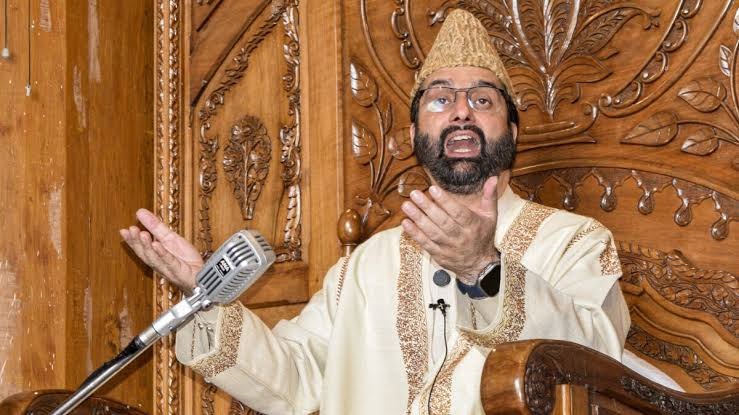
Srinagar: Mirwaiz Umar Farooq has welcomed the decline in militancy, street protests and violence in Jammu and Kashmir, but cautioned that a quieter security environment cannot, by itself, be treated as proof of lasting peace. Addressing the Friday congregation at Srinagar’s historic Jamia Masjid, he argued that durable stability requires justice, reconciliation, restoration of civil liberties and a meaningful political process capable of rebuilding public trust.
His remarks came as he referred to a recently released report by the International Crisis Group (ICG), titled A Trigger in Jammu and Kashmir: Militant Violence under Indian Central Rule. Published on October 22, the report examines the security situation seven years after the 2019 constitutional and administrative changes, arguing that although the security landscape has changed, political disaffection and the risk of renewed instability remain important concerns.
The Mirwaiz said the report deserved serious consideration, particularly its central observation that a reduction in violence does not automatically mean that underlying political grievances have been resolved or public confidence restored.
“No one understands the value of peace more than the people of Kashmir, who have suffered enormously over the past several decades,” he said, acknowledging the importance of the decline in violence while questioning whether security improvements were being matched by progress on the political and humanitarian fronts.
His intervention brings a wider question back into focus: what should follow when a conflict-affected region experiences a sustained improvement in security? For the Mirwaiz, the next phase must move beyond containment of violence towards addressing the conditions that allow public alienation and political uncertainty to persist.
Security gains and the question of lasting peace
The decline in militancy and street unrest is a development that carries considerable significance for ordinary residents. Fewer violent incidents can mean safer public spaces, greater freedom of movement, improved conditions for businesses and tourism, and a more predictable environment for education and employment.
Governments generally assess security through measurable indicators such as militant incidents, civilian and security-force casualties, infiltration, arrests and law-and-order disturbances. These indicators matter, particularly in a region that has experienced decades of armed conflict.
But Mirwaiz argued that security statistics cannot capture the entire experience of a society emerging from prolonged political conflict.
His concern is that a reduction in visible violence may coexist with unresolved political grievances, restrictions on peaceful expression and a lack of confidence in institutions. In that situation, the absence of large demonstrations or street confrontations cannot necessarily be interpreted as public consent or reconciliation.
This distinction is central to the debate over normalcy in Jammu and Kashmir. One assessment focuses on the government’s ability to maintain order and prevent militant violence. Another asks whether people feel able to express disagreement, participate in political life and seek remedies through institutions without fear or prolonged uncertainty.
Both dimensions influence long-term stability. Security remains essential, but public confidence also depends on the credibility, fairness and accessibility of institutions.
International Crisis Group report puts political alienation back in focus
The ICG report has added an international dimension to the discussion by examining how the security approach adopted after August 2019 has shaped the region’s political and security environment.
Titled A Trigger in Jammu and Kashmir: Militant Violence under Indian Central Rule, the report argues that the changes introduced by New Delhi have produced mixed outcomes. While the security situation has improved in certain respects, the organisation warns that militant groups have adapted their tactics and targets, while disaffection among sections of the population remains a concern.
The report also places Jammu and Kashmir’s internal situation within the wider India-Pakistan security equation. The April 2025 Pahalgam terror attack and the subsequent military confrontation between the two countries demonstrated how a major incident in Kashmir can rapidly acquire regional consequences.
For Mirwaiz, the report’s significance lies not only in its assessment of militancy but also in its attention to the political and civic environment. He highlighted concerns about restrictions on political and civic activities, limitations on peaceful expression, pressure on independent reporting and a growing sense of alienation.
He urged policymakers to consider these observations rather than treating the decline in violence as a reason to postpone political engagement.
The report’s recommendations, as outlined in coverage of its findings, include restoration of statehood, meaningful powers for the elected government, review of stringent anti-terror laws and renewed India-Pakistan dialogue. These proposals form part of a broader argument that a durable security framework must be accompanied by political measures.
The recommendations are those of the International Crisis Group, not an agreed government policy. Their implementation would involve significant political and security considerations, particularly given the continuing dispute between India and Pakistan.
UAPA arrests and convictions raise questions over due process
One of the most pointed parts of the Mirwaiz’s address concerned arrests and detentions under stringent anti-terror legislation after 2019.
Citing figures attributed to the Union Home Ministry and discussed in the ICG report, he said that 3,662 people were arrested under the Unlawful Activities (Prevention) Act (UAPA) in Jammu and Kashmir between 2019 and 2023, while 23 convictions were recorded during the same period.
He said the figures raised serious questions about prolonged detention, due process and the use of stringent legal provisions. He also referred to the hardship faced by families whose relatives remain caught in lengthy investigations and judicial proceedings.
The figures require careful interpretation. The number of arrests recorded during a period and the number of convictions recorded during that same period are not necessarily drawn from the same set of cases. Some cases may remain under investigation or trial, while convictions during the period may relate to cases registered earlier. The two figures therefore cannot, on their own, establish the acquittal rate or prove that every arrest was unjustified.
Nevertheless, the scale of arrests makes questions about the duration of detention, access to legal remedies, the pace of trials and the application of stringent laws important matters for public scrutiny.
The UAPA is a central anti-terror law that gives investigating agencies and courts powers to deal with offences linked to unlawful and terrorist activities. Its use is defended by the authorities as necessary to address serious security threats. At the same time, the law’s stringent bail provisions and the consequences of prolonged proceedings have remained subjects of legal and civil-liberties debate.
The challenge for the justice system is to ensure that genuine threats are investigated effectively while protecting the rights of individuals and maintaining the principle that allegations must be tested through due legal process.
Mirwaiz said thousands of families continued to experience anxiety and uncertainty because of arrests, detention and lengthy legal proceedings. His remarks put the human consequences of criminal proceedings at the centre of the peace debate.
Political prisoners and the appeal for humanitarian consideration
The Mirwaiz also renewed his appeal concerning the continued incarceration of several Kashmiri political figures, including Muhammad Yasin Malik, Shabir Ahmad Shah, Shahid-ul-Islam, Engineer Rashid, Asiya Andrabi and Masrat Alam.
He called for their cases to be reviewed and urged humanitarian consideration for elderly and ailing prisoners. He noted that many detainees had spent years in custody, sometimes in prisons far from their families and home communities.
The individuals named by the Mirwaiz have different legal histories and are not all in the same procedural position. Their cases involve separate allegations, proceedings and judicial orders. Any consideration of their release, continued detention or other relief must therefore be examined through the relevant legal processes rather than treated as a single collective case.
The larger issue raised by the appeal concerns the relationship between justice, incarceration and reconciliation. The Mirwaiz’s argument is that humanitarian considerations and fair legal treatment should remain part of any effort to reduce political alienation.
For families, prolonged incarceration can carry consequences that extend beyond the person in custody. It can affect household finances, children’s education, emotional well-being and the ability to maintain ordinary family life.
The appeal for review and humanitarian consideration therefore adds a social dimension to the political debate, even as the legal merits of individual cases remain matters for the courts.
Civil liberties and the space for peaceful expression
Another central theme of the address was the restoration of civil liberties.
Mirwaiz argued that an improved security environment should create an opportunity to ease restrictions, review detentions and allow people greater space to express their opinions and grievances peacefully.
His concern extends to political participation, civic activity and independent reporting. These are important elements of public life because they provide channels through which disagreement can be expressed without resorting to confrontation.
The question is particularly relevant in Jammu and Kashmir, where the 2019 reorganisation changed the region’s constitutional and administrative status, and where the restoration of statehood remains a major political demand.
The 2024 Assembly election restored an elected legislature and government after years of central rule. However, Jammu and Kashmir continues to function as a Union Territory, with key areas such as public order and police remaining outside the elected government’s control.
This arrangement has kept the distribution of powers between the elected administration and the Lieutenant Governor at the centre of political debate.
The Mirwaiz’s call for meaningful political engagement therefore extends beyond the restoration of individual civil liberties. It also touches on the question of how much authority elected representatives should exercise and whether political institutions have sufficient space to respond to public concerns.
Dialogue between India and Pakistan remains part of the wider equation
The Mirwaiz also referred to the dangers of confrontation between India and Pakistan, saying that last year’s military escalation demonstrated the risks of allowing tensions to spiral.
His position is that dialogue remains a more responsible path than confrontation. He argued that political issues require political engagement and that longstanding grievances need sincere efforts at reconciliation.
The India-Pakistan relationship remains a critical factor in Jammu and Kashmir’s security environment. The two countries have fought multiple wars and experienced repeated military crises over the region. The Pahalgam attack in April 2025 and the subsequent confrontation again demonstrated how quickly violence in Kashmir can affect bilateral relations.
Any renewed diplomatic engagement faces substantial obstacles, including cross-border terrorism, competing political positions and deep mistrust between the two governments. New Delhi has consistently maintained that terrorism and dialogue cannot proceed together under the existing circumstances, while Pakistan has called for discussions on outstanding disputes.
The ICG’s call for renewed diplomatic engagement must therefore be understood against this difficult background. It is a policy recommendation, not evidence that a diplomatic process is currently underway.
For Mirwaiz, however, the lesson is that the security and political dimensions of Kashmir cannot be separated entirely from the broader regional relationship.
The government’s security narrative and the demand for political engagement
The remarks also reflect a wider debate over how progress in Jammu and Kashmir should be measured.
The government has repeatedly highlighted improvements in the security environment, development activity, tourism and public infrastructure as evidence of progress. These are important indicators, and improvements in everyday security have direct consequences for residents, visitors, traders and businesses.
The Mirwaiz’s intervention does not deny the value of reduced violence. Instead, it challenges the idea that improved security should be the only measure of normalcy.
His argument is that development and security gains will have a stronger foundation when accompanied by political participation, institutional accountability and public trust.
This debate is not limited to one Friday sermon. It concerns the future relationship between the Union government, the elected administration and the people of Jammu and Kashmir.
For the elected government, the challenge is to demonstrate that democratic representation can translate into meaningful governance despite the Union Territory’s constitutional and administrative limitations. For the Centre, the question involves balancing security responsibilities with political outreach and the stated commitment to restoring statehood. For political and civil society groups, the challenge is to articulate grievances through peaceful and democratic channels.
The positions differ, but the underlying question remains the same: how can improved security be converted into a stable political settlement and greater public confidence?
A peace process must be measured by trust
Mirwaiz said his remarks were motivated by concern for the future of the people of Jammu and Kashmir, not by a desire for confrontation. He urged policymakers to use the improvement in the security environment as an opportunity to begin a broader process of reconciliation.
That process, in his view, should include reviewing detention cases, restoring civil liberties, considering humanitarian concerns, strengthening the elected government’s role and creating space for meaningful political dialogue.
The practical challenges are considerable. Security agencies must continue to address militancy and protect civilians. Courts must decide individual cases on evidence and law. Governments must consider the political implications of restoring statehood and expanding democratic authority. India and Pakistan must also confront the mistrust that has repeatedly obstructed dialogue.
But these challenges do not make the wider debate less important. If the decline in violence is to become a lasting achievement, it must be accompanied by institutions that people trust and political channels through which grievances can be addressed peacefully.
The central message of the Mirwaiz’s address is that peace is not simply the absence of violence. It is also the presence of justice, confidence, political participation and the ability to live without fear or uncertainty.
For Jammu and Kashmir, the next measure of progress may therefore lie not only in how much violence has declined, but in whether that improvement creates the conditions for a more inclusive and durable political future.


