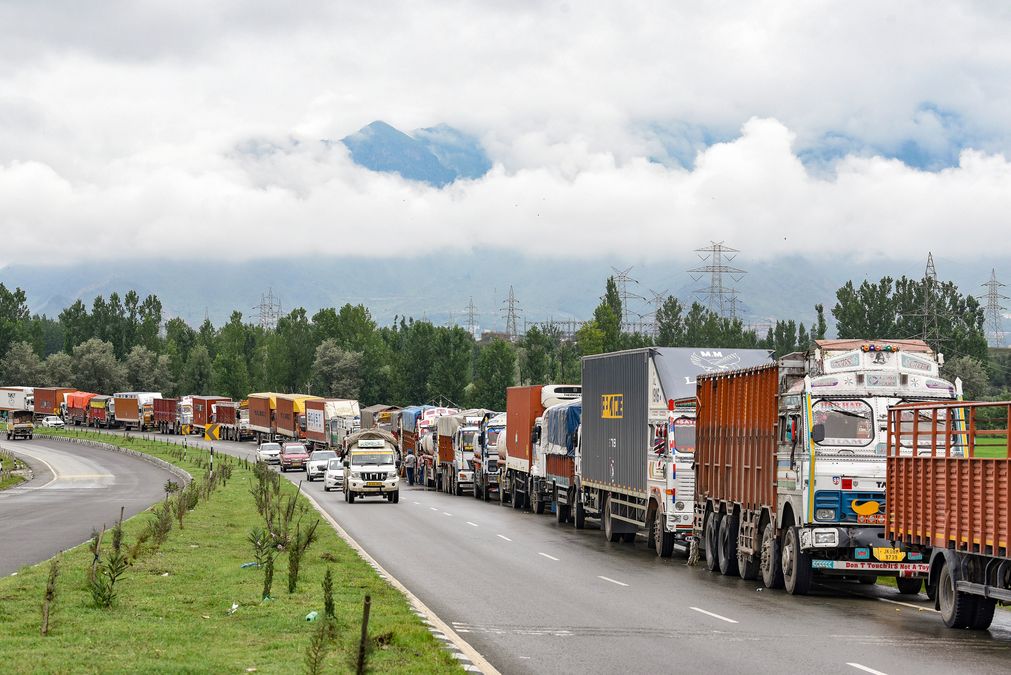
J&K Highway Fruit Trucks Get Priority Amid Amarnath Yatra, Rain; Rashid Seeks Green Corridor
By: News Desk | 07 Aug 2026
Kashmir’s Fruit Economy Meets a Highway Bottleneck
For Kashmir’s horticulture industry, the difference between a truck moving today and a truck moving tomorrow can translate into a significant financial difference.
That concern has returned to the centre of the conversation as Amarnath Yatra traffic, heavy rainfall, landslides and highway restrictions put additional pressure on the Jammu-Srinagar National Highway, or NH-44.
On Friday, August 7, Jammu and Kashmir Chief Minister Omar Abdullah said fruit-laden trucks travelling out of Kashmir and petroleum tankers moving from Jammu were being given priority on the highway. He made the remarks while reviewing the highway’s traffic situation after rain-triggered landslides in the Udhampur-Ramban sector.
The announcement came as the annual Amarnath Yatra continues to place additional demands on the highway’s traffic-management system.
At almost the same time, Baramulla MP Engineer Rashid sought something more permanent: a dedicated green corridor for fruit-laden trucks on the Srinagar-Jammu highway. Rashid reportedly raised the demand during a meeting with Union Road Transport and Highways Minister Nitin Gadkari.
The two developments point towards the same underlying problem:
Kashmir’s horticulture sector remains heavily dependent on a vulnerable road corridor, particularly at a time when weather and pilgrimage traffic can disrupt normal movement.
Omar Abdullah Orders Priority for Fruit Trucks and Fuel Tankers
Omar Abdullah’s intervention is aimed at balancing two essential requirements.
On one side is the Amarnath Yatra, which requires carefully regulated movement of pilgrim convoys and other vehicles.
On the other is the movement of essential commodities and Kashmir’s perishable agricultural produce.
According to reports, the Chief Minister directed that fruit-laden trucks from Kashmir and petroleum tankers from Jammu receive priority passage on the highway. The objective is to maintain the supply of essential commodities while ensuring that horticultural produce reaches markets without unnecessary delays.
The timing is significant.
The highway has recently faced disruption from heavy rainfall and landslides, particularly around the Udhampur-Ramban stretch.
For ordinary passenger vehicles, a delay may mean a postponed journey.
For a truck carrying perishable agricultural produce, the economics are very different.
Every additional hour can mean:
- Higher fuel and driver costs
- Longer delivery times
- Greater risk of quality deterioration
- Missed market windows
- Additional loading and unloading expenses
- Pressure on wholesale prices
- Potential losses for growers and transporters
This makes priority movement more than a traffic-management measure.
It is an agricultural supply-chain intervention.
Engineer Rashid Wants a Formal Green Corridor
Engineer Rashid’s demand goes a step further.
Rather than relying primarily on case-by-case traffic prioritisation, the Baramulla MP has called for a dedicated green corridor for fruit trucks.
The concept is straightforward: when highway conditions deteriorate or traffic becomes heavily regulated because of the Yatra, fruit-laden vehicles should receive a clearly defined, protected movement window.
Rashid’s proposal was raised during his meeting with Union Road Transport and Highways Minister Nitin Gadkari, according to reports.
The argument behind the proposal is economic.
Kashmir’s horticulture sector cannot operate on the same timetable as conventional freight.
A truck carrying machinery can wait.
A truck carrying construction material can sometimes wait.
A truck carrying fresh fruit has a much smaller logistical margin.
The longer the journey takes, the greater the risk to the commercial value of its cargo.
NH-44 Has Become Kashmir’s Economic Lifeline
The importance of the Jammu-Srinagar highway goes far beyond passenger travel.
NH-44 is one of the principal arteries connecting Kashmir with markets and supply chains outside the Valley.
It carries:
- Fruit and vegetables
- Fuel
- Medicines
- Food supplies
- Consumer goods
- Construction material
- Industrial supplies
- Tourist traffic
- Public transport
- Private vehicles
This makes any prolonged disruption economically consequential.
The problem becomes particularly acute when several pressures occur simultaneously.
Heavy rain + landslides + Yatra traffic + restricted convoy movement = reduced freight capacity.
Recent traffic advisories have already reflected the need to regulate different categories of vehicles according to weather and road conditions. A July advisory, for instance, said heavy motor vehicles carrying fresh fruits, vegetables and other perishables would be permitted subject to the movement of Yatra convoys and prevailing weather and traffic conditions.
Earlier traffic arrangements also provided priority for trucks carrying fresh perishable goods, while certain empty tankers and other vehicles were directed to use the Mughal Road under specified conditions.
This shows that priority movement is not an entirely new concept.
What is changing is the intensity of the debate over whether temporary arrangements are sufficient.
Why Apple Trucks Cannot Afford Long Delays
The economics of fruit transportation are fundamentally different from ordinary freight.
Once apples and other horticultural products are harvested, the supply chain begins a race against time.
The journey involves several stages:
Orchard → collection point → grading/packing → truck → highway → terminal market → wholesaler → retailer → consumer
A disruption at any point can create additional costs.
If hundreds or thousands of trucks are held up simultaneously, the problem can quickly move from an individual farmer’s concern to a regional supply-chain issue.
This is especially important as Kashmir’s fruit movement begins to intensify during the harvesting and dispatch period.
The government has already been using rail as an additional transportation option. By late July, officials said around 14,000 metric tonnes of apples, equivalent to about nine lakh boxes, had been moved from the Valley to outside markets through railway services during the season. The government also reported that more than 1.25 lakh apple boxes worth ₹10.03 crore had been dispatched by rail during a recent road-block period.
The figures underline an important development:
Kashmir’s horticulture logistics network is beginning to diversify beyond road transport, but NH-44 remains critically important.
Rail Has Emerged as a Pressure-Release Valve
The expansion of railway-based fruit movement could reduce some dependence on the highway.
This is particularly valuable when landslides or traffic restrictions temporarily reduce NH-44’s capacity.
Officials have said railway connectivity has provided a cost-effective alternative for moving horticulture produce to major markets, including Delhi. The government has also said it is coordinating with traffic police, transport authorities and district administrations to facilitate fruit-laden trucks.
The development presents an opportunity for a broader logistics strategy.
Instead of treating rail and road as competing systems, Kashmir could use both.
Road
Best suited for flexible, door-to-door movement from orchards and fruit mandis.
Rail
Useful for larger-volume movement over longer distances, especially during highway disruptions.
Mughal Road
Potentially valuable as an alternative route when NH-44 traffic is restricted and road conditions permit.
Cold-Chain Infrastructure
Could reduce the pressure created by short-term transport delays by extending the shelf life and market window of produce.
A resilient horticulture economy should not depend on a single corridor.
The Amarnath Yatra Adds Another Layer of Complexity
The Amarnath Yatra is one of the largest annual pilgrimages in the region, and traffic management during the pilgrimage is inherently complex.
Convoys need to move in a controlled manner.
Security arrangements require predictable traffic windows.
Weather conditions can force sudden changes.
Road conditions between Jammu, Ramban, Banihal and Kashmir can also deteriorate quickly during heavy rainfall.
Recent advisories have therefore regulated vehicle movement around Yatra convoys, including restrictions on when heavy motor vehicles can proceed.
The policy challenge is not to choose between pilgrims and fruit growers.
It is to create a traffic-management system capable of serving both.
That requires predictability.
Fruit traders and transporters need to know when their vehicles will be allowed to move.
Pilgrims need predictable convoy schedules.
Emergency and essential-service vehicles need clear priority.
And highway authorities need sufficient flexibility to respond when landslides or rainfall suddenly change road conditions.
Rain and Landslides Make the Problem Harder
The highway’s vulnerability is not purely a traffic-management issue.
The Ramban-Banihal belt contains terrain where landslides, shooting stones, road damage and sinking zones can interrupt movement, particularly during periods of heavy rain.
When a landslide blocks the road, no traffic-priority policy can immediately solve the problem.
The first requirement is road clearance and safety assessment.
This is why recent advisories have repeatedly stressed that vehicle movement remains subject to weather and road conditions.
For fruit transporters, this creates an uncomfortable uncertainty.
A truck may leave an orchard on schedule but encounter a blockage several hours later.
That uncertainty makes logistics planning difficult and can increase costs throughout the supply chain.
The Real Economic Stakes: Farmers, Not Just Trucks
The green-corridor debate should not be reduced to a dispute over which vehicles receive priority.
At its core is the livelihood of thousands of people associated with Kashmir’s horticulture economy.
The supply chain includes:
- Orchard owners
- Small growers
- Labourers
- Packers
- Grading units
- Transporters
- Commission agents
- Fruit mandi workers
- Cold-storage operators
- Wholesalers
- Retailers
A highway disruption can therefore create a ripple effect across multiple layers of the rural economy.
The grower may be the first person to feel the loss, but the impact can travel through the entire chain.
That is why highway reliability is effectively part of Kashmir’s agricultural infrastructure.
Could a Green Corridor Work?
A formal green corridor for fruit trucks would need to be designed carefully.
It should not simply mean allowing every fruit truck onto the highway regardless of weather or safety.
Instead, authorities could consider a structured system involving:
Dedicated Movement Windows
Fruit trucks could receive designated time slots based on highway conditions and Yatra convoy schedules.
Digital Registration
Loaded vehicles could be registered electronically, allowing authorities to identify genuine perishable consignments and coordinate their movement.
Real-Time Tracking
GPS-based monitoring could help traffic authorities know where fruit convoys are and identify bottlenecks.
Priority at Critical Junctions
Traffic personnel could facilitate the movement of registered fruit vehicles through major congestion points.
Alternative Routes
Mughal Road and rail could be integrated into the contingency plan when NH-44 capacity falls sharply.
Emergency Protocols
A predefined mechanism could be activated when landslides or prolonged closures threaten large consignments.
This would transform the idea of a “green corridor” from a political demand into a practical logistics programme.
But Safety Must Remain Non-Negotiable
There is one important caveat.
A fruit truck should not receive priority at the expense of road safety.
If a section of NH-44 is genuinely unsafe because of an active landslide, falling rocks, damaged pavement or unstable slopes, opening the road simply to move perishable goods could put drivers and other road users at risk.
The objective should therefore be:
priority when safe—not priority regardless of safety.
This distinction matters particularly during intense rainfall.
Traffic authorities must retain the ability to halt all movement when conditions become dangerous.
Kashmir’s Horticulture Needs a Multi-Modal Logistics Plan
The current debate offers an opportunity to rethink how Kashmir transports its most valuable agricultural produce.
Rather than depending almost entirely on one highway, the Valley needs a multi-modal horticulture logistics network.
That network could combine:
NH-44 + Mughal Road + railway + cold storage + controlled-atmosphere facilities + digital freight coordination.
Such a system would make the horticulture economy less vulnerable to a single landslide or highway closure.
The railway movement of apples already shows that diversification is possible.
The next step should be to institutionalise it.
A Green Corridor Could Become More Than a Seasonal Fix
If implemented properly, a green corridor need not remain limited to the Amarnath Yatra period.
It could evolve into a permanent perishable-goods priority framework activated during:
- Peak apple season
- Highway closures
- Severe weather
- Landslide events
- Major traffic disruptions
- Emergency supply shortages
Such a framework could also cover vegetables, dairy products, medicines and other time-sensitive commodities where appropriate.
That would make the policy useful throughout the year.
The Bigger Lesson: Kashmir Needs Reliable Connectivity
The current situation exposes a deeper structural weakness.
Kashmir’s economy has become increasingly dependent on uninterrupted connectivity, but its primary road connection remains vulnerable to geography and weather.
That vulnerability affects more than horticulture.
It affects tourism.
It affects fuel supply.
It affects construction.
It affects retail prices.
It affects industrial activity.
And it affects the confidence of businesses that need predictable delivery schedules.
For an economy seeking greater diversification and investment, logistics reliability is not a secondary issue.
It is foundational infrastructure.
Conclusion: Protect the Fruit Before It Becomes a Highway Crisis
The decision to prioritise fruit-laden trucks and petroleum tankers on NH-44 is an important immediate response to a difficult combination of Yatra traffic and weather-related disruptions. Omar Abdullah’s direction recognises that essential commodities and perishable horticultural produce cannot simply be treated like ordinary traffic.
But Engineer Rashid’s demand for a formal green corridor raises the more important long-term question: should Kashmir’s fruit transportation continue to depend on temporary, situation-by-situation arrangements, or should there be a permanent contingency system for the horticulture sector?
The answer increasingly points towards the latter.
A properly designed system could combine priority traffic windows, real-time monitoring, alternative routes, railway freight, cold-chain facilities and rapid-response protocols.
The objective should not be to give fruit trucks special treatment for its own sake.
It should be to protect a sector that supports a vast rural supply chain and contributes significantly to Kashmir’s economy.
When a truck carries Kashmir’s harvest, the highway is not merely carrying cargo. It is carrying the income of thousands of families.
That is why keeping the Valley’s fruit supply chain moving safely should be treated as an economic priority—not an afterthought whenever the highway becomes congested.