Omar Abdullah Calls FIR Row a ‘Fixed Match’, Alleges Agencies Are Reviving PDP’s Credibility
By: News Desk | 07 Aug 2026
Omar Abdullah Calls FIR Row a ‘Fixed Match’, Alleges Agencies Are Reviving PDP’s Credibility
The political battle between the National Conference (NC) and the Peoples Democratic Party (PDP) has intensified following an FIR against former Jammu & Kashmir Chief Minister Mehbooba Mufti and her daughter, PDP leader Iltija Mufti, over an alleged assault on a police officer during a protest against the abrogation of Article 370.
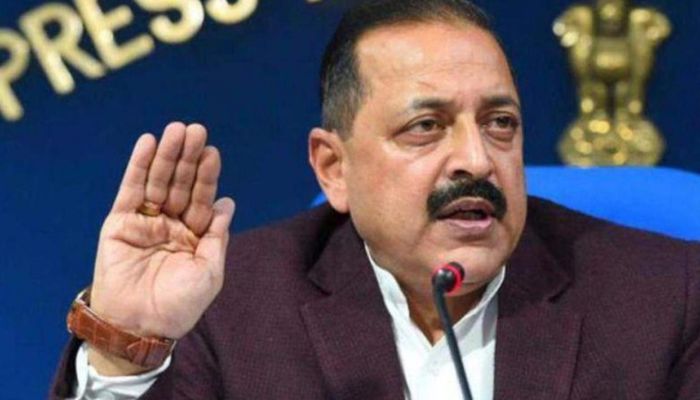
Jammu & Kashmir Chief Minister Omar Abdullah has rejected the episode as straightforward law enforcement, calling the confrontation a “fixed match” and alleging that government agencies are effectively helping restore the PDP’s political credibility.
The allegation has added a fresh layer to an already contentious dispute involving the police version of events, Iltija Mufti’s counter-allegations, and the wider political competition between the NC and PDP.
Police, meanwhile, maintain that an officer was assaulted during the PDP demonstration. Iltija has disputed that account, saying she was intercepted and manhandled by police personnel.
What Happened During the Article 370 Protest?
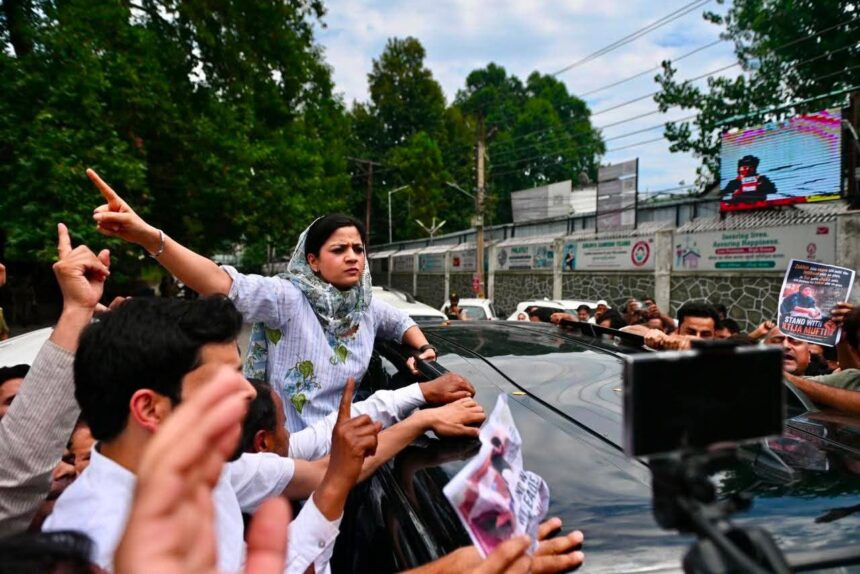
The controversy stems from a PDP protest in Srinagar on August 4, held ahead of the anniversary of the 2019 abrogation of Article 370.
According to police, a confrontation occurred during the demonstration involving Iltija Mufti and a police officer. An FIR was subsequently registered on August 6 against Mehbooba Mufti and Iltija Mufti in connection with the alleged assault.
The PDP has presented a sharply different version.
Iltija Mufti has alleged that she was stopped and manhandled by police personnel, including a woman police officer of SP rank. The competing accounts have turned what initially appeared to be a law-and-order case into a political controversy.
At this stage, the allegations from both sides remain contested. The FIR records the police version; it does not, by itself, establish guilt.
Omar Abdullah’s ‘Fixed Match’ Charge
Omar Abdullah has taken the controversy beyond the question of the alleged assault.
He has described the episode as a “fixed match”, arguing that the confrontation and subsequent political attention could help the PDP regain credibility among voters.
His criticism suggests that he sees the incident not simply as a dispute between protesters and police, but as part of a broader political narrative in which the PDP is able to present itself as a victim of government action.
That is a serious political allegation, but it remains Omar Abdullah’s characterization rather than an established fact.
The latest reporting confirms that Omar made the “fixed match” remark while discussing the police-Iltija confrontation and its potential political impact on the PDP.
Why the PDP’s Credibility Matters
The controversy comes at a time when the PDP is attempting to retain political relevance in Jammu & Kashmir.
The party, which once formed governments in the erstwhile state and later entered into a coalition with the BJP, has experienced a significant decline in electoral influence.
The 2024 Jammu & Kashmir Assembly election further reshaped the regional political landscape, with the National Conference emerging as the dominant regional force.
That makes political space between the NC and PDP increasingly important.
For the PDP, a confrontation with authorities over Article 370 provides an opportunity to reinforce its long-standing image as a party willing to challenge the Centre’s 2019 decision.
For the NC, however, the same development creates a political dilemma: whether to defend a rival opposition party against government action or question whether the controversy is strengthening a competing political force.
NC vs PDP: The Opposition Battle Behind the FIR
The dispute illustrates a deeper rivalry within Kashmir’s regional politics.
Both the NC and PDP oppose the 2019 abrogation of Article 370, but their political strategies and priorities have often differed.
National Conference
The NC currently controls the government in Jammu & Kashmir under Omar Abdullah and has emphasized the restoration of statehood, while continuing to maintain its broader position on the constitutional changes of 2019.
PDP
The PDP remains more explicitly focused on the restoration of Article 370 and constitutional safeguards, using the issue as a central element of its political identity.
This difference has created an unusual political situation: two parties can oppose the same constitutional decision while simultaneously competing for the same opposition space.
The FIR Has Become a Political Narrative
The legal case is now being interpreted through two competing narratives.
| Issue | Police/Premise of FIR | PDP/Iltija’s Response |
|---|---|---|
| Confrontation | Police allege an officer was assaulted | Iltija says she was manhandled |
| FIR | Legal action over alleged assault | PDP questions the circumstances |
| Political meaning | Law-and-order matter | Alleged targeting of opposition |
| Omar Abdullah’s position | Rejects the episode as straightforward politics | Calls it a “fixed match” benefiting PDP |
| Wider impact | Reinforces security and law-and-order narrative | Strengthens PDP’s victimhood narrative |
The competing versions mean that the political consequences could ultimately be more significant than the immediate legal dispute.
Is the PDP Gaining Political Sympathy?
That remains difficult to measure at this stage.
A confrontation involving prominent opposition figures can generate public attention and potentially strengthen a party’s ability to mobilize its supporters. However, whether it translates into broader electoral support is a separate question.
The PDP may attempt to use the FIR to reinforce its argument that opposition voices remain under pressure.
The NC, meanwhile, has an incentive to distinguish itself from both the BJP-led Centre and the PDP, positioning itself as the principal regional political force capable of governing while continuing to pursue its political demands.
This is where Omar Abdullah’s “fixed match” allegation becomes politically significant.
He is effectively questioning whether the controversy is inadvertently giving the PDP a political lifeline.
Agencies Allegation Raises a Bigger Political Question
Omar’s allegation that government agencies are helping revive PDP credibility is particularly significant because it introduces a claim of political manipulation into an already sensitive legal controversy.
There is currently no publicly established evidence proving that agencies orchestrated the confrontation to benefit the PDP.
That distinction is important.
The police have presented an allegation of assault, while Iltija has offered a counter-account. Omar has then interpreted the resulting controversy through the lens of political competition.
Until further evidence emerges, the claim that agencies deliberately engineered the episode should therefore be treated as an allegation, not a verified fact.
Article 370 Remains the Common Political Battlefield
The dispute cannot be separated from the larger political significance of Article 370.
The PDP’s protest was held specifically against the 2019 constitutional changes, and the anniversary continues to be a major political mobilization point for regional parties.
For the PDP, Article 370 remains a core ideological issue.
For the NC, it remains an important constitutional question, but its current political campaign places considerable emphasis on restoring statehood and strengthening democratic institutions.
The BJP, meanwhile, continues to defend the 2019 decision as a measure of national integration and development.
Thus, the same anniversary produces three distinct political narratives.
A Fresh Test for Opposition Politics in J&K
The FIR controversy could further expose differences among opposition parties in Jammu & Kashmir.
A unified opposition response against government action could strengthen the broader campaign over constitutional rights and statehood.
But competing claims about who represents the “real” opposition risk fragmenting that campaign.
Omar Abdullah’s comments indicate that the NC is unwilling to automatically endorse every political confrontation involving the PDP.
For the PDP, however, the controversy provides another opportunity to position itself as an uncompromising voice on Article 370.
What Happens Next?
The immediate issue will be the legal proceedings arising from the FIR and the competing accounts of the August 4 confrontation.
The political battle, however, is likely to continue well beyond the legal process.
The PDP can be expected to use the episode to reinforce its argument that political dissent remains constrained. The NC is likely to continue emphasizing governance and statehood while maintaining its broader opposition to the post-2019 constitutional framework.
For Omar Abdullah, the challenge is to prevent the PDP from occupying the political space created by the controversy without appearing to defend the government’s actions against opposition leaders.
That makes the “fixed match” remark more than a passing political jibe—it reflects the increasingly competitive struggle over who gets to define opposition politics in post-2019 Jammu & Kashmir.
Key Takeaways
- Police registered an FIR against Mehbooba Mufti and Iltija Mufti following a confrontation during a PDP protest against the abrogation of Article 370.
- Police allege that a police officer was assaulted; Iltija Mufti disputes the allegation and says she was manhandled by police personnel.
- Omar Abdullah called the episode a “fixed match”, arguing that it could help restore the PDP’s political credibility.
- Omar’s claim that agencies are deliberately helping the PDP remains an unverified political allegation.
- The controversy highlights the continuing NC-PDP rivalry over opposition leadership in Jammu & Kashmir.
- Article 370 remains the central political fault line linking the legal dispute, opposition strategy, and Kashmir’s wider political narrative.