Mehbooba Mufti Faces Twin Political Offensive as AIP and National Conference Question Her Human Rights Record
By: News Desk | 26 July 2026
Awami Ittehad Party demands an apology over alleged ‘double standards’, while National Conference leader Tanvir Sadiq accuses the former Chief Minister of political hypocrisy
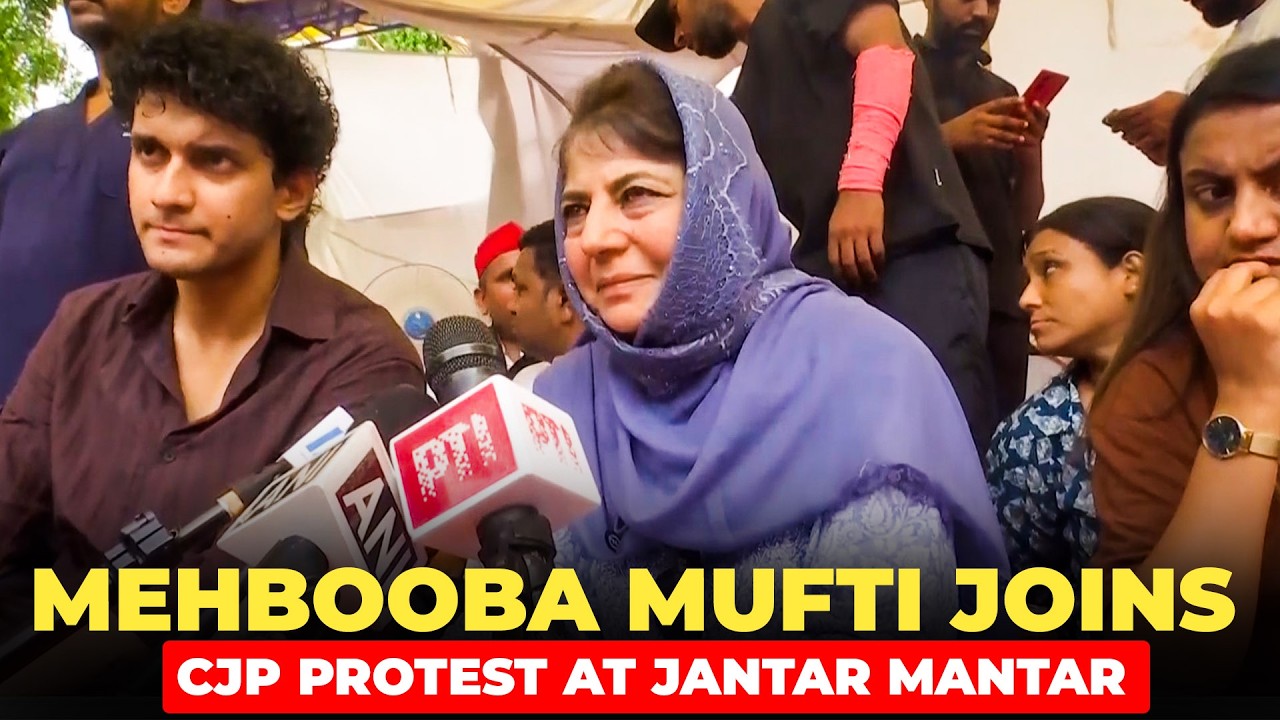
The political battle over human rights and accountability in Jammu and Kashmir has intensified, with People’s Democratic Party (PDP) president Mehbooba Mufti coming under simultaneous attack from both the Awami Ittehad Party (AIP) and the National Conference (NC).
In separate political interventions, the AIP accused Mehbooba of adopting “double standards” on human rights, while senior National Conference leader Tanvir Sadiq demanded that she apologise for her criticism of recent police action in the Valley.
The developments underscore how human rights have become one of the most contested issues in Jammu and Kashmir’s political landscape, with regional parties increasingly challenging each other’s credibility rather than focusing solely on the Union Government.
AIP Accuses Mehbooba Mufti of ‘Selective Outrage’
The Awami Ittehad Party, led by the political camp associated with jailed MP Abdul Rashid Sheikh (Engineer Rashid), alleged that Mehbooba Mufti has adopted inconsistent positions on human rights depending on whether her party is in government or in opposition.
According to AIP leaders, the PDP has been vocal in criticising alleged human rights violations under the present administration but has failed to adequately acknowledge or account for actions taken during its own tenure in office.
The party argued that human rights cannot be defended selectively and called upon Mehbooba Mufti to publicly acknowledge what it described as inconsistencies in the PDP’s political record.
AIP also demanded a public apology, asserting that political credibility depends upon applying the same standards irrespective of which party is in power.
The Background to AIP’s Criticism
The Awami Ittehad Party has increasingly sought to position itself as an alternative regional political force that challenges both the ruling establishment and traditional Kashmir-based parties.
By questioning Mehbooba Mufti’s record, AIP appears to be attempting to project itself as an independent voice focused on accountability across political lines rather than limiting criticism to the present government.
Political observers believe this strategy also reflects increasing competition among opposition parties seeking to expand their support base in the Valley.
Tanvir Sadiq Responds to Mehbooba’s Criticism of Police Action
In a parallel political development, National Conference leader Tanvir Sadiq criticised Mehbooba Mufti for her recent remarks regarding police action against civilians during protests and detentions.
Mehbooba had questioned the use of force and urged greater protection of civil liberties, arguing that democratic rights must be respected.
Responding to her comments, Tanvir Sadiq accused the PDP leader of overlooking her own government’s record while criticising the present administration.
He argued that political leaders should apply the same standards to their own tenure before criticising others and demanded that Mehbooba apologise for what he described as politically selective statements.
The exchange has further intensified the long-standing political rivalry between the National Conference and the People’s Democratic Party.
Human Rights Become a Political Battleground
The latest controversy illustrates how the language of human rights has become a central feature of political competition in Jammu and Kashmir.
For the PDP, criticism of police action and restrictions on civil liberties remains an important part of its opposition politics.
For the National Conference, the challenge is to demonstrate that it has maintained a more consistent position on democratic rights.
The Awami Ittehad Party, meanwhile, is attempting to distinguish itself by arguing that both mainstream regional parties have selectively invoked human rights depending on their political circumstances.
This three-way contest reflects the increasingly fragmented nature of opposition politics in Jammu and Kashmir.
Competing Narratives
PDP’s Position
Mehbooba Mufti has repeatedly criticised what she describes as restrictions on civil liberties, political freedoms and democratic space in Jammu and Kashmir since 2019.
The PDP maintains that its interventions are aimed at protecting constitutional rights and ensuring greater political accountability.
National Conference’s Position
The National Conference argues that criticism of government action should be accompanied by political consistency.
Leaders within the party contend that the PDP cannot ignore controversies from its own period in office while seeking to occupy the moral high ground today.
Awami Ittehad Party’s Position
AIP seeks to present itself as a watchdog willing to question all political actors.
Its criticism of Mehbooba Mufti reflects a broader effort to challenge the credibility of established regional parties and position itself as an independent alternative.
Political Implications
Pressure on Mehbooba Mufti
The coordinated criticism from two opposition parties increases political pressure on the PDP chief to defend her record and respond to allegations of inconsistency.
Fragmented Opposition
The controversy highlights continuing divisions among regional political parties at a time when several of them are simultaneously demanding the restoration of Jammu and Kashmir’s statehood and greater constitutional rights.
Changing Opposition Dynamics
Rather than presenting a unified political front, opposition parties are increasingly competing for public support by challenging each other’s past records and political credibility.
Public Sentiment
Public opinion remains divided.
Supporters of the PDP argue that political leaders have a responsibility to speak against alleged human rights violations regardless of who is in power.
Critics, however, contend that credibility depends on acknowledging actions taken during previous governments as well.
For many citizens, the broader concern remains whether political debate can translate into meaningful institutional reforms rather than remaining confined to partisan exchanges.
Risks Ahead
Greater Political Polarisation
The dispute could further widen divisions among Kashmir’s regional parties, making cooperation on broader constitutional and governance issues more difficult.
Credibility of Human Rights Advocacy
Repeated accusations of selective outrage risk shifting attention from substantive discussions on accountability to debates over political motives.
Weakening Opposition Coordination
As parties continue to criticise one another, efforts to build a common platform on issues such as statehood, democratic rights and constitutional reforms may become increasingly challenging.
The Road Ahead
The latest confrontation demonstrates that human rights have become as significant a political battleground as statehood and Article 370 in Jammu and Kashmir.
For the Awami Ittehad Party, questioning Mehbooba Mufti’s consistency is an opportunity to establish itself as an alternative regional voice. For the National Conference, Tanvir Sadiq’s criticism reinforces the party’s attempt to challenge the PDP’s claim to moral authority on civil liberties. The PDP, meanwhile, continues to position itself as a vocal critic of government policies affecting political freedoms.
Whether these exchanges strengthen democratic accountability or simply deepen political rivalries will depend on how the parties move beyond rhetoric. As Jammu and Kashmir’s political landscape continues to evolve, the credibility of each party’s commitment to human rights is likely to remain under close public scrutiny.
Editorial Note: Allegations made by the AIP and the National Conference against Mehbooba Mufti are political claims and counterclaims. Any assessment of responsibility for past policies or human rights concerns remains a matter of political debate and public scrutiny. No judicial finding has established the allegations referenced in this political exchange.