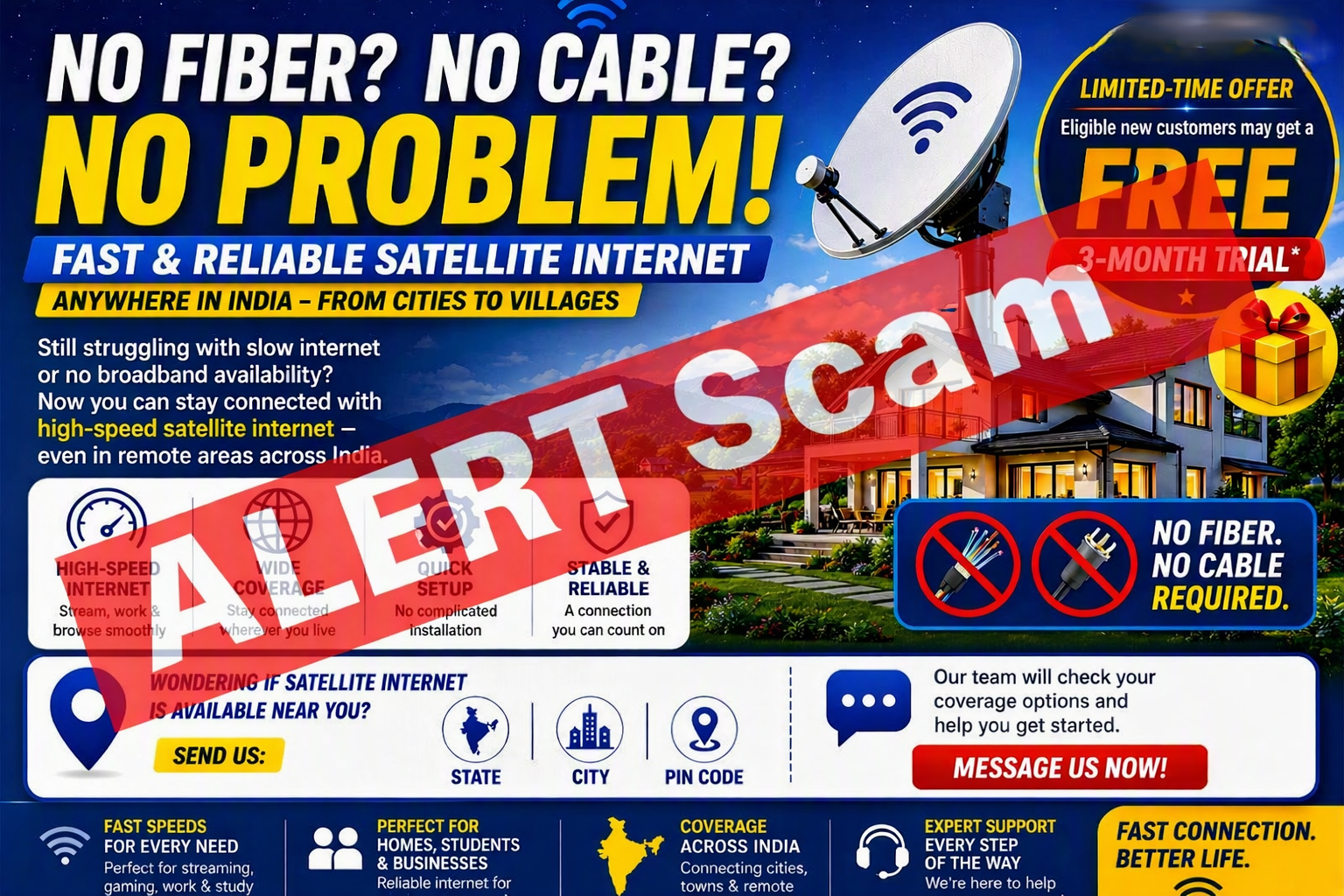
Fake Satellite Internet Scam Alert: The “Free 3-Month Trial” APK Trap Fooling Indian Users
By: Javid Amin | 27 July 2026
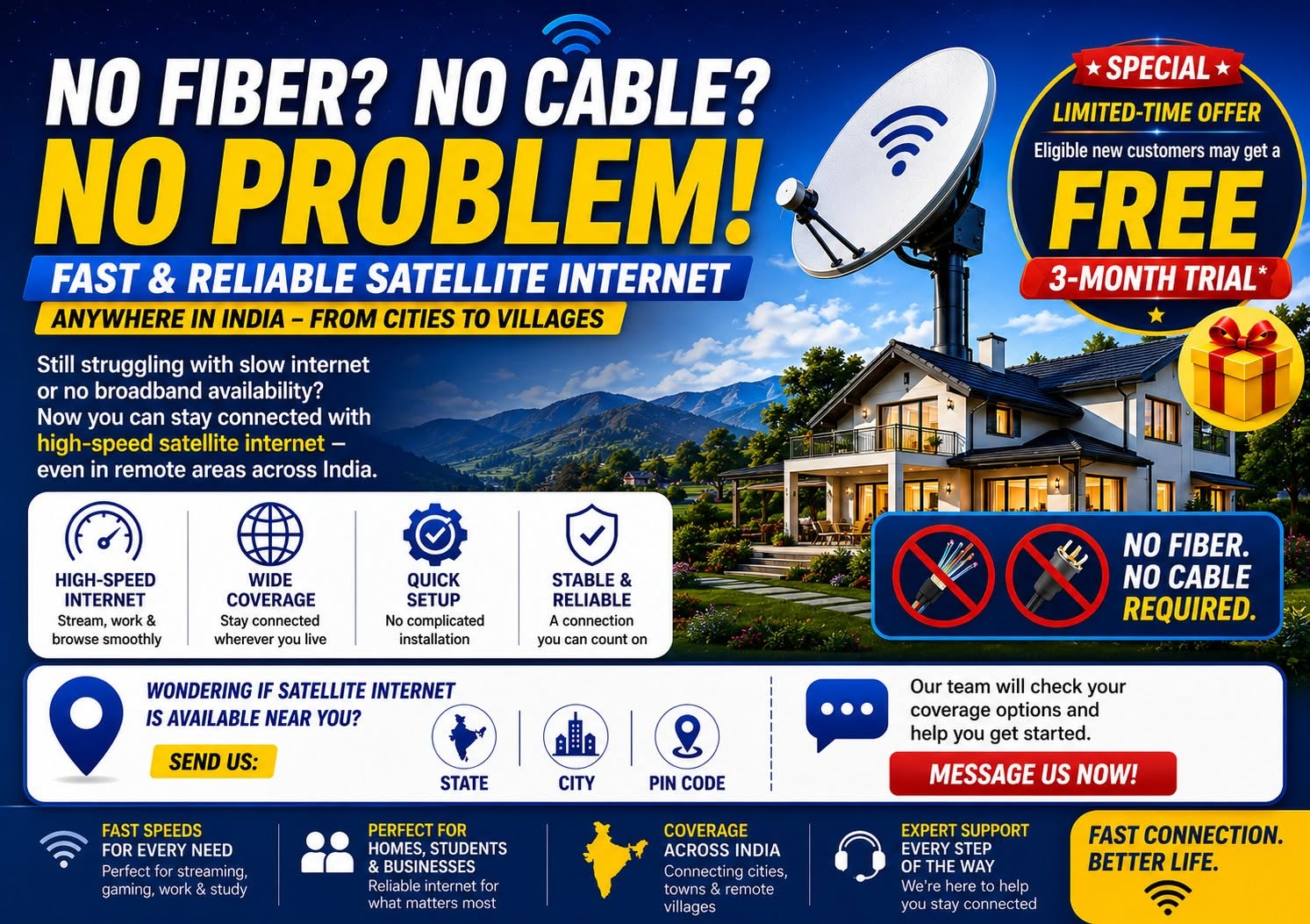
No fiber. No cable. No problem — except it is one. A slick-looking advertisement is doing the rounds online, promising Indian households instant, high-speed satellite internet with zero installation hassle and a tempting “FREE 3-Month Trial.” The catch? It isn’t a real internet service at all. It’s a carefully packaged scam built to get an unofficial app onto your phone — and once that happens, the real damage begins.
Cybersecurity researchers and consumer-fraud watchdogs are now flagging this campaign as a textbook case of social engineering wrapped in a marketing costume. Here’s everything you need to know about how it works, why the pricing and promises don’t add up, and what to do if you’ve already engaged with it.
The Bait: A Picture-Perfect Ad That Feels Too Good to Ignore
The advertisement itself is designed to hit every emotional trigger of someone frustrated with patchy broadband. It shows a satellite dish mounted on a beautiful home in the hills, bold yellow-and-blue branding, and headlines like “No Fiber? No Cable? No Problem!” alongside promises of coverage “anywhere in India — from cities to villages.”
It layers on urgency and exclusivity with a “Special Limited-Time Offer” badge and a gift-wrapped icon announcing a free three-month trial for “eligible new customers.” Below that sits a reassuring checklist — high-speed internet, wide coverage, quick setup, stable connection — plus a call-to-action asking users to message their state, city, and PIN code to “check coverage.”
On the surface, this looks like a normal telecom promotion. In reality, it’s the opening move of a fraud funnel that eventually pushes users toward downloading an unofficial Android application.
How the Scam Actually Works
Once a user responds to the ad or messages the number provided, the scam unfolds in a predictable, well-rehearsed sequence:
- The APK download link. Instead of directing users to the Google Play Store, the scammers send a direct APK file — an Android installation package that bypasses Google’s built-in security screening entirely.
- The install-and-report step. Victims are instructed to install the file and then take a screenshot of the installation or an in-app screen, sending it back to “activate” the service.
- The pricing hook. The plan is advertised as free for three months, after which it will supposedly cost just ₹199 a month — a price so low it almost guarantees curiosity and low resistance.
- The silence (or the real attack). In many versions of this fraud pattern, there is no functioning internet service at all. The APK itself is the product — and the “service” was never the point.
This structure — a screenshot-based “activation,” an app installed from outside the Play Store, and a suspiciously cheap monthly fee — is a well-documented fraud template already used across banking, KYC, and reward-point scams in India.
Why the Offer Doesn’t Hold Up
A little fact-checking exposes the scheme almost instantly.
No licensed satellite ISP works this way. Legitimate satellite broadband providers require regulatory clearance from India’s Department of Telecommunications, dedicated hardware installation by verified technicians, and formal KYC procedures — not a WhatsApp message and an APK file. Even globally recognized satellite players have faced regulatory hurdles to operate legally in India, underscoring how tightly controlled this sector actually is. No such provider activates a connection through a sideloaded Android app and a screenshot.
The pricing is a deliberate lure. Real satellite internet services worldwide typically cost several thousand rupees a month once equipment and subscription fees are included. A flat ₹199 rate is priced specifically to feel like an irresistible, low-risk bet — cheap enough that people won’t think twice before installing an app to “activate” it.
Government agencies have repeatedly warned against exactly this pattern. India’s Press Information Bureau and multiple bank fraud units have issued advisories about scams that lure users with rewards, discounts, or “special offers” tied to an APK download — the same mechanic used here, just repackaged around internet connectivity instead of banking.
The Real Risk: What an Unofficial APK Can Do to Your Phone
This is where the scam moves from “misleading advertisement” to genuine cybersecurity threat. Applications installed outside the Google Play Store skip every layer of malware screening that official apps go through. Once granted permissions, a malicious APK can potentially:
- Harvest personal data — contacts, photos, messages, and stored files, some of which can later be used for blackmail or identity theft.
- Intercept SMS and OTPs, giving attackers a path straight into banking apps, UPI accounts, and two-factor-protected logins.
- Grant remote or accessibility access, effectively handing control of the device to the attacker without the owner realizing it.
- Enable follow-up financial fraud, where victims are pushed toward additional “activation fees,” verification charges, or fraudulent payment requests.
This isn’t theoretical. Cybercrime units across India have documented cases where a single sideloaded APK — disguised as a bank update, a wedding invitation, a challan notice, or a rewards app — led to lakhs of rupees in losses per victim, with some coordinated fraud rings linked to tens of crores in cumulative damage. The “satellite internet” version simply swaps the disguise; the mechanics of data theft remain identical.
Situation at a Glance
| Aspect | Details |
|---|---|
| Advertised Offer | Free 3-month trial, then ₹199/month |
| Delivery Method | Direct APK download + screenshot “activation” |
| Target Devices | Android smartphones |
| Primary Risks | Malware installation, data theft, banking/UPI fraud, blackmail |
| Ground Reality | No licensed Indian ISP offers activation via unofficial APK |
What to Do If You’ve Interacted With This Offer
If you’ve already downloaded the APK, messaged your location details, or sent a screenshot, don’t panic — but act quickly:
- Do not open or grant further permissions to the installed app. Uninstall it immediately if possible.
- Disconnect from Wi-Fi or mobile data temporarily to limit any ongoing data transmission.
- Change your banking, UPI, and email passwords from a separate, trusted device.
- Monitor your bank statements and UPI transaction history closely for the next several weeks.
- Report the incident to India’s National Cybercrime Helpline (1930) or via cybercrime.gov.in, and file a complaint with local police if any financial loss occurs.
- Never share screenshots, OTPs, or personal identification details with unknown numbers, regardless of how official the messaging appears.
How to Spot the Next One
Scams like this evolve quickly, often reappearing under different branding — solar panels, electricity subsidy schemes, government cashback programs, or streaming service “free trials.” The pattern to watch for remains consistent:
- An offer that sounds too generous for the price point.
- A requirement to install an app from outside the Play Store or App Store.
- A request to send a screenshot or personal details as “proof” or “activation.”
- Vague or missing licensing information about the company behind the offer.
The Bottom Line
This “satellite internet” promotion is a fraud campaign engineered to look like a legitimate telecom advertisement while pushing victims toward a malicious Android app. There is no evidence that any authorized Indian internet service provider distributes connections this way, and the pricing, activation process, and screenshot requirement all match known cyber-fraud playbooks rather than genuine telecom onboarding.
The safest response is simple: never install an APK from outside official app stores, no matter how good the offer looks — and verify any ISP claim directly through its official website or customer care line before sharing a single detail.
This article is for public awareness and cybersecurity education. If you believe you have been a victim of this or a similar scam, contact India’s National Cybercrime Helpline at 1930 or visit cybercrime.gov.in immediately.


