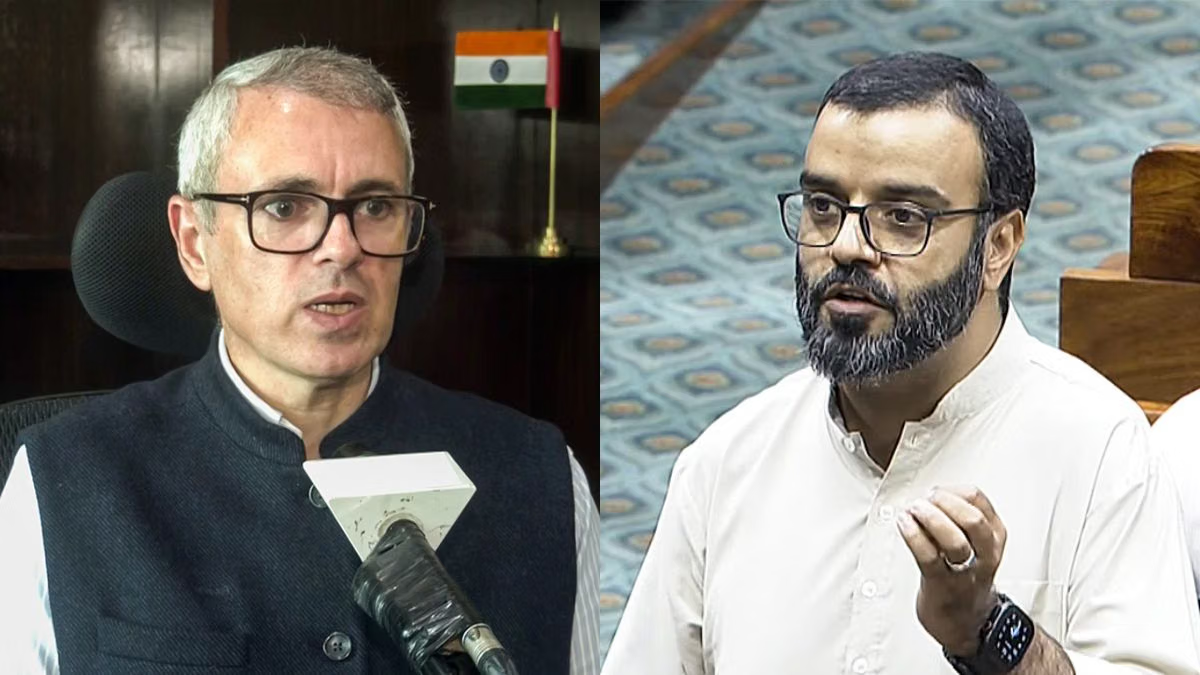
Aga Ruhullah Resignation Threat Deepens NC Crisis: Why He Wants Omar Abdullah to Quit as CM and Fight from Parliament
By: Javid Amin | 17 Aug 2026
Srinagar: A widening internal crisis in the Jammu and Kashmir National Conference has taken a dramatic turn, with Srinagar Lok Sabha MP Aga Syed Ruhullah Mehdi saying he has “made up his mind” to resign from Parliament within the coming months unless the party changes course on Jammu and Kashmir’s constitutional and political agenda.
But Ruhullah is not simply walking away.
Instead, he has put an extraordinary political proposal before NC president Dr Farooq Abdullah: Omar Abdullah should resign as Chief Minister, enter Parliament, and lead the party’s national campaign for restoration of Jammu and Kashmir’s constitutional protections, while another NC leader takes charge of the government.
Ruhullah says he would reconsider his own resignation if the party accepts this broader political strategy.
His proposed timeline is also striking.
Not a year. Not an indefinite future. “A few months.”
The development adds a new dimension to the increasingly public disagreement between Ruhullah and the NC leadership over what the party promised voters in the 2024 Assembly elections—and what it is actually pursuing in 2026.
Ruhullah Says He Has “Made Up His Mind”
In an interview with Kashmir News Service, Ruhullah said he intends to resign after taking his campaign over Jammu and Kashmir’s constitutional status to what he described as a “certain level.”
He stressed that he was not talking about waiting for a year.
“I need a few months. I am not even talking about a year.”
Ruhullah said he wanted to undertake several more political initiatives before giving up his parliamentary position.
He has already used Parliament to raise the issue of Article 370, constitutional protections and the political status of Jammu and Kashmir, and said he wanted to do more before stepping down.
This is important because his proposed resignation is not being presented as an impulsive reaction to a single disagreement.
It is being framed as the culmination of a political conflict that has been building for months.
The Bigger Fight: What Did NC Promise Voters?
At the heart of Ruhullah’s rebellion is a question that has increasingly troubled the National Conference:
What exactly was the party’s 2024 mandate about?
The NC returned to power in Jammu and Kashmir after the 2024 Assembly elections with 42 seats on its own and 48 with allies, while the BJP won 29 seats.
Ruhullah argues that the party did not seek votes merely on the promise of restoring statehood.
According to him, the central political commitment was to challenge the post-August 5, 2019 constitutional arrangement and fight for restoration of the protections associated with Article 370.
He has repeatedly warned that reducing the political struggle to statehood alone amounts to abandoning a larger promise.
In July, he argued that if voters had been told that statehood alone was the objective, they could have chosen the BJP, which had also promised statehood. He warned that the NC could pay a heavy electoral price if it moved away from its original agenda.
His warning was stark:
The NC’s 45-seat strength, he argued, could eventually shrink to 15 if the party failed to learn from its mistakes.
That criticism has now evolved into a direct challenge to the party’s leadership structure.
Ruhullah’s Three-Part Proposal to Farooq Abdullah
Ruhullah has effectively offered the NC leadership a political route out of the current confrontation.
His proposal has several interconnected elements.
1. Omar Abdullah Should Resign as Chief Minister
The most dramatic proposal is that Omar Abdullah should step down as Chief Minister.
Ruhullah himself would then resign as MP.
The objective would be to allow Omar to return to Parliament and use his political stature to lead the national fight over Jammu and Kashmir’s constitutional position.
Ruhullah believes Omar would have considerably greater influence in Parliament than he himself can exercise.
His argument is based partly on political reach.
Omar Abdullah has previously served as a Union minister and has considerably greater national recognition than most regional politicians.
Ruhullah therefore believes Omar could potentially build a wider coalition of political parties around the J&K issue.
2. Put a Different NC Leader in Government
Ruhullah’s proposal does not call for abandoning governance.
Instead, he suggests separating the party’s governance role from its constitutional-political campaign.
Under his suggested arrangement:
Omar Abdullah → Parliament and national political campaign
Another NC MLA/minister → Chief Minister and governance
The logic is straightforward.
The government should concentrate on administration, development and implementation of the NC manifesto.
Omar, meanwhile, could focus on building a national political movement around Jammu and Kashmir’s constitutional status.
Ruhullah believes this division of responsibilities could make the NC’s campaign more effective.
3. Build a Wider Political Movement
The third component is perhaps the most ambitious.
Ruhullah wants the National Conference to turn the constitutional question into a broader political movement, rather than treating it as an issue to be raised periodically inside Parliament or during political speeches.
He has previously argued that the NC should reach out to like-minded parties across India and build a wider coalition around federalism, state rights and the restoration of J&K’s constitutional protections.
In an earlier interview, he said the party needed to find allies across regions, including southern states, Bengal and the Northeast, as well as within the INDIA bloc, to build support for the restoration of Article 370.
His latest proposal takes that argument further.
He wants the NC itself to organise the movement and, if required, give him responsibility for helping build it.
Article 370 Remains Ruhullah’s Central Political Issue
The disagreement between Ruhullah and the NC leadership is fundamentally about priorities.
The Omar Abdullah government has made restoration of statehood a major political demand.
Ruhullah says that is insufficient.
His position is that the political struggle must also include restoration of the constitutional guarantees and protections that Jammu and Kashmir had before the 2019 changes.
For him, statehood is only one component.
The larger objective is restoration of what he describes as the region’s constitutional protections, identity and dignity.
That distinction has become increasingly important.
NC leadership’s approach
Statehood first, while continuing to raise broader political issues.
Ruhullah’s approach
Do not allow statehood to replace the larger fight over Article 370 and constitutional guarantees.
That difference is now at the centre of the internal NC dispute.
Why Ruhullah Thinks Parliament Matters
There is an apparent contradiction in Ruhullah’s position.
Why resign from Parliament when Parliament is the very platform he has used to raise the Kashmir issue?
He acknowledges the contradiction himself.
Ruhullah has said that resigning would mean losing a valuable national platform.
He would no longer have the same access to parliamentary debates, political parties, conferences and national-level lobbying.
He has acknowledged that this would be a loss.
But he appears to believe that the political symbolism of his resignation, combined with a much larger campaign, could produce greater pressure than continuing inside a party he believes has moved away from its promised agenda.
That is a risky calculation.
It could amplify his political message.
But it could also deprive him of the very parliamentary platform that has given his campaign national visibility.
Why Omar Abdullah Is at the Centre of the Proposal
Ruhullah’s proposal effectively puts Omar Abdullah at the heart of the dispute.
It is not simply a demand for the Chief Minister to resign.
It is an argument that Omar may be more valuable to the NC outside the J&K administration than inside it.
The reasoning is political.
As Chief Minister, Omar must deal with:
- governance;
- administration;
- Centre–UT relations;
- security;
- development;
- budgetary matters;
- public expectations; and
- day-to-day political management.
As an MP, he would potentially have greater freedom to campaign nationally on constitutional and federal questions.
Ruhullah believes that Omar’s political stature could make such a campaign substantially more effective.
His proposal is therefore less about removing Omar from politics and more about changing Omar’s political battlefield.
But There Is a Major Constitutional and Political Problem
There is, however, an obvious complication.
Omar Abdullah is currently the elected Chief Minister.
The NC won the 2024 Assembly election and formed the government.
Asking the Chief Minister to resign simply to return to Parliament would require a major political reconfiguration.
A new Chief Minister would have to command the confidence of the Assembly.
The change would also raise questions about whether such a move would strengthen or weaken the elected government’s bargaining position with the Centre.
There is no guarantee that shifting Omar to Parliament would produce the constitutional outcome Ruhullah wants.
In fact, critics could argue that removing the elected Chief Minister from the administration could weaken J&K’s government at a time when it is already seeking restoration of statehood.
That is likely to be one of the central arguments against Ruhullah’s proposal.
Farooq Abdullah Holds the Key—At Least Politically
Ruhullah’s relationship with Dr Farooq Abdullah is noticeably different from his relationship with Omar.
He described Farooq as a fatherly figure and stressed that their personal relationship was based on respect.
But he also made clear that the disagreement was not personal.
For Ruhullah, the issue is the political future of Jammu and Kashmir.
He said that if Farooq Abdullah genuinely wants to resolve the dispute, accepting his proposals could persuade him to reconsider the resignation.
This effectively puts the ball in the NC president’s court.
The message is:
Give the constitutional campaign a new political direction, and I can stay.
If nothing changes, Ruhullah says he will leave.
“This Is Not About Me and Omar”
One of the recurring themes in Ruhullah’s political arguments is his rejection of the idea that his dispute is simply a personal feud with Omar Abdullah.
In an earlier interview, he explicitly said the issue was not about his relationship with Omar but about the relationship between the political establishment and the people of Jammu and Kashmir.
He argued that voters had given the NC a mandate because they expected the party to fight for the restoration of their political rights.
That argument is important for Ruhullah’s political positioning.
If the dispute is portrayed as Ruhullah versus Omar, he can be dismissed as an internal dissident.
If it is framed as Ruhullah versus the NC’s alleged deviation from its manifesto, the argument becomes considerably more politically consequential.
He is clearly choosing the second framing.
A Conflict That Has Been Building for Nearly Two Years
The current confrontation did not emerge overnight.
Ruhullah has challenged the NC leadership on multiple occasions since the party returned to power.
In December 2024, for example, he openly opposed the government’s handling of the reservation policy and announced a protest outside Omar Abdullah’s residence when he believed the government had failed to meet his deadline.
In May 2025, he reportedly walked out of an NC working committee meeting following a clash with Omar Abdullah and criticised the direction in which the party was moving.
By 2026, the disagreement had become increasingly focused on Article 370, statehood and the party’s broader political strategy.
In July, Ruhullah also distanced himself from the NC’s Jantar Mantar programme for statehood, arguing that limiting the campaign to statehood suited the BJP and that the party’s responsibility was to fight for Article 370.
The latest resignation threat is therefore the latest escalation in a prolonged internal dispute, not an isolated political outburst.
The “Betrayal of Mandate” Argument
Ruhullah’s strongest criticism is that the NC has betrayed the mandate it received from voters.
He has repeatedly used language of trust, accountability and political commitment.
His argument is essentially:
A political party cannot campaign on one agenda and govern on another.
That is why he objects so strongly to the party’s emphasis on statehood.
In his view, voters expected the NC to challenge the post-2019 constitutional order.
If the party now concentrates primarily on restoring statehood, he believes it risks turning the larger constitutional question into a secondary issue.
He has warned that once statehood becomes the only demand, it could eventually become a fait accompli, leaving the larger question of constitutional guarantees politically marginalised.
The 1975 Accord Is Part of Ruhullah’s Argument
Ruhullah’s political reasoning also draws on an older lesson from Kashmir’s history.
He has referred to the 1975 Indira-Abdullah Accord while arguing that accepting what is politically achievable at a particular moment can result in the abandonment of larger constitutional objectives.
His concern is that accepting restoration of statehood alone could repeat that pattern.
Whether that historical comparison is politically persuasive is a matter of debate.
But it explains why Ruhullah sees the statehood demand as potentially insufficient.
For him, the question is not simply:
Will J&K become a state again?
It is:
What constitutional and political rights will J&K have after statehood is restored?
That is the deeper dispute.
What Happens If Ruhullah Actually Resigns?
A formal resignation would have several consequences.
Parliamentary Impact
Ruhullah would lose the Lok Sabha platform that has allowed him to raise Kashmir’s constitutional issues at the national level.
A by-election could eventually be required for the Srinagar seat, depending on the circumstances and applicable legal procedures.
Political Impact on NC
The resignation would be a major embarrassment for the ruling party.
An elected MP publicly leaving over ideological differences would reinforce the narrative that the NC is struggling to reconcile its traditional political agenda with the realities of governing a Union Territory.
Personal Political Impact
Ruhullah could emerge as an independent constitutional-rights voice outside the party structure.
But he would also lose the organisational machinery of the NC.
That would make his future political strategy uncertain.
Wider Opposition Politics
His departure could create space for a broader coalition around Article 370 and constitutional autonomy.
Alternatively, it could fragment an already divided regional political landscape.
Could Ruhullah Form a New Political Platform?
For now, there is no confirmation that he intends to form a new political party.
In July, he explicitly opposed attempts to break or split the NC and said he did not support political poaching. He also said he would not participate in efforts aimed at destabilising the elected government.
That is significant.
His current position appears to be:
Challenge the NC from within, demand that it return to its stated agenda, and leave only if the party refuses to change.
Whether that position survives an actual resignation is another question.
The NC’s Difficult Political Balancing Act
Omar Abdullah and Farooq Abdullah now face a complicated choice.
They can ignore Ruhullah.
But doing so risks allowing the dispute to grow.
They can confront him.
But that could turn an internal disagreement into a larger public rupture.
Or they can negotiate.
That could require the party to rethink how aggressively it wants to pursue Article 370 while simultaneously maintaining a workable relationship with the Centre.
The problem is that each option carries political costs.
What Ruhullah’s Resignation Threat Says About NC
The immediate story is about one MP.
The larger story is about what the National Conference wants to become after 2019.
For decades, the NC’s identity has been tied to:
- Kashmiri political identity;
- autonomy;
- Article 370;
- Sheikh Abdullah’s legacy;
- federalism; and
- the constitutional relationship between J&K and India.
But governing after 2019 requires operating within a fundamentally changed constitutional framework.
That creates an ideological tension.
Should the NC become a pragmatic governing party focused on statehood and development?
Or should it remain a political movement centred on reversing or challenging the constitutional changes of 2019?
Ruhullah has made his answer clear.
He wants the second path.
The Bigger Question: Is This About Ruhullah or the NC’s Future?
That may be the most important question emerging from this confrontation.
If Ruhullah resigns, the NC can attempt to portray him as a dissident who could not accept collective party discipline.
Ruhullah, however, is likely to portray his departure differently:
He would argue that he remained loyal to the party’s manifesto while the party itself moved away from it.
That clash over who is the real custodian of the NC’s ideology could become more consequential than the resignation itself.
Because ultimately, the dispute is not just about a parliamentary seat.
It is about who gets to define the National Conference’s political identity after August 5, 2019.
Bottom Line
Aga Syed Ruhullah Mehdi has now given the National Conference leadership a clear timeline and an equally clear political choice.
He says he has made up his mind to resign from Parliament within a few months, after taking his campaign over Jammu and Kashmir’s constitutional status to a “certain level.”
But he has also offered Farooq Abdullah a way to prevent that resignation.
His proposal is dramatic:
Omar Abdullah should resign as Chief Minister, enter Parliament and lead the national political campaign for restoration of J&K’s constitutional protections, statehood and dignity.
Another NC leader would then head the government, while the party would organise a broader movement around the constitutional question.
If those steps are accepted, Ruhullah says he could reconsider his resignation.
If they are not, he says he will proceed.
For the NC, this is no longer merely an internal disagreement.
It is a test of whether the party can reconcile governance with ideology, statehood with Article 370, and political pragmatism with the promises on which it sought the people’s mandate.
And for Ruhullah, the coming months could determine whether he remains a dissenting voice inside the National Conference—or becomes one outside it.


