Antibiotics for Kids: 7 Mistakes Parents Must Avoid
By: Saika J | Health Feature | Children’s Health | Antibiotic Awareness | Parenting
Antibiotics can be an important part of treating bacterial infections in children, helping prevent complications and speeding up recovery when the right medicine is prescribed. But when it comes to children’s health, the medicine itself is only part of the equation. How parents administer it, store it, and respond when a dose is missed can make a significant difference.
In many households, a bottle of antibiotic syrup left over from a previous illness is kept in the refrigerator or medicine cabinet, just in case a child develops a fever, cough or sore throat again. Some parents stop giving antibiotics once their child appears to have recovered, while others compensate for a missed dose by giving extra medicine later.
These decisions are often made with good intentions. Yet medical experts caution that improper antibiotic use can expose children to unnecessary side effects, delay the correct diagnosis and contribute to the growing problem of antimicrobial resistance.
Understanding how antibiotics work, when they are necessary and how to use them safely is an essential responsibility for parents and caregivers.
Why leftover antibiotics can be dangerous for children
One of the most common medicine-related mistakes at home is reusing antibiotics prescribed during an earlier illness.
A child who previously recovered from a throat infection after taking an antibiotic may develop a similar fever or sore throat weeks later. Parents may assume the same medicine will work again. However, similar symptoms do not necessarily mean the same illness.
Fever, cough, throat irritation, congestion and fatigue can occur in viral infections, bacterial infections and other medical conditions. The antibiotic prescribed previously may not be appropriate for the child’s current illness.
Antibiotics are selected based on several factors, including:
-
The type of infection suspected or confirmed.
-
The child’s age and body weight.
-
The child’s medical history and allergies.
-
The specific antibiotic required to treat the bacteria.
-
The appropriate dose and duration of treatment.
A leftover medicine may also have an insufficient quantity to complete a newly prescribed treatment, or it may be expired or improperly stored.
The American Academy of Pediatrics advises parents not to use antibiotics left over from previous illnesses or medicines prescribed to another person. The Indian government’s National Centre for Disease Control also advises against reusing antibiotics from previous illnesses, warning that self-medication can cause unwanted effects and contribute to resistance.
Why stopping antibiotics early can be a problem
Children often begin feeling better within a few days of starting treatment. Their fever may settle, appetite may return and they may become active again.
This improvement can tempt parents to stop administering the medicine, particularly if a child resists taking it or complains about its taste.
However, improvement in symptoms does not necessarily mean the infection has been adequately treated. Depending on the infection and the prescribed treatment, stopping too soon may allow the illness to persist or return.
Parents should follow the duration prescribed by the doctor and should not shorten, extend or restart treatment independently.
Does stopping early contribute to antibiotic resistance?
It can contribute to treatment failure and may increase the risk of some surviving bacteria continuing to multiply. But antibiotic resistance is more complicated than simply missing a dose or stopping one treatment early.
Resistance develops when bacteria evolve mechanisms that allow them to survive exposure to antibiotics. Unnecessary antibiotic use, inappropriate drug selection, incorrect dosing and excessive exposure all contribute to the wider resistance problem.
This is why the goal is not to give antibiotics for as long as possible. It is to use the right antibiotic, at the right dose, for the right duration prescribed by the doctor.
India’s National Centre for Disease Control and the World Health Organization advise responsible antibiotic use and warn against misuse, including taking antibiotics without a prescription and using leftover medicines.
Parents should not discontinue treatment simply because the child appears healthier. If the child develops side effects or seems fully recovered earlier than expected, the prescribing doctor should be consulted before changing the treatment plan.
What should parents do if a child misses an antibiotic dose?
Missed doses are common, especially when children are on multiple medicines, attending school or following an irregular routine. Parents may forget a dose, fall asleep before the scheduled time or realise the medicine was not given until the next dose is due.
The correct response depends on the particular antibiotic, its dosing schedule and how much time has passed.
-
Give the missed dose when remembered, unless it is nearly time for the next scheduled dose.
-
If the next dose is due soon, skip the missed dose and resume the normal schedule, as directed by the medicine’s instructions.
-
Do not give two doses together or double the amount to compensate.
-
If several doses have been missed, seek advice from the prescribing doctor or pharmacist.
These are general guidelines, not a rule for every antibiotic. Parents should check the patient information leaflet or ask a pharmacist, particularly for young children or medicines with specific dosing instructions.
The NHS advises against doubling antibiotic doses to make up for missed medication because taking doses too close together can increase the risk of side effects.
A missed dose is not a reason to panic, but it is a reason to avoid guessing.
Antibiotic dosage in children: Why accurate measurement matters
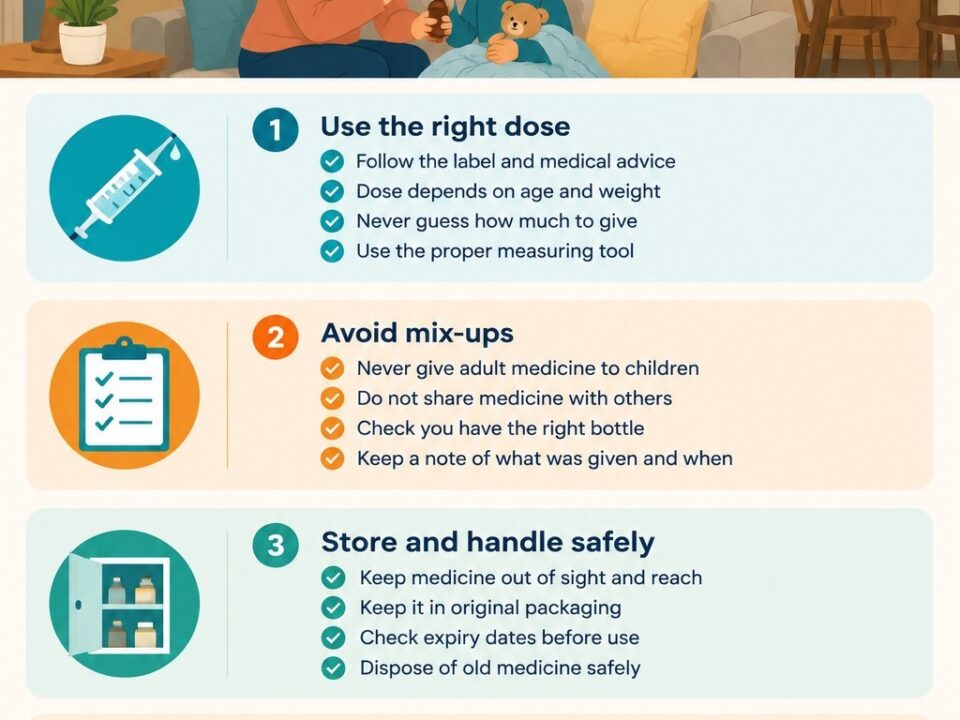
Antibiotic doses for children are often calculated according to body weight, age and the type of infection being treated. A dose appropriate for one child may be too much or too little for another.
This becomes particularly important with liquid antibiotics, which are commonly prescribed to younger children who cannot swallow tablets.
Parents should take care to:
-
Follow the exact dose written on the prescription or medicine label.
-
Use the measuring device supplied with the medicine or an appropriate oral syringe.
-
Avoid estimating the dose using kitchen teaspoons or tablespoons.
-
Check the concentration of the medicine, especially if a different bottle or formulation is supplied.
-
Confirm the dose with a pharmacist if the label is unclear.
A household teaspoon is not a reliable substitute for a proper medicine-measuring device. Even a small difference in volume can matter when a medicine is being administered repeatedly to a young child.
If the child spits out the medicine, vomits shortly after taking it or refuses part of the dose, parents should not automatically repeat the entire dose. Whether another dose is needed depends on the medicine and circumstances. Seek advice from the pharmacist or doctor.
Safe storage of antibiotic syrups is equally important
Antibiotic suspensions prepared for children may have specific storage requirements. Some need refrigeration, while others must be kept at room temperature. The correct storage method depends on the formulation and manufacturer.
Before using a medicine, check:
-
Storage instructions: Follow the temperature conditions printed on the label or provided by the pharmacist.
-
Expiry date: Never use expired medicine.
-
Discard date after preparation: Some antibiotics have a limited usable period once mixed with water, even if the printed expiry date is later.
-
Appearance: If the medicine looks unusual, has changed colour, smells different or shows signs of deterioration, ask a pharmacist before giving it.
-
Bottle instructions: Shake the suspension if the label instructs you to do so.
Liquid antibiotics may lose their quality or effectiveness if stored incorrectly. Parents should not keep partially used antibiotic suspensions for the next illness unless a healthcare professional has specifically advised otherwise.
Unused medicines should be disposed of safely, preferably through an appropriate pharmacy or medicine take-back facility where available, rather than being stockpiled in the home.
Antibiotics do not work against viral infections
One of the biggest reasons antibiotics are unnecessarily given to children is the misunderstanding that they treat every infection.
A child with a runny nose, cough, fever, sore throat or flu-like symptoms may appear seriously unwell. But many common childhood respiratory illnesses are caused by viruses.
Antibiotics work against bacteria. They do not kill viruses responsible for common colds, influenza and many other viral infections.
-
Common cold
-
Influenza (flu)
-
Most viral coughs
-
Many sore throats
-
Most uncomplicated viral respiratory infections
Some infections can have bacterial complications, and a doctor may prescribe antibiotics after assessing the child’s condition. Parents should not attempt to distinguish bacterial from viral illness solely on the basis of fever, mucus colour or the severity of a cough.
The Indian government’s antibiotic-use guidance highlights that colds, coughs and many diarrhoeal illnesses do not require antibiotic treatment. The decision to prescribe should be based on clinical assessment rather than pressure to provide medicine.
For viral illnesses, treatment may instead involve adequate fluids, rest, monitoring and appropriate symptom relief recommended by the healthcare professional.
Antibiotic resistance: A growing health threat beyond the household
Antibiotic resistance is no longer just a concern for hospitals or medical researchers. It has become a major public health challenge that affects how infections are treated around the world.
When bacteria become resistant to antibiotics, medicines that once worked effectively may no longer control the infection. Patients may need alternative treatments, longer medical care or more complex treatment strategies.
Children are part of this wider concern. Unnecessary antibiotic use, repeated self-medication and improper use of prescribed medicines can increase exposure to antibiotics and contribute to the conditions in which resistance develops.
This distinction is important because parents sometimes believe that using a stronger antibiotic will automatically solve the problem. In reality, the doctor may need to reassess the diagnosis, determine whether the infection is bacterial, review previous antibiotic use and select an appropriate treatment.
The WHO identifies antimicrobial resistance as a serious threat to global health, while India’s NCDC has issued public guidance urging people to use antibiotics only when prescribed, avoid leftovers and never share medicines.
What if a child develops side effects?
Antibiotics can cause side effects, even when they are prescribed correctly.
Some children may experience:
-
Nausea or vomiting
-
Loose stools or diarrhoea
-
Abdominal discomfort
-
Reduced appetite
-
Skin rashes
Parents should inform the prescribing doctor if symptoms are significant, persistent or worsening. They should not independently stop, change or replace the antibiotic without advice, unless a serious emergency reaction requires immediate medical attention.
When is it an emergency?
Seek urgent medical care if a child develops symptoms suggesting a severe allergic reaction, such as:
-
Difficulty breathing or wheezing
-
Swelling of the lips, tongue, face or throat
-
Fainting, collapse or unusual severe weakness
-
A rapidly spreading or severe rash accompanied by other symptoms
These signs may indicate a serious reaction and require immediate emergency assessment.
Parents should also seek prompt medical review if the child becomes unusually drowsy, shows signs of dehydration, has persistent vomiting, develops worsening symptoms or fails to improve as expected.
A child who is deteriorating should not be made to wait until the antibiotic course is over.
10 antibiotic safety rules every parent should follow
A parent’s antibiotic safety checklist
Keep these rules in mind whenever your child is prescribed antibiotics.
-
Give antibiotics only when prescribed by a qualified medical professional.
-
Follow the exact dose and timing on the prescription.
-
Give the medicine for the prescribed duration.
-
Never use leftovers from a previous illness.
-
Never share antibiotics between siblings.
-
Do not double a dose after missing one.
-
Use an accurate medicine-measuring device.
-
Follow storage instructions carefully.
-
Contact the doctor if symptoms worsen or treatment causes concerning side effects.
-
Dispose of unused medicines safely instead of storing them for future use.
Frequently asked questions about antibiotics for children
1. Can I give my child leftover antibiotics if the symptoms are the same?
No. Similar symptoms do not guarantee that the underlying infection is the same. The previous antibiotic may be unsuitable, and the child may not need an antibiotic at all. Consult a doctor before starting treatment.
2. Should I stop antibiotics if my child feels better?
Do not stop treatment simply because the child appears to have recovered. Follow the prescribed duration and contact the doctor before making any changes.
3. What should I do if I miss my child’s antibiotic dose?
Check the medicine leaflet. Generally, a missed dose may be given when remembered unless the next dose is close, in which case it is usually skipped. Do not double the dose. If uncertain, contact a pharmacist or doctor.
4. Can I give my child’s antibiotic to their brother or sister?
No. Antibiotics are prescribed for a specific patient and illness. A sibling may have a different infection, require another medicine or need a different dose based on their weight and medical history.
5. Do antibiotics treat fever?
Antibiotics do not directly treat fever. They treat certain bacterial infections that may cause fever. If the fever is caused by a virus, antibiotics will not help treat the underlying infection.
6. Should antibiotic syrup always be refrigerated?
No. Storage requirements differ between antibiotic formulations. Some need refrigeration, while others must be stored at room temperature. Follow the specific instructions on the label and ask your pharmacist.
7. What if my child vomits after taking an antibiotic?
Do not automatically give another dose. The decision depends on how soon the child vomited, the medicine and whether any of it was absorbed. Contact the prescribing doctor or pharmacist for guidance.
The bottom line: Responsible antibiotic use begins at home
Antibiotics have helped save countless lives, including those of children suffering from serious bacterial infections. But their effectiveness depends on responsible use.
A leftover bottle, an incomplete treatment or an unnecessary dose may seem like a minor decision in a busy household. Yet repeated misuse of antibiotics has consequences that extend beyond one child or one illness.
Parents do not need to become medical experts to use antibiotics responsibly. They need to understand a few essential principles: never self-medicate with leftovers, follow the prescribed dose and duration, ask questions when a dose is missed, store medicines correctly and seek medical advice when symptoms change.
The most responsible decision is not always to give a child more medicine. Sometimes, it is to understand when medicine is needed, when it is not, and when a doctor should make that decision.
Protecting children today also means protecting the effectiveness of antibiotics for tomorrow.