Sheshnag Lake Row Goes Beyond Politics: Kashmir Seeks Answers on Ecology and Development
By: Javid Amin | November 25, 2026
What began with a video showing heavy machinery operating near one of Kashmir’s most revered alpine lakes has rapidly turned into a political, environmental and public-accountability controversy.
The Sheshnag Lake excavation row is no longer limited to concerns over an excavator cutting into mountain terrain. The controversy has drawn environmental groups, political parties, religious leaders, former chief ministers and ordinary citizens into a debate over what is being done in a fragile Himalayan landscape, why it is being done, and who is responsible for ensuring that the work does not cause lasting damage.
The Border Roads Organisation (BRO) says it is undertaking post-Amarnath Yatra work on existing tracks, widening and stabilising vulnerable stretches to improve pilgrim safety. Critics, however, say that explanation does not adequately answer questions about the exact location of excavation, the environmental assessment, the disposal of earth and the permissions governing work near a high-risk glacial lake.
The political pressure has also moved towards Jammu and Kashmir Chief Minister Omar Abdullah, whose silence on the controversy has been questioned by Mirwaiz Umar Farooq, while opposition leaders are demanding an independent scientific assessment and greater transparency.
The immediate dispute is about construction. The larger question is whether development in Kashmir’s most sensitive mountain ecosystems is being subjected to the same level of scrutiny that the risks demand.
From a viral excavator video to a political flashpoint
The controversy began after a video circulated on social media showing a crawler excavator engaged in earthwork in the vicinity of Sheshnag Lake. The video, reportedly uploaded by the machine operator, was subsequently removed, but by then it had triggered widespread concern and political reactions.
The footage raised questions that cannot be answered by simply watching a video: How close was the machinery to the lake’s shoreline? Was it widening an existing trail, cutting a new section, levelling terrain or disposing of excavated soil? What was the approved construction footprint? Was the work supported by a site-specific geological and environmental assessment?
These questions are particularly important because Sheshnag is not an ordinary roadside construction site. It is a high-altitude alpine lake surrounded by steep mountain terrain, loose glacial deposits and a vulnerable drainage system.
The debate gained further momentum after the BRO issued a clarification on November 23, saying the work was part of post-Amarnath Yatra track-widening and stabilisation activity, not what it described as new construction being portrayed on social media. The organisation said the work was restricted to existing tracks and that it was taking steps to safely dispose of excavated material, protect natural drainage and minimise disturbance to the surrounding terrain.
But the clarification has not ended the controversy. Critics argue that a general assurance of environmental safeguards is not a substitute for releasing the technical documents that would allow independent scrutiny of the work.
BRO says pilgrim safety is the priority, but questions remain
The agency says it is focusing on stabilisation and widening of existing tracks to prescribed standards and that these works serve pilgrims, Yatra personnel and other users of the route.
That is a legitimate public-safety argument. The Amarnath route crosses difficult terrain, where narrow sections, uneven surfaces, exposure to weather and congestion can create risks for pilgrims and workers. Track maintenance and slope stabilisation can be necessary to reduce those hazards.
However, environmental scrutiny is not an argument against pilgrim safety.
The issue is whether the engineering intervention is proportionate to the risk, whether the chosen method is appropriate for the terrain, and whether its environmental footprint has been properly assessed.
The BRO’s clarification addresses its stated purpose and general safeguards. But some of the questions being raised by environmental groups and political leaders remain unanswered in the public domain:
-
What is the precise location and length of the work?
-
How much soil and rock is being excavated?
-
Is the work confined to the existing track alignment in practice?
-
What technical assessment was conducted on the slope and lake catchment?
-
Where is the excavated material being deposited?
-
What monitoring is being conducted to prevent sediment from entering the lake and streams?
-
What permissions, assessments or clearances apply to the particular worksite?
These are verifiable questions. They should be answered with documents, maps, engineering reports and a site inspection, rather than political exchanges.
Sheshnag is not just a lake. It is part of a fragile glacial system
The surrounding landscape contains loose rock, gravel, sand, fine soil and glacial deposits. These materials are not necessarily stable simply because they appear solid or have remained in place during a dry period. Mountain slopes are continuously affected by weathering, snowmelt, rainfall, freeze-thaw cycles and gravity.
Heavy excavation in such terrain can create several potential risks.
Slope instability and erosion
Cutting into slopes may remove supporting material, expose fractured ground or change how water moves across a hillside. Depending on the geology and engineering design, this can increase the risk of erosion, rockfall or local slope failure.
Sedimentation and lake pollution
Excavated earth left uncovered can be carried by runoff into streams and water bodies. Increased sedimentation can affect water clarity, alter lake-margin habitats and disrupt natural ecological processes.
Natural drainage disruption
Mountain drainage channels are crucial for moving snowmelt and rainwater safely through valleys. Improper road embankments, blocked channels or badly designed drainage structures can concentrate runoff and create erosion elsewhere.
Damage to slow-recovering vegetation
Alpine vegetation grows under harsh conditions, with short growing seasons and limited soil development. Heavy machinery can destroy vegetation and compact the surface. Recovery can be slow, and exposed ground may remain vulnerable to erosion.
Construction pollution
Fuel, lubricants, waste, plastics and discarded material can contaminate the surrounding environment if they are not carefully controlled.
These are recognised environmental risks of mountain construction. They do not establish that every risk has materialised at Sheshnag, or that the current work has already damaged the lake. That determination requires an independent inspection and scientific evidence.
But in a fragile ecosystem, waiting until visible damage becomes irreversible is precisely what environmental safeguards are meant to prevent.
Why the high-risk glacial lake designation matters
A GLOF occurs when water stored in a glacial lake is suddenly released, potentially following a breach, overtopping or other failure of its natural containment. Such floods can carry large volumes of water, rocks and debris into downstream valleys.
The designation of Sheshnag as a high-risk lake makes monitoring and risk assessment important. It does not mean an outburst is imminent, nor does it prove that track work will trigger one.
The concern raised by environmentalists is that any disturbance to surrounding slopes, drainage channels, loose deposits or lake margins should be assessed carefully in light of the area’s existing vulnerability.
That assessment should consider the lake and its catchment as a connected system, rather than examining a construction site in isolation.
The downstream implications also matter. The Lidder river system supports settlements, agriculture, tourism and infrastructure downstream, making the management of mountain risks a wider public-safety issue, not merely a local environmental concern.
Why the debate is turning towards Omar Abdullah
Mirwaiz Umar Farooq has questioned the Chief Minister’s silence and urged people to collectively raise their voices against what he described as destruction of fragile ecological zones. He also endorsed the online petition seeking to stop construction around Kashmir’s alpine lakes.
The demand for the Chief Minister to speak is not simply political theatre. It reflects a wider expectation that the elected government should explain what is happening in an environmentally sensitive area, even when the work is being executed by a central agency.
The public is looking for answers on several fronts:
-
Does the J&K government have complete information about the work?
-
Have the concerned environmental, forest, geological and disaster-management departments reviewed the location?
-
Has the government independently verified BRO’s assurances?
-
Will it disclose the applicable approvals and project details?
-
Will it order an independent assessment if concerns remain unresolved?
Omar Abdullah does not necessarily need to prejudge the work or declare it illegal to respond to these concerns. A transparent statement explaining what the administration knows, what it has verified and what it intends to examine could help reduce public uncertainty.
In an environmental controversy involving a high-risk alpine lake, silence can create a vacuum. That vacuum is quickly filled by speculation, political allegations and public mistrust.
The Chief Minister’s role is therefore not to choose between development and environmental protection. It is to ensure that both claims are tested against evidence and that accountability is clear.
Mehbooba Mufti stopped at Chandanwari: The controversy moves from the lake to the political ground
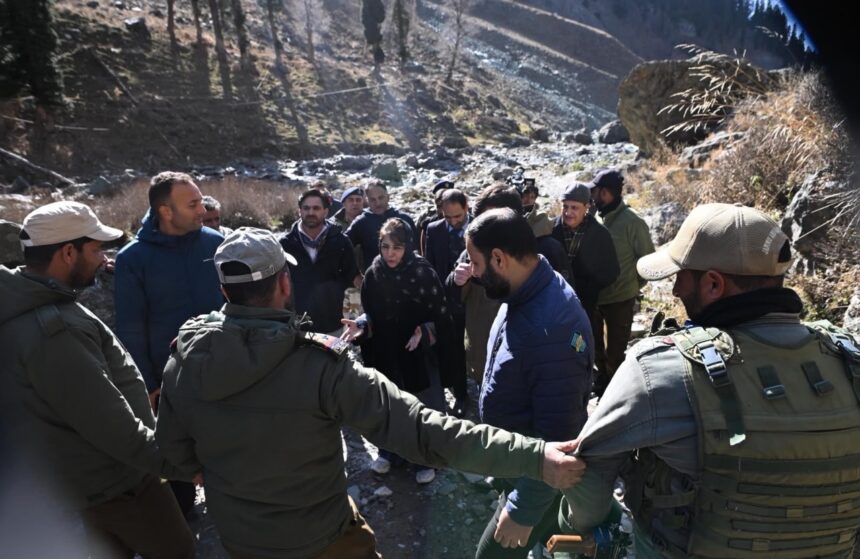
The dispute escalated further on November 24, when former Chief Minister and PDP president Mehbooba Mufti attempted to proceed towards Sheshnag Lake but was stopped by police at Chandanwari.
Police cited security concerns, according to reports. Mehbooba, accompanied by PDP leaders, wanted to visit the area amid the controversy surrounding the heavy machinery. She subsequently criticised the decision to stop her and questioned what was happening at the site.
Her attempted visit added another layer to the controversy. The issue was no longer only about the environmental consequences of construction. It also became about access, the administration’s handling of political scrutiny and whether public representatives could independently assess the situation on the ground.
The police decision should also be assessed separately from the environmental dispute. The stated security rationale needs to be distinguished from claims that authorities were preventing inspection or concealing information. The available reporting confirms that Mehbooba was stopped at Chandanwari, but does not establish that the purpose was to hide environmental damage.
Nevertheless, her inability to reach the site has increased calls for an independent inspection by a team that is not politically aligned with any of the competing parties.
An inspection involving geologists, glaciologists, hydrologists, environmental experts and relevant government officials would be more useful than competing political delegations attempting to draw conclusions from a distance.
BJP accuses opposition of politicising the issue
The controversy has also produced a sharp political counter-narrative.
The BJP has defended the track-widening work and accused opposition parties of politicising the issue and exploiting religious sentiments. BJP leaders have argued that the BRO has already clarified that the work is intended to improve the existing track and pilgrim safety.
This argument reflects a broader political dispute over how environmental concerns are being framed and whether the controversy is being used to generate tensions around the Amarnath pilgrimage.
But political accusations do not resolve the underlying environmental questions.
If the work is confined to existing tracks, supported by appropriate engineering assessments and conducted with effective safeguards, those facts should be documented and made public.
If excavation extends beyond the approved footprint, if spoil is being improperly dumped, or if risks to natural drainage and slopes have not been assessed, those concerns should be investigated regardless of who raises them.
The environmental question should not become hostage to political identity. Nor should environmental concerns be dismissed because they are being voiced by opposition politicians.
The same standard of evidence must apply to every side.
An online petition gathers support, but the numbers need context
Public opposition has also taken the form of an online petition titled “Stop Construction Around Kashmir’s Alpine Lakes”, initiated by Zarqua Banday on Change.org.
The petition calls on authorities to reconsider construction plans affecting alpine lakes and engage with local environmental and community groups to develop a sustainable approach. It argues that development should not damage natural landscapes that cannot easily be restored.
The petition’s reported signature count has changed rapidly, and news reports have published different figures:
-
A November 24 report by The Tribune put the number at more than 2,661 signatures.
The Tribune
-
An earlier report on November 25 referred to approximately 2,600 signatures.
The Tribune
-
Some other local reports published earlier figures, including around 1,600, reflecting different reporting times or updates.
Kashmir Reader+1
The discrepancy appears to reflect a changing petition count and different publication/update times, rather than necessarily contradictory claims about the same moment. The figure should be treated as a snapshot, not a permanent count.
A petition does not establish the technical merits of an environmental claim. But it does show that public concern has moved beyond individual social-media posts and is becoming an organised demand for disclosure, consultation and reconsideration.
That public pressure should not be ignored. It should be met with verifiable information.
Environmentalists want an independent scientific probe, not political assurances
Climate activist and environmental campaigner Raja Muzaffar Bhat, associated with the J&K Climate Action Group, has raised concerns about excavation, slope cutting and the possible dumping of debris near the lake. The group has reportedly submitted a representation seeking an independent scientific inquiry into the work and its potential impact on the ecosystem.
The concerns are technically grounded in the kinds of risks that can arise from disturbing fragile mountain terrain, although the actual level of risk at the Sheshnag site remains to be independently established.
An investigation should examine:
-
The extent of slope cutting and earth removal.
-
The stability of the ground surrounding the excavation.
-
The proximity of the work to the lake, streams and natural drainage channels.
-
The location and volume of excavated material and spoil.
-
The potential for sediment runoff during snowmelt and rainfall.
-
The impact on alpine vegetation and habitat.
-
The cumulative effect of road widening, pilgrim facilities, traffic and future construction.
-
The applicable permissions, clearances, environmental conditions and compliance records.
The inspection should not be limited to a quick visit or a visual review of the excavator footage. Experts should examine the site, compare the actual work with project drawings and assess the terrain using appropriate scientific methods.
The findings should be published in a form that the public can understand, including maps, photographs, the work footprint, identified risks and mitigation measures.
That is how an environmental inquiry can move from political rhetoric to meaningful accountability.
The Supreme Court connection: Safety directions do not end the environmental debate
The BRO’s track-stabilisation explanation has been linked in media reporting to Supreme Court directions issued in 2012 concerning safety arrangements along the Amarnath route.
The legal context is important. Pilgrim safety and the maintenance of difficult routes are legitimate objectives, and courts have previously addressed safety and infrastructure issues associated with the pilgrimage.
However, references to a Supreme Court direction should not be treated as proof that all work currently being undertaken near Sheshnag has received specific judicial approval.
There is a distinction between a direction to improve safety or stabilise an existing track and authorisation for a particular excavation at a particular location.
The public needs clarity on the exact order, what it directed, how the current work relates to it and which other approvals or technical assessments apply.
The BRO has said the work is limited to existing tracks and is being undertaken with environmental safeguards. That is the agency’s stated position. Independent verification of the actual site and the relevant documents would help establish whether the work is consistent with that position.
The legal argument should not be used as a shortcut around environmental scrutiny. Nor should environmental concerns be used to dismiss legitimate safety work without examining the facts.
Both require evidence.
The Amarnath Yatra is not the issue. Protecting its landscape is.
The annual pilgrimage holds immense religious significance and contributes to local economic activity. Pilgrims need safe routes, medical facilities, sanitation, emergency assistance and well-managed infrastructure. Improving the safety of an existing trail can be a reasonable and necessary objective.
But Sheshnag Lake itself is part of the natural and cultural landscape associated with the pilgrimage. Its alpine surroundings, waters, mountains and traditional route are not incidental to the experience.
Protecting this landscape should not be framed as an obstacle to religious access. It can be part of safeguarding the pilgrimage for future generations.
The argument that pilgrims need safer infrastructure and the argument that sensitive ecosystems need protection are not mutually exclusive. In fact, they should reinforce one another.
The best infrastructure in a fragile mountain region is not necessarily the largest, widest or most heavily engineered. It is infrastructure that addresses a genuine need while avoiding unnecessary damage, managing risk and remaining within scientifically and legally appropriate limits.
Kashmir’s mountains cannot absorb unlimited intervention simply because a project carries the label of tourism, pilgrimage or development.
What makes this controversy bigger than one excavator?
Across the region, concerns over urban expansion, forest loss, wetland degradation, river pollution, unregulated construction, waste disposal and pressure from tourism have intensified.
The Himalayas are also exposed to climate-related changes, including rising temperatures, shifting precipitation patterns, glacier retreat in many mountain systems and increasingly complex hazards involving rainfall, slopes and snow.
In this setting, even relatively small construction projects can become controversial when they take place in sensitive locations without clear public information.
The problem is not that every development project is harmful. The problem is that the public often learns about environmental interventions through photographs, videos, protests and political statements rather than through accessible project documents and monitoring reports.
That creates mistrust.
When a machine is seen operating near an alpine lake and the public cannot readily find the project map, environmental assessment, work order, disposal plan or monitoring details, suspicion grows. When authorities respond only with broad assurances, they may fail to address the specific questions that prompted the controversy.
Environmental governance should not work this way.
In sensitive areas, transparency should come before controversy, not after it.
What the Omar Abdullah government should do now
The government should consider a clear, time-bound response.
First, disclose the project information. The public should be given the exact work location, project scope, responsible agency, approved alignment, work order and relevant permissions.
Second, order an independent site assessment. A multidisciplinary team of geologists, glaciologists, hydrologists, environmental experts, forest officials and disaster-management specialists should inspect the work area and surrounding catchment.
Third, temporarily halt any disputed activity that may pose an immediate risk. If credible concerns arise about unauthorised excavation, spoil dumping, drainage disruption or slope instability, precautionary suspension of the affected work should be considered until the site is assessed.
Fourth, verify compliance instead of relying solely on assurances. The administration should independently establish whether the work is confined to the existing track and whether the stated environmental safeguards are actually being implemented.
Fifth, publish the findings. An assessment that remains inside government files will do little to reassure the public. Findings, photographs, maps, recommendations and corrective measures should be made accessible.
Sixth, establish a broader environmental protocol for the Amarnath route. The controversy highlights the need for clear standards governing construction machinery, excavation, debris disposal, drainage, restoration, monitoring and public disclosure across sensitive pilgrimage corridors.
A measured response would protect the environment, respect pilgrim safety and prevent the issue from escalating into a prolonged political confrontation.
The unanswered questions that matter most
The Sheshnag Lake controversy has produced statements, allegations, political reactions and public demands. But the most important questions remain technical and administrative.
| Question | Why it matters |
|---|---|
| What exactly is being excavated? | Establishes whether the work is track stabilisation, widening, levelling or a different intervention. |
| How close is the work to the lake and drainage channels? | Determines the potential exposure of water bodies and sensitive terrain. |
| What geological assessment was conducted? | Helps establish slope stability, erosion and landslide risks. |
| Where is excavated material being dumped? | Improper spoil disposal can cause sedimentation and drainage problems. |
| What approvals and permissions apply? | Establishes legal and regulatory compliance. |
| Has an independent inspection been conducted? | Helps verify the agency’s claims and address environmental concerns objectively. |
| Will the findings be made public? | Allows citizens to assess the work using evidence rather than competing political claims. |
Until these questions are answered, neither blanket assurances that everything is safe nor sweeping claims that irreversible environmental damage has already occurred should be treated as established fact.
Sheshnag is a warning about Kashmir’s development choices
The controversy around Sheshnag Lake has become a test of environmental responsibility, political accountability and public trust.
The BRO maintains that its work is intended to widen and stabilise existing tracks for pilgrim safety and that environmental safeguards are being followed. Environmental groups, activists and political leaders are questioning whether those assurances are sufficient without independent verification and disclosure of the project details.
The BJP says the controversy is being politicised. Opposition parties are demanding answers. Mirwaiz Umar Farooq is questioning the Chief Minister’s silence. Mehbooba Mufti’s attempted visit, stopped at Chandanwari on security grounds, has added to public scrutiny. An online petition is gathering signatures from people who want authorities to reconsider construction around alpine lakes.
But beneath the political noise lies a question that should unite all sides: how can Kashmir protect its natural heritage while providing the infrastructure people genuinely need?
The answer cannot be found in slogans, political accusations or social-media outrage alone. It requires scientific assessment, transparent decision-making, responsible engineering and a willingness to stop or modify work when environmental risks are demonstrated.
Sheshnag Lake is not merely a patch of land beside a pilgrimage track. It is part of a fragile mountain system that took thousands of years to form and cannot be repaired overnight once seriously damaged.
The responsibility now rests with the authorities to establish the facts, disclose the relevant documents and ensure that the work being undertaken is both necessary and environmentally defensible.
Kashmir’s development cannot be measured only by the roads it builds or the destinations it makes accessible. It must also be measured by the rivers, lakes, forests and mountains it manages to preserve.