1.61 Lakh Candidates for 600 Posts: Why J&K’s Youth Are Stuck, and How They Can Move Forward
More than 1.6 lakh candidates are competing for 600 posts. Here is what the numbers, the labour market and the workers themselves say about why, and what struggling young people and institutions can do about it.
By: Javid Amin | Ground Report & Analysis | 22 November 2026
One Exam, 1.6 Lakh Hopes
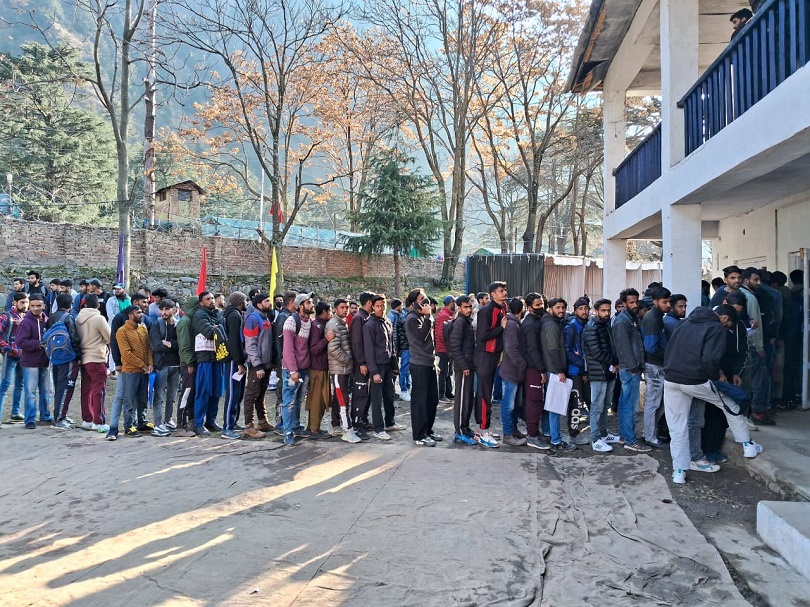
On Sunday, 15 November 2026, the Jammu and Kashmir Services Selection Board (JKSSB) conducted a written test for 600 Accounts Assistant posts in the Finance Department. Officials said 1,61,961 candidates were scheduled to appear at 495 centres across all 20 districts, 82,489 from the Jammu Division and 79,472 from the Kashmir Division. That works out to roughly 270 candidates for every vacancy.
A small correction for accuracy: that figure counts candidates scheduled to sit the exam, not everyone who applied. The real number of applicants is usually higher, because many do not turn up on the day.
The headline number is striking, but the pattern behind it is not new. For years, a government job has been treated in Jammu and Kashmir as the safest and most respected career, while the private sector has stayed small and uncertain.
Meanwhile, a very different group of workers arrives in the Valley every spring. Masons, tile-fitters, carpenters, brick-kiln hands, orchard labourers and tea-stall owners from Bihar, Uttar Pradesh, Rajasthan, Jharkhand, West Bengal and other states find regular work here, even in remote villages.
This leads many people to ask a hard question: if outsiders can find work almost anywhere in the Valley, why are educated local youth not taking up the same openings? This report looks at that question honestly, with data, with the workers’ own accounts, and with solutions.
The Pattern in Numbers
The 2026 exam is one of many. Here is how a few large JKSSB recruitments compare.
| Year | Recruitment | Posts | Candidates |
|---|---|---|---|
| 2020 | Accounts Assistant (Panchayat) | 1,889 | About 1.92 lakh applied; 1.62 lakh sat the test |
| 2022 | Accounts Assistant | 972 | Nearly 2 lakh applied; about 1.36 lakh appeared |
| 2025 | Naib Tehsildar | 75 | Over 1 lakh applicants; fees collected exceeded ₹6.43 crore |
| 2026 | Accounts Assistant (Finance Dept) | 600 | 1,61,961 scheduled to appear (about 270 per post) |
The wider labour data points the same way:
- Overall unemployment: The Periodic Labour Force Survey (PLFS) bulletin for July to September 2025 put J&K’s unemployment rate at 6.1 percent against 5.2 percent nationally, with urban unemployment at 10.6 percent.
- Youth unemployment: A Mission YUVA baseline report citing PLFS 2023-24 put youth unemployment at 17.4 percent, against 10.2 percent nationally.
- Registered job seekers: Employment department data reported in December 2025 showed more than 3.57 lakh unemployed youth registered in the UT as of November 2025. In the first quarter of 2024, 3.52 lakh had registered, of whom 1.09 lakh were graduates and postgraduates.
- A shrinking public payroll: The J&K government reported about 4.12 lakh employees on its rolls in 2022-23, the smallest government workforce in a decade, according to an analysis in Scroll.
The core problem is simple: the pool of educated young people is growing while the number of government vacancies is not.
Why Are Our Youth Glued to the Government Sector?
There is no single reason. Researchers, commentators and job seekers point to a mix of economic and social causes.
1. Security that the private market has not matched
A government post offers a regular salary, low risk of layoffs, predictable hours and benefits. Commentators writing in Kashmir Life describe this stability as the main attraction. In a region where conflict, lockdowns and the pandemic have repeatedly disrupted private business, that stability matters even more.
2. A thin private sector
J&K has few large factories, corporate offices or IT parks. Most private jobs are in small shops, coaching centres, private schools, hotels and restaurants, which often offer low pay and little career growth. Scroll’s analysis also notes that services make up about 61 percent of the UT’s economy but only about 29 percent of its employment, a sign that growth has not translated into enough jobs.
3. Shocks that damaged private livelihoods
The Kashmir Chamber of Commerce and Industry has estimated that over 1.5 lakh youth in the Valley lost work after the 2019 changes and the COVID-19 lockdowns. Each shock pushed more families toward the idea that only a government job is safe.
4. Social prestige
In many households, a government employee is seen as the financial anchor of the whole family. Writers such as Dr Farooq A. Lone argue that society has made these jobs so glamorous that young people spend the best years of their lives preparing for them, even though only a small fraction can succeed. His central point: the challenge is also to change how society views work itself.
5. A skills mismatch
Retired Col Shiv Choudhary, writing in Daily Excelsior, describes a trap: many youth are overqualified for basic jobs, underqualified for skilled ones, and unwilling to accept either. Degrees in general streams do not automatically lead to jobs that employers need to fill.
6. Weak career guidance
Most students hear about the civil services, teaching, medicine and engineering, but far fewer learn about trades, hospitality, horticulture value chains, logistics or digital freelancing. Without exposure, young people choose the options they can see.
7. A cycle of hope
Each exam gives families a reason to wait one more year. The cost is real. Application fees alone can be significant: reports on the 75-post Naib Tehsildar recruitment noted more than ₹6.43 crore collected from applicants.
Who Are the Non-Local Workers?
There are no official figures for migrant workers in the Valley. Estimates vary:
- Trade bodies cited by Outlook in August 2026 place the seasonal migrant workforce in Kashmir at more than four lakh, and over 12 lakh across J&K and Ladakh.
- Economist Nisar Ali, formerly of the University of Kashmir, told the same report that nearly five lakh work in Kashmir alone, compared with about 70,000 in the late 1960s.
- Earlier reports in 2021 estimated between three and four lakh in the Valley.
- The Kashmir Traders and Manufacturers Federation says about 80 percent of the skilled construction workforce comes from outside J&K. This is a trade body’s claim, not an audited figure.
They work as masons, tile and marble layers, carpenters, welders, painters, brick-kiln workers, cold-storage hands and orchard and paddy labourers. Others run tea stalls, barber shops and roadside food carts selling snacks and juice.
Their importance became visible in August 2019, when official figures indicated about 30,000 non-local labourers left the Valley within days, and many development projects, industries and harvests were disrupted. Some farmers then told Deccan Herald that local labourers charged roughly double and that harvests became hard to complete. These are farmers’ accounts, but they show how deeply the economy had come to rely on migrant labour.
Are They Really “Enjoying” Work and Life in the Valley?
It is tempting to see migrant workers as people who have it easy. The ground reports tell a more sober story.
What they earn. According to Outlook’s August 2026 field report, experienced masons and tile-fitters earn between ₹1,000 and ₹1,500 a day, while the workers in their crews earn between ₹500 and ₹900 depending on the job. At about 25 working days a month, a skilled mason would earn roughly ₹25,000 to ₹37,500 in a good month (our arithmetic, not a reported average). Work is seasonal, typically March to November.
Where they live. At a labourers’ hostel in Wanpoh, Anantnag, eight to 15 men share a room and pay ₹500 to ₹700 each per month. At brick kilns, many live in compounds or makeshift shelters. Their families usually stay in their home states.
Why they come. Interestingly, a 14-year veteran from Bihar told the reporter he can earn similar money elsewhere, and that what keeps him in Kashmir is regular work. Another said that back home there was no certainty of work.
What they risk. More than 30 migrant workers have been killed in militant attacks since August 2019, according to Outlook. In October 2024, six labourers and a local doctor were killed at a tunnel-construction camp at Gagangir in Ganderbal. On 31 July 2026, two workers from Chhattisgarh were shot dead at a brick kiln in Kelam, Kulgam, the first such killing in the Valley in nearly 22 months. Police advise workers to be indoors before dusk, and a tea-stall owner in Wanpoh said he now shuts before dark. One worker summed up why many stay anyway: “If we stop working, our families stop eating.”
Not always fairly paid. A 2021 Tribune report described a brick-kiln worker from Bihar who fled the Valley with his family after his employer refused to pay ₹27,000 in pending wages. Wage theft and unsafe conditions are real concerns for informal labour anywhere.
So are they enjoying life in the Valley? Some have built settled lives. A tea-stall owner from outside has run his shop in Wanpoh since 1996. Some workers have returned for 14 or 30 years. But most are working hard, living modestly, staying vigilant and sending money home. They are not on holiday. They are making a living, and they accept risks that few would choose.
Myths and Facts
| Common belief | What the evidence shows |
|---|---|
| “Outsiders earn far more here.” | Skilled trades earn ₹1,000 to ₹1,500 a day, helpers ₹500 to ₹900. Many workers say regular work, not a higher rate, is the attraction. |
| “They live comfortably.” | Shared rooms, kiln compounds and tents are common. Several describe curbs on movement after dark since the latest attacks. |
| “They are safe and settled.” | Over 30 migrant workers killed since 2019, per Outlook. Most still return because they need the income. |
| “They take locals’ jobs.” | No official data settles this. Farmers, contractors and officials say shortages exist in construction, orchards and kilns, but graduates mostly apply for different jobs. |
| “Locals simply refuse to work.” | Some commentators and employers say so for certain manual jobs, but the full picture includes skills, seasonality, wages and safety. |
So Why Do Local Graduates Shy Away from These Jobs?
The honest answer is that it is not only about attitude. The two groups are in very different positions. The table below is our analysis, based on the reports above, not a survey.
| Factor | Typical migrant worker | Typical local graduate job seeker |
|---|---|---|
| Why they work | Needs cash for family back home; fewer options at home | Wants a job matching the degree and the family’s expectations |
| Skills | Years of hands-on trade training (masonry, tiling, welding, carpentry) | General degree; little vocational training |
| Networks | Recruited and led by contractors and crew heads who know the work | Few organised crews, placement links or apprenticeships to join |
| Living costs | Shared rooms; family lives elsewhere | Needs year-round income at local prices |
| Season | Works March to November, goes home in winter | Cannot leave; winter slowdown hits income |
| Status | Judged mainly by earnings sent home | Judged by community, relatives and marriage prospects |
| Safety | Accepts known risks because the alternative is no income | May avoid sites or areas seen as exposed |
In short, a migrant mason is a trained professional with a crew, a contractor and a clear purpose. A fresh graduate is often being asked to start from zero in a trade without training, support or social approval. Calling that “shying away” is partly unfair. It is also fair to say that attitudes, such as seeing manual and skilled trades as lesser work, add to the problem, as Kashmiri writers themselves point out.
There is another side. Not every job a graduate wants is a government job, and not every private job should be a manual one. The real gap is the missing middle: well-paid, respected private work in tourism, horticulture processing, logistics, technology, healthcare support and skilled trades.
What Is Being Done, and What Is Missing
Self-employment push. Mission YUVA, launched on 28 June 2025 with IIM Jammu, NABARD and J&K Bank, aims to create about 1.37 lakh enterprises and 4.25 lakh jobs. A baseline survey of 24 lakh households identified 5.5 lakh potential entrepreneurs. By early 2026, officials reported more than 1.7 lakh registrations and bank sanctions nearing ₹1,000 crore, and J&K Bank reported funding thousands of enterprises. Women can also use the Tejaswini scheme, which offers interest subsidy support.
Industry and investment. Official figures cited in a Daily Excelsior opinion piece say 381 new industrial units started in 2024-25 with ₹3,887 crore of investment and 10,715 jobs, and that a central sector scheme has drawn ₹10,471 crore and 51,897 jobs. Critics, including analysts quoted by Scroll, argue that local industry has faced setbacks and that employment gains remain far below need. Both views deserve to be heard, and independent evaluation of job numbers would help.
What is still missing. Local career guidance close to villages, industry-linked skill training, apprenticeships, formal private-sector pay and social security, and a safe working environment for every worker, local or not.
A Practical Roadmap for Struggling Youth
If you are preparing for government exams and feel stuck, you do not have to quit. But you can stop putting all your hopes in one basket.
1. Set a time limit, then add a second route. Decide how many attempts or months you will give the exams. Alongside, build one marketable skill. Many people clear exams later with a job already in hand and less stress.
2. Choose a skill in demand. Possibilities include electrical and solar installation, plumbing, tiling and finishing, welding, carpentry, HVAC repair, hospitality and tour guiding, cold-chain and packaging operations for horticulture, healthcare support, data analysis, digital marketing and e-commerce for handicrafts. Pick one with clear local demand and a visible earning path.
3. Learn from the best in the room. On many sites, the most skilled tradesperson is from outside. Working under an experienced master, whoever they are, is the fastest route to expertise. It is no shame to start as an apprentice. Every master did.
4. Aim to lead, not just labour. One veteran mason in the Outlook report leads a crew of nearly 70 workers. The same step is available to local youth: learn a trade, build a small team, bid for contracts and hire others.
5. Use Mission YUVA with a plan. Register, prepare a simple business plan, seek mentoring, and begin small with an idea you have tested. Borrow carefully. A loan should grow an income, not replace it.
6. Be willing to move, even temporarily. Migrant workers go where the work is. Young Kashmiris can also work in other Indian cities, join seasonal projects or work remotely for clients elsewhere, and still return home with savings and experience.
7. Build proof, not just papers. A short portfolio, a certification and two or three references from real jobs will often open more doors than another degree.
8. Look after your mind and money. Join a study or skill group, stay in touch with mentors, and avoid paying for unverified placement promises.
What Institutions Can Do
The appeal in the opening statement is right: government, the private sector, educational institutions and banks need to work together. Concretely:
- Local career guidance centres at block level, with counsellors who know local employers, apprenticeships and schemes.
- Skill courses built with employers, so that ITIs and polytechnics teach what contractors, hotels, processors and tech firms actually need.
- Apprenticeships and recognition of prior learning, so that skilled workers get certificates for what they already do.
- Better private jobs: written contracts, minimum wages, provident fund and health cover, so that a private job feels as secure as a government one.
- Credit with mentoring, so that new entrepreneurs get support after the loan is sanctioned.
- Fairer, faster recruitment, with predictable exam calendars and a review of fee burdens on lakhs of applicants.
- Safety for all workers, including those from other states, and prompt payment of wages.
- Investment in the sectors that already define J&K: tourism, horticulture, handicrafts and agri-processing, plus new areas such as IT services.
A Word of Caution: It Is Not “Us Versus Them”
Migrant workers are fellow citizens doing difficult, honest work. Many have been targeted by violence that local leaders, across party lines, have condemned. They are not the cause of local unemployment, and they are not the enemy. At the same time, local youth are not lazy. They have been facing a market that did not grow fast enough for them.
The better question is not “why do outsiders succeed?” but “what would it take for local youth to have the same training, support and opportunity?”
Final Thoughts
The 1.61 lakh candidates sitting for 600 posts are not a sign of weak ambition. They are a sign of strong ambition with too few outlets. The way forward is to widen the road: more skills, more private and self-employment options, more respect for work of every kind, and safer workplaces for everyone.
A government job will remain a worthy goal for some. For lakhs of others, the future may be built in workshops, orchards, kitchens, studios and start-ups at home.
Investing in youth is not a favour. It is the foundation of J&K’s economic growth, social stability and long-term prosperity.
Frequently Asked Questions
How many people applied for the 600 Accounts Assistant posts? Officials said 1,61,961 candidates were scheduled to appear for the written test on 15 November 2026. Total applications may be higher.
Why do J&K youth prefer government jobs? Because of job security, benefits, social prestige and a thin private sector, along with the economic shocks of recent years.
How many migrant workers are there in Kashmir? There is no official count. Trade bodies and economists estimate between four and five lakh in the Valley during the working season.
Are migrant workers paid more than locals? No reliable comparison exists. Reports show skilled workers earning ₹1,000 to ₹1,500 a day and helpers ₹500 to ₹900, with some farmers saying local labourers have asked for higher pay and extra facilities.
What is Mission YUVA? A J&K government entrepreneurship programme launched in June 2025 that connects young people with training, mentoring and bank credit.