Falling Hydropower Generation, a Daily Energy Shortfall of 4,400 MWh, Grid Instability and Extended Load-Shedding Raise Questions Over Kashmir’s Long-Term Power Security
By: Javid Amin | 16 November 2026
Srinagar: Another winter is approaching, but Kashmir’s electricity problem is showing little sign of easing. Despite an additional allocation of nearly 329–330 megawatts (MW) from the Centre for the winter months, the Valley continues to face a widening gap between electricity demand and available supply. Falling hydropower generation, increasing dependence on imported electricity and weaknesses in the transmission network are combining to create a familiar seasonal crisis.
For thousands of households, the consequences are already becoming visible. As temperatures fall, electric heaters, geysers and other heating appliances are adding pressure to an electricity system that is struggling to meet existing requirements. Scheduled power cuts are becoming an increasingly important part of daily life, while consumers in several areas continue to complain about prolonged interruptions and inadequate voltage.
The figures emerging from the Power Development Department and electricity distribution authorities reveal the scale of the challenge. Kashmir’s daily electricity requirement has reportedly reached approximately 34,400 megawatt-hours (MWh), while available supply fluctuates between 29,000 and 31,000 MWh. This leaves a daily energy deficit of nearly 4,400 MWh.
At the same time, an earlier winter preparedness assessment placed the Valley’s average demand at approximately 1,700 MW against available supply of 1,300 MW, indicating an average shortfall of 400 MW. Peak winter demand was projected to reach 2,400 MW.
These figures are alarming, but they also require careful interpretation. More recent operational estimates suggest an average demand of approximately 1,435 MW against availability of 1,280 MW, translating into a shortfall of around 155 MW at the time of that assessment. The higher 400 MW figure represents a separate winter planning estimate, not necessarily the continuously measured deficit on every day.
The distinction does not diminish the seriousness of the crisis. Instead, it highlights how rapidly electricity demand and availability can change with temperature, heating requirements and power procurement.
The more uncomfortable question is why Kashmir continues to face such seasonal shortages despite possessing substantial hydropower resources and receiving additional electricity allocations from the national grid.
The 329 MW Question: Why Additional Electricity May Not Be Enough
The additional allocation from the Ministry of Power has been presented as an important measure to strengthen Jammu and Kashmir’s winter electricity supply.
According to officials quoted in recent reports, approximately 329 MW of additional electricity has been allocated from the central pool for December 2026 and the January–February 2027 period.
The allocation is expected to compensate, at least partially, for declining hydropower generation during the coldest months.
However, the additional allocation should not be mistaken for a complete solution.
There are three reasons.
First, the allocation is intended to support the electricity requirements of Jammu and Kashmir, not exclusively Kashmir Valley.
Second, the Union Territory’s overall electricity demand is expected to rise substantially during peak winter.
Third, the electricity must pass through transmission and distribution infrastructure before reaching consumers. Additional procurement cannot automatically resolve overloaded feeders, low-voltage conditions or local transformer failures.
An official quoted by Kashmir News Observer has indicated that Jammu and Kashmir’s demand, currently around 2,100–2,200 MW, could rise to nearly 2,900 MW during peak winter. The same report put the typical seasonal shortage at approximately 800–1,000 MW, which authorities generally seek to manage through central allocations and purchases from power exchanges.
This makes the additional 329 MW important, but insufficient on its own to eliminate the seasonal supply gap.
Winter electricity challenge: Key figures
329 MW – Additional central allocation
2,900 MW – Projected peak J&K demand
800–1,000 MW – Typical peak-winter shortage cited by officials
4,400 MWh – Reported daily Kashmir energy deficit
Figures refer to different geographical areas, reporting periods and demand measures. Sources: KNO, Kashmir Reader and Greater Kashmir.
There is another development worth watching. Officials have also discussed allocations from the unallocated quota of Central Generating Stations in the Northern Region. Documents cited by KNO indicate that the allocation for Jammu and Kashmir and Ladakh could vary between 655 MW and 845 MW during different winter months.
These figures are separate from the additional 329 MW allocation and should not simply be added together as guaranteed electricity available to Kashmir. Allocations, actual drawal and electricity received can differ depending on generating-station availability and other operational conditions.
The real measure of relief will therefore be how much additional electricity actually reaches the Union Territory during peak demand.
Kashmir’s Daily Electricity Deficit: 4,400 MWh Missing Every 24 Hours
One of the most revealing indicators of the current situation is the daily energy deficit reported by power-sector officials.
According to a November 13 report by Kashmir News Observer, the Valley requires approximately 34,400 MWh over a 24-hour period. Available electricity fluctuates between 29,000 and 31,000 MWh, leaving a shortfall of nearly 4,400 MWh.
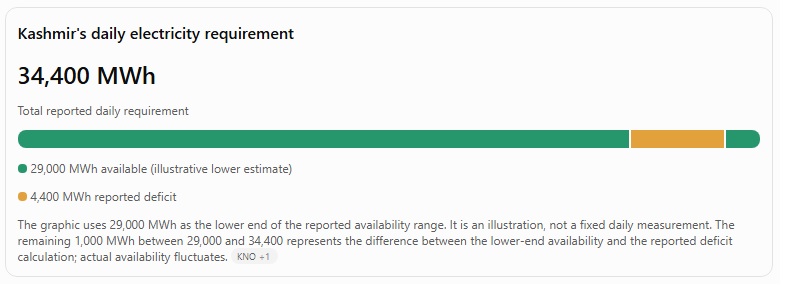
Kashmir’s daily electricity requirement
34,400 MWh – Total reported daily requirement
4,400 MWh reported deficit
The graphic uses 29,000 MWh as the lower end of the reported availability range. It is an illustration, not a fixed daily measurement. The remaining 1,000 MWh between 29,000 and 34,400 represents the difference between the lower-end availability and the reported deficit calculation; actual availability fluctuates.
The same official estimated average demand at approximately 1,435 MW against available supply of around 1,280 MW, producing an instantaneous average gap of nearly 155 MW during the reporting period.
Peak non-solar demand had also increased from 1,650 MW to 1,700 MW within a day.
These figures provide a more immediate picture of the pressure on Kashmir’s electricity system as temperatures decline.
Why the difference between MW and MWh matters
The distinction is important because electricity demand is often reported in two different measurements.
-
MW (megawatts): Measures the rate at which electricity is being demanded or supplied at a particular moment.
-
MWh (megawatt-hours): Measures the quantity of electricity consumed or supplied over a period.
A shortage of 155 MW at a particular operating point is not the same thing as a daily energy deficit of 4,400 MWh.
The two figures describe different aspects of the supply problem. Both are useful, but confusing them can exaggerate or understate the actual situation.
For Kashmir, the daily energy deficit is particularly significant because it reflects the cumulative amount of electricity that remains unavailable to meet the reported requirement over 24 hours.
Hydropower: Kashmir’s Natural Advantage That Weakens When Electricity Is Needed Most
Kashmir’s dependence on imported electricity becomes easier to understand when its hydropower generation is examined.
The region has considerable hydropower potential. However, its ability to generate electricity changes with water availability, particularly in river systems affected by seasonal variations in discharge.
Winter creates an unusual contradiction.
Electricity demand increases because households need heating, but water availability for many hydroelectric projects declines, reducing local generation.
According to a November 4 report by Kashmir Reader, an official said generation from Jammu and Kashmir-owned hydropower projects had fallen to approximately 250–280 MW during the preceding period, with some estimates fluctuating around 270–300 MW.
The official attributed the decline to lower water levels during winter and described the reduction in hydropower output as close to 80 per cent compared with higher-generation periods.
This reduction creates additional pressure on the electricity procurement system.
Why does hydropower generation fall?
Hydroelectric projects use the movement and pressure of water to operate turbines.
When river discharge declines, the volume of water available for generation can fall. The extent of the reduction depends on the design of the project, reservoir storage, operating arrangements and seasonal river conditions.
Not every hydropower project experiences an identical decline.
Nevertheless, the overall seasonal pattern creates a serious problem for Jammu and Kashmir.
The region’s demand rises while a major source of its own electricity becomes less productive.
The untapped hydropower opportunity
The larger problem is that Jammu and Kashmir has not fully harnessed its identified hydropower potential.
The Economic Survey 2025–26 places the region’s identified potential at approximately 14,867 MW, while installed and harnessed capacity stands at around 3,540 MW.
This means a substantial portion of the identified potential remains undeveloped.
However, the solution cannot simply be to build more dams.
Hydropower development requires environmental clearances, geological assessments, financial investment, rehabilitation arrangements and careful evaluation of ecological consequences.
Projects must also be designed with the region’s fragile mountain environment in mind.
The policy challenge is to expand reliable generation without creating unacceptable environmental and social costs.
NRPC’s Low-Voltage Warning: The Transmission Network Could Become Another Winter Casualty
The shortage of electricity is only one part of Kashmir’s problem.
The other is the ability of the transmission system to deliver the available electricity without compromising grid stability.
The Northern Regional Power Committee (NRPC) has already warned that Kashmir could experience a repeat of the low-voltage problems recorded during the previous winter.
Its winter preparedness assessment for 2026–27 highlighted the relationship between rising electricity demand, reduced hydropower generation and increased dependence on the interstate transmission network.
According to the assessment, demand in the Jammu and Kashmir control area reached approximately 3,200 MW during peak periods last winter.
The increased demand, particularly during early morning and evening hours, coincided with reduced hydropower generation and heavy drawal of reactive power from the interstate network.
The result was a significant decline in voltage at important transmission stations in Kashmir.
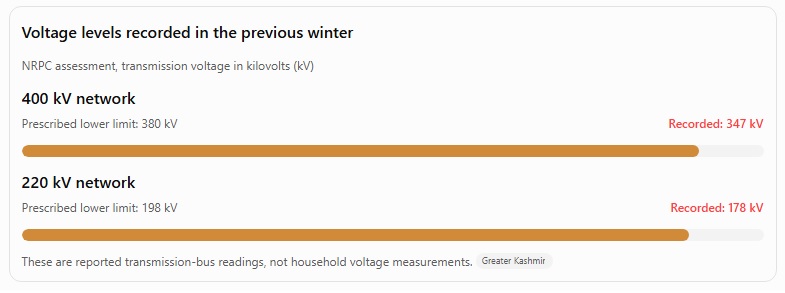
Voltage levels recorded in the previous winter
NRPC assessment, transmission voltage in kilovolts (kV)
400 kV network – Prescribed lower limit: 380 kV | Recorded: 347 kV – 220 kV network | Prescribed lower limit: 198 kV – Recorded: 178 kV
The recorded voltage at 400 kV buses dropped to 347 kV against a prescribed lower operating limit of 380 kV. At 220 kV buses, the reading fell to 178 kV against a prescribed limit of 198 kV.
The NRPC warned that similar conditions could return unless corrective action was taken before the onset of peak winter demand.
Why low voltage is dangerous for the power system
Voltage is an essential characteristic of electricity supply.
When voltage falls significantly below acceptable operating levels, electrical equipment may not function properly. Motors, pumps and other appliances can become less efficient, while certain operating conditions may increase equipment stress.
The issue becomes more serious when the network is already operating under heavy demand.
For households, this can mean more than dim lights. Electric appliances may struggle to operate, and consumers can experience unreliable service even when electricity has not been completely disconnected.
What corrective measures have been recommended?
The NRPC has sought advance preparations from the State Load Despatch Centre and transmission agencies.
Its recommendations include:
-
Preparing a detailed winter power-management plan.
-
Ensuring the availability of voltage-support equipment.
-
Prioritising maintenance of the Static Var Compensator at New Wanpoh.
-
Completing maintenance of important 400 kV transmission lines.
-
Avoiding planned shutdowns of major transmission lines during the most demanding winter period.
-
Improving emergency restoration arrangements at important substations.
The committee has also highlighted the absence of a synchronising trolley at the Amargarh end during restoration following a partial blackout last winter.
Such equipment helps synchronise electrical systems during restoration. Its absence can complicate the process of bringing parts of the network back online.
The warning is particularly relevant because procuring additional electricity will be of limited value if transmission constraints prevent that electricity from being delivered reliably.
Another Winter of Load-Shedding: Some Feeders Face Eight Hours of Scheduled Cuts
For consumers, the electricity crisis is experienced less through official demand projections and more through the number of hours their homes remain without power.
KPDCL’s revised load-curtailment arrangements, implemented from October 17, link scheduled interruptions to feeder-wise AT&C losses.
Under the notified structure, the duration of scheduled curtailment increases with the losses recorded on individual feeders.
| Feeder AT&C losses | Scheduled curtailment |
|---|---|
| 0–15% | 30 minutes |
| Above 15–40.5% | 3 hours |
| Above 40.5–65% | 6 hours |
| Above 65% | 8 hours |
The arrangement also expanded the number of feeders receiving round-the-clock supply, with 85 additional feeders bringing the reported total to 214.
The policy is intended to reward better-performing feeders and encourage improvements in metering, billing and revenue recovery.
But it also creates a difficult question about fairness.
Should households in areas with higher distribution losses bear the consequences through longer scheduled power cuts, even when some of those losses may result from ageing infrastructure, overloaded transformers or technical deficiencies beyond the control of individual consumers?
There is a strong argument for holding consumers accountable for unauthorised electricity use. But utilities must also accept responsibility for technical losses and inadequate infrastructure.
A fair electricity policy should distinguish between the two.
The problem of unscheduled outages
Scheduled load-shedding is one issue. Unexpected outages are another.
When electricity disappears beyond the published curtailment timings, consumers have little certainty about when supply will return.
This is particularly difficult for households with elderly people, children and patients who depend on electric heating.
The administration’s insistence on adherence to scheduled curtailment timings is therefore important.
If authorities cannot immediately eliminate the shortage, they should at least ensure that consumers receive the supply hours officially promised to them.
Why Is a Hydropower-Rich Region Still Dependent on Imported Electricity?
This question deserves more than a seasonal explanation.
Jammu and Kashmir has substantial hydropower resources, yet its electricity security depends heavily on external procurement, particularly during winter.
The reasons include:
-
Only a fraction of identified hydropower potential has been developed.
-
Existing projects experience seasonal variations in generation.
-
Electricity demand has increased with population growth, urbanisation and wider appliance usage.
-
Distribution losses reduce the amount of electricity that can be effectively billed and recovered.
-
Transmission constraints and low-voltage conditions can limit reliable power delivery.
-
Long-term infrastructure investment has not eliminated the gap between peak demand and available supply.
There is also a financial dimension.
Purchasing electricity from central generating stations and power exchanges can involve substantial expenditure. When demand rises sharply, utilities may have to procure additional power at prevailing market rates, placing pressure on their financial position.
This is one reason why electricity-sector reforms, including smart metering and improved revenue recovery, have become central to government policy.
However, better collections alone cannot resolve the region’s dependence on external power.
The long-term answer requires a combination of generation expansion, efficient procurement, stronger transmission infrastructure and lower distribution losses.
The Financial Burden: Who Pays for Kashmir’s Winter Electricity Shortage?
The electricity crisis also has a direct economic cost.
Every additional unit purchased from outside Jammu and Kashmir adds to the financial responsibilities of the distribution companies. During peak winter, when local hydropower output declines, dependence on external electricity becomes more pronounced.
At the same time, the distribution companies must recover revenue from consumers while managing technical losses, unpaid bills and infrastructure expenditure.
This creates a difficult financial equation:
-
Electricity purchases become more expensive when demand increases.
-
Local hydropower generation declines.
-
Distribution companies must arrange additional power.
-
Consumers face higher consumption-based bills.
-
Government subsidies are required to keep electricity affordable.
-
Infrastructure investment remains necessary to reduce losses and improve reliability.
The problem is particularly sensitive in Kashmir because electricity bills have increased for many households following the expansion of smart metering.
Consumers increasingly question why they should pay according to actual consumption while continuing to experience scheduled and unscheduled power cuts.
The answer cannot simply be that electricity is expensive to purchase. Utilities must also demonstrate that revenue improvements are translating into better infrastructure and more dependable service.
What the Government and KPDCL Must Deliver Before Peak Winter
The coming weeks will be crucial.
The administration has already initiated winter preparedness measures, but the electricity crisis requires more than temporary arrangements.
Several priorities deserve immediate attention.
1. Ensure the additional power actually reaches consumers
The Centre’s additional allocation must be translated into effective electricity availability. Authorities should publish the actual power received, peak-hour drawal and supply distributed to Kashmir.
2. Complete transmission maintenance
The NRPC’s recommendations regarding transmission lines, voltage-support equipment and emergency restoration must be implemented before peak demand.
3. Upgrade overloaded transformers
District-level transformer stocks are useful, but authorities must also identify areas where existing transformer capacity is insufficient.
4. Reduce unscheduled power cuts
Even if scheduled curtailment cannot immediately be eliminated, KPDCL should ensure that interruptions do not routinely exceed the notified timings.
5. Publish daily supply information
Consumers should have access to feeder-wise supply hours, curtailment schedules, actual interruptions and restoration updates.
6. Improve electricity procurement planning
Power procurement must be arranged in advance, particularly for November and March, when seasonal supply pressures can become difficult.
7. Strengthen hydropower planning
The administration must develop a realistic long-term strategy to expand generation capacity while protecting Kashmir’s fragile ecological environment.
Kashmir’s Winter Power Crisis Is Becoming an Annual Test of Governance
The additional 329 MW allocation offers some relief, but it does not resolve the structural weaknesses behind Kashmir’s recurring electricity shortages.
The Valley continues to face a difficult combination of rising consumption, falling hydropower generation, dependence on imported electricity and a transmission network vulnerable to winter stress.
The reported daily deficit of 4,400 MWh is a reminder that the shortage is not merely a projection for some distant winter period. Power-sector officials are already reporting a substantial gap between the electricity Kashmir requires and the amount available.
The NRPC’s warning about low voltage makes the situation more concerning. Even where additional electricity can be arranged, the transmission network must be capable of carrying it safely and reliably.
For ordinary families, however, the debate is much simpler.
They want electricity when temperatures fall. They want heaters and geysers to function without repeated interruptions. They want published schedules to be respected. And they want their electricity bills to reflect a service that is dependable, not merely a system that has become better at measuring consumption.
Kashmir’s hydropower potential is an important natural advantage, but potential alone cannot provide winter electricity security.
The administration must move beyond seasonal power allocations and repeated preparedness reviews towards a comprehensive strategy that addresses generation, procurement, transmission and distribution together.
The real question is no longer whether Kashmir can arrange another 329 MW for winter. It is why a region with such considerable hydropower resources continues to enter every winter facing the same electricity uncertainty.
Until that question is addressed through measurable improvements, additional allocations will remain temporary relief for a recurring crisis.