JKSSB Exam Row Escalates: Ruhullah Joins Students, 16 Arrested in Alleged Cheating Racket
Former Srinagar MP joins protesting aspirants in Srinagar, accuses successive administrations of playing with young people’s careers; police investigation into alleged Finance Accounts Assistant examination cheating racket expands as questions mount over recruitment transparency
By: Javid Amin | 21 December 2026 | Srinagar
The anger among Jammu and Kashmir’s government-job aspirants is once again spilling onto the streets. This time, the trigger is an alleged organised cheating operation linked to the Jammu and Kashmir Services Selection Board’s (JKSSB) Finance Accounts Assistant (FAA) examination, held on November 15, 2026.
The controversy has brought together several concerns that have troubled young candidates for years: alleged examination manipulation, the possibility of organised cheating networks, questions about institutional accountability and the fear that genuine merit may not be enough to secure a government job.
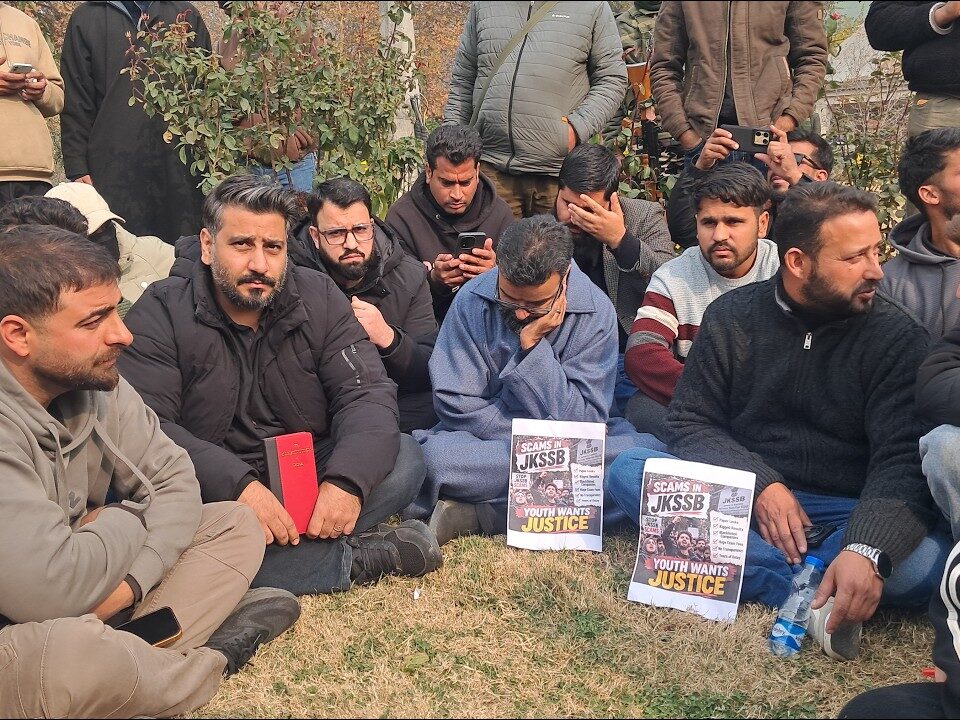
Former Srinagar Member of Parliament Aga Syed Ruhullah Mehdi joined protesting candidates at Sher-e-Kashmir Park in Srinagar on Saturday, November 21. Describing recruitment corruption as “worse than murder”, he demanded exemplary punishment for those responsible and warned that compromising recruitment examinations could destroy the careers and futures of entire generations.
Ruhullah was careful to clarify that he had joined the students’ agitation rather than taken leadership of it. “The students are not joining with me. I am joining with the students. I am not leading this,” he said.
His remarks reflected the frustration of candidates who believe that years of preparation, family sacrifices and financial investment can be rendered meaningless if recruitment examinations are compromised.
The protest has since developed into an indefinite sit-in, with aspirants demanding accountability and a credible investigation. Ruhullah also accused the Lieutenant Governor’s administration and the elected government led by Chief Minister Omar Abdullah of shifting responsibility instead of addressing the concerns of unemployed youth.
The immediate controversy concerns the FAA examination. But the anger it has generated goes beyond one test. For thousands of candidates, the question is whether Jammu and Kashmir’s public recruitment system can still guarantee a fair opportunity to everyone.
What happened in the JKSSB Finance Accounts Assistant examination?
The JKSSB conducted the Finance Accounts Assistant examination on November 15, 2026, for 600 posts in the Finance Department.
The examination was held across all 20 districts of Jammu and Kashmir. According to the Board’s official clarification issued on November 19, the test was scheduled across 493 examination centres, with 1,61,946 candidates scheduled to appear.
The scale of the examination explains why allegations of organised cheating have caused such concern. More than 1.6 lakh candidates were competing for only 600 vacancies, making the examination a crucial opportunity for young people seeking government employment.
The controversy emerged after Jammu Police acted on intelligence inputs about a suspected group allegedly planning to facilitate cheating through electronic communication devices.
According to police, the suspected network had developed a method through which questions could be transmitted from candidates inside examination centres to accomplices waiting outside. The latter would allegedly obtain answers and communicate them back to selected candidates using wireless equipment.
Police teams reportedly monitored the suspected facilitators around examination centres and made arrests before and after the test.
The operation resulted in the registration of three FIRs at Domana Police Station and the constitution of a Special Investigation Team (SIT) to investigate the alleged network.
The police action prevented the suspected operation from proceeding as planned, but it also exposed the possibility that organised groups may be attempting to exploit competitive examinations through technology and coordinated assistance.
Four alleged cheating modules, wireless sets and electronic devices
The details emerging from the police investigation have added to the seriousness of the case.
SSP Jammu Joginder Singh said the police had received specific information about attempts to use unfair means during the examination. Teams were deployed around identified centres to track the suspected facilitators.
According to the police account reported by The Tribune, four modules were allegedly operating to facilitate cheating.
The reported modus operandi involved two groups: candidates inside examination halls and facilitators stationed outside. Questions or portions of the question paper were allegedly to be passed to the outside network, which would arrange answers and relay them to selected candidates through electronic devices.
Police initially arrested 14 people in connection with the alleged operation.
The seizures included:
- Eight wireless communication sets.
- Around 22 mobile phones.
- Five vehicles allegedly used by the suspected network.
The investigation subsequently led to two more arrests, including a Forest Guard and a candidate, taking the reported total to 16 by November 18.
According to reports, the Forest Guard was allegedly assigned to obtain a copy of the question paper after its distribution at an examination centre and pass it to accomplices outside. The candidate was allegedly among those who intended to benefit from the arrangement.
These are allegations under investigation. Arrest does not establish guilt, and the role of each accused must be determined through evidence and the judicial process.
The SIT is examining how the alleged network operated, how the equipment was procured, whether more people were involved and whether any additional candidates or officials facilitated the attempted fraud.
Possible involvement of officials raises fresh questions
The investigation took a more serious turn after reports emerged that police were examining the possible involvement of officials associated with the recruitment process.
A report published by The Tribune on November 20 said investigators suspected that at least four officials may have assisted the alleged network in providing answers to selected candidates.
The report said the suspected officials were being questioned by the SIT to establish whether they had played any role in the alleged operation.
No names or designations were publicly disclosed in that report, and the alleged involvement of officials has not been established as a final finding.
Nevertheless, the possibility requires a thorough investigation. An organised cheating operation involving communication between examination halls and outside facilitators would raise questions about access to examination material, internal security arrangements and the possibility of assistance from individuals familiar with examination procedures.
Investigators must establish whether the alleged network was limited to candidates and outside facilitators or whether it had access to people responsible for handling examination material.
If any public servant is found to have misused an official position to facilitate cheating, the consequences must extend beyond the immediate criminal case. Departmental proceedings and other applicable legal action would also be necessary.
The credibility of the recruitment process depends on ensuring that no individual, regardless of position or influence, can manipulate an examination.
JKSSB says the examination was not compromised
As the police investigation intensified, JKSSB issued an official clarification on November 19, maintaining that the Finance Accounts Assistant examination had been conducted successfully across Jammu and Kashmir.
The Board said the examination covered all 20 districts and 493 centres, with 1,61,946 candidates scheduled to appear for 600 posts.
It described the incident as an isolated attempt to use unfair means and stated that the attempt did not compromise the examination process.
JKSSB also appreciated the Jammu and Kashmir Police for identifying and apprehending the suspected individuals. It said the Board worked with police, district administrations and other agencies to ensure the examination was conducted in an orderly manner.
The clarification is important because it establishes the Board’s official position: the alleged cheating attempt was detected and did not compromise the overall examination.
However, the statement does not eliminate the need for a detailed investigation. Candidates are entitled to understand how the alleged network operated, whether any examination-related information was compromised and whether the safeguards were sufficient to prevent similar attempts in future.
There is a distinction between an attempted examination fraud and a successfully compromised examination. The two should not be treated as interchangeable.
At the same time, an institution cannot expect public confidence to be restored through a press statement alone. The investigation must establish the facts and make its findings credible to the candidates who appeared in the examination.
Ruhullah: Successive administrations cannot escape responsibility
Addressing the protesters, Ruhullah criticised both the previous Lieutenant Governor-led administration and the present elected government, accusing them of shifting responsibility while young candidates continued to face uncertainty.
He argued that recruitment irregularities had become a recurring problem and that the administration could not avoid accountability by citing jurisdictional limitations.
His criticism was directed at the wider system rather than only the latest examination controversy.
Ruhullah alleged that a network had developed over the past five to eight years to facilitate compromises in recruitment processes and benefit selected individuals. He described the irregularities as deliberate rather than accidental and demanded exemplary action against those responsible.
His demand that “heads should roll” was a call for accountability at the highest levels.
He also questioned why the elected government could not intervene more effectively when recruitment-related controversies emerged, arguing that the administration must engage directly with protesting candidates instead of allowing the dispute to continue.
The political significance of his intervention is difficult to separate from his recent break with the National Conference and his resignation from the Srinagar Lok Sabha seat. However, he explicitly said that the students’ movement was not his personal political programme.
That distinction matters. The protest began around the candidates’ grievances, and its legitimacy depends on whether their demands remain central rather than becoming absorbed into the political competition between parties.
Why the students are angry: Government jobs represent years of sacrifice
For many young people in Jammu and Kashmir, a government job is more than a monthly salary.
It represents financial stability, social security and the possibility of supporting an entire family. In households where private-sector employment remains limited or uncertain, government recruitment examinations often become the most important route to a stable future.
Candidates spend years preparing for competitive examinations. Families frequently redirect household savings towards coaching, books, accommodation and travel. Many aspirants postpone other career options while waiting for recruitment notifications and examination schedules.
The pressure is particularly intense when thousands of candidates compete for a limited number of posts.
When allegations of paper leaks, cheating or selection manipulation emerge, the damage is not confined to those directly affected by an examination. It creates doubt among candidates who may have performed honestly but cannot be certain that the selection process will reward merit.
The psychological and financial consequences can be substantial. Candidates may lose years of preparation, families may exhaust savings, and young people may become increasingly distrustful of public institutions.
This is why recruitment transparency is not simply an administrative requirement. It is a matter of public confidence and equal opportunity.
A candidate who prepares honestly should never have to wonder whether another person secured an advantage through money, influence or access to confidential examination material.
The problem goes beyond one examination
The latest controversy has revived memories of earlier recruitment disputes in Jammu and Kashmir.
Over the years, several recruitment processes have faced allegations of paper leaks, irregularities, cancellations and investigations. Each controversy has added to the anxiety of candidates who have already spent years preparing for competitive examinations.
The issue is not that every examination conducted by JKSSB or another recruitment agency is necessarily compromised. Such a conclusion would be unfair and unsupported.
The problem is that repeated allegations can weaken public confidence even when individual investigations do not establish widespread wrongdoing.
Once candidates begin to question the fairness of an examination, the recruiting institution faces a credibility challenge that cannot be resolved merely by publishing a selection list.
The FAA examination controversy has therefore brought the larger recruitment framework back into focus.
The government and JKSSB must demonstrate that examination papers are secure, candidate verification is reliable, examination centres are properly monitored and any attempt to manipulate the process is detected before it can affect the outcome.
The public also needs clear information about the status of investigations into earlier recruitment controversies and the action taken against those found responsible.
Without visible accountability, every new allegation risks reinforcing the belief that the system has not learned from previous failures.
Protest spreads as aspirants demand answers
The anger was not confined to Srinagar.
Reports on November 21 said job aspirants had launched indefinite sit-in protests in Srinagar and Jammu, raising concerns over alleged JKSSB examination irregularities, administrative finger-pointing and the unresolved reservation-policy issue.
The candidates’ demands reflect a wider frustration with the recruitment system. They want an impartial investigation into the alleged cheating operation, accountability for those responsible and assurances that future examinations will be conducted without manipulation.
The reservation-policy issue has added another dimension to the protests. Candidates have been seeking clarity over the government’s position and the impact of reservation arrangements on recruitment opportunities.
These concerns should be addressed separately and transparently. The alleged cheating racket and the reservation-policy debate involve different administrative and legal questions, even though both affect candidates’ confidence in public recruitment.
Ruhullah urged the authorities to engage directly with the protesters and resolve their concerns rather than allow the agitation to continue.
His intervention also brought the protest greater political visibility, although he insisted that he was standing alongside the students rather than leading them.
Mehbooba Mufti, Tarigami and Mirwaiz also raise concerns
The recruitment controversy has drawn reactions from political and religious leaders beyond Ruhullah.
PDP president Mehbooba Mufti described the alleged cheating incident as a serious matter, stressing that the future and years of hard work of young candidates were at stake.
She argued that recruitment controversies had also occurred during the Lieutenant Governor-led administration and said the present elected government could not avoid responsibility by referring to earlier periods.
CPI(M) leader and Kulgam MLA M.Y. Tarigami described the latest FAA cheating case as another addition to a long history of recruitment controversies that had weakened the confidence of Jammu and Kashmir’s youth.
He called for accountability and action against those responsible for damaging the credibility of public examinations.
Mirwaiz Umar Farooq also expressed concern over recurring allegations of irregularities in recruitment examinations. He called for a thorough, impartial and transparent investigation, arguing that candidates who spend years preparing for competitive examinations deserve a fair opportunity.
The reactions show that concern over recruitment credibility extends across political and social platforms.
However, public statements must be followed by institutional action. The immediate requirement is not another exchange of accusations but a clear account of the alleged cheating operation, the people involved and the safeguards needed to prevent a recurrence.
Police remove protesters from Sher-e-Kashmir Park; Ruhullah alleges forced eviction
The protest took another turn late on Saturday night.
Ruhullah and his office claimed that police removed him and the protesting candidates from Sher-e-Kashmir Park, where they had been holding an indefinite sit-in.
In a statement shared on social media, his office rejected reports suggesting that the former MP had voluntarily left the protest site. It alleged that the protesters were removed against their wishes.
Ruhullah also claimed that police were restricting the entry of food and blankets into the park, leaving students exposed to the cold during the night.
The claims were reported by PTI and other media outlets. A detailed official explanation of the police action was not available in the reporting reviewed for this article.
The episode has raised a separate question about the administration’s handling of peaceful protests.
Authorities are responsible for maintaining public order and ensuring that demonstrations do not disrupt essential services. But students raising concerns about recruitment fairness also have a legitimate interest in being heard.
Any restrictions or action against protesters should be lawful, proportionate and clearly explained.
The administration would be better served by engaging with representatives of the candidates and providing a time-bound response to their demands rather than allowing the dispute to become another confrontation between protesters and police.
What the government and JKSSB must do now
The latest controversy presents an opportunity to address weaknesses in the recruitment process rather than treating the matter as an isolated law-and-order problem.
Several steps are necessary.
First, complete the investigation transparently. The SIT should establish the full network behind the alleged cheating operation, including the source of the equipment, the role of each accused and whether any public officials assisted the operation.
Second, clarify whether examination integrity was affected. JKSSB has said the attempted cheating did not compromise the examination. The Board should explain the basis for that assessment and whether investigators have found any evidence that questions or answers reached candidates inside examination halls.
Third, publish meaningful updates. Candidates should not have to rely entirely on political statements or fragmented media reports to understand the status of an investigation involving their careers.
Fourth, strengthen examination security. JKSSB has said it is adding preventive measures. These should include robust electronic surveillance, biometric verification, strict control over examination material, secure communication arrangements and stronger monitoring of suspicious activity around centres.
Fifth, establish accountability at every level. If candidates, facilitators, officials or other individuals are found to have participated in the alleged fraud, action must follow under the law. The investigation should not stop at the arrest of people operating outside examination centres if evidence points to a wider network.
Finally, create a reliable grievance mechanism. Candidates should have a formal channel to report suspected irregularities, seek clarification and receive timely responses without having to resort to repeated street protests.
The objective should be to make recruitment examinations credible before the next controversy emerges.
The real test is whether merit can be protected
Ruhullah’s description of recruitment corruption as “worse than murder” was deliberately forceful. It reflected the anger of candidates who see examination manipulation as an attack on their future.
The phrase is rhetorical, not a legal comparison. But the underlying concern is serious.
A recruitment scam can deprive deserving candidates of opportunities they may never recover. It can destroy years of preparation, deepen unemployment and weaken the belief that public institutions reward hard work.
The latest FAA controversy has also exposed a difficult distinction. Police say they foiled an alleged organised cheating attempt and arrested suspects. JKSSB says the examination was not compromised. Both statements can coexist: an attempted fraud may have been detected without changing the overall examination outcome.
The responsibility now lies with investigators and the recruitment authorities to establish the full facts and demonstrate that the system is capable of protecting honest candidates.
The government must also recognise that recruitment credibility cannot be restored through political assurances alone. It requires transparent procedures, independent scrutiny where necessary, prompt prosecution of proven wrongdoing and clear communication with candidates.
For Jammu and Kashmir’s youth, the issue is deeply personal. They are not asking for preferential treatment or political patronage. They are asking for a fair examination, a transparent selection process and the assurance that their hard work will not be defeated by someone else’s influence.
The future of public recruitment in Jammu and Kashmir depends on one fundamental principle: a government job must go to the deserving candidate, not to the person with the strongest connections or access to a cheating network. Merit must be protected in practice, not merely promised in official statements.