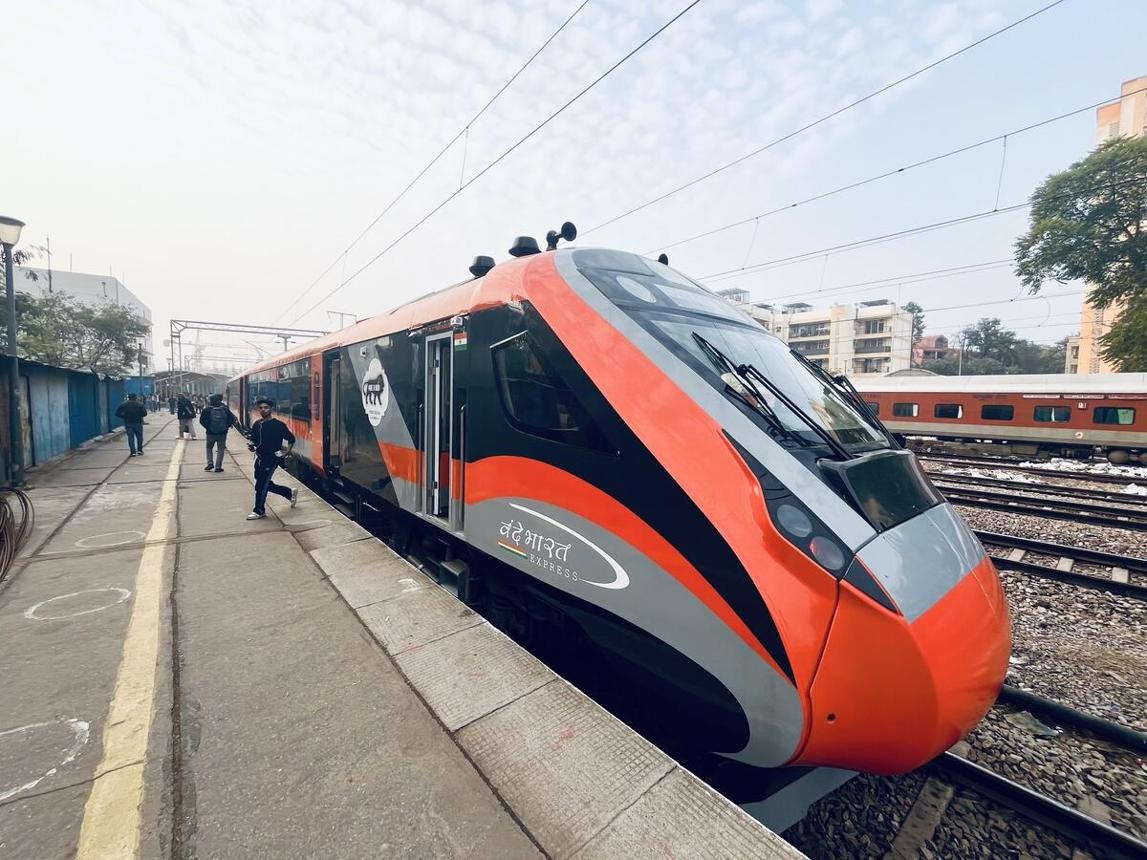
Third Vande Bharat Between Jammu and Srinagar Approved: What It Means for Kashmir’s Rail Connectivity, Tourism and Economy
The Railway Ministry has approved a third Vande Bharat Express between Jammu Tawi and Srinagar, adding another high-speed service to one of Jammu & Kashmir’s fastest-growing passenger corridors. The proposed train, 26407/26408, is expected to strengthen capacity, improve travel flexibility and support tourism and commercial movement between the Jammu region and Kashmir Valley.
By: News Desk | 20 Aug 2026
Jammu/Srinagar: Jammu and Kashmir’s railway story is entering another important phase.
The Railway Ministry has approved the introduction of a third Vande Bharat Express between Jammu Tawi and Srinagar, according to a letter from Railway Minister Ashwini Vaishnaw shared by Union Minister Jitendra Singh on August 20.
The proposed service will operate as Train Nos. 26407/26408, travelling between Jammu Tawi and Srinagar via Udhampur, Shri Mata Vaishno Devi Katra, Reasi and Banihal.
The announcement comes at a time when demand for rail travel between Jammu and Kashmir is rising rapidly. Existing Vande Bharat services have already been expanded to larger 20-coach configurations, while railway authorities have recently approved a higher permissible speed of up to 100 kmph across the 111-km Katra–Banihal section.
But there is an important clarification to the supplied brief: the 100-kmph approval does not mean that Vande Bharat is already routinely running at 100 kmph across the entire section or over the Chenab Bridge. Northern Railway clarified on August 20 that although the higher speed had been approved, it had not yet been operationally implemented at that point.
That distinction matters because the new train and the speed upgrade are related developments—but they are not the same announcement.
Third Jammu-Srinagar Vande Bharat: What Has Been Approved?
The newly approved service is identified as:
26407 Jammu Tawi–Srinagar Vande Bharat Express
26408 Srinagar–Jammu Tawi Vande Bharat Express
The service will run through the strategically important railway corridor connecting the Jammu region with the Kashmir Valley.
The proposed route includes:
Jammu Tawi → Udhampur → Shri Mata Vaishno Devi Katra → Reasi → Banihal → Srinagar
The inclusion of Shaheed Captain Tushar Mahajan (Udhampur) is particularly significant because it gives passengers from the Udhampur area another direct high-speed connection toward Kashmir.
The exact commercial launch date, timetable, fare structure and detailed stoppage pattern should, however, be treated as pending unless separately notified by Indian Railways/IRCTC.
That is an important distinction: approval of a service is not the same as commencement of bookings.
Why Does Jammu and Kashmir Need a Third Vande Bharat?
The simplest answer is demand.
The Jammu-Srinagar corridor has quickly evolved from a symbolic railway connection into a commercially important passenger route.
Existing Vande Bharat services have attracted strong occupancy, prompting the Railways to increase rake capacity. Reports from May indicated that 20-coach services were running close to capacity on several days, with weekend demand particularly strong.
The two existing Jammu-Srinagar services are:
- 26401/26402
- 26403/26404
Together, they currently provide multiple daily services between Jammu Tawi and Srinagar, although their operating days and exact schedules can vary.
The third service is therefore less about creating a railway connection from scratch and more about adding capacity to a corridor where demand is already testing available seats.
From Katra-Srinagar to Jammu-Srinagar: A Remarkably Fast Transformation
The evolution of the Vande Bharat service itself is significant.
The first Vande Bharat connecting the Kashmir Valley was inaugurated on June 6, 2025, initially linking Katra and Srinagar.
The service was subsequently extended to Jammu Tawi on April 30, 2026, creating a direct high-speed rail connection between Jammu and Srinagar.
The Jammu-Srinagar journey covers approximately 269 kilometres and takes around 4 hours 45–50 minutes, depending on the service.
That represents a major change in the way people can move between the two regions.
For decades, the road through the Jammu-Srinagar National Highway was the principal surface connection between Jammu and Kashmir.
Now passengers have an alternative that is:
- less dependent on highway traffic;
- more predictable during difficult weather conditions;
- comfortable for tourists;
- useful for business travellers;
- increasingly attractive to local residents.
The Udhampur Factor: Why the New Stop Matters
The proposed routing through Udhampur adds an important regional dimension.
Udhampur is not simply a railway stop between Jammu and Katra.
It is an expanding urban and administrative centre with substantial military, government, commercial and residential activity.
Direct access to a Jammu-Srinagar Vande Bharat could benefit:
- government employees;
- students;
- business travellers;
- tourists;
- families travelling between regions;
- residents of surrounding districts.
It also reinforces Udhampur’s position within the wider Udhampur-Srinagar-Baramulla Rail Link (USBRL) network.
The railway corridor is gradually transforming what was once a difficult mountain journey into an integrated rail route.
The 100-kmph Speed Upgrade Could Change the Journey Again
One of the most important recent railway developments is the approval to increase the maximum permissible speed to 100 kmph on the 111-km Katra-Banihal section.
Previously, different sections operated under lower permissible speeds.
Reports indicate that the earlier limits included 85 kmph on Katra-Sangaldan and 75 kmph on Sangaldan-Banihal. The new approval allows up to 100 kmph across the section, subject to operational implementation and safety requirements.
The potential benefits go beyond simply making trains faster.
Higher permissible speeds can:
- reduce journey time;
- improve timetable flexibility;
- increase line capacity;
- improve punctuality;
- reduce the time trains occupy critical sections;
- create greater operational efficiency.
Northern Railway has specifically linked the speed enhancement with improved connectivity and reduced travel time.
Chenab Bridge: A Major Clarification
The Chenab Railway Bridge has become one of the defining symbols of the Kashmir railway project.
At 359 metres above the Chenab River, it is the world’s highest railway arch bridge.
Recent reports initially stated that a Vande Bharat had crossed the bridge at nearly 100 kmph following the speed approval.
But Northern Railway subsequently clarified that no train had actually operated at 100 kmph over the bridge as of August 20. The approval had been granted, but operational implementation was still pending.
This is a good example of why infrastructure stories require careful verification.
The accurate position is:
100 kmph has been approved as the maximum permissible speed for the Katra-Banihal section; that does not mean every train is already running at that speed throughout the section.
That distinction should be retained in any published version of this story.
More Than a Train: What It Could Mean for Kashmir Tourism
For Kashmir’s tourism industry, improved railway connectivity could be transformative.
Tourism demand is highly sensitive to:
- travel time;
- cost;
- reliability;
- weather;
- road conditions;
- availability of transport.
The Jammu-Srinagar Vande Bharat addresses several of these factors at once.
A tourist arriving in Jammu can potentially reach Srinagar in less than five hours without undertaking the long road journey through the mountains.
That creates opportunities for tour operators to design packages around rail travel.
Instead of:
Jammu arrival → long road transfer → Srinagar
a package can increasingly be structured as:
Jammu arrival → Vande Bharat → Srinagar
This could make Kashmir more accessible to families, senior travellers and tourists who are uncomfortable with lengthy mountain-road journeys.
A New Economic Corridor Is Taking Shape
The significance extends beyond tourism.
Rail connectivity can change the economics of a region by reducing the friction associated with moving people and goods.
Although Vande Bharat is primarily a passenger service, its existence within the broader railway network improves the overall connectivity ecosystem.
Better passenger connectivity can help:
Hospitality
Hotels, homestays and tourism operators can receive visitors from a wider catchment area.
Handicrafts
Kashmir’s handicraft and artisan economy benefits from easier access for buyers, traders and visitors.
Horticulture
The larger USBRL network also has implications for the movement of agricultural products and other freight.
Business Travel
A reliable four-to-five-hour rail connection makes same-day or short-duration business travel more practical.
Employment
Increased visitor movement creates indirect demand for taxis, hotels, restaurants, guides, retail and other services.
This is why railway connectivity should be viewed not simply as a transportation project but as economic infrastructure.
The Tourism Dividend Could Be Significant—but Not Automatic
It would nevertheless be wrong to assume that a third Vande Bharat alone will transform Kashmir’s economy.
Connectivity is an enabler, not a guarantee.
The tourism sector will also need:
- adequate hotel capacity;
- reliable local transport;
- responsible destination management;
- affordable packages;
- better waste management;
- crowd management at major attractions;
- preservation of fragile ecosystems;
- consistent visitor safety.
If rail connectivity rises while destination infrastructure remains under pressure, the result could simply be more tourists arriving faster into an already crowded system.
The next challenge is therefore managing growth sustainably.
What It Means for Ordinary Passengers
For passengers, the most immediate benefit is choice.
A third Vande Bharat could mean:
More departure options.
Greater flexibility.
Less pressure on existing services.
Better chances of securing seats during peak periods.
This matters particularly during:
- summer holidays;
- weekends;
- festive periods;
- Amarnath pilgrimage season;
- winter travel;
- major tourism peaks.
When trains are consistently full, additional frequency can be more useful than simply adding more seats to existing trains.
Capacity Has Already Been Increased
The Railways has already responded to demand by expanding Vande Bharat rakes on the Jammu-Srinagar route.
The services have moved from smaller configurations to 20-coach trains, substantially increasing passenger capacity. Reports from the Jammu division indicated that the two pairs operating on the route could carry nearly 2,900 passengers daily after the expansion.
That fact makes the approval of a third service especially significant.
It suggests that capacity expansion is occurring on two fronts:
- larger trains, and
- more trains.
Together, these measures can substantially increase passenger-handling capacity.
But There Is Another Constraint: Track Capacity
The success of the third Vande Bharat will ultimately depend on the railway network’s capacity to accommodate additional services without creating operational conflicts.
The USBRL is an engineering-intensive railway.
The Katra-Banihal section includes numerous tunnels and major bridges, including the Chenab and Anji Khad bridges.
The line is also geographically difficult and operationally more complex than a conventional plains railway.
That means adding trains requires careful scheduling around:
- maintenance windows;
- freight movements;
- other passenger services;
- crossing requirements;
- emergency contingencies;
- seasonal weather conditions.
The Railway Ministry itself has indicated that additional services are dependent on network capacity, passenger demand, infrastructure availability and operational feasibility.
The Bigger USBRL Story
The third Vande Bharat cannot be understood separately from the USBRL project.
The Udhampur-Srinagar-Baramulla Rail Link represents one of India’s most ambitious railway engineering projects.
Its importance goes beyond reducing travel time.
It provides Jammu and Kashmir with a more integrated railway connection to India’s national rail network.
The network includes:
- major tunnels;
- high bridges;
- electrified broad-gauge track;
- advanced signalling;
- difficult Himalayan terrain;
- specialised infrastructure designed for severe winter conditions.
The railway has also been progressively strengthening signalling and safety systems in J&K. Railway Minister Ashwini Vaishnaw recently said Kavach has been sanctioned for approximately 401 route kilometres across several sections of the J&K railway network.
Winter Could Be One of the Biggest Tests
The true value of the Jammu-Srinagar railway may become particularly evident during winter.
The Jammu-Srinagar road corridor can be disrupted by:
- snowfall;
- landslides;
- avalanches;
- rockfalls;
- traffic restrictions;
- road maintenance.
The railway itself is not immune to Himalayan weather, but a dedicated rail corridor offers another transport option when road connectivity is disrupted.
The Vande Bharat trains serving Kashmir have also been specially adapted for cold-weather operation, including heating and anti-freezing systems designed for the Valley’s harsh winter conditions.
That makes the railway more than a tourism convenience.
It is increasingly becoming part of J&K’s all-weather transport infrastructure.
What Happens Next?
The most important information passengers will now be waiting for is the operational schedule.
The Railway Ministry’s approval establishes the service, but passengers will still need confirmation of:
- launch date;
- departure time from Jammu;
- departure time from Srinagar;
- arrival timings;
- stoppages;
- days of operation;
- fare;
- reservation opening date;
- coach configuration.
Until these are formally notified, passengers should not rely on unofficial social-media schedules.
Indian Railways/IRCTC and the National Train Enquiry System should be treated as the authoritative sources for booking and operational information once the service is opened.
A Turning Point for Jammu-Kashmir Connectivity
There is a larger story unfolding here.
For generations, the Jammu-Srinagar journey was shaped by the geography of the Pir Panjal.
Road travel meant negotiating mountain roads, tunnels, weather disruptions and traffic.
The railway is changing that equation.
The third Vande Bharat is not simply another train.
It is another step in converting Kashmir from a relatively difficult-to-reach destination into a more seamlessly connected part of India’s passenger railway network.
That could influence tourism, business, employment, education and family mobility for years to come.
But the real measure of success will not be the number of trains announced.
It will be whether passengers can actually find seats, reach destinations reliably, travel safely and affordably, and whether the improved connectivity produces sustainable economic benefits for communities across Jammu and Kashmir.
Final Takeaway
The Railway Ministry’s approval of Vande Bharat trains 26407/26408 between Jammu Tawi and Srinagar represents a significant capacity expansion for the Jammu-Kashmir rail corridor. The service will run via Udhampur, Katra, Reasi and Banihal, adding another option to an increasingly busy route.
At the same time, the recently approved 100-kmph maximum permissible speed on the Katra-Banihal section could further reduce travel times once operationally implemented.
For passengers, that means more choices.
For tourism, it means easier access.
For businesses, it means a potentially more reliable passenger corridor.
And for Jammu and Kashmir as a whole, it represents something larger: the gradual transformation of rail connectivity from an engineering ambition into an everyday economic and social lifeline.


