Ladakh Gears Up for June 23 Bandh and Peace Rally as Demands for Statehood and Constitutional Safeguards Intensify
By: Javid Amin | 19 June 2026
A United Call Echoes Across the Himalayas
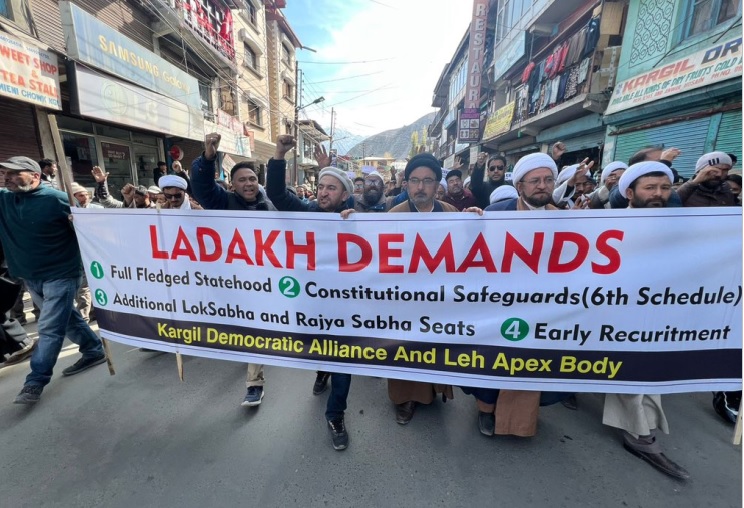
Ladakh is preparing for a significant day of public mobilization on June 23 as the Leh Apex Body (LAB) and the Kargil Democratic Alliance (KDA) jointly organize a region-wide bandh and peace rally to press for long-pending constitutional and political demands.
The coordinated action is expected to bring markets, businesses, educational institutions, and transport services to a standstill across both Leh and Kargil districts. More importantly, organizers say the event is intended to send a powerful democratic message to New Delhi regarding Ladakh’s aspirations for greater political representation and constitutional protection.
The joint call by LAB and KDA reflects a rare and strong consensus between the two major socio-political platforms representing the interests of Ladakh’s diverse communities.
Leaders from both organizations have urged citizens to participate peacefully and responsibly, emphasizing unity, non-violence, and democratic engagement.
Why June 23 Matters
The bandh and peace rally are not isolated events.
They represent the latest chapter in Ladakh’s ongoing political movement that has gained momentum since the region was separated from Jammu & Kashmir and designated as a Union Territory in August 2019.
Initially, many residents welcomed Union Territory status, believing it would accelerate development and improve governance. However, over time, concerns emerged regarding political representation, employment opportunities, protection of land rights, and preservation of Ladakh’s unique cultural identity.
These concerns have gradually transformed into a broader demand for constitutional safeguards and greater autonomy.
The June 23 mobilization is therefore being viewed as both a protest and a reminder that many of Ladakh’s aspirations remain unresolved.
Four Core Demands at the Heart of the Movement
The bandh and rally revolve around four key demands that LAB and KDA have repeatedly raised before the Union Government.
1. Statehood for Ladakh
One of the most significant demands is the restoration of democratic political structures through statehood.
Supporters argue that statehood would provide Ladakh with a stronger legislative framework, greater administrative accountability, and enhanced local decision-making powers.
Many activists believe that a full-fledged state government would allow local communities to play a more direct role in shaping policies affecting their future.
2. Sixth Schedule Constitutional Safeguards
The demand for inclusion under the Sixth Schedule of the Constitution remains central to the movement.
Community leaders argue that such protections would help safeguard:
- Traditional land ownership patterns
- Indigenous cultural heritage
- Local resources
- Tribal rights
- Community institutions
Given Ladakh’s ecological sensitivity and distinct cultural character, advocates believe constitutional safeguards are necessary to prevent unchecked demographic and developmental pressures.
3. Local Cadre Control
Employment remains a major concern among Ladakh’s youth.
Local organizations have consistently demanded stronger control over recruitment and administrative services to ensure that government jobs primarily benefit local residents.
Supporters of the demand argue that local cadre control is essential for protecting employment opportunities and ensuring governance remains sensitive to regional needs.
4. Transparent and Accountable Governance
The movement also reflects broader concerns regarding governance structures in the Union Territory.
Activists have called for greater transparency in policymaking, increased public consultation, and stronger institutional mechanisms that allow local voices to influence developmental decisions.
For many residents, governance reforms are closely linked to questions of political empowerment and democratic participation.
A Rare Display of Unity Between Leh and Kargil
Perhaps the most significant aspect of the June 23 action is the united front presented by Leh and Kargil.
Historically, political priorities in the two districts have not always aligned. However, recent years have witnessed growing cooperation on issues concerning constitutional safeguards, representation, and local rights.
The partnership between LAB and KDA demonstrates that demands for greater autonomy and constitutional protection now extend across regional, cultural, and religious lines.
Political observers note that such unity strengthens Ladakh’s negotiating position and increases pressure on policymakers to engage seriously with the region’s concerns.
The joint movement has also challenged attempts to portray these demands as representing only one section of Ladakhi society.
Bandh as Symbolism, Rally as Message
Organizers have stressed that the bandh is intended as a peaceful and symbolic expression of public sentiment rather than an act of confrontation.
Expected Impact of the Bandh
| Sector | Likely Impact |
|---|---|
| Markets | Closure of shops and businesses |
| Transport | Reduced public and private movement |
| Educational Institutions | Potential disruption of normal activities |
| Government Attention | Increased political visibility |
| Public Participation | Demonstration of collective support |
While the economic impact of a one-day shutdown may be temporary, its political symbolism is expected to resonate far beyond Ladakh.
The accompanying peace rally is designed to highlight the movement’s commitment to democratic and non-violent methods.
Organizers believe that peaceful participation will reinforce the legitimacy of their demands and project Ladakh’s aspirations to a national audience.
National Attention on Ladakh’s Constitutional Question
The June 23 protest comes at a time when questions surrounding federalism, regional representation, and constitutional safeguards are increasingly prominent in national political discussions.
For Ladakh’s civil society groups, the issue is not simply administrative—it concerns identity, dignity, and the future direction of the region.
The peaceful nature of the planned mobilization may also attract wider attention because it contrasts with more confrontational forms of political protest.
Leaders hope that a united and disciplined demonstration will encourage meaningful dialogue with the Union Government and create momentum for future negotiations.
Growing Public Frustration and the Risk of Escalation
While organizers continue to emphasize peaceful engagement, there is also a growing sense of impatience among sections of the population.
Many residents feel that discussions on constitutional safeguards and political representation have progressed slowly despite repeated assurances and consultations.
Political analysts warn that prolonged delays could deepen public frustration and lead to larger mobilizations in the future.
The June 23 bandh is therefore being viewed as both a demonstration of patience and a warning that public expectations cannot remain unaddressed indefinitely.
Beyond Protest: A Struggle for Identity and Representation
At its core, the Ladakh movement reflects a broader debate about how development, governance, and constitutional protections should coexist in one of India’s most strategically important and culturally unique regions.
Supporters argue that economic development alone cannot address concerns related to identity, representation, and local control.
For many residents, the demands for statehood, Sixth Schedule protections, local cadre control, and transparent governance are interconnected components of a larger vision for Ladakh’s future.
The June 23 bandh and peace rally therefore represent more than a political event—they symbolize a collective effort to define the region’s place within India’s democratic framework.
Conclusion
The joint bandh and peace rally called by the Leh Apex Body and Kargil Democratic Alliance mark a pivotal moment in Ladakh’s evolving political movement.
By uniting around demands for statehood, Sixth Schedule safeguards, local cadre control, and accountable governance, Ladakh’s civil society organizations are seeking to transform regional concerns into a national conversation.
Whether the protest leads to immediate policy outcomes remains uncertain. What is clear, however, is that the movement has entered a new phase—one characterized by unprecedented unity, peaceful mobilization, and a determined assertion of Ladakh’s constitutional aspirations.
As June 23 approaches, all eyes will be on Leh and Kargil, where thousands are expected to participate in what organizers describe as a democratic call for recognition, representation, and respect.


