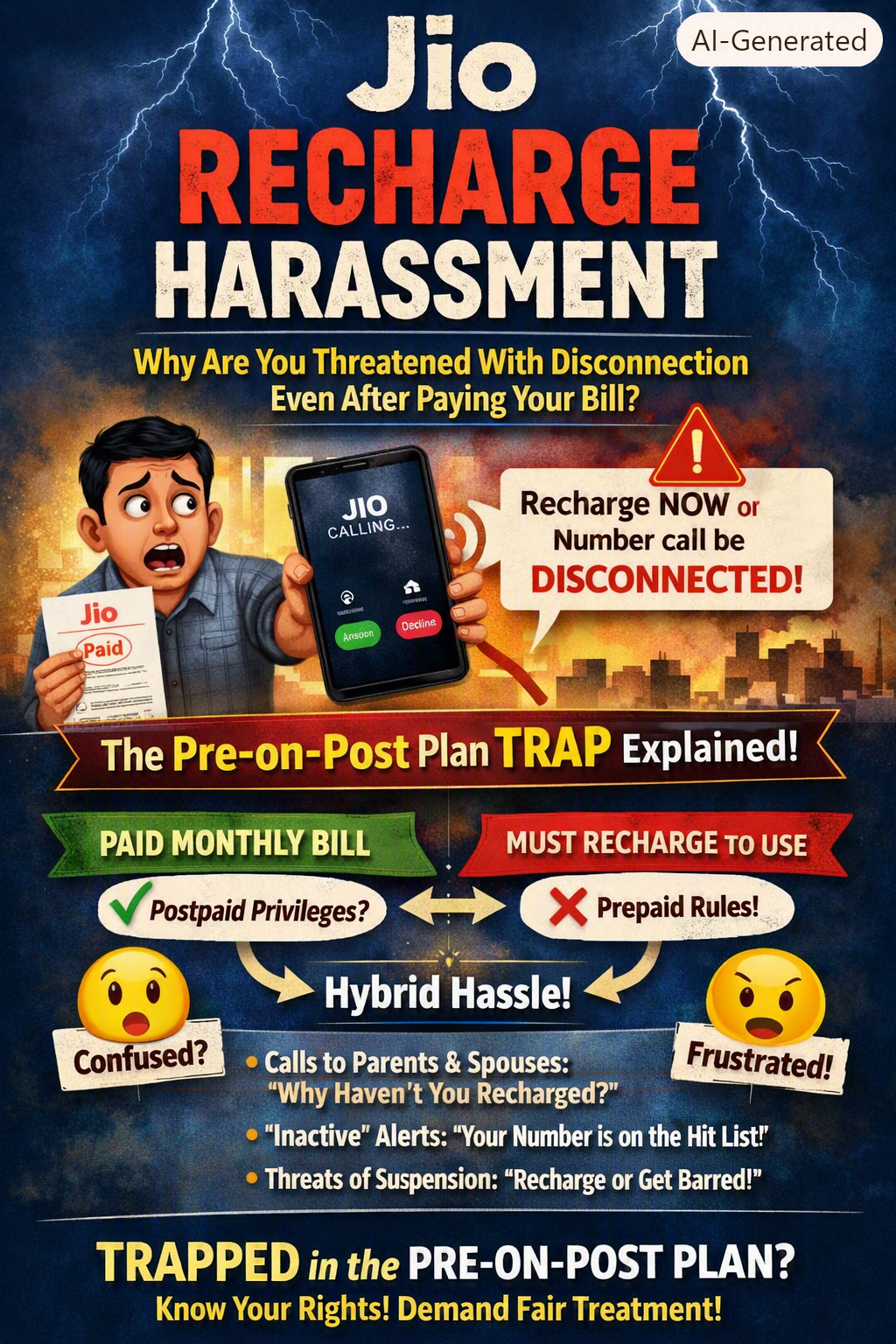
Jio Recharge Harassment: Why Your Number Is on the “Hit List” Even After You’ve Paid Your Bill
By: Javid Amin | 25 July 2026
The Pre-on-Post Trap: When Paying Your Bill Still Isn’t Enough
Picture this. You’ve paid your Jio bill on time, like clockwork, for months. There’s no due amount pending. Your account shows “active.” And yet, one morning, you get a call — not on your number, but on your father’s, your spouse’s, or your best friend’s phone — asking why you haven’t recharged, and warning that your number is about to be barred or permanently disconnected.
For a growing number of Reliance Jio users on the lesser-known Pre-on-Post (PoP) plan, this isn’t a one-off glitch. It’s a monthly ritual of stress, confusion, and — as many describe it — outright harassment.
This piece breaks down exactly what the Pre-on-Post plan is, why this problem keeps happening, what telecom rules actually say about it, and what you can do if you find your own name — or your family’s phone number — caught in the middle of a recharge reminder gone too far.
What Exactly Is a Pre-on-Post Plan?
To understand the harassment complaints, you first need to understand the plan itself — because it’s genuinely a hybrid most people don’t fully grasp when they sign up.
A Pre-on-Post connection is Jio’s middle-ground offering, sitting between a classic prepaid SIM and a full postpaid account. Jio itself confirms that certain plans are applicable only to Prepaid and Pre-on-Post recharges, distinguishing it clearly from both standard prepaid and standard postpaid categories.
Here’s how it actually works in practice:
- A fixed monthly bill keeps your SIM technically “alive.” This covers your basic account maintenance and keeps the number allotted to you, even if you use zero data or make zero calls.
- A separate recharge is what actually activates your usable services — data, calling, SMS. Without this recharge, your bill payment alone does not switch on your benefits.
- Two separate payment cycles run in parallel, which is precisely where the confusion — and the harassment complaints — begin.
In other words, a Pre-on-Post user can be 100% compliant on the “bill” side of the plan and still be flagged as “non-recharging” on the “service” side. To the company’s system, these look like two different, unrelated obligations. To the customer, it feels like being punished twice for the same phone number.
The Harassment Pattern: What Customers Are Actually Reporting
Complaints about this exact experience are not isolated. Across consumer forums, social media, and telecom grievance platforms, a consistent pattern shows up again and again.
1. Repeated, escalating calls before the deadline. Users report receiving multiple calls in a single week — sometimes daily — from Jio representatives or automated systems, pushing them to recharge immediately. On telecom discussion forums, one user described receiving five to six reminder calls in the days leading up to their trial or recharge expiry, even after activating the Do Not Disturb service.
2. Threats of permanent disconnection. The language used in these calls is often described as alarming rather than informative. Consumer complaint platforms have documented cases where a Jio telecalling executive allegedly warned a customer that his number would be permanently disconnected the very same day if he didn’t recharge — despite the customer holding an alternate, actively used number.
3. Calls made to alternate or emergency contact numbers. Perhaps the most invasive complaint: when the primary number doesn’t answer, some users say Jio’s recovery process escalates to calling numbers registered as alternate or emergency contacts — parents, spouses, even old references given at the time of SIM purchase. On broadband and telecom user forums, one customer reported that after they switched off their Jio SIM entirely, calls still followed them onto their alternate personal number.
4. Public venting, hashtags, and mounting frustration. The frustration has spilled onto social media too, with dissatisfied subscribers using hashtags to vent and warn others, describing the experience as constant and emotionally draining rather than a simple courtesy reminder.
Taken together, this pattern — persistent calling, disconnection threats, and outreach to third-party numbers — is what many affected users are now labelling “Jio harassment.”
Why Does This Keep Happening? The System Behind the Stress
It’s worth being fair here: telecom operators genuinely are permitted, and even expected, to remind customers about recharges. Reminder calls and messages are a legitimate, common industry practice across every operator in India, not just Jio.
The trouble isn’t that reminders exist. It’s the combination of three things:
- Automated recovery systems that don’t distinguish plan types well. A Pre-on-Post account can trigger the same “non-recharge” alert as a plain prepaid SIM that’s genuinely gone unpaid, even when the customer’s bill account is in perfectly good standing.
- Third-party call centres working on volume-based targets. Much of this outreach is understood to be handled by outsourced telecalling teams, where pressure to close “pending recharge” tickets quickly can translate into scripted urgency and repeated dialling.
- Alternate numbers collected at KYC stage being reused for recovery, not just verification. Most customers provide a backup contact purely for identity or emergency verification — not expecting it to become a channel for recharge pressure.
None of this excuses aggressive conduct, but it does explain why an ordinary process can spiral into something that feels personal and punitive to the customer on the receiving end.
What the Rulebook Actually Says
This is where things move from “annoying” to genuinely worth knowing your rights over.
The Telecom Regulatory Authority of India (TRAI) governs how operators must treat subscribers, including around communication and disconnection. Jio’s own published consumer charter states that customers must be informed about usage and account balance in line with the Telecom Consumer Protection Regulation, 2012 issued by TRAI, and that disconnection-related processes must follow the timelines specified under these regulations — not an arbitrary deadline set by a call centre agent.
A few practical points every subscriber should know:
- There is no rule that entitles a company representative to threaten “instant” or “same-day” permanent disconnection outside the regulatory grace period. Complaint-tracking platforms note that operators are required to observe a defined grace period before permanent disconnection, and that misleading a customer about this timeline is itself a violation of consumer protection norms.
- Excessive or repeated reminder calls can be reported. Consumer helplines note that while reminder communication is allowed, calling with unreasonable frequency, or in a manner that amounts to harassment, is not, and can be escalated.
- You are not obligated to justify your recharge choices to a third party, including a family member contacted on your behalf. Doing so without clear customer consent raises real privacy concerns.
Real Impact: More Than Just an Inconvenience
It’s easy to dismiss this as “just a phone call,” but for many users, the impact goes further:
- Family friction. Parents or spouses receiving unexpected calls about “your number being on a hit list” can cause unnecessary alarm, confusion, or even conflict at home over something the account holder had already budgeted for.
- Erosion of trust. Customers who otherwise have no billing issues start to feel surveilled and mistrusted by their own service provider — a corrosive feeling for a relationship that’s supposed to be built on reliable, everyday service.
- Time and mental load. Repeatedly explaining the same situation — “yes, my bill is paid, no, I haven’t forgotten to recharge” — to different callers, sometimes multiple times a week, adds up to real, avoidable stress.
What You Can Do If This Happens to You
If you’re a Pre-on-Post user facing this exact situation, here’s a practical, step-by-step way to push back:
- Check your account status directly on the MyJio app, not through a call, to confirm your actual bill and recharge status side by side.
- Register your number, and your family’s numbers, under DND (Do Not Disturb) by dialling 1909 or through the app, to formally limit unsolicited commercial and reminder communication.
- Ask for the complaint or interaction to be logged, and request a formal written response rather than a verbal warning over the phone.
- Escalate to Jio’s Appellate Authority if the initial customer care response doesn’t resolve the issue, using your complaint docket number as reference.
- File a complaint with TRAI if calls persist, especially if they involve threats, misleading disconnection timelines, or contact with your alternate numbers without your consent.
- Keep a simple log — dates, times, and what was said in each call — since a documented pattern is far more effective for escalation than a one-off complaint.
The Bigger Picture: A Fixable Problem, Not an Unsolvable One
None of this means Pre-on-Post, or Jio’s network itself, is a bad choice. The underlying value — a reliable network at competitive pricing — is exactly why the plan has so many subscribers in the first place. The issue isn’t the product; it’s the customer communication layer wrapped around it, one that hasn’t caught up with how a hybrid plan should actually be explained and enforced.
For millions of Indians who now treat their phone number as a lifeline for banking, work, and family contact, a respectful, transparent recharge reminder process isn’t a luxury — it’s a basic expectation. Fixing this doesn’t require reinventing the plan. It requires operators, including Jio, to train recovery teams to recognise the difference between a genuinely lapsed prepaid number and a hybrid billing structure that’s already been paid for — and to stop treating a family member’s phone as a collection tool.
Until that changes, the smartest move for any Pre-on-Post subscriber is simple: know your plan’s actual structure, know your rights under TRAI’s rules, and don’t hesitate to escalate the moment a reminder call starts to feel like a threat.
This article is based on publicly available consumer complaints, telecom forum discussions, and Reliance Jio’s own published consumer charter. Individual experiences may vary by region and account type. Readers facing persistent harassment are encouraged to escalate through official Jio and TRAI grievance channels.