Medical Interns on Strike in J&K: Stipend Delay, Government Response and Ruhullah Mehdi’s Challenge
By: News Desk | 06 September 2026
With MBBS and BDS interns demanding ₹30,000 a month after years of waiting, Ruhullah Mehdi has challenged the government’s handling of the strike, questioning why a demand described as “genuine” is now allegedly being met with warnings.
SRINAGAR — What began as a long-running dispute over the monthly stipend of MBBS and BDS interns in Jammu and Kashmir has steadily moved beyond the walls of government medical colleges.
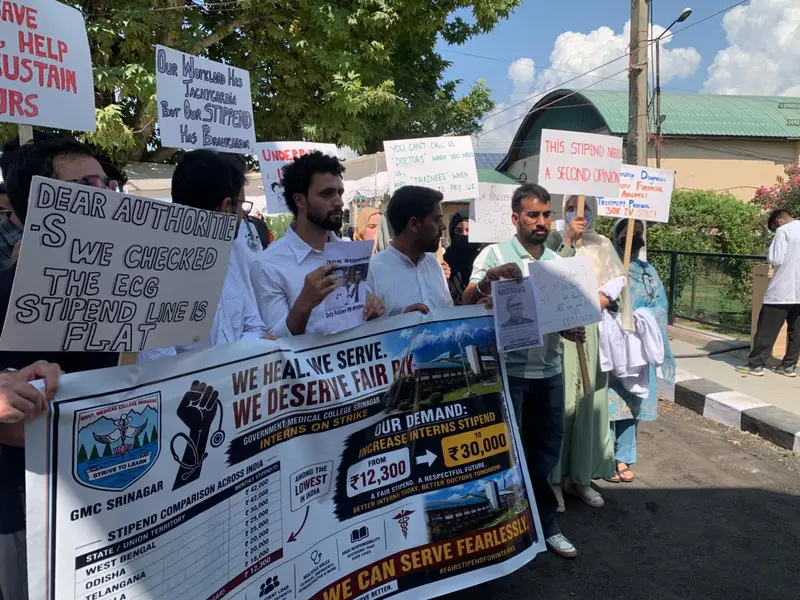
The interns have now been on indefinite strike for more than a week, demanding that their monthly stipend be raised from ₹12,300 to ₹30,000. The issue has attracted support from political leaders across the spectrum, while the government says the demand is genuine and that the matter is under consideration.
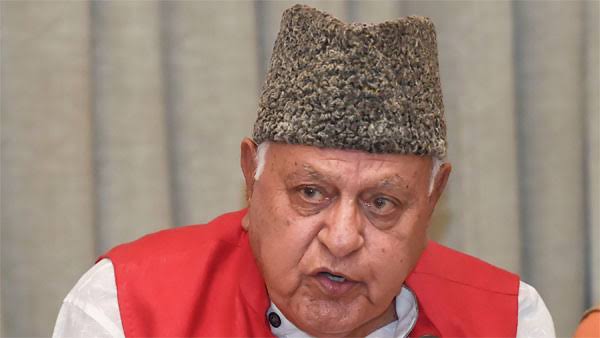
But the dispute took a sharper political turn over the weekend after Srinagar Lok Sabha MP Aga Syed Ruhullah Mehdi accused the administration of changing its approach towards the protesting interns.
Mehdi has questioned reports that principals of government medical colleges were warning interns to return to duty, asking Health and Medical Education Minister Sakina Itoo whether such directions came officially from the department or represented decisions taken at the institutional level.
His central argument is straightforward: if the government accepts that the interns have a legitimate grievance, why should the response shift from dialogue to pressure?
That question has now become almost as politically significant as the stipend itself.
The dispute that has been building for years
The present confrontation did not emerge overnight.
J&K medical interns have been receiving ₹12,300 per month, a figure that they say has remained unchanged for nearly seven years. They argue that inflation, rising living costs and the increasing responsibilities assigned to interns have made the existing stipend increasingly inadequate.
The interns are seeking ₹30,000 a month.
At first glance, the difference may look like a straightforward administrative question: how much can the government afford to pay?
But the dispute has acquired a second dimension because the government itself had previously accepted that the existing amount needed revision.
In February 2026, the J&K government informed the Legislative Assembly that a committee constituted in 2023 had recommended increasing the stipend from ₹12,300 to ₹25,000.
The proposal had been examined by the Health and Medical Education Department and sent to the Finance Department for concurrence. Finance, however, sought additional information and clarifications, with the matter subsequently moving back through the administrative process.
For the interns, this has created an obvious source of frustration.
They are not merely asking the government to consider a new proposal.
They have been waiting for an earlier recommendation to become a government order.
From ₹25,000 recommendation to ₹30,000 demand
There is an important distinction in the numbers that is easy to miss amid the political debate.
The 2023 government committee recommendation was ₹25,000.
The interns’ present demand is ₹30,000.
Recent statements by political leaders and reports from the protest have consistently referred to the ₹30,000 figure, while the government’s earlier Assembly response dealt with the ₹25,000 recommendation.
That difference matters because a committee recommendation is not the same thing as a sanctioned salary or stipend.
The administrative chain still requires financial concurrence and a formal government decision.
Health Minister Sakina Itoo has nevertheless publicly described the interns’ demand as genuine and has urged them to trust the government and return to work while the matter is processed. She has also argued that the ongoing strike is affecting patient care.
So the government’s position, based on publicly reported statements, is not that the demand is illegitimate.
It is that the government needs time to complete the process.
That is precisely where the disagreement now lies.
Why are the interns refusing to call off the strike?
The interns say patience has already been exhausted.
They argue that they have repeatedly approached the authorities over the stipend and that the issue has remained unresolved despite the government’s own committee recommending an increase.
Their other major argument concerns workload.
Interns are not simply observing doctors from the sidelines. During compulsory clinical training, they work in wards, emergency departments, outpatient departments and other clinical areas. Protesters have described extended duties, including shifts lasting well beyond conventional working hours. Some have spoken of 24- to 36-hour duties, while political supporters have cited even longer stretches in certain circumstances.
The argument, therefore, is about more than money.
It is about whether the compensation attached to compulsory clinical training adequately reflects the contribution interns make to the functioning of government hospitals.
And the interns have another comparison on their side.
They point to significantly higher internship stipends in several other states and argue that doctors performing broadly similar clinical duties should not receive dramatically different compensation simply because their internship happens to be in J&K.
A strike that is beginning to test healthcare services
The government has a legitimate concern too.
Interns form part of the workforce supporting patient care, and a prolonged withdrawal of their services can put additional pressure on resident doctors, consultants and other healthcare staff.
Reports have described protests across government medical colleges and institutions including GMC Jammu, GMC Srinagar, GMC Baramulla, GMC Anantnag, GMC Handwara, GMC Rajouri and SKIMS Bemina.
The impact should not be exaggerated into a collapse of J&K’s health system. There is no evidence that hospitals have stopped functioning altogether.
But a prolonged strike by a large group of interns inevitably creates an operational burden.
Emergency services cannot simply be switched off. Patients still arrive. Wards still require monitoring. Doctors still need assistance.
That creates an uncomfortable situation in which the interns’ right to press their demand and the public’s right to uninterrupted healthcare must both be considered.
The longer the dispute continues, the more difficult that balance becomes.
Ruhullah Mehdi enters the dispute
It is against this backdrop that Ruhullah Mehdi’s intervention assumes significance.
On September 6, Mehdi said he had written separately to Health and Medical Education Minister Sakina Itoo and principals of government medical colleges.
He questioned reports that principals had begun warning interns about consequences if they refused to return to duty.
In his communication to the minister, Mehdi contrasted the government’s earlier public position with what he described as a subsequent change in administrative conduct.
His complaint was essentially that a dispute that had been handled publicly through representations and discussions appeared to be moving towards institutional pressure.
In a separate message to college principals, Mehdi appealed to them to remember their role as teachers and mentors.
The political message was unmistakable: a disagreement over stipend should be resolved through engagement, not intimidation.
But there is an important caveat.
The reports currently available establish Mehdi’s allegation and his letters. They do not independently establish that the Health Department issued a formal written order directing principals to threaten disciplinary action against the interns.
That distinction should remain clear.
A warning allegedly issued by an individual principal is not necessarily the same thing as a government-wide policy.
And until the administration publicly clarifies the matter, the question remains open.
The timing makes Mehdi’s intervention particularly significant
Mehdi’s intervention comes at a politically sensitive moment.
The Srinagar MP recently announced his resignation from the ruling National Conference, making his criticism of the Omar Abdullah-led administration particularly consequential.
His intervention therefore cannot be separated completely from the wider political tensions surrounding his relationship with the ruling party.
But dismissing the interns’ issue as merely political would be equally simplistic.
The stipend dispute predates the latest political confrontation.
The committee recommendation dates back to 2023. The government acknowledged the pending issue in the Assembly in February 2026. The interns subsequently went on strike after concluding that the matter was not moving quickly enough.
In other words, the politics came after the grievance had already existed for years.
That distinction is important.
Opposition parties seize on the issue
The interns’ agitation has attracted support well beyond Mehdi.
PDP leader Iltija Mufti joined the protesters at GMC Srinagar and backed their demand for an increase from ₹12,300 to ₹30,000. She called for meaningful dialogue and argued that the workload and compensation were out of balance.
The broader opposition has also rallied behind the demand.
The Apni Party, led by Altaf Bukhari, has supported an increase in the stipend, while J&K Pradesh Congress Committee chief Tariq Hameed Karra — representing a party that is part of the governing arrangement — separately wrote to Chief Minister Omar Abdullah seeking urgent attention to the interns’ concerns.
That makes the political landscape more complicated than a simple government-versus-opposition confrontation.
The demand has supporters inside and outside the ruling arrangement.
It is increasingly becoming a test of whether the administration can resolve a relatively contained policy dispute before it develops into a wider symbol of youth dissatisfaction.
The government’s defence: the demand is being processed
The administration’s response deserves equal attention.
Health Minister Sakina Itoo has said that the interns’ demand is genuine and that the government is working on the issue. She has urged the protesting doctors to have faith in the government and return to their duties because their absence is affecting patient care.
In the meeting held between the minister and representatives of the interns, the government reportedly sought one month’s time to address the demand.
The interns, however, wanted a written assurance or formal order before withdrawing their strike. They subsequently decided to continue the protest.
That difference captures the entire dispute in one sentence:
The government is asking for time; the interns are asking for certainty.
And neither side appears willing to move first.
The “file is under process” problem
There is a broader governance lesson here.
For citizens, especially young professionals, phrases such as “the matter is under consideration”, “the file is with Finance” or “formal orders will follow” can become frustrating when repeated for months or years.
Administratively, such phrases can be entirely accurate.
Financial concurrence may genuinely be required. Departments may need expenditure calculations. Cadre structures and budgetary implications may need examination.
But politically, prolonged processing creates a different perception.
It begins to look like inaction.
That is particularly damaging when the government itself has already accepted the basic premise that the existing stipend requires revision.
The February Assembly response provides evidence that the issue was alive inside government well before the current strike.
The question is therefore no longer simply:
“Should the stipend be increased?”
It is:
“Why has an accepted recommendation taken so long to become a decision?”
Young doctors and the morale question
There is a less visible consequence of the dispute: morale.
Medical education demands years of study, competitive entrance examinations, clinical training and substantial financial investment by families.
By the time a student reaches internship, expectations are understandably high.
An internship is also the bridge between academic training and professional medical practice.
If young doctors begin their careers believing that their concerns are routinely ignored, the damage may extend beyond one stipend dispute.
Some may consider postgraduate training or employment outside J&K.
Others may simply conclude that government healthcare institutions offer little incentive for young professionals to remain.
That does not mean the current strike will trigger a mass exodus of doctors. Such a conclusion would go beyond the evidence.
But the underlying concern about retention and morale is legitimate.
For a region that needs skilled medical professionals, keeping young doctors engaged with public healthcare is not merely a financial calculation.
It is a policy priority.
Is ₹30,000 financially possible?
That is ultimately a question for the government’s Finance Department.
The government has to calculate the number of interns covered, the annual additional expenditure, the implications for MBBS and BDS interns across institutions and whether the revised stipend can be sustained through the budget.
But the argument should not be reduced to the absolute rupee amount.
A government also has to calculate the cost of not resolving a dispute.
A prolonged strike can disrupt hospital operations, increase pressure on other medical personnel and damage confidence among young professionals.
There is also a political cost.
When a government publicly calls a demand genuine but cannot provide a clear timeline, the gap between acknowledgement and action becomes a source of frustration.
That is the space in which political criticism grows.
The democratic-rights argument needs careful handling
Mehdi has framed the alleged warnings as a question of democratic space.
There is a legitimate principle behind that argument.
Peaceful protest is an important mechanism through which citizens and workers can bring unresolved grievances into public view.
At the same time, medical interns work inside public healthcare institutions, which creates professional obligations that do not disappear simply because a protest is underway.
The administration therefore has legitimate reasons to protect patient care.
The difficult question is how it does so.
There is a major difference between:
- reminding interns of their professional responsibilities;
- asking them to return to duty;
- explaining the consequences of prolonged absence;
- and threatening punitive action merely because they participated in a peaceful protest.
The first three can be part of normal administration.
The fourth would raise much more serious questions.
That is why Mehdi’s demand for clarification is politically significant even before the allegation itself is independently established.
The issue is becoming bigger than a stipend
The interns’ protest now sits at the intersection of several issues facing J&K.
Healthcare: Can government hospitals maintain adequate staffing and morale?
Governance: How quickly can the elected administration convert recommendations into decisions?
Youth: Does the government listen to educated young professionals before frustration turns into confrontation?
Politics: Can opposition parties turn professional grievances into a wider governance narrative?
Democratic space: How should governments respond when public-sector professionals take collective protest action?
Each question has a different answer.
But they have converged around one relatively simple demand:
Pay medical interns more.
What could end the standoff?
The government has several possible routes.
The most straightforward would be to communicate a clear timeline for the stipend revision and publish a formal order once the necessary financial approvals are completed.
A second option would be an interim assurance backed by a written commitment.
The interns, meanwhile, could consider structured negotiations with safeguards for essential patient-care services while talks continue.
The most useful outcome would probably be neither a government climbdown nor an intern surrender.
It would be a negotiated settlement that gives the interns a definite decision timeline while protecting patients from unnecessary disruption.
The present impasse — government asking for time and interns asking for a written commitment — is unlikely to disappear through competing press statements.
It requires a table, a file, a deadline and a decision.
The larger political test for Omar Abdullah’s government
For the Omar Abdullah administration, this is not the largest crisis it has faced.
Nor is it necessarily the most financially difficult.
But politically, it is unusually manageable.
The government already appears to accept that the stipend needs revision. A committee has already recommended an increase. The matter has already reached the Finance Department. The Health Minister has publicly called the interns’ demand genuine.
That means the basic disagreement is not over whether there is a problem.
It is over how quickly the government can solve it and whether it can maintain trust while doing so.
That is why the controversy over alleged warnings may prove more damaging than the original stipend dispute.
A delayed financial decision can be explained as bureaucracy.
A perception that young doctors are being pressured into abandoning a legitimate grievance is much harder to defend politically — particularly when the government itself has described that grievance as genuine.
For now, the interns remain on strike, political support continues to grow and the government is asking for more time.
Ruhullah Mehdi has added another question to the table: if dialogue remains the government’s stated approach, why are interns allegedly being warned to return?
The administration now has an opportunity to answer that question clearly.
And perhaps more importantly, it has an opportunity to end a dispute that has been running for years with something more useful than another assurance that the file is “under process”.
A government earns credibility not merely by recognising a grievance, but by showing people when and how it intends to resolve it.