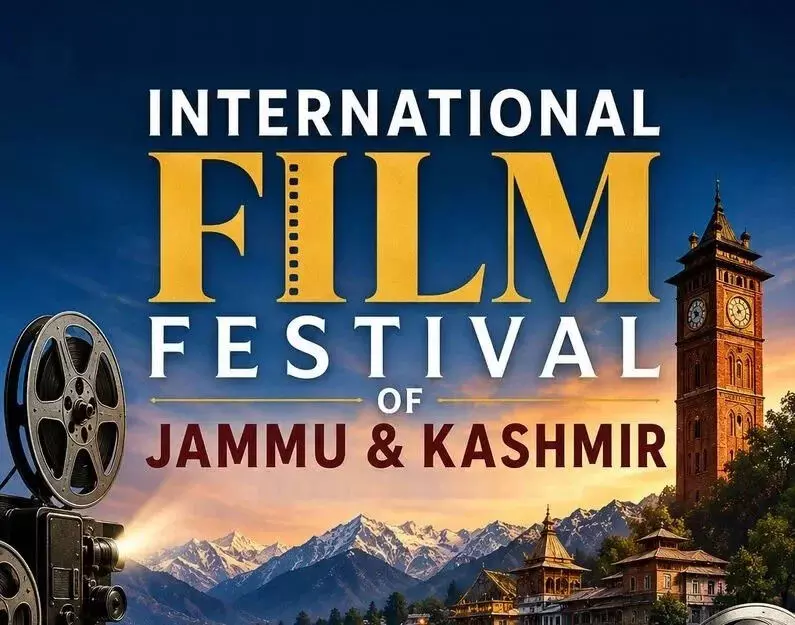
Jammu & Kashmir International Film Festival 2026: 135 Films From 41 Countries Put Kashmir on Global Cinema Map
By: Javid Amin | 07 September 2026
From a film backdrop to a filmmaking destination
For decades, Kashmir has had a complicated relationship with cinema.
Its mountains, lakes, meadows and old neighbourhoods have appeared in some of Indian cinema’s most memorable frames. From the romantic imagery of Kashmir Ki Kali and Kabhi Kabhie to more contemporary productions, the Valley has repeatedly served as a spectacular backdrop.
But beginning September 7, 2026, Jammu & Kashmir is attempting something considerably bigger.
Instead of simply being the place where films are shot, the Union Territory wants to become a place where filmmakers, audiences, critics and industry professionals come to meet.
The first International Film Festival of Jammu & Kashmir (IFFJK) will run from September 7 to 10, under the theme “Rang-e-Cinema”, bringing 135 films from 41 countries to the region. The festival is being organised by the J&K Department of Information and Public Relations, with the programme spread across venues in Srinagar, Jammu and Gulmarg.
That makes the festival more than another entry on Kashmir’s cultural calendar.
It is an attempt to rewrite the region’s relationship with the film industry.
135 films, 41 countries and more than 1,100 submissions
The headline numbers are striking.
Organisers say the festival received roughly 1,100 submissions from around 80 countries, from which 135 films representing 41 countries were selected for the inaugural programme. Some reports have described the initial submission pool slightly differently, with figures ranging from more than 50 to around 80 countries, but the figure consistently reported for the final festival selection is 135 films from 41 countries.
India has the largest representation, with 64 films, followed by France with 13 and Iran with eight. Other participating countries include the United States, Germany, Russia, Spain, Argentina, Brazil, South Korea, Sweden, Taiwan, Qatar, Colombia and Türkiye.
The programme is not limited to conventional feature films.
The official festival programme includes international competition, curated showcases, documentaries, short films, regional cinema and dedicated sections such as J&K Select and Bharat Panorama.
That variety matters.
For an emerging film ecosystem such as J&K’s, a festival cannot survive simply by importing established international cinema. It needs to create space for local stories, independent filmmakers, student filmmakers and regional voices.
That is where the festival’s structure becomes particularly important.
‘Rang-e-Cinema’: Kashmir wants to tell its own story
The choice of “Rang-e-Cinema”, or colours of cinema, is more than a decorative festival slogan.
For Jammu & Kashmir, storytelling has always carried unusual weight.
The region has been portrayed through tourism advertisements, Bollywood romance, political documentaries, news reports and, increasingly, independent filmmaking. Those representations do not always overlap.
The festival offers an opportunity to introduce another layer: stories told by filmmakers from the region and stories about the region that can be viewed alongside international cinema.
The official IFFJK programme includes J&K Select, specifically intended to bring regional narratives into the festival’s wider cinematic conversation.
That could prove to be one of the festival’s most important long-term contributions.
A successful festival does not merely attract visitors. It creates an ecosystem in which filmmakers return, collaborations develop, production companies look at locations differently and young people begin to see filmmaking as a viable profession rather than an unreachable industry.
Experience Kashmir Beyond the Screen
If you’re travelling to J&K for the International Film Festival, or simply want to combine the cinematic experience with Dal Lake, Gulmarg, Pahalgam, Sonamarg and Kashmir’s cultural attractions, JKL Travels can help arrange customised Kashmir itineraries, stays, transfers and sightseeing. Call or WhatsApp +91 88033 24 365 | +91 97960 24 365
From SKICC to Gulmarg, cinema will travel beyond the theatre
The festival is also unusual in the way it uses Kashmir’s landscape.
Major activities are planned at the Sher-i-Kashmir International Convention Centre (SKICC) and cinema venues in Srinagar, alongside programmes in Jammu and a dedicated programme in Gulmarg. The official festival website lists SKICC, INOX Multiplex Srinagar, Movie Time Cinemas KC Central Jammu and the Gulmarg Convention Centre among the venues.
Then comes the most visually distinctive idea: a floating screen on Dal Lake.
The planned floating cinema is designed to combine film viewing with one of Kashmir’s most recognisable landscapes. Reports say the screen will be installed near SKICC, while the wider programme is expected to include screenings of films associated with Kashmir’s cinematic history.
It is easy to see why organisers are attracted to the idea.
A conventional cinema can exist in almost any city.
A film screening on the waters of Dal Lake is unmistakably Kashmir.
For tourism officials, filmmakers and international delegates, that distinction can become part of the destination’s identity.
The festival is about much more than watching films
A film festival becomes economically and culturally meaningful when the activity continues after the credits roll.
IFFJK is therefore bringing together screenings with masterclasses, workshops, panel discussions, roundtables, in-conversation sessions and cultural performances.
The masterclass programme is particularly relevant to young people.
According to festival-related announcements, sessions will feature filmmakers and industry professionals including Vidhu Vinod Chopra, Namrata Rao, Baylon Fonseca, Chittranjan Tripathi, Supriyo Sen and Anil Mehta, among others. A technical workshop involving Canon is also planned.
This is where the event can have a lasting impact.
A teenager or university student attending a masterclass with an established cinematographer is receiving something that a conventional film screening cannot provide: access.
Access to knowledge.
Access to professional networks.
And, perhaps most importantly, access to the idea that the global film industry is not necessarily somewhere far away.
A jury with international experience
The credibility of a new film festival depends heavily on its jury and programming standards.
IFFJK has announced a five-member international jury featuring prominent figures from Indian and international cinema.
The panel includes acclaimed cinematographer and filmmaker Santosh Sivan, Oscar- and BAFTA-winning sound designer Resul Pookutty, German film curator and journalist Dorothee Wenner, Japanese media entrepreneur and curator Keiko Bang, and National Award-winning filmmaker and educator Himansu Sekhar Khatua.
Their presence gives the inaugural festival a stronger industry profile than a purely regional cultural event.
Special guests are also expected to include filmmaker Ramesh Sippy and Kashmir-born filmmaker Vidhu Vinod Chopra, further strengthening the festival’s connection with India’s established film industry.
Make the Festival Part of a Kashmir Holiday
From a Dal Lake houseboat and Shikara ride to Gulmarg and Pahalgam excursions, Kashmir Travels offers Kashmir travel planning and destination services. Contact +91 88033 24 365 | +91 97960 24 365 for customised travel assistance.
₹96 lakh prize purse adds another layer
The festival is also putting real money behind its competition categories.
The announced prize pool totals ₹96 lakh across nine award categories.
The top award, Best Film, carries ₹25 lakh, while Best Director and Best Debut Film of a Director carry ₹15 lakh each. The Best Film in the J&K Select category carries ₹10 lakh.
Best Actor and Best Actress are listed at ₹8 lakh each, while Best Cinematography, Best Sound Design and Best Editing carry ₹5 lakh apiece.
The inclusion of a substantial J&K-focused award is significant.
It signals that the festival is not intended merely to showcase international films against the backdrop of Kashmir. There is an explicit attempt to encourage stories connected to the region.
Can a film festival become an economic engine?
This is where the festival’s socio-economic significance becomes more interesting.
The immediate spending generated by visiting filmmakers, delegates and audiences will benefit hotels, restaurants, taxis, tour operators, handicraft sellers, cafés and other local businesses.
Reports indicate that the event could bring more than 300 delegates to Jammu & Kashmir.
But the larger economic opportunity is not four days of hotel occupancy.
It is film tourism.
A successful film destination develops a chain of economic activity around production.
Hotels accommodate crews.
Drivers transport them.
Local guides help identify locations.
Caterers feed production units.
Artists and technicians find employment.
Costume designers, carpenters, photographers, electricians and equipment suppliers become part of the production ecosystem.
Even small businesses can benefit when a film crew spends weeks rather than days in a destination.
That is why the government’s stated ambition of positioning J&K as a filmmaking destination is more consequential than simply attracting tourists for a festival.
Kashmir already has the landscape. The missing piece is an ecosystem
There is an obvious advantage here.
Kashmir does not need to convince filmmakers that it is visually attractive.
The region has been doing that for generations.
The harder challenge is creating the infrastructure that makes production practical.
Filmmakers need predictable permissions, reliable transportation, accommodation, equipment, trained crews, post-production facilities, locations and clear administrative procedures.
A festival can open conversations, but it cannot build that ecosystem overnight.
That is why the real test of IFFJK will begin after September 10.
Will filmmakers return to shoot?
Will local production companies emerge?
Will Kashmiri technicians find regular employment?
Will students who attend the masterclasses move into professional filmmaking?
Will international participants maintain relationships with local artists?
And will the festival become an annual institution rather than a one-off spectacle?
Those are the questions that will ultimately determine whether the event leaves an economic footprint.
Tourism gets a new storyline
For Kashmir’s tourism economy, cinema can provide something that mountains and lakes cannot: a narrative that travels internationally.
The Valley has traditionally been marketed through snow, meadows, houseboats, gardens and adventure tourism.
Cinema adds another dimension.
A visitor can come to Kashmir because of a film they watched, a filmmaker they admire, a festival they attended or a location they recognise from the screen.
That is the essence of film tourism.
The floating cinema on Dal Lake is especially well suited to this strategy because it combines the destination and the cinematic experience in a single product.
For international visitors, the festival could become an entry point into a broader Kashmir itinerary covering Srinagar, Gulmarg, Pahalgam and other destinations.
Planning a Kashmir trip around the festival?
Travellers looking to combine the IFFJK experience with Srinagar, Gulmarg, Pahalgam, Dal Lake and other Kashmir attractions can explore customised itineraries through JKL Travels. The company lists Kashmir holidays, accommodation, transportation and customised travel services, with travel assistance available at +91 88033 24 365 and +91 97960 24 365.
The local creative economy could be the biggest winner
Tourism receives the immediate attention, but the more important long-term opportunity may lie with J&K’s creative sector.
The region has a rich tradition of handicrafts, music, theatre, literature, photography and visual arts.
Cinema can connect these sectors.
A film production requires costumes, jewellery, props, traditional crafts, music, locations, food and visual design. A festival creates another marketplace where these creative industries can meet outside the conventional tourism cycle.
The festival’s cultural programming and J&K Select section can therefore help broaden the definition of what Kashmir’s cultural economy looks like.
For young people, this matters because the creative economy can provide opportunities that are not dependent entirely on government employment or traditional tourism.
Kashmir’s cinematic history makes the festival feel almost overdue
There is an element of homecoming in the event.
Kashmir was once deeply embedded in the popular imagination of Indian cinema.
Songs, romance and landscapes associated with the Valley helped create an enduring cinematic image of Kashmir.
That relationship weakened over decades as security concerns and changing production practices pushed filmmakers towards other destinations.
The rise of new filmmaking locations across India made it possible to recreate Himalayan landscapes elsewhere, while changing production economics also encouraged studios to look for destinations with simpler logistics.
IFFJK is therefore an attempt to rebuild an older relationship under new conditions.
The goal is not simply to recreate the Kashmir of 1960s Bollywood.
It is to create a modern ecosystem where international cinema, independent filmmaking, regional storytelling and mainstream Indian production can coexist.
A cultural event with a wider message
There is also a softer form of diplomacy at work.
When filmmakers from dozens of countries arrive in Jammu & Kashmir, the interaction does not end inside a cinema hall.
They meet local artists.
They travel through the region.
They encounter its food and handicrafts.
They speak with students.
They see the Valley beyond the familiar images circulated internationally.
That kind of person-to-person cultural exchange is one of the quieter forms of international engagement.
Cinema is particularly effective at it because stories cross borders more easily than official statements.
The festival’s own stated objective is to promote cinema, creative expression, cultural exchange and dialogue while positioning J&K as an international destination for filmmaking.
But the real measure of success will come after the cameras leave
It would be easy to call the inaugural festival a cultural renaissance before it has even opened.
That would be premature.
A four-day event, however impressive, cannot by itself transform an economy.
The difficult work begins afterwards.
Jammu & Kashmir will need to maintain production-friendly policies, strengthen local technical skills, encourage private investment, improve film infrastructure and ensure that local talent receives opportunities beyond the festival stage.
There is another consideration: sustainability.
If film tourism grows, the region must ensure that the additional traffic does not place unnecessary pressure on already fragile ecosystems and urban infrastructure.
The success of Kashmir as a film destination should ultimately be measured not by how many cameras arrive, but by how much lasting value remains after they leave.
The bigger picture: Kashmir wants to become a storyteller, not just a backdrop
The first International Film Festival of Jammu & Kashmir arrives with an ambitious proposition.
Kashmir should not only be seen. It should be heard. It should be interpreted. And it should tell its own stories.
With 135 films from 41 countries, an international jury, masterclasses, workshops, competitions, cultural programming and a planned floating cinema on Dal Lake, IFFJK has the ingredients of a major cultural event.
But its real legacy will be determined by what follows.
If the festival becomes an annual meeting point for filmmakers, creates opportunities for Kashmiri artists, attracts productions, strengthens film tourism and connects young people with the global creative economy, it could become much more than another event on the tourism calendar.
It could help create a new identity for Jammu & Kashmir.
Not simply Kashmir, the place where films are shot.
But Kashmir, the place where cinema happens.
Planning a September Kashmir Trip?
Festival dates can make accommodation and transport planning more important, particularly for visitors combining the event with popular tourist destinations. For personalised assistance, contact JKL Travels & Kashmir Travels on WhatsApp/phone: +91 88033 24 365 | +91 97960 24 365 or visit JKLTravels.com and KashmirTravels.in.