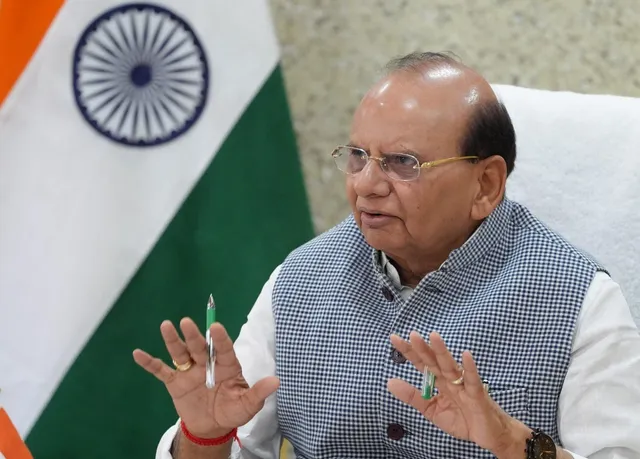
Why Ladakh LG Vinai Kumar Saxena Is Now Handling J&K: A Rare Constitutional Arrangement Explained
By: News Desk | 08 September 2026
Ladakh LG Vinai Kumar Saxena will temporarily discharge the functions of the Jammu & Kashmir Lieutenant Governor during Manoj Sinha’s leave, with the arrangement beginning at a significant moment for the common High Court
SRINAGAR, September 9, 2026: Jammu and Kashmir has a new Lieutenant Governor, but only temporarily.
In an unusual administrative arrangement, President Droupadi Murmu has appointed Ladakh Lieutenant Governor Vinai Kumar Saxena to discharge the functions of the Jammu & Kashmir Lieutenant Governor in addition to his existing duties, during the absence on leave of incumbent LG Manoj Sinha.
The decision was formally notified by Rashtrapati Bhavan on September 8. It does not replace Sinha as the regular Lieutenant Governor of Jammu and Kashmir. Rather, Saxena is temporarily exercising the functions of the office until Sinha returns.
The timing is particularly significant.
On Wednesday, September 9, Saxena is scheduled to administer the oath of office to Justice Pushpendra Singh Bhati, the newly appointed Chief Justice of the High Court of Jammu and Kashmir and Ladakh, in Srinagar.
It is the first time since Ladakh became a Union Territory in 2019 that its Lieutenant Governor will administer the oath to the Chief Justice of the common High Court of Jammu and Kashmir and Ladakh.
What might otherwise have been a routine temporary charge has therefore acquired an unusual constitutional and institutional significance.
Why Vinai Kumar Saxena is holding additional charge of J&K
The Rashtrapati Bhavan order is straightforward.
President Murmu has appointed Saxena to discharge the functions of the J&K Lieutenant Governor during Manoj Sinha’s absence on leave. Saxena will continue to perform his responsibilities as Ladakh LG at the same time.
Sinha, who has been Jammu and Kashmir’s Lieutenant Governor since August 2020, is currently in the United States. Officials cited by PTI said he addressed the IIT (BHU) Global Alumni Meet in Chicago on Monday. The 2026 alumni gathering was held at The Westin Chicago Lombard on September 5-6.
The arrangement is therefore primarily about continuity of administration, rather than a change in political leadership.
That distinction is important.
Sinha remains the regular J&K Lieutenant Governor. Saxena’s appointment is an additional-charge arrangement linked to the incumbent’s absence.
A constitutional arrangement with an unusual visual
The symbolism will be hard to miss in Srinagar.
The Lieutenant Governor of Ladakh will administer the oath to the Chief Justice of the High Court shared by Jammu & Kashmir and Ladakh.
That is not because the two Union Territories have been merged administratively. They remain separate Union Territories with separate administrations.
Rather, the two regions continue to share the High Court of Jammu and Kashmir and Ladakh, making the office of Chief Justice institutionally relevant to both.
Ordinarily, the J&K Lieutenant Governor administers the oath to the Chief Justice. With Sinha away, that responsibility has passed temporarily to Saxena. Officials have described the September 9 ceremony as the first such instance involving Ladakh’s Lieutenant Governor since Ladakh became a UT.
The development consequently places an otherwise temporary administrative arrangement against a much larger institutional backdrop: the evolving relationship between the two Union Territories after the 2019 reorganisation.
Justice Pushpendra Singh Bhati takes charge of the common High Court
The other major development behind Saxena’s temporary charge is the appointment of Justice Pushpendra Singh Bhati as Chief Justice of the High Court of Jammu and Kashmir and Ladakh.
President Droupadi Murmu appointed Justice Bhati on September 5, following the recommendation of the Supreme Court Collegium on August 31. He succeeds Justice Sanjeev Kumar, who had been serving as Acting Chief Justice since June 2.
The oath ceremony is scheduled for 11 am at the Convention Centre in Srinagar.
Justice Bhati comes from the Rajasthan High Court. He was elevated as a judge on November 16, 2016 and has extensive judicial experience.
The Rajasthan High Court’s judicial directory lists him as having been enrolled as an advocate in 1992, with academic qualifications including B.A., LL.B., LL.M. and a Ph.D.
His appointment also completes a broader process of filling regular Chief Justice positions across India’s High Courts. The Supreme Court Collegium’s recent recommendations resulted in all 25 High Courts having regular Chief Justices, according to recent reporting.
The Ladakh angle is bigger than the oath ceremony
The timing of Saxena’s additional charge is particularly interesting because Ladakh itself has just crossed an important judicial threshold.
On September 5, the Union Territory of Ladakh (Sitting of Bench of the High Court of Jammu and Kashmir and Ladakh in Ladakh) Regulation, 2026 came into force.
The regulation enables a Bench of the High Court of Jammu and Kashmir and Ladakh to sit in Ladakh. It was promulgated by President Murmu on August 27 and brought into force in Ladakh on September 5 through notification by the Lieutenant Governor.
This point needs a correction to the supplied summary.
The High Court bench in Ladakh has not already been fully established and operationalised merely because the regulation has come into force.
The Ladakh administration itself says that the September 5 notification begins the process of operationalising the bench, including consultations with the High Court and concerned departments over judicial, administrative, infrastructure, financial and logistical arrangements.
That makes the sequence of events especially noteworthy.
Within days:
- the legal framework for a High Court Bench in Ladakh came into force;
- Justice Bhati was appointed Chief Justice of the common High Court;
- and Ladakh’s LG was temporarily entrusted with the functions of J&K’s LG.
The three developments are legally separate, but together they put the common High Court and the judicial relationship between the two UTs firmly in the spotlight.
Who is Vinai Kumar Saxena?
Saxena is not new to constitutional administration.
Before moving to Ladakh, he served as Lieutenant Governor of Delhi from May 2022 until March 2026.
He relinquished the Delhi post on March 10, 2026, before moving to Ladakh. He was sworn in as Ladakh’s fourth Lieutenant Governor on March 13, 2026, succeeding Kavinder Gupta.
That corrects another detail in the original summary.
Saxena did not become Ladakh LG in 2025 or earlier in the year in a general sense. His tenure began in March 2026.
The Ladakh administration describes him as having more than four decades of experience spanning government, corporate and social sectors. Before his Delhi appointment, he served as chairman of the Khadi and Village Industries Commission.
His move from Delhi to Ladakh was part of a wider gubernatorial reshuffle announced in March 2026, when former diplomat Taranjit Singh Sandhu was appointed Delhi LG.
Saxena’s Ladakh tenure has already entered a consequential phase
Although Saxena has been in Ladakh for only about six months, his tenure has already included several important administrative developments.
The most significant judicial development is the new framework for a High Court Bench in Ladakh.
The Ladakh administration says the move is intended to reduce the difficulties faced by litigants who otherwise have to travel outside the Union Territory to pursue matters before the High Court. For a geographically vast region with difficult terrain and harsh weather, the administration argues that physical access to justice is a major issue.
The regulation is particularly important for people in remote areas of Leh and Kargil.
But the real test will come later.
A legal notification is only the beginning. The effectiveness of the bench will ultimately depend on where it sits, how frequently judges hear cases there, infrastructure, staffing, filing systems and whether ordinary litigants actually experience reduced cost and travel.
That implementation question is now more important than the symbolism.
J&K’s LG office: only two regular occupants since 2019
The temporary Saxena arrangement also makes the short history of the J&K Lieutenant Governor’s office worth revisiting.
The office was created following the Jammu and Kashmir Reorganisation Act, 2019, under which the former State was reorganised into the Union Territories of Jammu & Kashmir and Ladakh.
Since October 31, 2019, Jammu and Kashmir has had only two regular Lieutenant Governors:
Girish Chandra Murmu
Murmu became the first Lieutenant Governor of the Union Territory of Jammu and Kashmir when the reorganisation took effect on October 31, 2019.
His tenure lasted until August 2020.
He subsequently became Comptroller and Auditor General of India.
Manoj Sinha
Sinha succeeded Murmu in August 2020 and remains the regular Lieutenant Governor of J&K.
His tenure has covered a major period in the Union Territory’s political transition, including the restoration of an elected government under Chief Minister Omar Abdullah following the 2024 Assembly elections.
The present Saxena arrangement therefore does not represent a third permanent J&K LG.
He is the third person to temporarily discharge the functions of the J&K LG office since the Union Territory was created, but the third entry should not be described as a new permanent tenure.
That distinction matters when presenting the institutional history.
The Omar Abdullah government adds another layer
There is also a political dimension to the temporary arrangement.
Unlike Ladakh, Jammu & Kashmir has a legislature and an elected government headed by Chief Minister Omar Abdullah.
The Lieutenant Governor’s office therefore operates alongside the elected Council of Ministers, within the constitutional and statutory framework applicable to the Union Territory.
Saxena’s additional charge does not mean that the elected J&K government has been suspended or replaced.
Nor does it amount to a political transition.
It is an administrative substitution during the regular LG’s absence.
That is likely to be the most important practical feature of the arrangement.
For the administration in Srinagar, continuity is the priority.
Why the timing matters for Ladakh too
There is a broader Himalayan administrative story unfolding here.
Jammu & Kashmir and Ladakh emerged from the same 2019 reorganisation, but their institutional paths have since diverged.
Jammu & Kashmir has a legislature and an elected government.
Ladakh does not.
Jammu & Kashmir continues to have its own administrative and political institutions, while Ladakh has been pushing for greater safeguards, local representation and administrative mechanisms suited to its geography and demographic composition.
The new High Court Bench regulation is one part of that institutional evolution.
Saxena’s temporary responsibility across both UTs is another unusual point of intersection.
It does not mean the Centre is creating a common administrative structure for the two UTs.
But for a brief period, the same individual will formally discharge the functions of both Lieutenant Governor offices.
That makes September 2026 an unusual moment in the post-2019 administrative history of the region.
Is this a “historic precedent”?
The phrase needs some qualification.
It is certainly unprecedented since Ladakh became a Union Territory in 2019 for the Ladakh LG to administer the oath to the Chief Justice of the common J&K and Ladakh High Court. PTI and multiple local reports have confirmed that distinction.
But calling it a sweeping “constitutional precedent” would go further than the available evidence supports.
The President’s order is an established administrative mechanism for ensuring that the functions of a Lieutenant Governor continue during the incumbent’s absence.
What makes this instance unusual is the identity of the person holding additional charge and the judicial event coinciding with that temporary assignment.
That is significant.
But it does not fundamentally rewrite the constitutional relationship between Jammu & Kashmir and Ladakh.
What happens after Manoj Sinha returns?
The answer is straightforward.
Saxena’s additional charge is tied to Sinha’s absence on leave.
Once Sinha returns, the temporary arrangement is expected to end and Sinha will resume his functions as J&K Lieutenant Governor.
Saxena will continue as Ladakh’s Lieutenant Governor.
The President’s September 8 communique does not indicate any permanent change in the J&K LG office.
For now, therefore, the development should be read as continuity rather than succession.
A rare overlap in the post-2019 history of two UTs
The significance of Vinai Kumar Saxena’s additional charge lies less in the fact that one LG is temporarily performing another LG’s functions and more in what is happening around it.
A new Chief Justice is taking charge of the common High Court.
A legal framework for a High Court Bench in Ladakh has just come into force.
Jammu & Kashmir is functioning under an elected government headed by Omar Abdullah.
And the Lieutenant Governor of Ladakh is temporarily exercising the functions of J&K’s LG while Manoj Sinha is away.
Each development has its own legal basis.
Together, however, they offer a snapshot of how the institutional landscape created after the 2019 reorganisation continues to evolve.
For Srinagar, the immediate issue is administrative continuity.
For Ladakh, the more enduring question is whether the newly enabled High Court Bench can translate into genuinely easier access to justice.
For the judiciary, Justice Bhati’s arrival begins a new chapter in the common High Court.
And for the Centre, the arrangement demonstrates that the Union Territory framework has enough administrative flexibility to maintain continuity even when its constitutional heads are temporarily unavailable.
The unusual part is not that governance continues.
It is who will be standing at the centre of the constitutional stage in Srinagar on September 9: the Lieutenant Governor of Ladakh, temporarily carrying the additional responsibilities of Jammu & Kashmir, administering the oath to the new Chief Justice of a High Court shared by both Union Territories.
That is a rare image of the post-2019 constitutional architecture of Jammu, Kashmir and Ladakh in a single ceremony.


