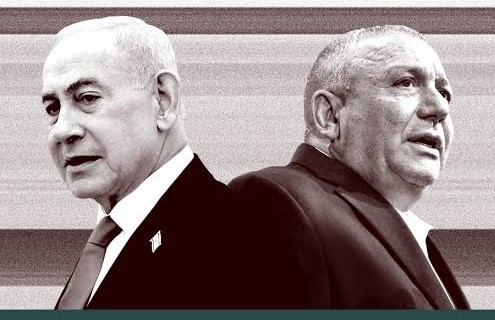
Eisenkot Gives Netanyahu 24 Hours to Prove Unity Offer Is Genuine; Crucial Meeting Could Decide Israel’s Next Government
Israel’s political crisis has entered a decisive phase after Prime Minister Benjamin Netanyahu offered to serve as deputy to his rival, former military chief Gadi Eisenkot, in a proposed rotating government. Eisenkot has given Netanyahu’s Likud party 24 hours to demonstrate that the offer is serious, demanding concrete agreements on policy and governance. Their November 29 meeting, now scheduled to begin with a security briefing at Israel’s military headquarters, could determine whether Netanyahu remains in power or a new political coalition takes shape.
By: Javid Amin | 29 November 2026 | International Affairs | Middle East | Israel Politics
JERUSALEM: A dramatic political manoeuvre by Benjamin Netanyahu has opened a new chapter in Israel’s struggle to form its next government, with the country’s longest-serving prime minister offering to surrender the first turn in office to his principal political rival, Gadi Eisenkot.
The proposal, announced on Saturday, November 28, came at a particularly sensitive moment for Netanyahu. Following Israel’s inconclusive October 27 general election, neither major political bloc secured a parliamentary majority. Eisenkot, meanwhile, has been making progress towards assembling an alternative coalition that could remove Netanyahu and his Likud party from power.
Netanyahu’s offer is therefore more than a conventional call for political unity. It represents a significant concession intended to prevent the formation of a government without Likud.
But Eisenkot is not accepting the proposal at face value.
The leader of the centrist Yashar party has accused Likud of avoiding substantive negotiations for approximately three weeks. He says his negotiating team has already submitted a detailed proposal covering the principles and policies of a possible government but has received no meaningful response.
His message to Netanyahu is straightforward: if the offer is genuine, the two sides must demonstrate it through concrete negotiations.
The two leaders are scheduled to meet on Sunday morning, November 29. However, the venue has changed. What was initially planned as a meeting at the Dan Accadia Hotel in Herzliya has been moved to the Kirya military headquarters in Tel Aviv, where the discussion will begin with a security briefing.
The outcome could reshape Israel’s political leadership at a time when security concerns, tensions with Iran and disagreements over the country’s future direction are already placing enormous pressure on the political establishment.
What happened? Netanyahu offers Eisenkot the first term as prime minister
The political development began on November 28, when Netanyahu publicly proposed establishing a national unity government with Eisenkot.
Under the proposed arrangement, Eisenkot would become prime minister first, while Netanyahu would serve as alternate prime minister. The two leaders would subsequently exchange positions under a rotation agreement.
Netanyahu acknowledged that, as leader of the largest political party, he would ordinarily expect to lead the government.
However, he argued that the security threats confronting Israel justified putting aside that principle.
His public message presented the proposal as an attempt to prevent the formation of a government that might lack the political strength or experience to address what he described as existential threats.
He also called for immediate, sincere and accelerated negotiations, saying both sides would need to demonstrate a willingness to compromise.
The offer is politically striking because Netanyahu has spent much of his career defending his position as the natural leader of Israel’s right-wing political camp.
Allowing Eisenkot to occupy the prime minister’s office first would therefore represent a substantial departure from his traditional political position.
But the timing is equally important.
Netanyahu’s offer came as Eisenkot’s coalition-building efforts were gaining momentum and the December 6 deadline for forming a government was approaching.
In other words, Netanyahu is negotiating from a position in which the possibility of losing power has become increasingly real.
Eisenkot’s 24-hour deadline: Why he is demanding more than a power-sharing promise
Eisenkot’s response exposed the central weakness in Netanyahu’s proposal.
Rather than immediately accepting the rotating-premiership arrangement, he challenged the prime minister to prove that Likud was genuinely prepared to negotiate.
In his November 28 statement, Eisenkot said his party had spent approximately three weeks attempting to conduct serious discussions with Likud but had encountered what he described as refusal and evasion.
He also disclosed that a detailed proposal addressing substantive government issues had been transmitted to Netanyahu through a confidential channel established at the prime minister’s request.
According to Eisenkot, Likud had yet to respond to that proposal.
He therefore offered Netanyahu and his negotiating team 24 hours to demonstrate their commitment to genuine negotiations.
The invitation initially proposed an immediate meeting at the Dan Accadia Hotel in Herzliya, where Eisenkot was staying with his negotiating team.
The distinction between the two leaders’ positions is important.
Netanyahu has publicly offered a rotation arrangement. Eisenkot wants agreement on the actual functioning of the government.
That includes questions such as:
- What will be the government’s basic policy guidelines?
- Who will control important ministries?
- What will happen to the current security and military policy?
- How will disagreements between Likud and Eisenkot’s partners be resolved?
- When exactly will Netanyahu leave the premiership?
- Will the rotation agreement be legally and politically enforceable?
For Eisenkot, agreeing to a power-sharing formula without resolving these questions could mean entering a government in which Netanyahu retains significant control despite formally surrendering the first turn as prime minister.
This is why the 24-hour deadline is politically important.
It is not simply an ultimatum about whether Netanyahu wants unity. It is a test of whether he is prepared to negotiate the terms that would make such a government workable.
The Iran factor: Why Netanyahu reportedly wants to delay the transfer of power
The most consequential complication in the negotiations may not be the rotation agreement itself. It is the question of who controls Israel’s security policy during a possible renewed confrontation with Iran.
Israeli media reports on November 29 suggest that Netanyahu may be seeking to remain prime minister for another three to four months before allowing Eisenkot to take over.
According to Maariv, Yedioth Ahronoth and Haaretz reporting cited by Hürriyet Daily News, Netanyahu intends to argue that Israel needs continuity in leadership because of the possibility of another military confrontation with Iran.
The reported condition was not included in his public November 28 announcement.
Eisenkot is said to have strongly opposed any such delay.
This is an important distinction: Netanyahu has publicly offered Eisenkot the first turn as prime minister, but there is no publicly confirmed agreement on when the transfer would actually happen. The reported three-to-four-month delay remains a media account of Netanyahu’s negotiating position, not an agreed condition.
Why Iran has become central to the leadership dispute
Israel’s confrontation with Iran has been one of the defining security issues of the current political crisis.
Netanyahu has repeatedly argued that Iran continues to pose a serious threat and that Israel must retain the ability to act militarily before Tehran restores its strategic capabilities.
Eisenkot, however, has questioned the urgency of launching another major military operation.
His position is particularly significant because he is not a politician without security experience.
He served as Chief of General Staff of the Israel Defense Forces from 2015 to 2019. He understands the military establishment, intelligence assessments and the potential consequences of a confrontation with Iran.
In remarks reported by The Washington Post on November 25, Eisenkot argued that he did not see an immediate Iranian threat requiring Israel to act before a new government was established.
He acknowledged the seriousness of Iran’s capabilities but emphasised the importance of addressing the remaining enriched-uranium stockpile.
He cited approximately 440 kilograms of enriched uranium as a major unresolved security concern.
This figure is important, but it must not be confused with 440 kilograms of weapons-grade uranium. It refers to the quantity of enriched material cited by Eisenkot; the precise enrichment level and its current status are separate technical questions.
The disagreement therefore involves more than political personalities.
It concerns the threshold for military action, the authority to make strategic decisions and whether an outgoing prime minister should retain control over a potentially major military operation while a successor is attempting to form a government.
The security briefing could be more important than the political photographs
The November 29 meeting is now scheduled to begin with a security update at the Kirya, Israel’s military headquarters in Tel Aviv.
This is not an ordinary coalition meeting.
The decision to begin with a security briefing places Iran and Israel’s broader strategic environment directly at the centre of the discussion.
There is also a recent precedent.
On November 12, Netanyahu and Eisenkot held a separate security briefing concerning Iran. Israeli media subsequently reported conflicting accounts of the intelligence presented.
One account suggested that the briefing was intended to persuade Eisenkot of the urgency of Netanyahu’s security concerns. Another, attributed to Channel 13, reported that the IDF assessment presented at the meeting did not identify an immediate need for Israel to strike Iran.
That report also indicated that Israel might join military action if the United States resumed attacks.
The disagreement is revealing.
Netanyahu appears to view the Iranian threat as requiring sustained political and military leadership continuity. Eisenkot argues that the security situation must be assessed on its actual urgency rather than used to justify delaying a political transition.
Neither position can be understood simply as a disagreement over the timing of a government handover.
It raises a much bigger question: who should decide when Israel goes to war, and what safeguards should apply when that decision is being made during a contested transfer of political power?
Israel’s election arithmetic: Why Eisenkot still needs 13 more seats
Behind the dramatic exchange between Netanyahu and Eisenkot lies a straightforward parliamentary problem.
Neither political camp has secured the 61 seats required to control Israel’s 120-member Knesset.
The October 27 election produced a fragmented parliament, forcing both sides to search for coalition partners.
The arithmetic explains why Netanyahu’s offer has arrived at this moment.
Israel’s 120-seat Knesset
61 seats
Minimum support required for a conventional parliamentary majority
Eisenkot-aligned bloc
48
40% of Knesset
Netanyahu-aligned bloc
53
44.2% of Knesset
The remaining seven seats are outside these two reported blocs. The figures describe political alignment, not guaranteed votes on a confidence motion.
According to the election analysis published by Al Jazeera, Eisenkot’s wider bloc holds 48 seats, while Netanyahu’s alliance holds 53.
The Arab-led parties collectively hold 19 seats, making them potentially decisive in the formation of a government.
Eisenkot therefore needs to expand his parliamentary support significantly.
His difficulty is that the potential partners available to him do not necessarily share the same political priorities.
The three coalition routes available to Eisenkot
1. A national unity government with Likud
This is the option Netanyahu is now promoting.
It could create a substantial parliamentary majority and reduce the likelihood of another election.
However, it would require Eisenkot’s supporters to accept a government that includes the very political leader they campaigned to replace.
It would also create difficult questions about ministerial portfolios, military policy and the timing of the premiership rotation.
2. An agreement with ultra-Orthodox parties
The ultra-Orthodox parties, particularly Shas and United Torah Judaism, could provide another route to a majority.
But this comes with a major policy complication: military conscription.
The exemption of ultra-Orthodox yeshiva students from compulsory military service has become one of Israel’s most divisive domestic political issues.
The Supreme Court ruled in June 2024 that there was no longer a legal basis for the blanket exemption that had allowed many ultra-Orthodox men to avoid military service.
With the IDF facing manpower pressures, the issue has become even more politically sensitive.
Eisenkot’s coalition partners, particularly Avigdor Lieberman’s Yisrael Beiteinu, have historically demanded greater equality in military service obligations.
A deal with the religious parties could therefore require compromises that anger other members of his bloc.
3. Support from Arab-led parties
The Arab-led political parties collectively secured 19 seats, giving them substantial potential influence over government formation.
The Joint List and Ra’am are particularly important in this equation.
However, Eisenkot’s partners have reservations about relying on Arab parties, especially Lieberman, who has publicly opposed a government dependent on their support.
This is why the parliamentary numbers alone do not guarantee a coalition.
A party may be willing to vote against Netanyahu without being willing to participate in an Eisenkot-led government.
That distinction is central to the negotiations.
The political divide inside Eisenkot’s own camp
One of the biggest obstacles to forming a new government is that Eisenkot’s supporters do not agree on what kind of government Israel needs.
The opposition to Netanyahu may be broad, but it is not ideologically uniform.
Eisenkot’s political challenge is to keep together centrist, left-wing, right-wing and potentially Arab-backed political forces while negotiating with a Likud party that many of his supporters want removed from government.
This is an unusually complicated coalition-building exercise.
Avigdor Lieberman: A key partner with his own red lines
The leader of Yisrael Beiteinu , Avigdor Lieberman, is an important figure in Eisenkot’s coalition strategy.
His party has signed a coalition agreement with Yashar, strengthening Eisenkot’s position.
But Lieberman has also opposed relying on Arab-led parties to establish a government.
His position creates a strategic limitation: Eisenkot may have the parliamentary numbers to remove Netanyahu if Arab parties support him, but securing Lieberman’s continued participation could become difficult if that support is essential.
Lieberman’s importance goes beyond the number of seats his party controls.
He has previously served as Israel’s defence minister and has considerable experience in security and coalition politics. His participation gives Eisenkot’s proposed government a significant right-wing component.
The Democrats: Why the left is uncomfortable with Netanyahu’s return
The left-wing Democrats party, which holds eight seats, represents another important part of the equation.
The party has expressed opposition to the possibility of Netanyahu remaining in government through a unity arrangement.
Al Jazeera reported that the Democrats suspended coalition discussions with Eisenkot after progress was reported in negotiations with Likud.
This illustrates the political cost of Netanyahu’s proposal: a unity government could make the parliamentary arithmetic easier while weakening the political coalition Eisenkot has spent weeks trying to build.
The Arab parties: The numbers that could change everything
The Arab-led parties have a potentially decisive role.
Their combined 19 seats could provide Eisenkot with the parliamentary support needed to establish a government.
Ra’am, led by Mansour Abbas, has been particularly relevant to discussions about possible parliamentary support.
Recent reporting has indicated that Abbas’s position on Hamas and his willingness to make political compromises could affect the prospects of an Eisenkot-led coalition.
However, there is a difference between supporting a government in a confidence vote and formally joining its coalition.
That distinction could become decisive.
Eisenkot may attempt to secure outside parliamentary support from Arab parties while keeping his formal government coalition limited to Jewish-majority parties.
But whether his existing partners would accept that arrangement remains uncertain.
Netanyahu’s political calculation: Unity or a strategy to prevent his removal?
Netanyahu’s offer has produced an immediate debate about his intentions.
Supporters can argue that a national unity government would provide Israel with greater political stability during a period of serious security challenges.
Israel faces multiple strategic concerns, including Iran, regional armed groups, Gaza and the security of its northern border.
From that perspective, bringing competing political camps into one government could reduce domestic divisions and improve coordination.
However, Netanyahu’s opponents see another explanation.
They argue that he is attempting to prevent Eisenkot from completing the coalition-building process that could end his premiership.
There are several reasons behind their suspicion.
First, the timing. Netanyahu made the offer after Eisenkot had secured important coalition agreements and moved closer to a possible parliamentary majority.
Second, the unresolved policy questions. The public announcement included a rotation proposal but did not provide a complete agreement on the government’s programme, ministerial appointments or the timing of the handover.
Third, the Iran condition. Reports that Netanyahu wants to remain in office for another three to four months could fundamentally change the meaning of the proposal.
Fourth, the history of Israeli coalition politics. Netanyahu’s previous rotation arrangement with Benny Gantz in 2020 remains an important reference point for politicians who distrust another power-sharing agreement.
Yair Lapid, a former prime minister and leader of the opposition’s centrist camp, dismissed Netanyahu’s latest proposal as a political deception.
Other opposition figures have similarly questioned whether the offer is intended to establish a functioning unity government or disrupt Eisenkot’s efforts to replace Netanyahu.
The criticism is not simply about personal distrust. It reflects a deeper concern that a rotation agreement could be used to retain political control without guaranteeing a genuine transfer of authority.
The Benny Gantz precedent: Why Eisenkot cannot ignore the history of 2020
Israel has already experienced a high-profile rotating premiership arrangement.
In 2020, Netanyahu and Benny Gantz agreed to establish a unity government following repeated electoral deadlock.
Under the agreement, Netanyahu would serve first as prime minister, with Gantz scheduled to take over after 18 months.
The arrangement was formalised through amendments to Israel’s Basic Law: The Government, which established the position of alternate prime minister.
However, the agreement eventually collapsed before Gantz could assume the premiership.
The Knesset dissolved in December 2020 after the government failed to pass a state budget within the required period.
Netanyahu remained prime minister during the political breakdown.
For Eisenkot and his supporters, this history creates an obvious concern.
A promise to rotate the premiership is not sufficient by itself. The agreement must contain enforceable provisions, clear dates, safeguards against deliberate collapse and a mechanism to prevent either side from using parliamentary procedures to avoid the transfer.
This is particularly important because Netanyahu is not merely a political rival. He is the incumbent leader with control over the government until a successor is formally sworn in.
The 2020 precedent explains why Eisenkot is demanding more than a public statement of political goodwill.
December 6 deadline: What happens if Eisenkot fails to form a government?
The immediate political clock is running against Eisenkot.
Israeli President Isaac Herzog tasked him with forming the next government on November 8 after consultations with political parties following the inconclusive October election.
Under the applicable government-formation procedure, he has 28 days to complete the task.
That places the initial deadline at December 6.
He can request a one-time extension of up to 14 additional days from the president, potentially extending the deadline to December 20.
Eisenkot has indicated that he wants to announce the formation of a government by December 6 without relying on the additional time.
There are three possible outcomes.
- Eisenkot reaches an agreement with Netanyahu
The two sides could establish a national unity government with a rotation arrangement. This would likely produce a broader parliamentary base but require Eisenkot’s partners to accept Netanyahu’s continued participation.
- Eisenkot forms an alternative coalition
He could reach agreements with religious parties or secure outside support from Arab-led parties. This would allow him to replace Netanyahu without bringing Likud into the government, although the ideological compromises could be difficult.
- Negotiations fail and Israel moves towards another election
If Eisenkot cannot form a government, the president can consider the next constitutional steps, including assigning the task to another Knesset member. If no government can be established, Israel could face another election, with Netanyahu continuing as caretaker prime minister until a successor takes office.
Israel has experienced repeated electoral deadlocks in the past, particularly during 2019–2020, when several elections were held before a coalition agreement finally produced a government.
Another election would therefore not be unprecedented.
But it would deepen political uncertainty at a time when the country faces serious external security challenges and difficult domestic policy disputes.
What the November 29 meeting could actually decide
The meeting between Netanyahu and Eisenkot is scheduled for 10 am Israeli time on November 29, at the Kirya military headquarters in Tel Aviv. That corresponds to 1:30 pm Indian Standard Time.
The change of venue from the Dan Accadia Hotel in Herzliya is significant because the meeting is now set to begin with a security briefing.
As of the latest reporting available before the scheduled meeting, there is no confirmed agreement between the two leaders.
Four issues will be particularly important:
1. The date of the premiership transfer
Will Netanyahu agree to Eisenkot becoming prime minister at the beginning of the government’s term, or will he insist on remaining in office for several additional months?
2. The Iran question
Will the two leaders agree on the threshold for further military action against Iran? Can security decisions be separated from the political negotiations?
3. The composition of the government
Will Likud enter a government with Eisenkot, and what happens to the Democrats, Yisrael Beiteinu and other potential coalition partners?
4. Binding guarantees
Will the proposed rotation be supported by a detailed legal agreement that prevents either side from obstructing the transfer?
A meeting that produces agreement on these questions could change the direction of Israeli politics.
A meeting that produces only another public declaration of unity could leave the underlying crisis untouched.
The bigger picture: Netanyahu’s offer may have changed the political game, but Eisenkot holds the immediate advantage
The latest confrontation is not simply about two politicians negotiating who gets to occupy the prime minister’s office.
It is about the future direction of Israeli politics following an inconclusive election.
Netanyahu wants to preserve his political influence and maintain a central role in the country’s security decision-making.
Eisenkot wants to demonstrate that Israel can change its political leadership without compromising national security.
Their disagreement over Iran makes the confrontation particularly sensitive. A renewed military escalation could alter coalition calculations, while a delayed transfer of power could undermine the credibility of any agreement between them.
There is also a larger democratic question.
Can Israel establish a stable government when political parties are deeply divided over military conscription, religious exemptions, Arab political participation, judicial accountability and the use of military force?
A national unity government might provide temporary stability, but unity without agreement on these issues would offer only a short-term solution.
For Eisenkot, the immediate challenge is to avoid becoming part of an arrangement that preserves Netanyahu’s control while weakening the alternative coalition he has spent weeks trying to build.
For Netanyahu, the challenge is to convince his political rival that the offer represents a genuine change of position rather than a tactical attempt to avoid losing office.
The November 29 meeting is therefore a test of political credibility as much as a negotiation over power.
If Netanyahu accepts a clear transfer timetable and substantive policy commitments, Israel could move towards a new national unity government.
If he insists on retaining the premiership for several more months, particularly under the reported Iran-related condition, the negotiations could collapse.
And if Eisenkot manages to assemble an alternative coalition before December 6, Netanyahu could face the end of his latest period in office without another election.
The next few days may determine which of these possibilities becomes reality.