Who Gains More Power, Who Could Lose It, and What Does the Common Citizen Actually Get?
By: Javid Amin | 29 November 2026
India’s delimitation debate is about much more than redrawing constituency maps. It could reshape the balance of political power between states, change the number of elected representatives and determine how much influence different regions have in Parliament. The central question is whether India can make representation fairer without penalising states that successfully controlled population growth.
Before examining the winners and losers, one distinction is essential: delimitation is a constitutional process, but the proposed 2026 seat-expansion formula described in recent reports must not be confused with an already completed or legally implemented redistribution. A proposal, a political assurance and an enacted constitutional change are three different things.
1. Delimitation explained to kid
Imagine India is a very big school.
There are many classrooms. Each classroom has one class representative who speaks to the principal about the children’s problems.
Now imagine:
-
Classroom A has 20 children.
-
Classroom B has 100 children.
-
Both have only one representative.
The children in Classroom B might say: “Our representative has too many people to listen to!”
So the school decides to redraw the classroom groups and decide how many representatives each group should have.
That is the basic idea of delimitation.
In India, instead of classrooms, we have constituencies. Instead of class representatives, we have MPs and MLAs.
Delimitation means deciding:
-
Where one constituency ends and another begins.
-
How many people should be represented by each constituency.
-
Which constituencies should be reserved for Scheduled Castes and Scheduled Tribes, according to the constitutional rules.
-
When applicable, how the total number of seats is distributed.
The simplest explanation: Delimitation changes the electoral map so that people’s representation can better reflect the population and constitutional requirements.
It does not mean the government automatically creates more jobs, builds roads or gives every family more benefits.
2. Why is India discussing delimitation now?
India’s Lok Sabha currently has 543 elected seats. The basic distribution of seats among states has remained tied to the 1971 Census for decades.
Why?
Because India faced a difficult situation in the 1970s. The government wanted states to control population growth. Policymakers worried that states which succeeded in family planning would lose political representation if seats were redistributed purely according to population.
The Constitution was amended in 1976 to freeze the allocation of Lok Sabha seats among states. Subsequent amendments extended the arrangement. The 84th Constitutional Amendment of 2001 continued the freeze until the first Census taken after 2026, while the 87th Amendment allowed constituency boundaries to be redrawn using the 2001 Census without changing the overall allocation of seats between states.
This is why India has had constituency boundary changes without a corresponding redistribution of Lok Sabha seats between states.
The Election Commission’s official explanation confirms this history and the principle that constituencies should, as far as practicable, have broadly equal populations within a state.
3. What exactly is proposed in November 2026?
This is where the debate becomes especially important.
As of November 29, 2026, the Union Cabinet has cleared a revised constitutional amendment package. The proposed legislation is expected to be taken up in Parliament during the special sitting beginning November 30.
It has not yet become law. Cabinet approval does not itself change the number of MPs or redraw any constituency.
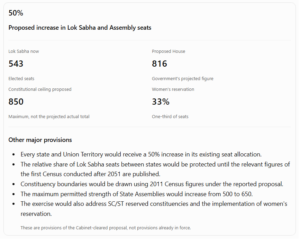
The revised proposal includes the following:
Other major provisions
-
Every state and Union Territory would receive a 50% increase in its existing seat allocation.
-
The relative share of Lok Sabha seats between states would be protected until the relevant figures of the first Census conducted after 2051 are published.
-
Constituency boundaries would be drawn using 2011 Census figures under the reported proposal.
-
The maximum permitted strength of State Assemblies would increase from 500 to 650.
-
The exercise would also address SC/ST reserved constituencies and the implementation of women’s reservation.
These are provisions of the Cabinet-cleared proposal, not provisions already in force.
The key political change is this: the government is proposing to increase the number of seats for every state while protecting the existing relative share of states in the Lok Sabha.
That is intended to address the concern that southern states could lose their share of national political representation if seats were redistributed solely according to newer population figures.
4. How will the process actually happen?
Think of it as preparing a new election map for the entire country.
-
Parliament must approve the legislation.
The proposed constitutional amendment requires a special majority in both Houses: a majority of the total membership and at least two-thirds of members present and voting. The required laws must also be passed.
-
The Delimitation Commission is constituted.
A commission is established under the relevant law. It undertakes the exercise of determining constituencies and their boundaries.
-
Population and geographical information is examined.
The Commission uses the Census figures specified by the legislation, along with geography, administrative boundaries, communication facilities and public convenience.
-
New constituency maps are prepared.
Existing constituencies may be divided, combined or reorganised. New seats are identified, and SC/ST and women’s reserved constituencies are determined under the applicable provisions.
-
The public gets an opportunity to object.
Draft proposals are published. People, political representatives and other stakeholders can submit suggestions and objections. Public hearings allow the Commission to hear those concerns.
-
Final orders are published.
After considering the submissions, the Commission finalises its orders. Under India’s existing delimitation framework, these orders have the force of law and cannot be modified by Parliament.
This is not supposed to be a process in which a political party simply draws a map and announces new constituencies. The Commission’s procedure includes public consultation and formal final orders.
5. Who gains and who loses? Let’s examine the numbers.
The most important thing is to separate two different questions:
-
How many seats does a state receive in Parliament?
-
How are those seats distributed among constituencies within that state?
The November proposal attempts to protect the first while changing the second.
A. What happens to different states?
Here are some examples using the proposed 50% increase. The figures are illustrative projections, not final constituency allocations.
| State | Current Lok Sabha seats | Illustrative proposed seats |
|---|---|---|
| Uttar Pradesh | 80 | 120 |
| Maharashtra | 48 | 72 |
| West Bengal | 42 | 63 |
| Bihar | 40 | 60 |
| Tamil Nadu | 39 | 59 |
| Madhya Pradesh | 29 | 43–44 |
| Karnataka | 28 | 42 |
| Gujarat | 26 | 39 |
| Andhra Pradesh | 25 | 38 |
| Rajasthan | 25 | 37–38 |
| Kerala | 20 | 30 |
| Telangana | 17 | 25–26 |
The government has also given a wider example of the southern states’ combined representation:
-
Current seats: 129
-
Proposed seats: 195
-
Current share: approximately 23.76%
-
Proposed share: approximately 23.87%
This is a crucial point. Under the uniform expansion model, the southern states do not lose their combined share of Lok Sabha seats. They gain more MPs while broadly maintaining their existing proportion of the House.
B. Who benefits most?
1. States with large existing representation
Uttar Pradesh, Maharashtra, West Bengal and Bihar receive substantial additional seats in absolute numbers.
For example, Uttar Pradesh would move from 80 to 120 MPs under the simple formula. That means 40 additional elected representatives from the state.
This increases the number of MPs available to represent its districts and constituencies.
2. Southern states
Tamil Nadu, Kerala, Karnataka, Andhra Pradesh and Telangana would also gain seats.
This is important because the principal criticism of population-based redistribution has been that southern states could lose relative parliamentary influence after controlling population growth more successfully.
The revised formula is designed to prevent that particular outcome.
3. Voters in densely populated constituencies
If the number of MPs increases by 50% while the total population remains broadly the same, the average population represented by each MP would fall to roughly two-thirds of its previous level.
In simple terms, an MP could have fewer people to represent.
That could improve access to elected representatives, although actual constituency sizes would depend on the final maps and geographical conditions.
4. Women
Women could gain one-third reservation in the Lok Sabha and State Assemblies under the proposed implementation framework.
This could be one of the most significant changes to political representation.
However, reservation does not guarantee that every woman candidate will have equal political influence, financial independence or decision-making power within her party. Those questions will depend on how parties select candidates and how the system works in practice.
5. Underrepresented regions within states
Areas that have grown substantially, or have been poorly represented under existing boundaries, could benefit from new constituencies and better representation.
But the exact winners will only become clear after the Commission publishes the maps.
6. Who could lose?
This is where the discussion needs to be precise. Under the revised 50% formula, no state is supposed to lose its existing relative share of Lok Sabha seats simply because another state has grown faster.
But that does not mean nobody loses.
1. Existing MPs and MLAs
When constituency boundaries change, a politician’s traditional political territory may be divided between two or more constituencies.
A sitting representative may find that the area they previously represented is no longer part of their constituency.
Political strongholds can disappear, and new electoral contests can emerge.
2. Political parties with established vote banks
Suppose a party has a stronghold in one large constituency.
The Commission redraws the map, dividing that constituency into two. The party may not automatically win both new constituencies.
Its voters may be distributed differently, and local political equations may change.
This can benefit one party and disadvantage another. The result depends on the actual boundaries and voting patterns, not simply the total number of seats.
3. Constituencies that become reserved
When a constituency is reserved for women, SCs or STs, candidates who previously contested it under a different eligibility arrangement may no longer be able to contest that seat.
This is not necessarily an unfair loss. Reservation is intended to improve representation of groups that have historically faced barriers. But it will change the political opportunities available to some existing candidates.
4. Regions whose population figures do not match current realities
The reported proposal uses the 2011 Census for boundary demarcation.
By the time a new delimitation order is implemented, population patterns may have changed significantly.
A constituency drawn using 2011 figures may not perfectly reflect the population of 2026, 2027 or the year in which the new maps take effect.
That is a legitimate administrative concern.
7. The North-South debate: Is the South actually losing?
This is probably the most politically sensitive part of the entire exercise.
Let’s understand both sides.
The southern states argue that they invested in education, healthcare and family planning. If Parliament distributes seats purely according to population growth, states that achieved slower population growth could lose a proportion of their national representation.
That concern is not imaginary.
Under a straightforward population-based redistribution, states with faster-growing populations could gain a larger share of the Lok Sabha.
The government has responded with the proposed uniform 50% increase. Under this approach, Tamil Nadu would go from 39 to approximately 59 seats, while Kerala would go from 20 to 30.
The government’s argument is that the South gains additional MPs without losing its existing relative share.
There is a strong mathematical basis for that argument.
But there is another side.
Protecting the 1971-based inter-state allocation until after 2051 means the Lok Sabha would not fully reflect differences in population growth between states during that period.
A voter in a state with slower population growth and a voter in a state with faster population growth may therefore continue to have different levels of population-based parliamentary representation.
This is the central constitutional and democratic tension:
-
Should every state retain its existing share to protect federal fairness?
-
Or should parliamentary representation increasingly reflect current population to protect the principle of equal representation?
Both arguments have democratic logic. The challenge is finding a balance between them.
8. What does this mean for Jammu and Kashmir?
Jammu and Kashmir deserves separate attention because it is currently a Union Territory with a Legislative Assembly, not a full-fledged state.
It currently has:
-
5 Lok Sabha seats
-
90 elected Assembly constituencies
Under a simple 50% calculation, five Lok Sabha seats would become approximately seven or eight, depending on the final allocation method. Ninety Assembly seats would become 135.
These are mathematical illustrations, not confirmed seat allocations for J&K.
There are several important questions for the region.
First, political representation. More MPs and MLAs could mean more elected representatives for different geographical areas, potentially improving access to decision-makers.
Second, regional balance. The distribution of constituencies between Jammu, Kashmir and other areas will matter enormously. A larger Assembly is not automatically a fairer Assembly. The boundaries and population distribution must be examined.
Third, reserved representation. The Commission’s decisions on SC/ST and women’s reservation will affect the composition of the Assembly.
Fourth, the status of the Union Territory. More elected representatives do not automatically mean restoration of statehood or an expansion of the powers of the elected government. The constitutional division of authority between the elected administration and the Lieutenant Governor remains a separate issue.
For people in J&K, this distinction is particularly important: more seats can mean more representation, but they do not by themselves mean more constitutional autonomy.
9. What will the common man actually gain?
This is the question that matters more than political arguments.
Let’s consider what could change for an ordinary citizen.
Potential direct benefits
More accessible representatives
An MP or MLA may have fewer constituents to serve, making personal contact and grievance follow-up more manageable.
Better-defined constituencies
Redrawn boundaries could make representation more balanced and take geographical realities into account.
Greater representation of women
The proposed one-third reservation could create more opportunities for women to participate directly in lawmaking.
More local political voices
Previously underrepresented areas could receive their own elected representatives, depending on the final maps.
But let’s also be honest about what delimitation does not provide.
| What people may expect | Does delimitation guarantee it? |
|---|---|
| More government jobs | No |
| Lower inflation | No |
| Better roads | No |
| Cheaper electricity | No |
| Better hospitals | No |
| Lower corruption | No |
| More direct access to MPs/MLAs | Potentially |
| More women in legislatures | Yes, if the proposed reservation is implemented as intended |
| More equal population per constituency | It is a guiding objective, subject to geographical and practical considerations |
A person may get a new MP after delimitation, but that MP is not automatically more capable, honest or effective than the previous one.
The benefit depends on how representatives use their office.
10. The cost taxpayers should not ignore
A larger Parliament and larger State Assemblies will require more public expenditure.
There will be additional costs associated with:
-
Salaries and allowances of MPs and MLAs.
-
Office space and accommodation.
-
Staff and administrative support.
-
Travel and security arrangements.
-
Legislative facilities and infrastructure.
-
Constituency offices and public outreach.
However, there is no reliable final cost estimate for the proposed expansion that should be presented as an established figure.
It is also important to understand the counter-argument: India has more than 1.4 billion people, and 543 Lok Sabha constituencies have to represent this enormous population. A larger legislature could improve the quality of representation and make elected representatives more accessible.
The question is not simply whether more representatives cost more. It is whether the additional expenditure produces measurable improvements in democratic accountability.
Taxpayers should be able to judge that through outcomes, not promises.
11. Five difficult questions the government must answer
Even if the 50% formula addresses the North-South concern, several issues remain.
1. Why use the 2011 Census for boundary changes?
If the purpose is to reflect population distribution, why not use the latest available Census figures? The government must explain the choice, particularly when the exercise is expected to be implemented years after 2011.
2. How independent will the Delimitation Commission be?
The credibility of the entire exercise depends on public confidence that constituency boundaries are drawn objectively rather than to benefit a ruling party.
3. How will public objections be handled?
Public hearings must be meaningful. Citizens should be able to understand why a village, town or district is being moved into a different constituency and what criteria have been applied.
4. How will caste and community representation be protected?
The redrawing of SC/ST reserved constituencies has direct consequences for political representation. The government must explain how the relevant population data and constitutional safeguards will be applied.
5. How will women’s reservation work in practice?
The rotation of reserved constituencies could create opportunities for women but also affect political continuity. The Commission must provide clarity about how seats will be identified and rotated.
These are not minor technical details. They determine whether the process will be seen as fair.
12. The final verdict: More representatives do not automatically mean better democracy
There are two competing principles at the heart of delimitation.
The first is population-based representation: people should have broadly equal representation, so that a constituency with twice as many people does not have the same single representative as a much smaller constituency.
The second is federal fairness: states that successfully controlled population growth should not automatically lose their influence in national decision-making.
The revised 2026 proposal tries to accommodate both principles by increasing seats uniformly while protecting the existing relative share of states.
That is a significant political compromise. It is not, however, the end of the debate.
The way constituencies are redrawn, the independence of the Commission, the use of population data, women’s reservation and the treatment of regional and social representation will determine whether the exercise is genuinely fair.
For the common citizen, the test is much simpler.
Will the new MP listen more closely? Will the MLA be more accessible? Will women have a meaningful place in decision-making? Will remote and neglected regions receive a stronger political voice?
If the answers are yes, delimitation could strengthen democracy.
If the exercise only produces more political positions, more competition for tickets and a larger public expenditure without better accountability, ordinary citizens may see little benefit.
India does not simply need a bigger Parliament. It needs a Parliament that represents its people more fairly and works more effectively.
That is the real measure of whether delimitation succeeds.
The most important facts at a glance
| Question | Evidence-based answer |
|---|---|
| Is delimitation a new idea? | No. India has conducted four national delimitation exercises since Independence. |
| Why was seat redistribution frozen? | To avoid penalising states for population-control efforts. |
| Is the 2026 proposal already law? | No. Cabinet clearance is not parliamentary passage. |
| Will the South lose its share under the revised 50% formula? | The proposal is designed to preserve the existing relative share until after 2051. |
| Will every constituency remain the same? | No. Boundaries can change substantially. |
| Will women gain representation? | One-third reservation is part of the proposed implementation framework. |
| Will J&K automatically get statehood? | No. Delimitation and restoration of statehood are separate matters. |
| Will ordinary people automatically get better services? | No. That depends on governance and accountability. |