Two Years After the Elected Government Took Office, the Chief Minister Wants a Timeline, Not Another Assurance of an “Appropriate Time”
By: Javid Amin | 18 November 2026
MENDHAR, POONCH: Jammu and Kashmir Chief Minister Omar Abdullah has sharply escalated his criticism of the BJP-led Union government over the continued delay in restoring statehood, questioning whether New Delhi is deliberately waiting for the BJP to install its own Chief Minister before returning the region to full statehood.
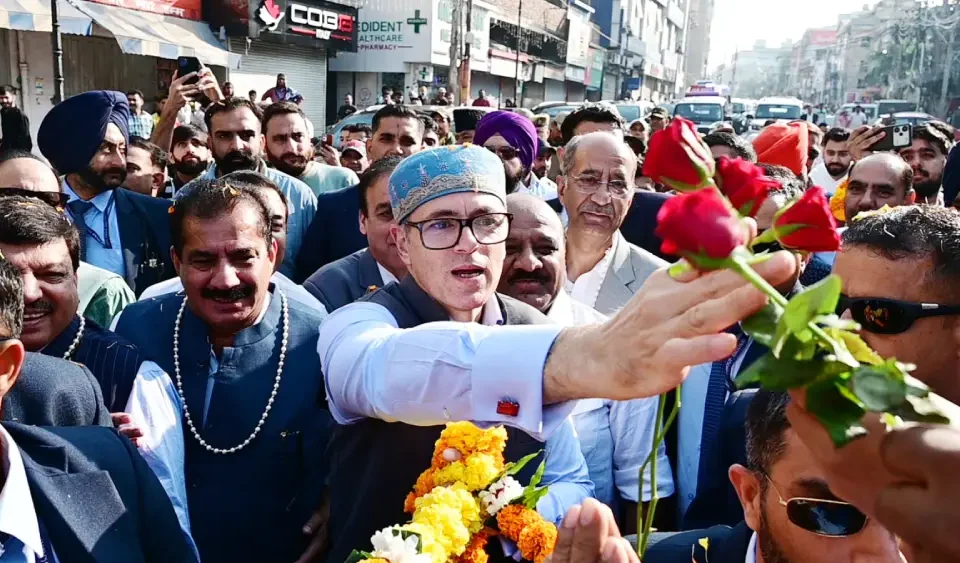
Addressing a public rally in Mendhar, a strategically important border town in Poonch district, Abdullah said the Centre’s repeated assurance that statehood would be restored at an “appropriate time” had lost its meaning. After more than two years of waiting, he argued, the people of Jammu and Kashmir deserve a clear answer rather than another open-ended promise.
“If it is your wish not to restore statehood until the BJP has its own Chief Minister in Jammu and Kashmir, then say it openly. Tell the people clearly so that they are not kept under any illusion, and we are not humiliated repeatedly,” he said.
The remark represents one of Abdullah’s strongest public challenges to the Centre since assuming office in October 2024. It also signals a change in the political tone of a Chief Minister who, for much of his tenure, had sought to persuade New Delhi through meetings, appeals and institutional resolutions rather than direct confrontation.
But the Mendhar speech was about more than political frustration. It raised a fundamental question about the relationship between an elected government and the Union government in a Union Territory where the elected administration does not control key areas of governance, including police and public order.
The central issue is increasingly difficult to avoid: if the Centre has committed itself to restoring statehood, what conditions remain to be fulfilled, and when will it explain them to the people?
The “Appropriate Time” Question: An Assurance Without a Deadline
The phrase “appropriate time” has become the most contentious expression in Jammu and Kashmir’s statehood debate.
The Centre has repeatedly indicated that statehood will be restored at an appropriate time. However, it has not publicly established a definitive timetable that tells the elected government or the public when the transition will take place.
Abdullah questioned the basis on which that decision is being delayed.
“What is the yardstick you have to measure this? What kind of scale will you use to decide that the time has finally come to restore our statehood?” he asked.
His argument is straightforward. The delimitation exercise has been completed, Assembly elections have taken place, and an elected government has been functioning since October 2024. These were among the milestones repeatedly discussed in the political and legal debate surrounding the restoration of statehood.
The Chief Minister says the Centre has now exhausted the reasons for keeping the region under the Union Territory arrangement.
The Union government, however, has not announced a specific date for restoring statehood. Nor has it publicly set out a detailed list of conditions that must be met before the decision can be taken.
This absence of a clear framework is at the heart of the current dispute.
An assurance without a deadline may preserve political flexibility for the government making it. For the people waiting for its implementation, however, it creates uncertainty.
What Was Actually Promised? The Constitutional and Political Background
To understand Abdullah’s criticism, it is necessary to return to August 5, 2019.
The Union government revoked Jammu and Kashmir’s special constitutional status under Article 370 and reorganised the former state into two Union Territories: Jammu and Kashmir, with a legislature, and Ladakh, without one. The reorganisation took effect on October 31, 2019.
The change fundamentally altered the region’s constitutional and administrative position.
Unlike a state, Jammu and Kashmir as a Union Territory operates under a framework in which the Lieutenant Governor and the Union government retain authority over important areas. The elected Assembly has legislative powers, but those powers do not extend to police and public order.
During the Supreme Court proceedings challenging the 2019 changes, the Solicitor General informed the Court that statehood would be restored, except for the Union Territory of Ladakh.
In its December 11, 2023 judgment, the Supreme Court recorded that assurance and directed that steps be taken for the Assembly elections by September 30, 2024. It also stated that restoration of statehood should take place “at the earliest and as soon as possible.”
The Court upheld the constitutional validity of the 2019 changes, but it did not prescribe a fixed date for restoring statehood.
This distinction is important.
The Supreme Court recorded the Union government’s assurance and expressed the expectation that statehood would be restored at the earliest. It did not set a specific deadline that automatically triggers restoration on a particular date.
Nevertheless, the judicial record gives the demand a significance beyond ordinary political campaigning. It is an assurance made before the country’s highest court, subsequently reinforced by repeated political commitments.
For Abdullah, the completion of delimitation and the conduct of Assembly elections should have cleared the way for the next step.
For the Centre, the timing of restoration remains a decision it has not yet formally announced.
The dispute is therefore not simply about whether statehood has been promised. It is about why the promise remains unimplemented and what standard the Centre is applying.
Two Years of Elected Government, But Not Full Statehood
Abdullah’s reference to waiting for two years and one month reflects the time that has passed since his government assumed office in October 2024.
The Assembly elections were conducted in September and October 2024, followed by the formation of the elected government.
The National Conference emerged as the largest party, winning 42 of the Assembly’s 90 elected seats. Omar Abdullah took oath as Chief Minister on October 16, 2024.
The return of an elected government was a major political development after years of direct administration under the Lieutenant Governor.
But the restoration of an elected Assembly did not restore Jammu and Kashmir’s statehood.
The region continued to function under the Union Territory framework, leaving important responsibilities outside the elected government’s jurisdiction.
That arrangement has created a political contradiction. Voters elect a government expecting it to exercise meaningful authority, while the government must operate within a constitutional structure that reserves significant powers for the Centre and the Lieutenant Governor.
Abdullah’s question, “Where has our state gone?”, captures the frustration of a government that has electoral legitimacy but does not enjoy the institutional authority associated with a full state.
The Assembly Has Already Sent a Message to New Delhi
The statehood demand is no longer confined to speeches by the Chief Minister or resolutions adopted by the ruling National Conference.
On September 28, 2026, the Jammu and Kashmir Legislative Assembly passed a resolution calling upon the Government of India to restore full statehood immediately and urgently.
The resolution was moved by Abdullah on September 25 and referred to earlier Assembly resolutions passed in 2000 and November 2024.
The final resolution specifically called for restoration of full statehood and directed that the resolution be forwarded to the Government of India.
It was passed by voice vote after BJP legislators walked out of the House.
The BJP’s objection, however, requires some explanation. The party has publicly supported restoration of statehood, but its legislators objected to the wording and the references to earlier resolutions concerning autonomy and special status.
Leader of Opposition Sunil Sharma maintained that the BJP supported statehood but opposed language that, in the party’s view, reopened the pre-August 2019 constitutional debate.
This exposed an important distinction in Jammu and Kashmir politics.
Supporting restoration of statehood does not necessarily mean supporting restoration of Article 370 or the former constitutional arrangement.
The Assembly resolution was specifically about full statehood. It did not itself restore Article 370 or Article 35A.
The political significance of the September resolution was that it provided a formal institutional demand from the elected legislature, even though the BJP disputed parts of the political context in which it was presented.
Abdullah’s latest remarks in Mendhar build on that resolution. They suggest that the government is no longer satisfied with simply passing resolutions and waiting for a response.
The Security Argument: Why Is an Elected Government Being Held Accountable?
One of the most consequential parts of Abdullah’s Mendhar speech concerned the security situation.
The Chief Minister argued that incidents such as the Pahalgam terror attack and subsequent violence in Kulgam, Reasi and Kishtwar were being cited to justify continued delay in restoring statehood.
His objection was based on the division of constitutional responsibilities.
“We have no control over the police or law and order, yet we are told that because of the Pahalgam attack, perhaps statehood cannot be restored now,” he said.
He questioned why the elected government and the people of Jammu and Kashmir should continue to bear the consequences of security developments over which, he argued, the elected administration has limited authority.
This is not a minor constitutional detail.
Under Section 32 of the Jammu and Kashmir Reorganisation Act, 2019, the Legislative Assembly can make laws on applicable subjects in the State List and Concurrent List, but the subjects of public order and police are expressly excluded from its legislative authority.
The Act also provides for the Council of Ministers to aid and advise the Lieutenant Governor in matters within the Assembly’s legislative competence, subject to the statutory exceptions.
In practical terms, the elected government does not exercise the same authority over policing and public order that a full state government would normally possess.
The Union government also retains substantial responsibilities in security-related matters, as reflected in the Ministry of Home Affairs’ administrative framework for Jammu and Kashmir.
Abdullah’s argument is that the Centre cannot indefinitely use security incidents as a reason to delay statehood while leaving the elected government without control over the principal institutions responsible for policing and public order.
But there is another side to the issue.
The Union government may argue that security is not merely an administrative subject. It is also a national responsibility, particularly in a region affected by cross-border terrorism, militant violence and sensitive border conditions.
That makes the security situation relevant to the Centre’s assessment of the region’s political and administrative future.
However, the central question remains unanswered: if security is the condition for restoration, what measurable improvements are required, who will assess them, and how long must the people wait?
Without transparent criteria, the phrase “appropriate time” remains difficult to distinguish from an indefinite postponement.
Pahalgam and the Security Situation: A Difficult Political Calculation
The April 22, 2025 Pahalgam terror attack, in which 26 people were killed, including 25 tourists and one local pony operator, deeply affected Jammu and Kashmir’s tourism industry and renewed national attention on the region’s security situation.
The attack was followed by an intensified security response and heightened scrutiny of the region’s counterterrorism arrangements.
Other incidents in Kulgam, Reasi and Kishtwar have also remained part of the wider security debate.
For the Centre, the argument that Jammu and Kashmir remains strategically sensitive is not without context. The region shares an international border and the Line of Control with Pakistan and has experienced decades of militancy and cross-border violence.
But security challenges and constitutional status are not necessarily mutually exclusive.
A state government can operate within a national security framework. Other Indian states also face security challenges while exercising constitutional authority over their police and public order institutions.
The question is therefore not whether Jammu and Kashmir’s security situation deserves attention. It clearly does.
The question is whether the continuation of Union Territory status is the only possible response, and whether the Centre has identified any objective threshold that must be reached before statehood can return.
Abdullah is asking New Delhi to explain that position rather than leaving the region to interpret repeated assurances.
The Political Accusation: Is Statehood Being Delayed for Electoral Reasons?
The most politically explosive part of Abdullah’s speech was his suggestion that the BJP may be withholding statehood until it can form a government of its own in Jammu and Kashmir.
“If you do not want to restore statehood until the BJP gets its own Chief Minister, then have the courage to say so,” he said.
This was an allegation, not an established explanation for the Centre’s position.
There is no publicly verified evidence that the Union government has formally made restoration of statehood conditional on the BJP winning an Assembly election or installing its own Chief Minister.
Nevertheless, Abdullah’s remark reflects a growing suspicion among sections of the regional political leadership that the delay may be influenced by political calculations.
The BJP’s position is more complicated than a simple rejection of statehood. Its legislators have said they support restoration, while opposing attempts to connect the statehood resolution with demands for the pre-2019 constitutional arrangement.
This distinction gives the Centre political room to support statehood in principle while continuing to defer the decision on timing.
The problem is that the public has not been given a clear explanation of what remains outstanding.
If the delay is administrative, the Centre should explain the administrative requirements.
If it is security-related, it should identify the security benchmarks.
If it is political, the government should address the allegation directly rather than allowing speculation to grow.
Statehood Is Not the Same as Restoration of Article 370
Another source of confusion in the public debate is the tendency to treat statehood and restoration of special constitutional status as the same demand.
They are not.
Restoration of statehood would change Jammu and Kashmir’s constitutional classification from a Union Territory to a state. It would significantly alter the distribution of authority between the elected government and the Union government.
It would also restore the institutional standing associated with statehood, including a stronger position for the elected government in the federal structure.
But statehood alone would not automatically restore Article 370 or Article 35A.
The Supreme Court upheld the 2019 constitutional changes in December 2023. Any future attempt to restore the former constitutional position would involve a separate and much more complicated legal and political process.
This distinction is especially important because the September 2026 Assembly resolution sought immediate restoration of full statehood while referring to earlier resolutions on autonomy and special status.
The ruling National Conference has continued to advocate a broader constitutional agenda. The BJP, meanwhile, has supported statehood while rejecting the reopening of the pre-2019 arrangement.
The two sides therefore agree on one demand in principle but remain sharply divided on the wider constitutional question.
For the public, the immediate issue is whether Jammu and Kashmir will regain statehood at all.
For the political parties, the debate extends to what kind of constitutional relationship the region should have with the Union government.
The Cost of Remaining a Union Territory
The dispute is not merely about political prestige or the title of the Chief Minister.
The institutional consequences affect how the region is governed.
Under the current arrangement, the elected government is responsible for a wide range of public services and development functions, but important areas remain outside its direct control.
This creates a divided accountability structure.
When infrastructure projects are delayed, government departments under the elected administration may face criticism. When policing or public order becomes a major issue, the elected government has limited direct authority over the relevant institutions.
The arrangement can therefore create a gap between public expectations and the actual powers of elected representatives.
It also affects the political standing of the Chief Minister, ministers and legislators in comparison with their counterparts in full-fledged states.
Abdullah raised this issue in Mendhar, arguing that the Union Territory arrangement diminishes the standing of elected representatives and weakens the authority of the government chosen by the people.
The larger concern is institutional. A democratic mandate carries expectations of responsibility, but effective accountability requires corresponding authority.
If the elected government is expected to deliver, it must have a clearly defined and meaningful share of the powers necessary to govern.
What Does the Centre Say?
The Centre’s publicly stated position has been that statehood will be restored at an appropriate time.
That assurance has been repeated in the political and legal debate, but a firm date has not been announced.
The BJP’s position in the Assembly has also been that it supports statehood, while rejecting the inclusion of references that it believes revive the debate over autonomy and the constitutional position before August 2019.
As of the reporting available on November 18, no detailed public response from the Union government directly addressing Abdullah’s latest Mendhar allegations was evident in the reports reviewed.
That absence matters.
The Chief Minister has asked the Centre to clarify whether statehood is being delayed for security reasons, administrative considerations or political calculations. A response that merely repeats the phrase “appropriate time” would not answer those questions.
New Delhi has the constitutional authority to initiate the process of restoring statehood. It also has a political responsibility to explain why the process has not yet moved forward.
The people of Jammu and Kashmir should not have to rely on competing political interpretations to understand the government’s intentions.
What Happens Next? Three Possible Paths
1. A Fresh Political Engagement Between Omar Abdullah and the Centre
The first possibility is another round of direct engagement between the Chief Minister and the Union leadership.
Abdullah has previously raised the issue with Prime Minister Narendra Modi and Union Home Minister Amit Shah. His latest speech may be an attempt to increase political pressure before seeking another formal meeting.
Such engagement could produce a clearer commitment or a timetable, although no such outcome has been announced.
2. Stronger Political Pressure Through the Assembly
The September 2026 resolution provides the elected government with an institutional basis for pressing the demand.
The NC and Congress could use the Assembly and Parliament to seek a formal response from the Centre.
However, the BJP’s objections to the wider constitutional references show that even a common position on statehood does not necessarily translate into agreement on every aspect of the regional political agenda.
3. A More Confrontational Political Phase
If the Centre continues to avoid a clear timeline, Abdullah may face growing pressure from his own party, opposition groups and the public to adopt a more forceful position.
The NC has already faced criticism from within its political ranks over the pace of its efforts on constitutional promises.
The statehood question could therefore become a major test of the government’s political credibility.
But confrontation alone will not restore statehood. The political leadership will need a sustained strategy that combines constitutional arguments, institutional pressure and public engagement.
The Larger Question: How Long Can a Democratic Mandate Operate Under an Uncertain Framework?
Omar Abdullah’s Mendhar speech has brought an important issue back to the centre of Jammu and Kashmir’s political debate.
The region has an elected Assembly and a Chief Minister, but it continues to function under a Union Territory framework that reserves key powers for the Centre and the Lieutenant Governor.
The Supreme Court has recorded the Union government’s assurance that statehood would be restored and directed that it should happen at the earliest. The Assembly has passed a resolution seeking immediate restoration. The Chief Minister has repeatedly raised the matter with the Union leadership.
Yet the public still has no date.
This is where the issue becomes bigger than Omar Abdullah or the National Conference.
Statehood is not simply a demand of the ruling party. It concerns the constitutional status of Jammu and Kashmir, the authority of its elected representatives and the relationship between the region and the Union government.
The Centre may have its own assessment of the security and administrative situation. It is entitled to explain those considerations.
But an indefinite assurance is not the same as a policy framework.
If certain conditions must be met, the people deserve to know what those conditions are. If the decision is political, that too should be addressed openly.
Final Verdict: Jammu and Kashmir Needs a Timeline, Not Another Phrase
Omar Abdullah’s question is difficult to dismiss: what does “appropriate time” actually mean?
More than seven years after the 2019 reorganisation, more than two years after the elected government assumed office and nearly three years after the Supreme Court recorded the Centre’s assurance, Jammu and Kashmir remains without a clear restoration timetable.
The security situation is serious. The region’s strategic importance is undeniable. But those realities do not remove the need for constitutional clarity and democratic accountability.
The Centre must explain what is delaying the restoration of statehood and whether any specific conditions remain.
The elected government, meanwhile, must continue to demonstrate that it can deliver on development, education, healthcare, infrastructure and public services within the powers currently available to it.
Neither side can resolve the issue through political statements alone.
The real question is no longer whether Jammu and Kashmir has been promised statehood. It is whether that promise will be honoured, when it will happen and what justification the Centre has for continuing to delay it.
For the people of Jammu and Kashmir, clarity is no longer a political courtesy. It is a democratic expectation.