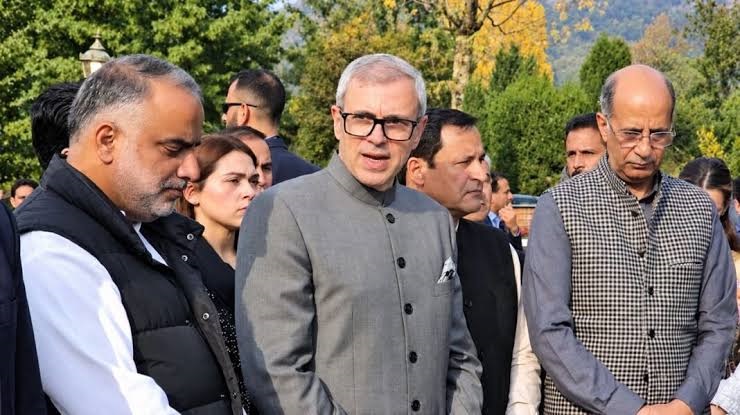
Omar Abdullah’s Local Hiring Challenge: Can Jammu and Kashmir Turn Industrial Investment Into Jobs for Its Own Youth?
By: Javid Amin | 17 November 2026
Jammu and Kashmir has spent years trying to attract private investment, expand industrial infrastructure and create an economy capable of offering opportunities beyond government recruitment. But a fundamental question remains: when companies arrive, factories open and new businesses begin operations, how many jobs will actually go to young people from the Union Territory?
Chief Minister Omar Abdullah has now put that question directly to prospective investors. His message is firm: companies setting up operations in J&K must give local youth priority, and they cannot keep using a shortage of trained manpower as a reason to recruit workers from outside.
Speaking at public functions in Kathua on November 17, 2026, Abdullah said the government could give companies six months or even a year to train local candidates. Jammu and Kashmir, he argued, already has colleges, universities, academies and training facilities capable of helping young people meet industry requirements.
The statement is more than an appeal to corporate responsibility. It raises a wider economic and political challenge for the government: how can J&K attract investment while ensuring that the benefits reach the people whose land, resources and local markets help sustain that investment?
The industrial investment promise and the employment gap
Omar Abdullah’s intervention comes at a time when Jammu and Kashmir is trying to attract large-scale industrial investment through a combination of government incentives, subsidised infrastructure and easier business approvals.
The Centre’s New Central Sector Scheme for Industrial Development of J&K, notified in February 2021, carries a financial outlay of ₹28,400 crore and is designed to encourage new investment, support existing businesses and generate employment. Its incentives include capital investment support, interest subvention and GST-linked benefits. The scheme is scheduled to operate until March 31, 2037.
But investment figures and employment figures tell different stories.
A written reply by the Union Ministry of Commerce and Industry in the Rajya Sabha on December 12, 2025, provided a useful snapshot of implementation. A total of 918 units had received registration under the scheme: 347 new units, 520 existing units and 51 existing units undertaking substantial expansion. Of the 347 new units, 267 had been grounded, with actual investment of ₹2,449.47 crore. Their proposed employment generation stood at 23,298 jobs.
The word proposed is crucial. The figure of 23,298 represents employment that the new units said they could generate. It is not proof that 23,298 people had already been hired, that the jobs were filled by local candidates, or that those positions were permanent.
That distinction goes to the heart of Abdullah’s concern. The government can announce investment, approve land and provide incentives, but the public ultimately judges industrial development by what it delivers: operational businesses, stable employment, better wages and opportunities for local residents.
The Chief Minister has now acknowledged a problem that deserves closer examination. According to a report by The New Indian Express, he said factories had been established but many of the people working in them had come from outside J&K. He argued that the government’s expectation of local employment had not been fulfilled and said the new industrial policy would link government support to recruitment of local youth.
This is a significant shift in emphasis. The debate is no longer simply about how many companies can be persuaded to invest. It is about what obligations should accompany the public support those companies receive.
Unemployment: the numbers behind the political message
Employment remains one of the most sensitive economic issues in Jammu and Kashmir, particularly among educated young people who have invested years in higher education but struggle to find work matching their qualifications.
Official figures need to be read carefully. In a written reply to the Rajya Sabha on February 12, 2026, the Union Labour Ministry cited the Periodic Labour Force Survey (PLFS). It reported that the unemployment rate for people aged 15 and above in J&K fell from 6.7 per cent in 2019-20 to 6.1 per cent in 2023-24. The corresponding national rate declined from 4.8 per cent to 3.2 per cent.
The same reply contained another important indicator: the unemployment rate among people with secondary education and above in J&K was 12.7 per cent in 2023-24, compared with 14.6 per cent in 2019-20. For those educated up to higher secondary level, it was 10.7 per cent.
These figures suggest that educational attainment does not automatically translate into employment. However, they should not be presented as the unemployment rate of young people alone: the cited figures cover people aged 15 and above, and the education categories are not youth-specific.
There is also a limitation in the data’s timing. The 2023-24 PLFS figures are the latest estimates cited in the parliamentary reply, not a real-time count of unemployed graduates in November 2026. They nevertheless provide an official baseline against which the government’s employment promises can be assessed.
For young job seekers, the issue is not merely whether unemployment has declined statistically. It is whether a graduate, diploma-holder, ITI-trained candidate or engineering student can find a decent job without having to leave the region.
A legal mechanism already exists, but the details matter
The Chief Minister’s remarks are particularly significant because Jammu and Kashmir has recently created a statutory route through which local recruitment can be encouraged and, under specified conditions, required.
The Jammu and Kashmir Ease of Doing Business Act, 2026, which received the Lieutenant Governor’s assent on October 1, contains a provision specifically addressing recruitment of local residents. Section 32 empowers the government’s Executive Committee, subject to rules and approval of the Council’s chairperson, to direct enterprises employing more than ten people to reserve a specified percentage of vacancies for J&K domicile candidates.
The provision also contains safeguards and conditions. Enterprises operating in similar trades or commercial activities are to be treated uniformly when the percentage is fixed. A company unable to find enough candidates with the required skills, qualifications or proficiency may apply for exemption. The Executive Committee can grant or reject that request, giving reasons, or direct the company to train local candidates to acquire the required skills. Violations of an applicable order can attract penalties prescribed under the rules.
This is important because it gives the government a potential enforcement mechanism beyond political appeals. But it does not mean that every private company is automatically required to hire a fixed percentage of local workers from the moment the Act was passed. The law requires the government to frame rules and the Executive Committee to issue an order specifying the percentage. The actual obligations will depend on those implementation steps.
The policy challenge, therefore, is not simply to announce that local hiring will be compulsory. It is to publish clear rules, define which enterprises are covered, establish a fair method for verifying domicile and recruitment, and ensure that exemptions are not used as a routine escape route.
The proposed Industrial Policy 2026-35: a chance to change the terms of investment
Abdullah’s statement also comes amid the preparation of a new industrial policy for the 2026-35 period.
A report by Kashmir Life in October described a draft framework that was still under consideration. It reported an ambition to attract around ₹1 lakh crore in investment over ten years and generate approximately ten lakh direct and indirect employment opportunities. The draft was also reported to propose that new units employ at least 50 per cent local workers, with the proportion rising to around 75 per cent over five years. Units employing more than 30 people were reportedly expected to provide paid apprenticeships equivalent to 15 per cent of their workforce.
These are reported proposals, not a final notified policy. They should not be treated as binding conditions until the government publishes the approved framework.
Still, the direction is revealing. The administration appears to be considering a model in which access to public support comes with measurable employment responsibilities. That could include subsidised industrial land, concessional electricity, tax-linked incentives and other forms of assistance.
The distinction between a policy proposal and an enforceable condition is critical. Investors need certainty before committing capital, while local residents need assurance that public incentives will produce public benefits. A final policy must reconcile both interests through transparent rules rather than broad political promises.
The wider Ease of Doing Business framework is already being put into operation through government notifications issued in November. These include provisions for a single nodal agency for investment-related approvals and measures to reduce duplicate licensing requirements. The government is therefore moving on the investment-facilitation side of the equation. The next test is whether the employment side receives equally clear implementation.
The skills question: are companies right to complain?
Omar Abdullah has rejected the argument that companies cannot find trained workers locally. His proposed solution is straightforward: if a business needs specialised manpower, it should give local candidates six months or a year of training rather than immediately recruiting from outside J&K.
There is a strong economic case for this approach. Companies often need workers who understand particular machinery, production processes, quality-control systems, software platforms or safety procedures. These skills can frequently be developed through structured training and supervised workplace experience.
But the issue should not be reduced to a contest between local graduates and outside workers. A company may genuinely need a specialised engineer, senior technician or experienced manager for whom a suitable local candidate is not immediately available. In other cases, the problem may be that local applicants are not being offered apprenticeships, entry-level positions or the training required to progress into skilled roles.
The government needs to establish which situation applies in each sector.
For example, manufacturing units may require machine operators, electricians, maintenance technicians, quality-control assistants, packaging workers and production supervisors. Food-processing businesses need people trained in hygiene, storage, testing and supply-chain management. Pharmaceutical and chemical units require more specialised technical and regulatory knowledge. Information technology and service-sector firms may need software developers, cybersecurity specialists, accountants, customer-support teams and data professionals.
A single training model cannot meet all these needs.
The practical solution would be to connect industrial estates with local Industrial Training Institutes, polytechnics, universities and technical colleges. Companies should identify the skills they need before recruitment begins, while educational institutions should tailor courses to those requirements. Apprenticeships should be paid, supervised and linked to genuine vacancies rather than used as a source of inexpensive temporary labour.
The government should also publish data showing how many trainees complete these programmes, how many are hired and how many remain employed after six or twelve months. Without such tracking, training targets can become another set of figures that look impressive on paper but produce limited long-term employment.
Investment cannot be judged by announcements alone
Jammu and Kashmir’s industrial expansion has often been discussed through investment proposals, land allotments and projected employment. These indicators are useful, but they do not tell the whole story.
The December 2025 parliamentary figures illustrate why. While 918 units had received registration under the central scheme, only 267 of the 347 registered new units had been grounded at the time of the reply. The proposed employment figure of 23,298 was not an actual hiring count.
For the public, the more meaningful questions are:
-
How many registered units have actually started commercial production?
-
How much of the proposed investment has reached the ground?
-
How many jobs have been created, rather than projected?
-
How many employees are J&K residents?
-
How many local workers are employed in skilled and supervisory positions?
-
What are the wages, contract conditions and social-security protections?
-
How many jobs survive beyond the initial recruitment period?
The government should publish an annual industrial employment audit, preferably district-wise and sector-wise. It should distinguish permanent employees from contract labour, apprentices and temporary workers. It should also disclose how many companies receiving subsidised land, electricity or other incentives have met their employment commitments.
This would allow the government to identify firms that are delivering on their promises and those that are benefiting from public support without generating the expected local employment.
The other side of the equation: investors also need a workable environment
A local employment policy will succeed only if Jammu and Kashmir remains an attractive place to do business.
Industrialists have their own concerns: reliable electricity, transport costs, access to markets, availability of industrial infrastructure, credit, timely payments and regulatory uncertainty. Local manufacturers also need support to compete with businesses operating in larger industrial centres with stronger supply chains and lower logistics costs.
A report published by The News Now in August 2026 highlighted concerns among existing industrial units over delays in changes to the incentive framework, pending investment applications and uncertainty surrounding future incentives. Industry representatives were seeking freight support, tax reimbursements and relief for stressed micro, small and medium enterprises.
These concerns cannot simply be dismissed. If the government imposes recruitment obligations without addressing the cost of operating in J&K, some investors may delay projects, reduce expansion plans or choose other locations.
The objective should therefore be a fair exchange: companies receive land, infrastructure, concessions and administrative support, while the region receives investment, training, decent jobs and opportunities for local suppliers.
Local recruitment should not become a substitute for improving the wider industrial environment. Equally, the promise of investment should not become an excuse for allowing companies to benefit from public incentives without meaningful employment commitments.
Jammu and Kashmir must also avoid uneven distribution of jobs
Another important consideration is geographical fairness.
Industrial development in J&K is not evenly distributed. Industrial estates and manufacturing activity are concentrated in particular locations, while remote districts often have limited access to large employers. A local hiring policy could produce positive results in areas where industries are already operating, but it may do little for young people in districts with few industrial opportunities.
The government needs to connect recruitment with regional development. Industrial expansion should be encouraged in locations where infrastructure, transport links, utilities and environmental conditions make it viable. Skill centres should also be distributed according to local economic needs, rather than concentrated only around major urban centres.
The employment strategy must recognise that the requirements of Kathua’s manufacturing base may differ from those of a tourism-dependent district, an agricultural area or a region with potential in food processing, handicrafts and information technology.
Women also need a more visible place in the employment framework. Recruitment figures should disclose female participation, workplace safety provisions, transport arrangements and access to technical training. Otherwise, a policy that increases local employment may still leave a substantial section of the potential workforce outside industrial opportunities.
What the government needs to do next
Omar Abdullah has made the political commitment. The next step is to turn it into an implementation system that can be measured and enforced.
Five measures would make the difference:
1. Publish the final recruitment rules: Specify the percentage of local vacancies, the enterprises covered, the method of compliance and the procedure for exemptions under Section 32 of the Ease of Doing Business Act.
2. Make training a contractual obligation: Companies receiving subsidised land, electricity or other incentives should identify skill requirements and offer structured, paid training or apprenticeships to eligible local candidates.
3. Introduce transparent employment reporting: Publish district-wise and sector-wise data on actual recruitment, local participation, wages, contract status and employee retention.
4. Audit incentive recipients: Review whether companies receiving public concessions have fulfilled investment and employment commitments. Where conditions are breached, enforcement should follow the applicable policy and law.
5. Build partnerships with educational institutions: Connect ITIs, polytechnics, universities and skill-development centres directly with industrial employers so that training leads to real vacancies.
The government should also establish a public grievance mechanism for candidates who believe recruitment conditions have been ignored or that local applicants are being unfairly excluded.
A promise that must be measured in jobs
During his November 17 visit, Omar Abdullah also highlighted development projects worth more than ₹30 crore across Jammu, Samba and Kathua. These included an irrigation project at Ghagwal in Samba, expected to provide irrigation to around 400 hectares across seven villages, and the strengthening of the Central Artificial Breeding Station at Hakkal in Jammu at a cost of ₹11.83 crore.
Such projects matter because employment is not created only inside factories. Better irrigation can support agriculture and allied businesses. Improved infrastructure can reduce costs for entrepreneurs. Investment in tourism, food processing, logistics and services can create jobs across different skill levels.
But the Chief Minister’s challenge to industry is now a test of the government’s own credibility. If companies are expected to train and recruit local youth, the administration must provide the institutional support, transparent rules and monitoring needed to make that expectation realistic.
The central question is no longer whether Jammu and Kashmir has talented young people. It is whether the region can build an economic system that gives them a genuine chance to participate in its growth.
Investment figures may attract headlines, but the real measure of industrial development will be the number of local families whose incomes improve because those investments took place.
If the new industrial policy succeeds in linking public incentives with local employment, skill development and accountable recruitment, it could change the relationship between investors and the people of J&K. If it remains another promise without transparent implementation, the frustration among educated job seekers is unlikely to disappear.
The message to companies is clear: train local youth instead of overlooking them. The message to the government should be equally clear: prove that the jobs are being created.