Why Maulana Qasmi’s Police Summons Has Triggered Political Outrage in Kashmir
By: Javid Amin | 27 November 2026
The controversy over Vande Mataram in Kashmir is no longer confined to whether the national song should have been played at a religious institution’s function, or whether clerics who stood during its rendition were right or wrong. The reported summoning of prominent Islamic scholar Maulana Rahmatullah Mir Qasmi by police has shifted the debate towards a more consequential question: how should the state respond when citizens express religious objections to a national symbol, and where does law enforcement end and intimidation begin?
Maulana Qasmi was reportedly called to a police station and reprimanded after publicly criticising the rendition of Vande Mataram at a Jammu and Kashmir Waqf Board function in Srinagar. The reported police action has triggered criticism from political leaders, religious organisations and public representatives, who are demanding an explanation for why a scholar’s objections apparently led to police intervention.
Mirwaiz Umar Farooq has termed the reported summoning deeply regrettable, while former Chief Minister Mehbooba Mufti has accused authorities of intimidating respected religious voices. National Conference MP Aga Syed Ruhullah Mehdi has also questioned the legal basis of the police inquiry, demanding that Jammu and Kashmir Police explain under what authority the scholar was summoned.
The disagreement has now moved beyond the song itself. It touches upon constitutional freedom, religious conscience, national identity, the role of official institutions and the delicate responsibility of authorities in a region where political and religious sensitivities can quickly intensify.
The question is not whether citizens should respect national symbols. It is whether respect can be demanded in only one form, and whether peaceful disagreement over religious beliefs should be handled through police intervention.
How the Waqf Board event triggered the controversy
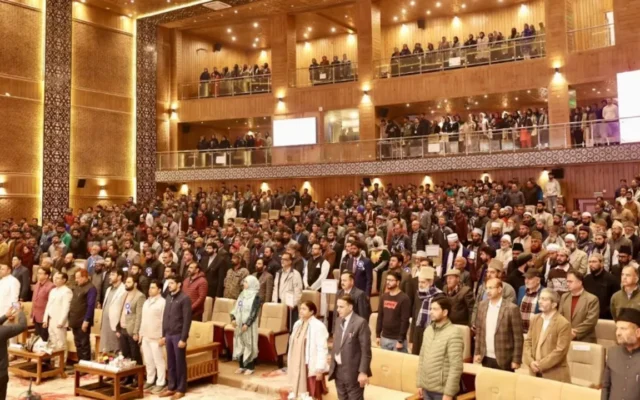
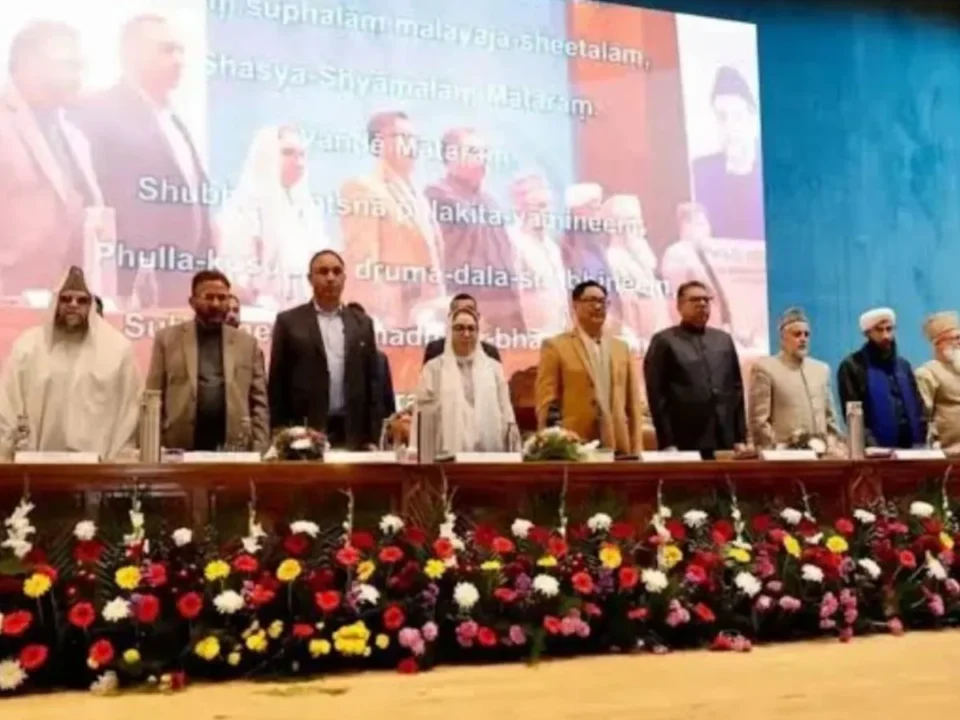
The dispute began on November 23 at a Waqf Board function in Srinagar, organised in connection with Waqf Day and attended by Union Minority Affairs Minister Kiren Rijiju. During the programme, all six stanzas of Vande Mataram were played, setting off objections among sections of the Muslim religious community.
Videos showing several clerics standing during the rendition subsequently circulated on social media. Their participation drew criticism from religious scholars and groups who argued that the song’s later stanzas contain imagery and references incompatible with Islamic belief in Tawheed, the oneness of God.
The reaction soon moved from criticism to public apologies. Some clerics who attended the event issued video statements expressing regret and seeking forgiveness for their participation. Those apologies, in turn, added another layer to the debate, raising questions about the pressure religious figures can face when their actions become the subject of public scrutiny.
The Mutahida Majlis-e-Ulama (MMU), an umbrella organisation of religious bodies led by Mirwaiz Umar Farooq, objected to the rendition at the Waqf Board function. Its argument was rooted in religious belief: Muslims can express love for their country without participating in expressions they interpret as attributing divine qualities to the motherland.
The organisation also questioned the appropriateness of playing the song at an event associated with a body entrusted with the administration of Muslim religious endowments.
The dispute could perhaps have remained a debate between religious scholars, organisers and participants. But the reported police summons to Maulana Qasmi changed its character, turning a religious disagreement into a question of state authority and constitutional freedoms.
Why Maulana Rahmatullah Mir Qasmi objected
Maulana Rahmatullah Mir Qasmi, a prominent Islamic scholar and rector of Darul Uloom Raheemiya in Bandipora, reportedly objected to the participation of religious scholars in the rendition of Vande Mataram. His criticism was framed around Islamic theology, particularly the principle of Tawheed, rather than simply political opposition to a national song.
The religious objection centres on the lyrics and imagery in the song’s full version. While the opening stanzas celebrate the motherland through descriptions of its natural beauty, fertility and prosperity, the later stanzas invoke Hindu goddesses, including Durga, Lakshmi and Saraswati, and contain devotional imagery.
For some Muslim scholars, singing those portions is not merely a patriotic expression. They believe it could conflict with their religious understanding of worship and the exclusive divinity of God.
This distinction is important because it separates objection to a particular form of expression from opposition to India itself. Muslims who hold this position argue that patriotism, loyalty to the country, respect for its people and participation in national life do not require them to accept religious imagery that conflicts with their faith.
That argument has also been at the heart of earlier debates surrounding the national song. India’s constitutional framework protects religious freedom and freedom of expression, while the state also recognises the historic importance of national symbols. The tension arises when these principles appear to come into conflict.
For Maulana Qasmi’s supporters, criticising the song on religious grounds should not itself be treated as a threat to national unity or public order.
Police summons: The question authorities have yet to publicly answer
The reported summoning of Maulana Qasmi has become the most contentious part of the episode.
According to news reports, he was called to a police station on November 26, where he was reportedly reprimanded over his remarks. Reports citing a senior police officer described the interaction as counselling over an allegedly inflammatory statement. However, political and religious leaders have questioned why such intervention was necessary and what legal basis supported it.
Aga Syed Ruhullah Mehdi demanded an explanation from Jammu and Kashmir Police, questioning under which law the inquiry was initiated. His criticism reflects concern that summoning a religious scholar over public comments could create a chilling effect, discouraging others from expressing opinions on matters of faith.
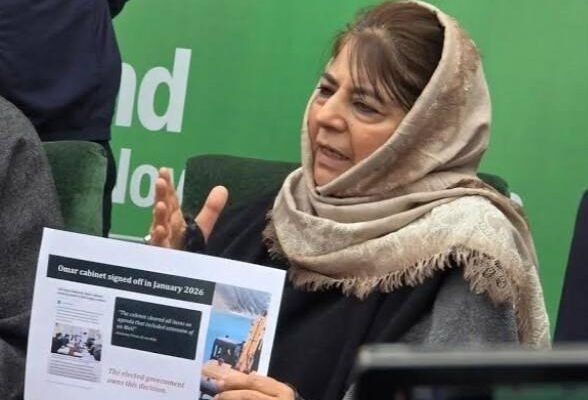
Mehbooba Mufti also condemned the reported action, describing it as an attempt to intimidate respected religious voices. She argued that people should not be subjected to pressure for expressing disagreement or defending their religious beliefs.
Mirwaiz Umar Farooq questioned whether religious leaders could still raise concerns about matters affecting their faith without facing administrative pressure. His criticism was particularly pointed because the dispute had already generated intense debate and public reaction.
As of the latest reports available on November 27-28, police had not issued a detailed public explanation of the legal basis for the reported summons. While an officer was quoted describing the interaction as counselling, the absence of a formal clarification has left questions about the purpose, procedure and scope of the police action unanswered.
That gap matters. If authorities believed Maulana Qasmi’s remarks crossed a legal threshold, they should explain the grounds and process. If the interaction was only intended as counselling, the circumstances surrounding it should still be clarified to prevent the perception that peaceful religious criticism is being treated as a law-and-order issue.
Vande Mataram’s history: Why the first two stanzas and the full song are debated
Written by Bankim Chandra Chattopadhyay in the 19th century, the song became a powerful expression of India’s anti-colonial movement. It was associated with nationalist mobilisation, resistance to British rule and the emotional idea of the motherland as a source of strength and sacrifice.
Its historical significance is widely recognised. On January 24, 1950, Constituent Assembly President Dr Rajendra Prasad announced that Jana Gana Mana would be India’s National Anthem and that Vande Mataram, because of its historic role in the freedom struggle, would be honoured equally and have equal status.
However, the song’s complete version has long been debated because its later stanzas contain explicit religious imagery.
In 1937, the Congress Working Committee recommended that the first two stanzas be used at national gatherings. The decision was influenced by the song’s historical importance as well as concerns that the later verses, with their references to Hindu deities, could make it less acceptable to people of different religious backgrounds.
The first two stanzas focus largely on the natural beauty and abundance of the motherland. The later verses introduce devotional references that some Muslim scholars consider incompatible with their faith.
For decades, the two-stanza version became the familiar rendition at many national gatherings. The distinction between that version and the full six-stanza composition is now central to the Kashmir controversy.
Why the full six-stanza rendition has become politically sensitive
The dispute has gained another dimension following the Union government’s 2026 directions concerning the National Song.
The Ministry of Home Affairs issued orders setting out the official version of Vande Mataram and specifying occasions for its rendition, including provisions concerning the complete six-stanza composition. The changes have renewed debate over the place of the song in official ceremonies and whether the full version should be expected at functions where people from different religious backgrounds are present.
The question is not simply about the song’s historical status. It is about how national symbols are presented in a diverse society and whether public institutions should account for the religious sensitivities of those attending official programmes.
The Waqf Board function has become a flashpoint because the rendition occurred at an event organised by an institution associated with Muslim religious endowments. Critics believe the choice of venue and the inclusion of all six stanzas were insensitive to the beliefs of some attendees. Others may view the playing of the song as an expression of national identity that should not itself be controversial.
These competing views are now colliding in the political arena.
What the Constitution says about freedom of conscience and expression
India’s constitutional framework provides protections that are directly relevant to the debate, although the precise legal questions surrounding Vande Mataram and the recent amendments remain subject to judicial scrutiny.
Article 19(1)(a) protects freedom of speech and expression, subject to constitutionally permissible restrictions.
Article 25(1) protects freedom of conscience and the right to freely profess, practise and propagate religion, subject to public order, morality, health and other provisions of Part III of the Constitution.
These rights do not mean that every statement is immune from legal scrutiny. Nor do they mean that national symbols cannot be given official recognition or that public events cannot have rules governing their conduct. But they do make the distinction between peaceful expression of belief and unlawful conduct important.
A person expressing a religious objection is not automatically engaging in unlawful activity merely because the opinion is unpopular, uncomfortable or politically inconvenient.
The Bijoe Emmanuel judgment and the right not to sing
In the landmark 1986 judgment Bijoe Emmanuel v. State of Kerala, the Supreme Court protected three schoolchildren who respectfully declined to sing the National Anthem because of their religious beliefs, while standing respectfully during its rendition.
The Court held that their expulsion violated their fundamental rights. The judgment became an important precedent concerning freedom of conscience and the right not to be compelled to express beliefs against one’s convictions.
The case is relevant to the current controversy because it establishes a constitutional principle: respectful non-participation on grounds of conscience is legally distinct from deliberately disrupting a national-symbol ceremony.
However, the Bijoe Emmanuel judgment concerned the National Anthem, not the present police action involving criticism of Vande Mataram. Its principles may be relevant, but the legal circumstances of Maulana Qasmi’s reported summons would have to be examined independently.
The Supreme Court is also examining legal challenges concerning the 2026 directions and the amended law relating to the National Song. The questions include the scope of government authority, the constitutional protection of conscientious objection and the consequences attached to non-participation. The matter remains legally contested.
Mirwaiz Umar Farooq: Is religious dissent being treated as a threat?
Mirwaiz Umar Farooq’s reaction has placed the controversy within the broader debate over religious expression and the ability of Kashmiri religious leaders to speak publicly.
He termed the reported summoning of Maulana Qasmi deeply regrettable and questioned whether religious scholars could raise concerns about their faith without facing pressure from authorities. He alleged that the scholar had been summoned and reprimanded after criticising the rendition at the Waqf Board function.
Mirwaiz has also separately alleged that he was placed under house arrest on November 27 and prevented from reaching Jama Masjid for Friday prayers and his sermon. In his public remarks, he linked the restrictions to his recent comments on the Vande Mataram controversy and concerns over construction activity near the ecologically sensitive Sheshnag region.
These are separate reported actions and should not be conflated. The reported summoning of Maulana Qasmi and Mirwaiz’s allegation of house arrest each require their own explanation from authorities.
In Kashmir, where restrictions on political and religious leaders have long been a source of controversy, the circumstances surrounding such actions inevitably attract scrutiny. The administration’s response is therefore important not only to the individuals concerned but also to public confidence in the ability to express views peacefully.
Mehbooba Mufti and Ruhullah demand answers
The police action has drawn criticism from leaders across the political spectrum, reflecting the sensitivity of the issue beyond party politics.
Former Chief Minister Mehbooba Mufti described the reported summoning as deeply unfortunate and an attempt to intimidate respected religious voices for expressing dissent. Her criticism focused on the treatment of a senior scholar and the broader implications for freedom of expression and religious conscience.
Aga Syed Ruhullah Mehdi also condemned the reported police action, describing it as deplorable and demanding that police explain the legal basis for the inquiry. His central concern was that a respected religious preacher should not be subjected to harassment for expressing an opinion on a matter of faith.
National Conference leader Choudhary Ramzan also criticised the move, invoking constitutional protections for peaceful expression and religious belief.
Other religious figures have expressed similar concerns, arguing that the right to object to a song or its religious interpretation should not be confused with disloyalty to the country.
While these statements have intensified political pressure on police, they also highlight a broader issue: a democratic society must be able to accommodate disagreements over national symbols without allowing those disagreements to turn into intimidation, hostility or communal confrontation.
National symbols, patriotism and religious conscience need not become opposing forces
The Vande Mataram controversy exposes a tension that is often oversimplified in public debate. For many Indians, the song carries memories of the freedom struggle, sacrifice and national pride. For some religious believers, however, portions of its lyrics raise concerns about worship, divinity and the boundaries of their faith.
Those two realities can exist at the same time.
Respect for the country does not necessarily require every citizen to interpret a song, symbol or ritual in precisely the same way. Equally, religious objections need not be expressed through insults, threats or attempts to prevent others from participating in a lawful ceremony.
The challenge for public institutions is to maintain that distinction. National symbols should not become instruments for testing the religious identity of citizens, and religious disagreement should not be allowed to become a source of coercion against others.
The Waqf Board event has brought that delicate balance into focus. Instead of allowing a debate over lyrics, history and religious belief to unfold through dialogue, the controversy is now being shaped by reported police intervention, public reprimands, political condemnation and fears of intimidation.
That is why a clear explanation from the authorities is important. It could help establish whether the reported police action was based on a legitimate legal concern or whether it risked unnecessarily escalating a peaceful disagreement.
The bigger question Kashmir is now asking
The Vande Mataram row is no longer only about what was sung at a Waqf Board function on November 23. It is about what happens when religious objections, national symbolism and state authority intersect.
The song’s place in India’s freedom movement is historic. Its official recognition is significant. The religious concerns raised by some Muslim scholars are also real to those who hold them. And the right to peacefully express disagreement is a constitutional principle that deserves protection, not suspicion.
The government and police now have an opportunity to prevent the controversy from escalating further by clarifying the circumstances of Maulana Qasmi’s reported summons, the legal basis for the action, and whether any formal proceedings have been initiated.
A democratic society does not become weaker because citizens express differing views about a national symbol. Its strength lies in the ability to protect national pride while respecting conscience, to uphold law without intimidation, and to resolve sensitive disagreements through dialogue rather than pressure.
In Kashmir, where trust in institutions is often fragile, how authorities handle this controversy may matter far beyond the song itself.
The most important question is not who stood, who sang or who apologised. It is whether people can express their beliefs peacefully without fear, and whether the state can uphold that freedom consistently.